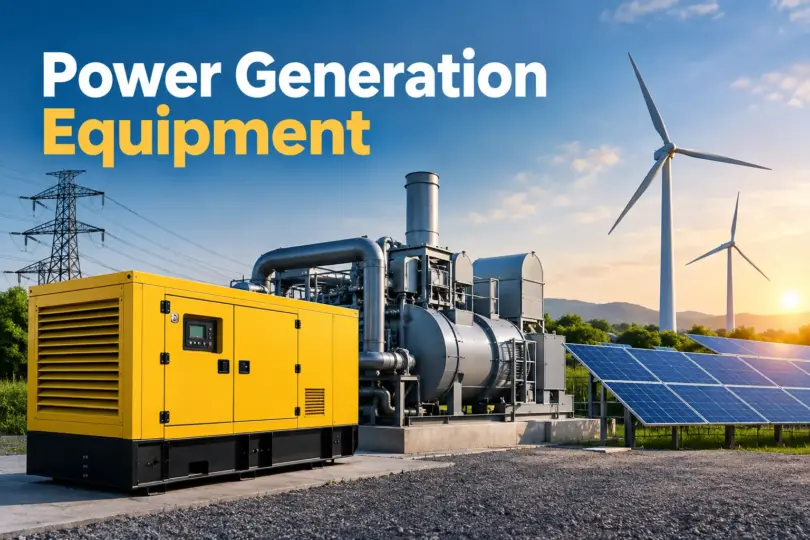

Power generation equipment is any machine that converts a fuel or natural energy source, diesel, gas, water, wind, sunlight, or heat, into usable electricity. The category spans everything from a 5 kW portable job-site generator to a 400 MW combined-cycle plant. The right piece of equipment for you depends less on which type sounds most modern and more on your load profile, run hours, site conditions, and how much downtime you can actually tolerate.
Most articles on this topic stop at “here are 13 types of generation equipment.” That’s useful as a glossary, but it won’t stop you from buying an undersized genset, getting blindsided by altitude derating, or discovering wet stacking six months into ownership. This guide covers the parts of the decision that competitor content skips: sizing math, real operating costs, maintenance failure points, and how professionals actually choose between options.
Why Equipment Choice Matters More Than the Fuel Source Debate
Most buying guides frame the decision as diesel vs. gas vs. solar panel. In practice, engineers choosing equipment weigh a narrower set of questions first:
- Load type, resistive loads like lighting and heaters behave nothing like motor-driven loads with high inrush current.
- Duty cycle, standby, prime, or continuous power each carry different derating rules and warranty terms.
- Site conditions, elevation, ambient temperature, and humidity all cut into a generator’s rated output before you even connect a load.
- Fuel logistics, a generator that’s perfect on paper is useless if diesel delivery to your site is unreliable.
Get these four right and the fuel-source debate becomes a much smaller decision than most articles suggest.
Sizing Power Generation Equipment: The Math Nobody Explains Properly
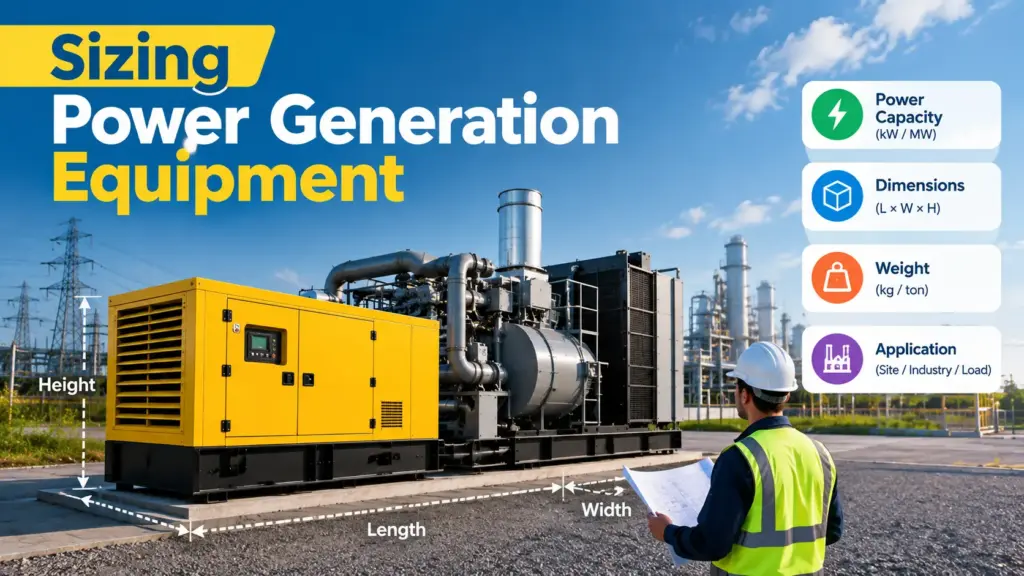
This is the single most common way projects go wrong, and it’s the part most competitor articles skip entirely. A generator’s nameplate kW rating is not the number that determines whether it will run your equipment.
kW is real power, the work actually done. kVA is apparent power, what the alternator has to supply, including the reactive load from motors and transformers. Generators are rated in kVA because the alternator, not the engine, is usually the limiting component.
The working formula:
kVA = kW ÷ Power Factor
A typical commercial power factor is 0.8. So a 100 kW load isn’t a 100 kVA job, it’s closer to 125 kVA. Miss this step and you’ll spec a generator that looks adequate on paper and trips under real load.
Motor starting current is the part that actually catches people out. A motor drawing 35 kW when running can pull 5 to 7 times that current at startup, sometimes needing 70+ kVA just for the first few seconds. If you size purely for steady-state running load, the first time a compressor or HVAC unit kicks on, you’ll get voltage sag, flickering lights, or a nuisance trip. Soft starters and VFDs reduce this spike and can let you spec a smaller, cheaper unit.
Site conditions quietly erase capacity you paid for. Engines lose roughly 3 to 4% of output per 1,000 feet of elevation because thinner air means less oxygen for combustion. At 5,000 feet, a non-turbocharged diesel unit may only deliver 80 to 85% of its sea-level rating. High ambient temperature does something similar. If your site sits at altitude or runs hot, this derating has to be built into the sizing math up front, not discovered after installation.
A practical rule of thumb for margin: add 20 to 30% headroom over your calculated peak load, and aim to operate the unit at 70 to 80% of rated capacity during normal running. That buffer protects the engine, accommodates future load growth, and, for diesel units specifically, helps avoid a maintenance problem almost nobody warns buyers about.
The Maintenance Failure Point Competitors Don’t Mention: Wet Stacking
If you run a diesel generator lightly loaded for extended periods, unburned fuel and carbon build up in the exhaust system instead of burning off cleanly. This is called wet stacking, and it shows up as black, oily residue dripping from the exhaust, along with a gradual loss of efficiency.
It’s a genuinely common field problem because it’s counterintuitive: people assume running a generator at low load is gentler on the machine. The opposite is true for diesel units. Running consistently below roughly 30% of rated capacity is the actual cause. The fix isn’t a part replacement, it’s a load bank test or periodically running the unit closer to 70 to 80% load to let the engine burn clean. Facilities that rent standby diesel gensets and run them mostly unloaded during testing are the most common victims of this, and it’s rarely covered in a warranty conversation.
Standby, Prime, and Continuous: Ratings That Change What You Should Buy
Manufacturers rate the same physical engine differently depending on how it will be used, and mixing these up leads to premature failure or an oversized, overpriced purchase.
| Rating | Typical Use Case | Run-Time Expectation | Overload Allowance |
|---|---|---|---|
| Standby | Emergency backup during utility outages | Limited hours per year | Usually none |
| Prime | Primary power source with variable load, no utility backup | Unlimited hours, variable load | 10% overload for short periods |
| Continuous | Constant, unchanging load, often grid-parallel or industrial base load | Unlimited hours, fixed load | None, sized at full rated output |
Buying a standby-rated unit and running it as your primary power source is one of the fastest ways to void a warranty and shorten engine life. It’s a mismatch that happens often on construction sites and in regions with frequent load-shedding, where a “backup” generator quietly becomes full-time power.
Types of Power Generation Equipment: Quick Reference
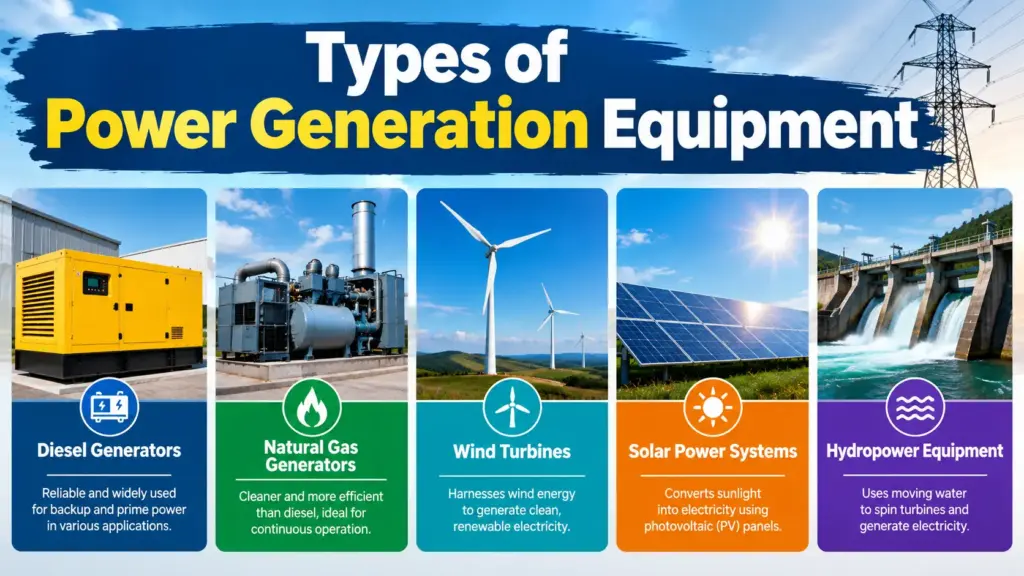
Rather than re-explaining what a steam turbine or PV panel is, here’s how the major categories differ on the dimensions that actually drive a purchase or infrastructure decision.
| Equipment Type | Typical Scale | Start-Up Speed | Best Fit |
|---|---|---|---|
| Diesel/gas gensets | 5 kW – 3 MW | Seconds | Backup power, remote sites, construction |
| Gas turbines | 1 MW – 500 MW | Minutes | Fast-ramping grid support, peaking |
| Steam turbines | 10 MW – 1 GW+ | Hours | Base-load thermal and nuclear plants |
| Combined cycle | 100 MW – 800 MW | Tens of minutes | High-efficiency utility generation |
| Wind turbines | kW – MW per unit | N/A (intermittent) | Grid-connected renewable capacity |
| Solar PV | W – MW | N/A (intermittent) | Distributed and utility-scale renewables |
| Hydroelectric | MW – GW | Minutes | Base-load and load-following renewable power |
| Battery energy storage (BESS) | kWh – GWh | Milliseconds | Grid stabilization, renewable firming, peak shaving |
One category worth calling out on its own: battery energy storage systems (BESS). These aren’t generation equipment in the traditional sense, they store power rather than create it, but they’ve become a standard companion to renewable installations and are increasingly paired with diesel and gas gensets to smooth demand spikes and cut fuel burn. If you’re planning renewable or hybrid capacity in 2026, BESS sizing belongs in the same conversation as generator sizing, not treated as a separate project.
Total Cost of Ownership: The Number That Actually Matters
Purchase price is the smallest line item over a generator’s working life. For a diesel unit running significant hours, fuel typically accounts for the majority of lifetime cost, followed by scheduled maintenance, and only then the upfront equipment cost. A cheaper unit that burns fuel inefficiently at partial load, or that requires more frequent service intervals, can easily cost more over five years than a pricier, better-matched machine.
Three questions to run before comparing quotes:
- What’s the expected load factor? A generator running at 40% average load all year has a completely different fuel and wear profile than one running at 80%.
- What’s the local fuel logistics situation? Diesel delivery reliability and price volatility matter as much as the generator’s specs in areas prone to supply disruption.
- What’s the service network like locally? A highly efficient unit with no nearby parts or technicians turns a two-day repair into a two-week outage.
Frequently Asked Questions
What size generator do I need for my home or business?
Add up the running wattage of everything that needs to run simultaneously, then add the highest single starting wattage on top of that (not all starting wattages combined, since equipment rarely starts at the exact same instant). Convert to kVA using your power factor, then add 20 to 30% headroom.
Can I run a generator at low load without damaging it?
Diesel units run consistently below about 30% load risk wet stacking over time. Gas-fired and gasoline units are generally more tolerant of light loading, but check manufacturer guidance either way.
How does altitude affect generator output?
Non-turbocharged diesel engines lose roughly 3 to 4% of rated output per 1,000 feet of elevation. Turbocharged units hold up better but still lose some capacity. Always ask for a derated rating for your site’s actual elevation, not the sea-level nameplate figure.
Is it cheaper to rent or buy power generation equipment?
Renting usually wins for short-term, seasonal, or uncertain-duration needs, since it avoids maintenance liability and capital outlay. Buying tends to pay off once you’re running the equipment for a majority of the year over multiple years, where the rental premium adds up faster than ownership costs.
What’s the difference between a genset and a power plant?
A genset is a self-contained, typically skid- or trailer-mounted unit pairing an engine with an alternator, usually under a few megawatts. A power plant is a full facility, turbines, boilers, cooling systems, switchgear, built for utility-scale generation, often hundreds of megawatts and up.
Why does my generator trip when a motor starts, even though it’s rated above my running load?
This is almost always a starting-current problem, not a running-load problem. The generator was likely sized to the steady-state kW draw without accounting for motor inrush, which can be 5 to 7 times the running current for a few seconds. Soft starters, VFDs, or a larger alternator solve it.
How often should power generation equipment be serviced?
It depends on run hours more than calendar time. Diesel gensets typically need oil and filter service every 250 to 500 running hours, with more extensive inspections at 1,000 to 2,000 hours. Standby units that rarely run still need monthly exercise cycles and annual load bank testing to catch wet stacking or battery issues before an actual outage.
Can renewable equipment like solar or wind fully replace traditional generators?
For grid-connected sites, renewables can cover a large share of average demand, but their intermittency means most installations still pair with battery storage, grid backup, or a traditional genset for periods of low sun or wind. For true off-grid or critical backup applications, a diesel or gas genset (or a hybrid system with BESS) is still the standard approach as of 2026.
You May Also Like It:
Public Power Energy Supplier: What It Is and How It Works
Power vs Energy: What Is the Difference and Why Does It Matter?
Green Power Energy: The Complete Guide to Clean, Renewable Electricity
Consumers Energy Power Outage: How to Report, Track, and Stay Safe