
Last updated: October 24, 2026
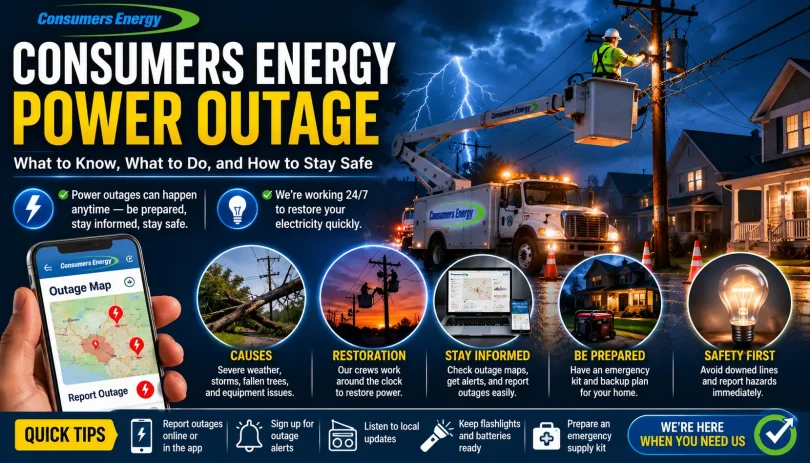
A Consumers Energy power outage can last a few minutes, several hours, or days after severe weather. Wind, falling trees, ice, equipment failures and planned maintenance are the most common causes across Michigan. When the lights go out, three things matter most: reporting the problem correctly, knowing how to read the outage map and restoration estimate, and understanding what you may be owed. This guide covers all three, plus the safety steps that matter while you wait.
How to Report a Consumers Energy Power Outage
Report an outage on the Consumers Energy Outage Center or call 800-477-5050. Check what is happening near you on the outage map. If you see a downed power line, stay at least 25 feet away, call 911 first, then call Consumers Energy. Qualifying electric customers receive outage credits automatically.
This guide is independent and is not affiliated with Consumers Energy. It does not show live outage status or access customer accounts. Always rely on the official tools below for current information.
Official Consumers Energy Outage Resources
| What you need | Where to go |
|---|---|
| Report an outage or check status | Outage Center or 800-477-5050 |
| See outages near you | Outage map |
| Outage alerts by text, email or phone | Alerts page or text REG to 232273 |
| Outage credit rules | Consumers Energy Outage Credit page and the Michigan Public Service Commission announcement (September 2026) |
| Downed power line | 911 first, then 800-477-5050 |
How to Report a Consumers Energy Power Outage
Reporting lets Consumers Energy locate affected customers and plan repairs. Even if a larger outage is already visible on the map, report your own address so the utility has accurate information about your service.
Fastest Way to Report an Outage
- Open the Consumers Energy Outage Center.
- Identify your service location using your address or account information.
- Enter your contact details and submit the report.
- Return to the Outage Center to follow updates.
You can also call 800-477-5050 to use the automated system or speak to a representative.
Should You Report If Your Neighbors Already Did?
Yes, especially if your power is still off. A neighborhood outage and a problem at your own service connection can happen at the same time, and a repaired street does not always mean every home is back on. Reporting does not guarantee earlier restoration, because crews prioritize safety, the number of customers affected and the damage found.
Power Out at Your House but Not Your Neighbors’?
- Check your breaker panel for a tripped breaker.
- Check the outage map for problems near your address.
- Report the outage if power has not returned.
If a breaker keeps tripping, equipment looks damaged or you smell burning, call a licensed electrician. Never open a meter, touch service wires or approach equipment that may be energized.
How to Use the Consumers Energy Outage Map
The outage map shows reported outages across the company’s electric service area. You can view it without signing in.
- Open the outage map.
- Search by address, city or ZIP code.
- Zoom in to your area.
- Select an outage marker or area to see its status, affected customers, cause and estimated restoration time when available.
Map Views Explained
| View | What it shows |
|---|---|
| Customer outage view | Number of customers without power in affected areas |
| City / ZIP code view | Percentage of customers affected in that city or ZIP |
| County view | Percentage of customers affected in the county |
Colors can mean different things in different views, so always check the legend currently displayed rather than assuming a color means the same severity everywhere.
Why Your Outage May Not Show on the Map
New or very small outages may take time to appear. If your power is off and the map shows nothing, report it anyway. If the map says your outage is restored but you still have no power, report that too.
Understanding the Estimated Time of Restoration (ETR)
ETR is the utility’s current best estimate of when power may return. It is not a guaranteed deadline. Check it on the Outage Center or by calling 800-477-5050.
Why the ETR Keeps Changing
Early estimates are often based on typical repairs. Once crews inspect the damage, the estimate can change. Common reasons:
- Additional damage found during inspection
- Unsafe weather that prevents repairs
- Fallen trees blocking access
- Multiple damaged lines or transformers
- Equipment that must be replaced or remote locations that are hard to reach
A revised ETR usually means new information arrived, not that work has stopped. During major storms, an estimate may be unavailable until damage assessment is complete.
The Five Stages of Restoration
| Stage | What happens |
|---|---|
| 1. Outage reported | The utility receives the report |
| 2. Analyzing the outage | Information is evaluated to find the likely problem |
| 3. Crews dispatched | Field crews are assigned to investigate or repair |
| 4. Repairs under way | Crews fix damaged equipment or lines |
| 5. Power restored | Service returns for the reported outage |
Why Some Neighbors Get Power Back First
Homes are connected through different circuits, transformers and service lines. Repairing a main line can restore thousands of customers at once, while individual connections need separate visits. Restoration order also reflects safety and critical facilities, so a neighbor’s restored power does not mean your outage was missed.
Consumers Energy Outage Credits: Who Qualifies and How Much
Michigan rules set by the Michigan Public Service Commission (MPSC) require electric utilities to give bill credits for long or repeated outages. Since 2023 these credits are automatic: eligible customers do not need to file a claim.
Current residential credit: $44 per day
The MPSC adjusts the credit every year for inflation. It was $42 after the October 2025 adjustment, and in September 2026 the Commission raised it to $44 per day. Utility web pages can take time to show a new figure, so if you see $42 on an older page, the regulator’s 2026 amount is the one that applies to new outages. The amount will change again with future annual adjustments.
When Does an Outage Qualify?
| Condition | What it means | Credit starts after |
|---|---|---|
| Normal (“blue sky”) conditions | Fewer than 1% of the utility’s customers without power | 16 continuous hours |
| Gray sky conditions | Between 1% and 10% of the utility’s customers without power | 48 continuous hours |
| Catastrophic conditions | 10% or more of the utility’s customers without power | 96 continuous hours |
| Repeat outages | Six or more outages lasting longer than five minutes within 12 months. After the credit is paid, the count restarts at zero. | A single credit |
For qualifying long outages, residential customers receive an additional credit for each subsequent continuous 24-hour period without power. Commercial and industrial credits are calculated differently.
Illustrative Example
Suppose a home loses power for 40 continuous hours under normal conditions. The 16-hour threshold is passed, and one further full 24-hour period has elapsed, so the home would be expected to receive two daily credits, or $88 at $44 each. This is an illustration only. Consumers Energy calculates credits from its own outage records.
How You Receive the Credit
Qualifying credits are applied to your bill automatically and should appear on your account within 90 days of power returning. Look for an outage credit line item in the center of your bill or an outage credit adjustment in the payment section. If more than 90 days have passed and you expect a credit, call 800-477-5050.
Two details many people miss: credits are only given to metered accounts, and planned (scheduled) outages follow the same rules as outages under normal conditions, so a long planned outage can qualify too. Partial loss of power is reviewed case by case to see whether it meets the requirements.
Keep Your Own Outage Log
A simple record helps if you ever need to dispute a missing credit. Note the date and time the power went out, when you reported it, any report or confirmation number, and the time power returned. Photos of storm damage or a dark meter display can also help.
Does the Credit Cover Spoiled Food?
No. The credit is a service-quality payment, not reimbursement for groceries or property. Some homeowner’s and renter’s policies cover food spoilage, so check your coverage, deductible and documentation requirements.
Safety During a Power Outage
First Steps When the Power Goes Out
- Use flashlights instead of candles to reduce fire risk.
- Report the outage using the Outage Center or 800-477-5050.
- Unplug or switch off sensitive electronics, and leave one light on so you notice when power returns.
- Keep refrigerator and freezer doors closed.
- Watch indoor temperatures during extreme heat or cold, and move to a safer place if needed.
How Long Does Food Stay Safe?
| Appliance | Approximate safe period (door closed) |
|---|---|
| Refrigerator | Up to 4 hours |
| Full freezer | About 48 hours |
| Half-full freezer | About 24 hours |
These are general food-safety guidelines. Use an appliance thermometer when possible, and discard perishable food that has been above safe temperatures. Looking or smelling normal does not make food safe.
Generator Safety
Portable generators can cause carbon monoxide poisoning, electric shock and fires when misused.
- Run generators outdoors, at least 20 feet from doors, windows and vents, with exhaust pointed away from buildings.
- Never run a generator in a garage, basement or enclosed porch.
- Use battery-powered carbon monoxide alarms.
- Never connect a generator directly to home wiring without a properly installed transfer switch.
If anyone feels dizzy, nauseated, confused or develops a headache while a generator is running, get to fresh air immediately and call emergency services.
If You See a Downed Power Line
Treat every fallen wire as energized. Stay at least 25 feet away, keep people and pets back, and call 911, then Consumers Energy at 800-477-5050. Never try to move a wire with a tool, rope or stick. If a power line falls on your vehicle, stay inside unless fire forces you out, and wait for emergency crews.
Medical Equipment and the Critical Care Program
If you rely on oxygen concentrators or other powered medical devices, plan for outages before they happen with your doctor and equipment supplier. Consumers Energy’s Critical Care Program may offer shutoff protection to eligible customers, but enrollment does not guarantee faster restoration or provide backup power. If a medical emergency develops, call 911.
Outage Alerts and Planned Outages
How to Set Up Outage Alerts
Alerts save you from refreshing the map. Residential customers can set preferences online or in their account. You can also text REG to 232273 to register for text alerts. Business customers are asked for their account number during registration. Visit the alerts page for the commands your enrollment supports, and note that standard message rates may apply.
Planned Power Outages
Consumers Energy schedules planned outages to upgrade or repair equipment that cannot be worked on safely while energized. Affected customers may receive advance notice by mail with the expected date, time and duration. Before a planned outage, charge phones and essential devices and arrange backup power for anything that cannot go without electricity. Schedules can change if crews find additional work.
| Planned outage | Unplanned outage | |
|---|---|---|
| Cause | Scheduled maintenance or upgrades | Storms, equipment faults, accidents |
| Advance notice | Usually provided | Typically none |
| Duration | Often estimated ahead | Uncertain at first |
Common Causes of Power Outages in Michigan
- Storms and high winds: damage poles, bring down lines and blow debris into equipment.
- Trees and branches: a leading cause of overhead line damage, especially in thunderstorms and ice.
- Ice and winter storms: heavy ice weighs down lines and branches, and snow can slow crews.
- Equipment failure: aging transformers, switches and connections can fail without weather involved.
- Vehicle crashes and animal contact: a single damaged pole or tripped protective device can cut power to nearby homes.
Modern grid technology, such as automatic reclosers and switching devices, can restore power after temporary faults or isolate damaged sections so fewer customers stay without power. These devices cannot repair broken wires or poles, so field crews are still needed for physical damage.
Frequently Asked Questions About Consumers Energy Power Outages
What is the Consumers Energy power outage phone number?
Call 800-477-5050 to report an outage or get information. For a downed line or life-threatening emergency, call 911 first, then Consumers Energy.
Can I check the outage map without logging in?
Yes. The public outage map can be viewed without an account. You can search by address, city or ZIP code. Reporting or detailed status may ask for address or account information.
How long does an outage usually last?
There is no standard length. A simple fault may be fixed quickly, while storm damage involving poles or multiple lines can take much longer. Check the Outage Center for the estimate tied to your address.
Why does my outage say restored when I still have no power?
A wider problem may be fixed while a separate fault remains at your home. If it is safe, check for a tripped breaker, then report the continuing outage. Do not touch wires, meters or service equipment.
Does Consumers Energy automatically know when my power is out?
Some systems detect outages, but not all. Report your outage so the utility has your address, especially if status is wrong or only your home is affected.
How do I check an outage by ZIP code?
Open the outage map and search your ZIP code, then switch to the city or ZIP view to see the percentage of customers affected. For your own address, use the reporting or status tools.
Why is my restoration time unavailable?
Crews may still be assessing damage, or a major storm may be under way. Check back later. A missing estimate does not mean work has stopped.
Does the Critical Care Program restore my power faster?
No. It may provide shutoff protection for eligible customers, but it does not guarantee faster restoration or supply backup power. Keep an emergency plan with your healthcare provider and equipment supplier.
Conclusion
When your power goes out, report it promptly, use the outage map to understand the wider picture, and follow your ETR on the Outage Center while remembering it can change. Stay clear of downed lines, run generators safely outdoors, and keep a simple outage log. For long or repeated outages, check your next bill for the automatic credit and confirm the current amount with Consumers Energy or the Michigan Public Service Commission. Storms and equipment failures will still happen, but knowing the steps makes each outage easier to manage.
Outage credit amounts, thresholds, phone numbers and alert options can change. Confirm current details on the official Consumers Energy website or with the Michigan Public Service Commission before relying on them.
You May Also Like It:
Green Power Energy: The Complete Guide to Clean, Renewable Electricity
Power vs Energy: What Is the Difference and Why Does It Matter?
Public Power Energy Supplier: What It Is and How It Works
Xcel Power Shut Off: Everything You Need to Know About PSPS Outages