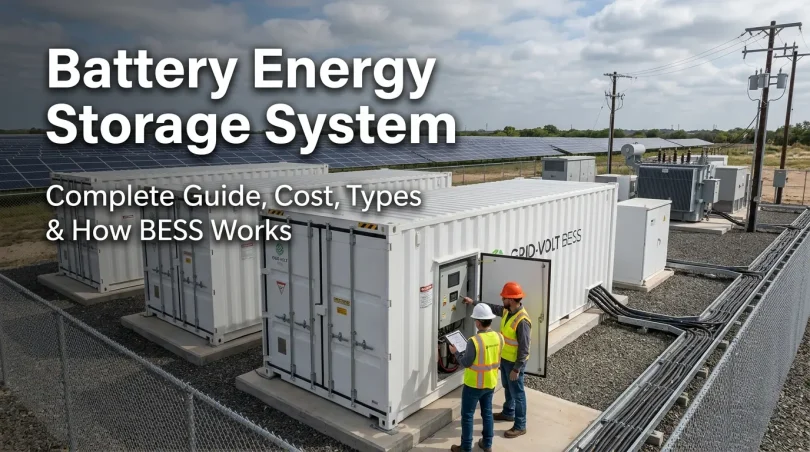

A battery energy storage system (BESS) is a technology that captures electrical energy, stores it in rechargeable batteries, and discharges it on demand. It bridges the gap between when electricity is generated and when it is actually needed, making power grids more flexible, reliable, and efficient.
BESS Meaning: What It Actually Represents in the Energy World
BESS stands for Battery Energy Storage System. But the acronym understates what the technology actually does.
It is not just a large battery. A BESS is a complete, integrated system that includes the batteries themselves, a power conversion system, a battery management system (BMS), a thermal management unit, and grid-connection hardware, all working together under a central energy management controller.
The “storage” part is the marketing pitch. The real value is controllability: the ability to respond to grid signals, price signals, or emergency events in milliseconds, something a gas peaker plant cannot do.
Most practitioners distinguish BESS from other storage types (like pumped hydro or flywheels) specifically because of its electrochemical foundation and the modular, scalable hardware stack it enables.
BESS System: How It Actually Works, Step by Step
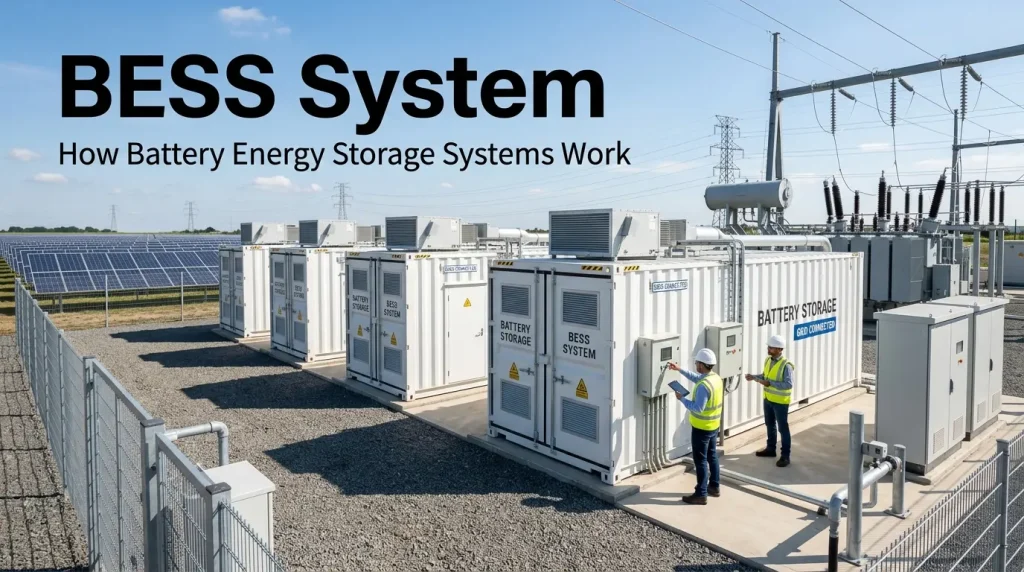
Understanding the BESS system means following the flow of electrons through each stage.
Charging phase:
- The grid (or a solar/wind source) feeds AC power into the BESS.
- The power conversion system (PCS) converts AC to DC current.
- The BMS checks cell voltages, temperatures, and state of charge before accepting the incoming power.
- DC current flows into the battery cells, where it is stored electrochemically.
Standby phase:
- The BMS monitors each cell continuously: voltage drift, thermal hotspots, and state of health.
- The thermal management system (usually liquid cooling or forced air) keeps cells within their optimal temperature window, typically 15-35°C.
- The energy management system (EMS) watches external signals: grid frequency, electricity prices, or pre-set schedules.
Discharge phase:
- When a trigger occurs (frequency deviation, peak demand, operator command), the EMS signals the PCS.
- The PCS converts DC from the battery bank back to AC at grid frequency.
- Power flows to the load, whether that is a building, a microgrid, or the wider transmission network.
The round-trip efficiency of a modern lithium-ion BESS is typically 85-95%, meaning roughly 5-15 cents of every dollar of stored energy is lost to heat during the charge-discharge cycle.
BESS Battery Energy Storage Systems: Types, Chemistry, and How to Choose
Not all BESS battery energy storage systems use the same chemistry. The chemistry choice drives cost, cycle life, safety profile, and use case.
| Chemistry | Energy Density | Cycle Life | Best Use Case | Key Trade-off |
|---|---|---|---|---|
| Lithium Iron Phosphate (LFP) | Moderate | 3,000-6,000+ cycles | Grid-scale, commercial | Lower energy density vs. NMC |
| Nickel Manganese Cobalt (NMC) | High | 1,500-3,000 cycles | EV-paired storage, space-limited sites | Cobalt supply chain risk |
| Lead-Acid (VRLA) | Low | 500-1,200 cycles | Backup power, UPS | Heavy, shorter lifespan |
| Flow Batteries (Vanadium) | Low | 10,000-20,000 cycles | Long-duration storage (4-12 hr) | High upfront cost, large footprint |
| Sodium-Ion | Moderate | 2,000-4,000 cycles | Cold climates, low-cost grid storage | Still scaling commercially |
LFP has become the dominant chemistry for utility-scale BESS projects globally as of 2024. Its thermal stability, longer cycle life, and rapidly falling prices, now below $100/kWh at the cell level in some markets, make it the default choice for most new installations.
Flow batteries are gaining traction specifically for long-duration storage (above 4 hours), where lithium-ion economics deteriorate. A vanadium flow battery can discharge for 8-12 hours at a flat power output, something most lithium-ion systems struggle to match economically.
What Competitors Miss: Real-World Sizing and the “1C” Rule
Most articles explain what a BESS does. Few explain how practitioners actually size one.
The key concept is C-rate: the ratio of discharge power to total energy capacity.
- A 1C system with 100 kWh of capacity can deliver 100 kW for exactly 1 hour.
- A 0.5C system with the same 100 kWh delivers 50 kW for 2 hours.
- A 2C system delivers 200 kW but drains in 30 minutes.
Why this matters in practice: A frequency regulation project needs a high C-rate (fast power delivery for short bursts). A peak-shaving project behind a commercial meter needs a 0.5C-1C system with 2-4 hours of capacity. Getting this wrong means either over-spending on capacity you never use or buying a system that cannot do the job.
Another sizing factor competitors miss: Depth of Discharge (DoD). Most LFP manufacturers warrant their systems at 80-90% DoD. Cycling cells to 100% repeatedly cuts cycle life significantly. A well-designed BESS project reserves 10-20% of nameplate capacity as a buffer, which needs to be factored into procurement.
Real-World Applications: Where BESS Is Actually Deployed
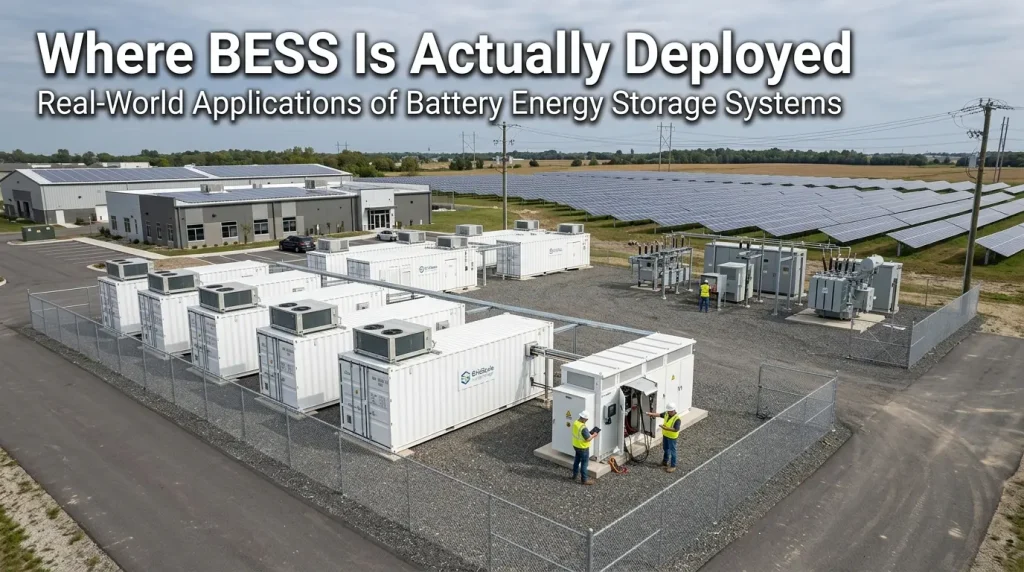
Utility grid services: Frequency regulation is the highest-value grid service in most markets. When grid frequency drifts from 50 or 60 Hz, a BESS can respond in under 200 milliseconds, far faster than any thermal generator. The UK’s Frequency Containment Reserve and the US frequency regulation markets have been early proving grounds for grid-scale BESS.
Renewable energy firming: A solar farm without storage only produces power when the sun shines. Pair it with a 2-4 hour BESS and you can shift solar generation from midday, when wholesale prices are low, to evening peak hours. This is called time-shifting, and it is the dominant business model for utility-scale solar-plus-storage projects.
Commercial and industrial (C&I) behind-the-meter: Large energy consumers use BESS to cut demand charges, the fees utilities apply based on peak 15-minute interval consumption. A 500 kW demand spike that lasts 15 minutes can add thousands of dollars per month to an electricity bill. A BESS can shave that peak, payback periods in high-demand-charge markets often run 5-8 years.
Microgrids and island communities: Remote communities, military bases, and island grids use BESS as the backbone of diesel-reduction projects. The BESS absorbs excess renewable generation and supplies power when wind or solar output drops, reducing diesel fuel consumption by 50-80% in well-designed systems.
Residential storage: Home batteries (most commonly Tesla Powerwall, Sonnen, or Enphase IQ) are typically 10-20 kWh systems designed for self-consumption optimization, backup power during outages, or time-of-use arbitrage.
BESS Safety: The Thermal Runaway Problem Nobody Talks About Plainly
Safety is the most under-explained topic in most BESS articles.
Thermal runaway is the core risk. When a lithium-ion cell is overcharged, physically damaged, or exposed to excessive heat, an exothermic chemical reaction begins. Heat from that reaction accelerates the chemistry further, creating a self-sustaining cascade that can lead to fire or explosion. In a large BESS with thousands of cells in close proximity, one failing cell can trigger adjacent cells.
Mitigations are layered:
- Cell-level: BMS voltage and temperature limits cut power to any cell approaching dangerous thresholds.
- Module-level: Fire suppression systems (often FM-200 or aerosol-based) activate within the battery cabinet.
- System-level: Spacing between BESS containers, blast walls, and site drainage plans prevent single-unit incidents from becoming multi-unit disasters.
- Operational: The NFPA 855 standard in the US and IEC 62933 internationally set minimum safety requirements for BESS installations.
LFP chemistry has a significantly better thermal stability profile than NMC, which is one reason it dominates new utility-scale installations despite its lower energy density.
Project Economics: The Numbers Behind the Decision
The total cost of a BESS project is not just the battery price.
Capital cost components:
- Battery cells and modules: 40-50% of total
- Power conversion system (inverter/converter): 15-20%
- EMS and BMS software: 5-10%
- Thermal management, enclosures, fire suppression: 10-15%
- Civil works, grid connection, commissioning: 15-25%
All-in installed cost for a utility-scale LFP BESS is currently $250-$400/kWh in most markets, down from over $1,000/kWh a decade ago.
Revenue streams to model:
- Energy arbitrage (buy low, sell high)
- Capacity payments
- Frequency regulation and ancillary services
- Avoided demand charges (C&I)
- Resilience value (hard to quantify, often real)
Stacking multiple revenue streams is called value stacking, and it is how most projects achieve an acceptable return. A project that relies on a single revenue stream is exposed to market price changes that can erode the business case.
The Degradation Curve: What Happens After Year 5
Every BESS loses capacity over time. This is not a flaw; it is a known, manageable engineering constraint.
LFP cells typically retain 80% of their original capacity after 3,000-4,000 cycles under normal operating conditions. At a once-daily charge-discharge cycle, that is roughly 8-11 years before hitting the 80% threshold.
What this means for project owners:
- Contracts need capacity guarantees, not just nameplate guarantees.
- A 100 MWh BESS in year 10 may only deliver 80 MWh, which can breach offtake contract terms.
- Augmentation strategies (adding fresh cells mid-life) are increasingly common in long-term project finance.
Operators who run cells hard: high C-rates, deep DoD, elevated temperatures, accelerate this curve. Thermal management is not a luxury feature; it is a direct financial investment in cycle life.
FAQ
What is the difference between a BESS and a UPS (Uninterruptible Power Supply)?
A UPS is designed to supply backup power for seconds to minutes during short outages, typically protecting sensitive equipment. A BESS is designed for sustained energy shifting over hours, can provide grid services, and scales to megawatt-hour capacities. Some modern BESS installations do perform UPS-like functions, but the design intent, capacity, and grid-integration features are fundamentally different.
How long does a battery energy storage system last?
Most commercial and utility-scale BESS projects are designed for a 15-20 year operating life. The battery cells typically degrade to 80% capacity in 8-12 years under standard cycling, after which cells may be augmented or replaced. The inverter and balance-of-plant equipment often outlast the first battery set.
Can a BESS fully power a home or building independently?
Yes, with the right sizing. An off-grid home BESS paired with solar needs to cover peak loads and overnight consumption without grid backup. Most residential systems are sized for partial backup (critical loads only) rather than full independence. Full off-grid sizing requires detailed load analysis and often a larger battery bank than most standard residential products provide.
What is the minimum BESS size for commercial use?
There is no regulatory minimum, but practical commercial installations typically start at 100 kWh to 500 kWh. Smaller systems often cannot justify the fixed costs of grid interconnection studies, protective relaying, and commissioning. Behind-the-meter C&I systems targeting demand charge reduction are often sized around the facility’s peak demand, typically 100 kW to several megawatts.
Is lithium-ion the only viable technology for utility-scale BESS?
No, but it dominates current deployments. Flow batteries (vanadium, zinc-bromine) are commercially deployed at scale for long-duration applications. Compressed air energy storage and pumped hydro are not battery-based but serve similar grid functions. Sodium-ion is entering commercial production and may compete with LFP on cost at large scale by 2027-2028.
How does a BESS help with renewable energy integration?
Renewable sources like solar and wind generate power intermittently. A co-located BESS captures surplus generation during high-output periods and releases it during low-output or high-demand periods. This improves grid stability, allows generators to commit to firm output schedules, and increases the economic value of the renewable asset by enabling price arbitrage.
What permits or standards apply to a BESS installation?
Requirements vary by jurisdiction, but common frameworks include NFPA 855 (Standard for the Installation of Stationary Energy Storage Systems) in the US, IEC 62933 for grid-integrated systems internationally, and UL 9540 / UL 9540A for fire safety testing. Most jurisdictions also require an interconnection study and approval from the local utility before a grid-connected BESS can operate.
What is the difference between energy capacity and power capacity in a BESS?
Energy capacity (measured in kWh or MWh) is how much electricity the system can store. Power capacity (measured in kW or MW) is how fast it can charge or discharge. A 1 MWh BESS with 500 kW of power capacity can deliver its full energy over 2 hours. Specifying only one of these without the other is an incomplete description of any storage system.
You May Also Like It:
Power Outage Safety Guide: How to Prepare for Outages and Emergencies
Power to Choose in Texas: The Complete Guide to Comparing Electricity Plans
CenterPoint Outage Map Houston: How to Report and Track Power Outages
Consumers Outage Map: Complete Guide to Tracking Power Outages in Michigan