
Introduction: Two Words, Two Very Different Meanings
Most people use the words power and energy as if they mean the same thing. In everyday conversation, that is fine. But when it comes to Power vs Energy in physics, engineering, and even on your electricity bill, they are completely different concepts, and mixing them up can cost you real money or lead to real confusion.”
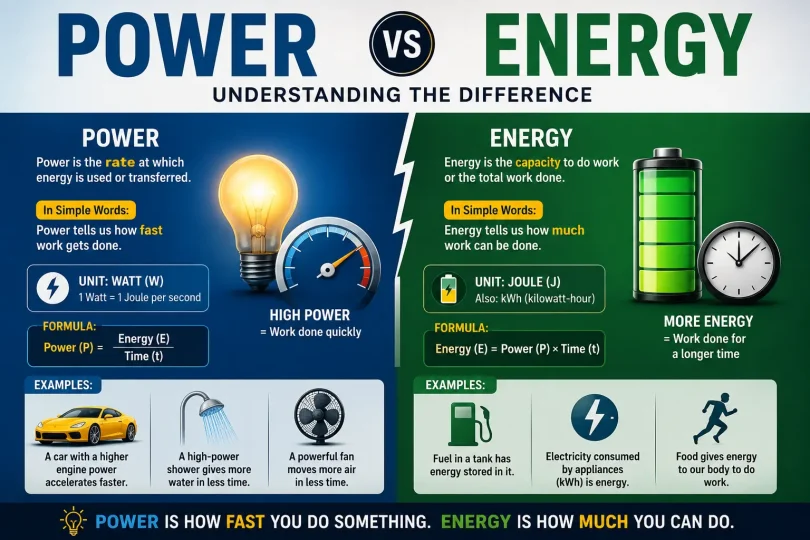
Here is the short version: energy is the total amount of work that gets done, and power is how fast that work happens. Think of it like the difference between how far you travel and how fast you are going. Same journey, two different measurements.
This article breaks down the difference in plain language, with real examples you actually encounter every day.
What Is Energy?
Energy is the capacity to do work. It is the total amount of “fuel” stored in something or used by something over a period of time.
In physics, the standard unit of energy is the joule (J). But in everyday life, you will come across several units of energy depending on the context:
- Joules (J): used in physics and engineering
- Kilowatt-hours (kWh): used on your electricity bill
- Calories (cal) and kilocalories (kcal): used in food and nutrition
- BTUs (British Thermal Units): used in heating and cooling systems
The key thing to understand about energy is this: it can change form, but it cannot be created or destroyed. That is the law of conservation of energy, and it applies everywhere from a car engine to a human body to a solar panel.
Types of Energy
Energy comes in many forms. Here are the most common ones:
- Kinetic energy: the energy of movement (a rolling ball, a moving car, flowing water)
- Potential energy: stored energy based on position (a rock at the top of a hill, a compressed spring)
- Thermal energy: heat energy (the warmth from a fire or a radiator)
- Chemical energy: energy stored in chemical bonds (food, fuel, batteries)
- Electrical energy: energy from the movement of charged particles (what powers your home)
- Nuclear energy: energy from splitting or fusing atomic nuclei (nuclear power plants)
- Electromagnetic energy: energy carried by light waves and radiation (sunlight, microwaves)
Devices convert energy from one form to another. A battery converts chemical energy into electrical energy. A light bulb converts electrical energy into light and heat. A solar panel converts electromagnetic energy (sunlight) into electrical energy.
What Is Power?
Power is the rate at which energy is used or transferred. It tells you how quickly work gets done.
The standard unit of power is the watt (W), named after James Watt, the Scottish engineer who helped develop the steam engine. One watt is equal to one joule of energy used per second.
In practical terms: if two machines both move the same object from point A to point B, but one does it in 5 seconds and the other does it in 10 seconds, the faster machine has greater power. Both used the same total energy, but the faster one delivered it at a higher rate.
The Watt and Its Multiples
You will see power measured across a huge range of scales:
| Unit | Value | Common Use |
|---|---|---|
| Watt (W) | 1 W | Light bulbs, small devices |
| Kilowatt (kW) | 1,000 W | Home appliances, EV chargers |
| Megawatt (MW) | 1,000,000 W | Power stations, industrial use |
| Gigawatt (GW) | 1,000,000,000 W | National grid capacity |
A typical microwave oven runs at around 1,000 watts (1 kW). A large wind turbine generates about 2 to 3 megawatts. The entire US national grid operates at a scale of hundreds of gigawatts.
The Core Formula: How Power and Energy Connect
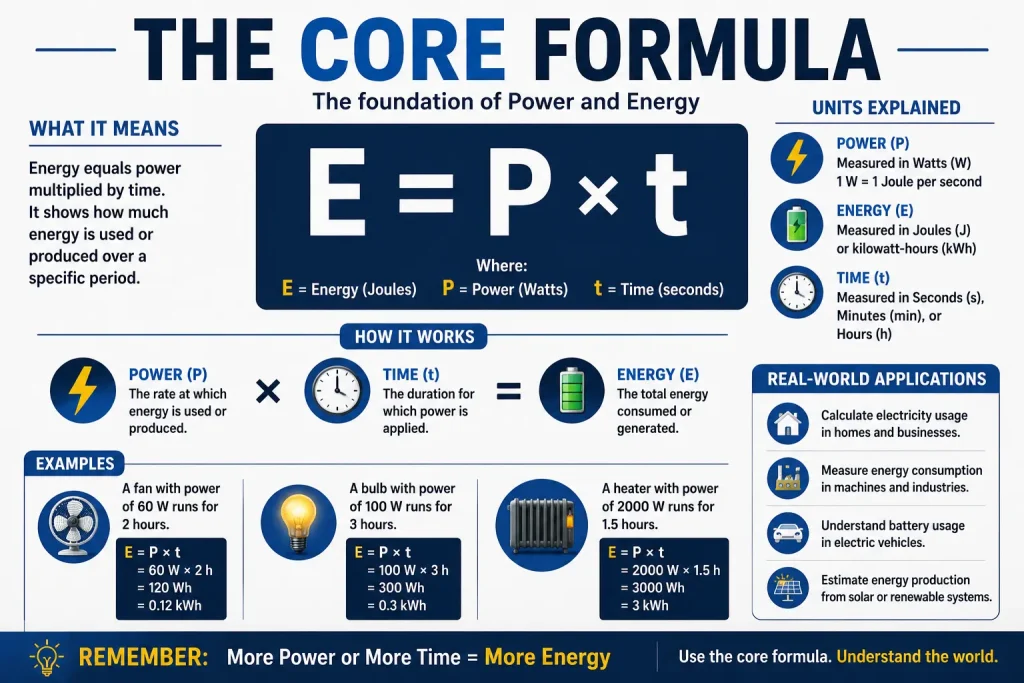
This is the relationship that ties everything together:
Energy = Power x Time
Or rearranged: Power = Energy / Time
This single formula explains almost every question people have about electricity bills, appliance efficiency, battery storage, and solar panel sizing.
Here is a simple example: if a 2 kW electric kettle runs for 30 minutes (0.5 hours), the energy it uses is:
2 kW x 0.5 hours = 1 kWh of energy
The kettle has a power rating of 2 kW (that never changes while it is on). The energy it uses depends entirely on how long you run it.
Power vs Energy: A Side-by-Side Comparison
| Feature | Power | Energy |
|---|---|---|
| Definition | Rate of doing work | Total work done or capacity to do work |
| SI unit | Watt (W) | Joule (J) |
| Practical unit | Kilowatt (kW) | Kilowatt-hour (kWh) |
| Time-dependent? | Yes (instantaneous rate) | Yes (accumulates over time) |
| Can be stored? | No | Yes (in batteries, fuel, food) |
| Formula | P = E / T | E = P x T |
| On your bill? | Sometimes (demand charges) | Yes (kWh charges) |
| Example | A 100W light bulb | 1 kWh used over 10 hours |
Real-World Examples That Make It Click
Example 1: The Light Bulb
A 100-watt light bulb draws 100 watts of power as long as it is switched on.
- Leave it on for 1 hour: it uses 0.1 kWh of energy.
- Leave it on for 10 hours: it uses 1 kWh of energy.
The power stays the same (100 W). The energy consumed grows with time.
Example 2: Two Cars on a Motorway
Two cars need to travel from London to Edinburgh (around 400 miles). Both use exactly the same amount of fuel to complete the journey. The total energy used is identical.
But if one car makes the trip in 6 hours and the other does it in 8 hours, the faster car was using energy at a higher rate. It had more power (more watts) at its disposal.
Same energy. Different power.
Example 3: Sprinter vs Marathon Runner
A 100-metre sprinter and a marathon runner both use energy from food. But the sprinter burns through energy in under 10 seconds at an enormous rate, while the marathon runner sustains a lower rate of energy use for over two hours.
The sprinter has high power output. The marathon runner has high energy capacity. This is why training for sprinting and training for long-distance running are completely different.
Example 4: Two Builders Lifting Bricks
Two builders each lift 500 bricks from ground level to the second floor of a building. The total energy they use is the same.
One takes 30 minutes. The other takes 60 minutes. The faster builder does the same amount of work in half the time. That means they generated twice the power.
Power vs Energy on Your Electricity Bill
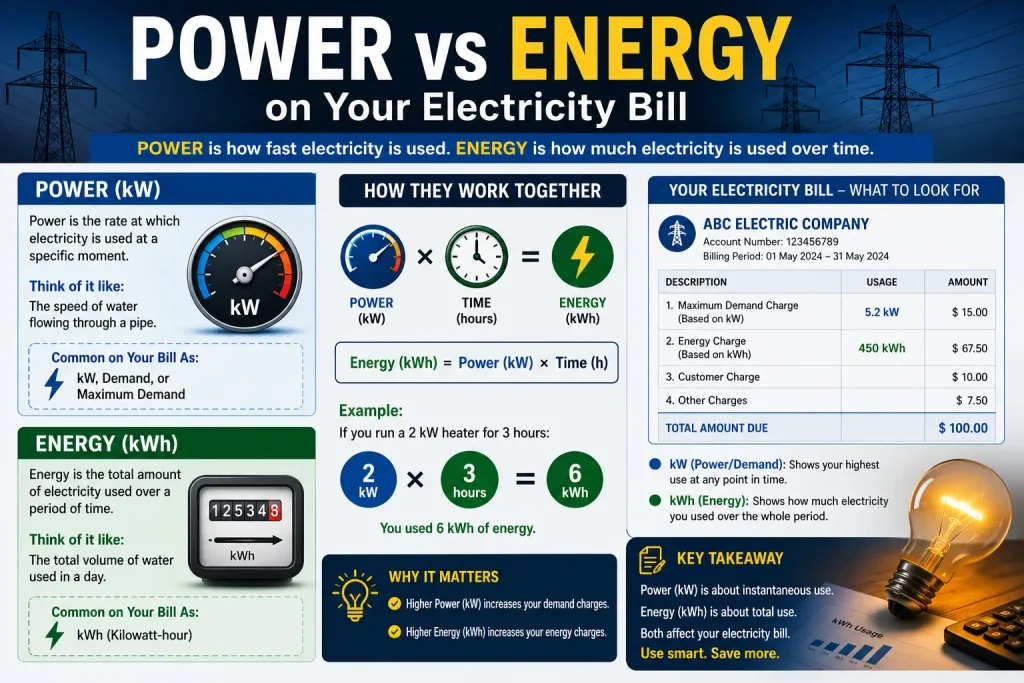
This is where most people have questions. Your electricity bill charges you for energy, not power. The unit is the kilowatt-hour (kWh).
A kilowatt-hour is the amount of energy used when a 1,000-watt (1 kW) device runs for one hour.
Here are some practical examples of kWh consumption for common household appliances:
| Appliance | Power | Time | Energy Used |
|---|---|---|---|
| LED light bulb | 10 W | 10 hours | 0.1 kWh |
| Laptop | 50 W | 4 hours | 0.2 kWh |
| Refrigerator | 150 W | 24 hours | 3.6 kWh |
| Washing machine | 2,000 W | 1 hour | 2 kWh |
| Electric shower | 9,000 W | 10 minutes | 1.5 kWh |
| EV charger (Level 2) | 7,500 W | 4 hours | 30 kWh |
A typical American household uses around 33 kWh per day, roughly 1,000 kWh per month. Each kWh costs between $0.12 and $0.30 depending on location and supplier.
What About Demand Charges?
Here is something most competitor articles miss entirely: while residential customers are billed only for energy (kWh), commercial and industrial customers often also pay a demand charge based on their peak power draw in kilowatts.
In simple terms: if a factory briefly draws 500 kW during its busiest 15-minute period of the month, it may be billed for that peak, even if the rest of the month is much quieter. Grid operators charge these fees because high peak demand forces them to maintain larger infrastructure.
This is why industrial businesses invest heavily in “peak shaving” strategies: they try to spread their energy use more evenly throughout the day to reduce their peak kW draw and lower their demand charges.
Power vs Energy in Solar and Battery Systems
If you are thinking about solar panels or a home battery, understanding power vs energy is essential.
Solar panels are rated in kilowatts (kW). This is their power output under ideal sunlight conditions. A 5 kW solar system produces 5 kW of power at its peak.
Home batteries are rated in kilowatt-hours (kWh). This is how much energy they can store. A 10 kWh battery can store 10 kWh of energy.
If your 5 kW solar panels produce electricity for 4 hours on a sunny day, they generate:
5 kW x 4 hours = 20 kWh of energy
That is 20 kWh you can use immediately, store in your battery, or feed back to the grid.
The battery’s kWh rating tells you how long you can run your home on stored power. If your home uses 2 kW of power, a 10 kWh battery would last:
10 kWh / 2 kW = 5 hours
Getting this calculation wrong leads people to buy undersized batteries and wonder why they run out of power overnight.
Power vs Energy in Electric Vehicles
Electric vehicles use both measurements in ways that trip up a lot of buyers.
Battery capacity is measured in kWh. This tells you the total energy stored and directly relates to driving range. A Tesla Model 3 Long Range has a 75 kWh battery. The Rivian R1T has a 135 kWh battery. More kWh generally means more range.
Motor output is measured in kW (or horsepower). This tells you the rate at which the motor can deliver energy to the wheels. It determines acceleration and top speed.
Charging speed is measured in kW. A standard home outlet delivers about 2.3 kW. A Level 2 home charger delivers 7 to 11 kW. A public DC fast charger can deliver 150 kW or more. Higher charging power fills the battery faster.
Energy consumption is measured in Wh/km or Wh/mile (watt-hours per kilometre or mile). This tells you how efficiently the car uses its stored energy. A 2023 Tesla Model S has a battery capacity of 100 kWh and averages around 175 Wh per kilometre. The lower this number, the more efficient the vehicle.
Power vs Energy in the Human Body
Your body is an energy conversion machine, and the difference between power and energy is just as real in biology as it is in physics.
Energy in the body comes from food, specifically from carbohydrates, fats, and proteins. We measure food energy in kilocalories (kcal), often just called “calories.” Your body converts these into adenosine triphosphate (ATP), the only direct fuel source your cells can actually use.
Power in the body is how fast you can produce and use that energy. It varies enormously depending on the activity:
- Sleeping or sitting: your body uses roughly 80 to 100 watts of power, just to keep organs running and maintain body temperature.
- Walking briskly: your output rises to around 200 to 300 watts.
- Cycling at moderate pace: around 150 to 250 watts.
- Elite sprinting: a world-class sprinter can produce over 2,500 watts during a 100-metre race for about 10 seconds.
- Elite endurance cycling: Tour de France riders sustain 350 to 400 watts for hours at a time on mountain climbs.
The sprinter has extraordinary power. The endurance cyclist has extraordinary energy capacity. Very few athletes excel at both, because the training demands are almost opposite.
About 75% of your daily calorie intake goes toward your basal metabolic rate (BMR), keeping your heart beating, lungs breathing, brain thinking, and organs functioning. Only the remaining 25% is available for physical activity. This is why people can exercise intensely and still struggle to create a significant calorie deficit.
Common Misconceptions About Power and Energy
“More powerful means more efficient”
Not necessarily. A high-powered device gets work done faster, but it does not automatically do it more efficiently. Efficiency is about how much of the input energy becomes useful output versus waste heat. A 100-watt LED light and a 100-watt incandescent bulb both draw the same power, but the LED converts far more of it to light rather than wasted heat.
“You can store power”
No. Power is a rate, not a thing. You cannot store a rate. What you store is energy. Batteries store energy (kWh). When you draw from the battery, you draw power (kW) at whatever rate you need.
“A higher wattage appliance always costs more to run”
Not always. Running time is just as important as wattage. A 50-watt device running for 20 hours uses the same energy as a 1,000-watt device running for 1 hour: both use 1 kWh. A high-powered appliance you use briefly can easily cost less than a low-powered appliance you leave running all day.
“Power and energy are the same thing in electricity”
They are not. Kilowatts (kW) measure power. Kilowatt-hours (kWh) measure energy. Many people see “kilowatt” and “kilowatt-hour” and assume they are the same unit with a different scale. They are actually measuring completely different things, related by time.
How to Use This Knowledge to Save Money
Understanding power vs energy gives you a practical advantage when managing your electricity costs.
1. Focus on the appliances you use for the longest time. A 10-watt phone charger running for an hour barely matters. A 2,500-watt air conditioner running for 8 hours uses 20 kWh. Time and wattage together determine your bill, not wattage alone.
2. Check wattage labels before you buy. Every appliance has a wattage rating. A lower-wattage appliance that does the same job will cost less to run over its lifetime, often saving far more than any upfront price difference.
3. Watch your standby (“phantom”) power. Many devices draw power even when switched off. Smart TVs, game consoles, and desktop computers can draw 5 to 20 watts continuously in standby mode. Over a year, that adds up. Smart power strips can cut this entirely.
4. Shift high-power use to off-peak hours. In many areas, electricity costs less at night or during low-demand periods. Running your dishwasher, washing machine, or EV charger overnight can reduce your bill without changing how much energy you use.
5. Size solar and battery storage correctly. If you are shopping for solar, match panel kW capacity to your household’s peak power demand. If you are adding battery storage, match battery kWh capacity to how many hours of backup power you actually need. Getting these numbers confused leads to expensive undersizing or oversizing.
Quick Reference: Power vs Energy at a Glance
Power (kW):
- Measures the rate of energy use right now
- Rated on appliance labels and generator specs
- Solar panels are sized in kW
- EV chargers are rated in kW
- Cannot be stored
Energy (kWh):
- Measures total electricity consumed over time
- Shown on your electricity bill
- Batteries are sized in kWh
- EV batteries are rated in kWh
- Can be stored
The formula that connects them: Energy (kWh) = Power (kW) x Time (hours)
Final Thought
Power and energy are not just abstract physics concepts. They show up on your electricity bill every month, in the specs of every appliance and electric vehicle you buy, in the sizing of solar panels and home batteries, and in how athletes train and compete. Once you understand the difference, a huge amount of everyday information starts to make sense in a way it did not before.
The bottom line: energy is the total work done, power is how fast you do it, and time is the bridge between the two.
You May Also Like It:
CNC Machining Tolerances: The Complete Expert Guide
Prototype CNC Machining: The Complete Expert Guide
Steel Grade: The Complete Guide to Understanding Every Type of Steel