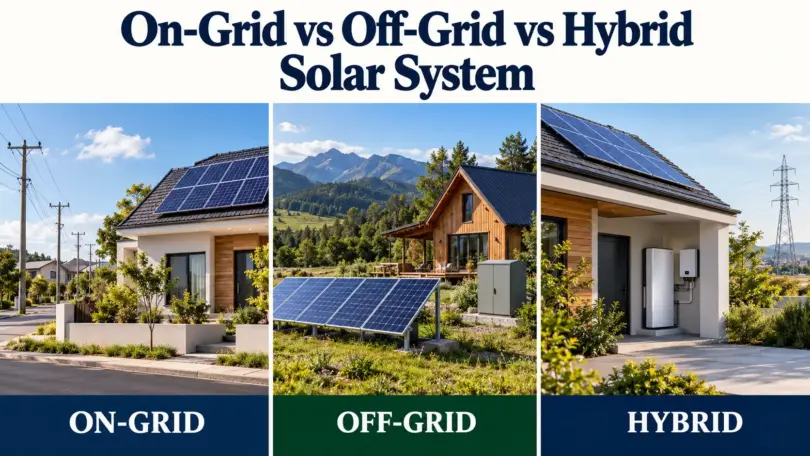

Which solar system is best? Choose on-grid if your power is reliable and your utility pays fair export credits: it costs the least and pays back fastest. Choose hybrid if you face frequent outages, time-of-use rates or low export credits. Choose off-grid only for remote property with no practical utility connection.
The decision comes down to three checks: which appliances must stay on during an outage, how many backup hours you need, and what the proposed equipment can actually do.
In this guide, on-grid means a conventional solar system with no battery, and hybrid means grid-connected solar with battery storage. Installers sometimes use these labels differently, so always check the equipment list, not just the product name.
On-Grid vs Off-Grid vs Hybrid Solar: Quick Comparison
| On-grid | Off-grid | Hybrid | |
|---|---|---|---|
| Works in a blackout? | No | Yes | Yes (on backup circuits) |
| Needs a battery? | No | Yes | Yes |
| Utility connection | Required | None | Required |
| Relative cost | Lowest | Highest | Medium to high |
| Night-time power | From the utility | From battery or generator | From battery, then utility |
| Maintenance | Low | High | Medium |
| Best for | Cutting bills on a stable grid | Remote land, cabins, farms | Outage-prone homes, time-of-use rates |
How an On-Grid Solar System Works
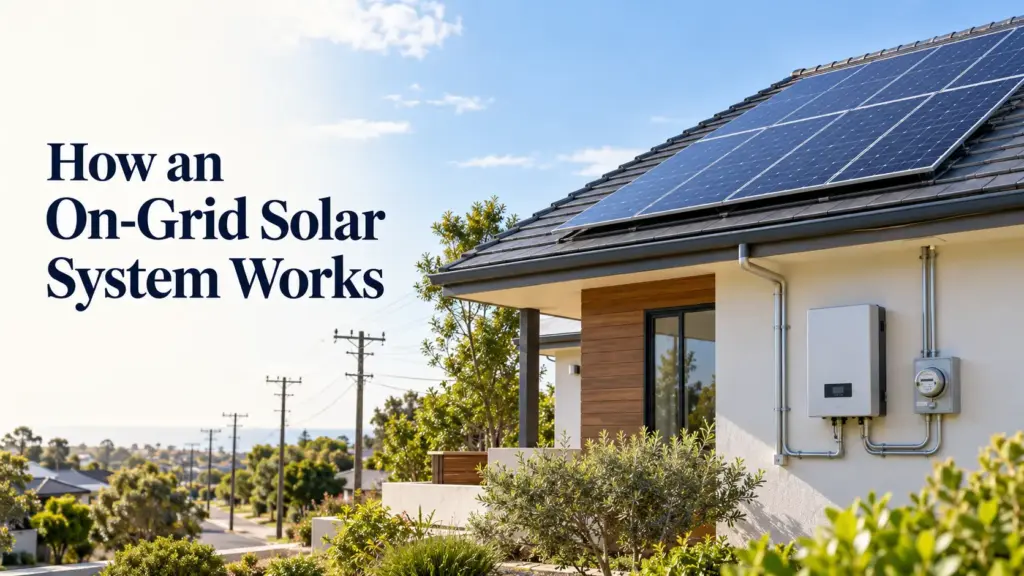
An on-grid (grid-tied) system powers your home first. If it produces more than you use, the surplus goes to the utility. If it produces less, the utility fills the gap.
Example: if the inverter produces 4 kW and your appliances use 1.5 kW, about 2.5 kW is available for export. If your load is 3 kW but solar gives only 1 kW, the utility supplies the other 2 kW. At night, the utility supplies everything.
Pros
- Lowest upfront cost
- Little maintenance
- Fastest payback on a stable grid
- Earns export credits
Cons
- Shuts down in a power outage
- No night-time solar
- Export value depends on your utility
- Needs interconnection approval
Best fit: homes and businesses with dependable service and high daytime use. Ask for a forecast based on your actual bills, because a big annual production figure does not show how much purchased electricity you will replace.
How an Off-Grid Solar System Works
An off-grid system runs without the utility. Panels charge a battery bank, and an inverter powers your loads. Many designs add a backup generator for poor-weather days.
Pros
- Full independence from the utility
- Works where no line exists
- No monthly utility bills
Cons
- Large battery bank needed
- Highest cost and upkeep
- Shortfall risk in cloudy winter spells
- No grid fallback
How to plan an off-grid system
- Build a daily energy budget. Split appliances into essential (fridge, lights, well pump) and flexible (dryer, space heating, workshop tools).
- Model the worst season. An annual average hides shortages during several cloudy days in a row.
- Plan the recovery. After a cloudy spell, the next sunny day must power the house and also recharge the battery.
- Budget for a generator if included: fuel, servicing and access in bad weather.
Best fit: remote homes, farms and cabins where a utility line is unavailable or too expensive to extend. For a part-time cabin, give the designer your real occupancy pattern so you do not pay for a full-time system.
How a Hybrid Solar System Works
A hybrid system manages three sources together: solar, battery and grid. Solar powers your home first, extra energy charges the battery, and the utility fills any gap. During an outage, the system switches to battery and solar for your backup circuits.
Pros
- Backup during outages
- Use stored solar in the evening
- Utility stays as a safety net
- Helps with time-of-use rates
Cons
- Higher cost than on-grid
- Battery replacement over time
- More settings to understand
- Backup limited to designed circuits
Essential-load vs whole-home backup
Write down your appliance list before you accept a quote. “Whole-home backup” must explain which heavy loads can run together. A typical priority list:
- Refrigeration: fridge and freezer.
- Lighting: a few key rooms.
- Communications: router, phone charging and work equipment.
- Water: well pump or sump pump, with its starting load checked.
- Comfort: furnace fan, and AC only if the design supports it.
Ask the installer to list these as named circuits on the proposal. “The house will run” is too vague to compare.
“Battery-ready” does not mean backup-ready
A battery-ready inverter only shows that a battery can be connected later. Ask for the exact inverter model, the approved battery list and the backup equipment schedule. Also ask whether solar can keep charging the battery during an outage, since that changes how long you can run through a multi-day blackout.
What Happens During a Power Outage?
Why on-grid solar shuts down
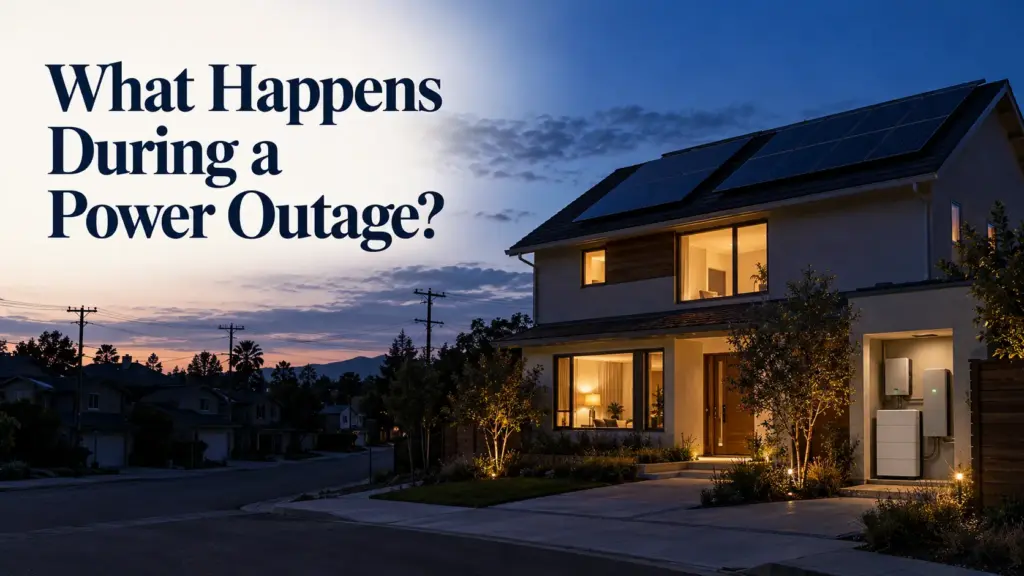
Standard grid-tied solar stops producing during an outage, even in bright sun. This is due to anti-islanding protection, which disconnects your system from a failed grid so it cannot energize lines that utility crews may be repairing. The U.S. Department of Energy describes this normal behavior and the role of specially designed equipment for a separate, islanded supply.
What makes backup loads keep running
Ask the installer to describe one specific test: grid power is lost while your chosen appliances are running. Get the transfer behavior, supported loads and limits in writing. Check the transfer time too if you have equipment that cannot tolerate even a brief interruption, such as a desktop computer or medical device. “Automatic backup” alone does not mean uninterrupted power.
On-Grid vs Off-Grid vs Hybrid Solar Cost
Installed prices depend on your state, roof, equipment and battery size. In 2026, residential solar commonly runs about $2.50 to $3.50 per watt before incentives, so a typical 5 kW on-grid system lands near $12,500 to $17,500. Home batteries typically add roughly $1,100 to $1,400 per installed kWh, so a 13.5 kWh battery often costs around $14,500 or more.
| Approx. 2026 cost (before incentives) | On-grid | Hybrid | Off-grid |
|---|---|---|---|
| 5 kW solar | $12,500-$17,500 | $12,500-$17,500 | $12,500-$17,500 or more |
| Battery | None | About $10,000-$19,000 for 10-13.5 kWh | Larger bank, plus generator |
| Typical total | $12,500-$17,500 | About $25,000-$35,000 | Often above hybrid |
These are indicative ranges based on published 2026 industry data, not quotes. Prices vary widely by state and installer, so get at least three itemized quotes.
What you are paying for
- Array: panels, racking, roof work.
- Conversion: inverters, controllers, monitoring.
- Storage: batteries and installation materials.
- Electrical work: protection, panel upgrades, cabling, backup subpanel.
- Permits and connection: local permits and utility interconnection.
- Reserve supply: generator, if included.
Long-term ownership costs
Ask for a lifecycle estimate that shows servicing, possible component replacement and any fuel. For batteries, read the warranty’s retained-capacity and usage conditions instead of only the headline years, and check who pays for diagnosis, removal and reinstallation. Judge battery payback separately from the solar-only part, so you can see whether the storage is justified by savings, resilience or both.
Why the cheapest quote may cover less
Before comparing totals, match usable battery storage, backup output, supported circuits and warranty scope. One installer may be pricing a basic bill-saving system and another a larger backup package. Also ask for the assumptions behind any savings claim: your usage profile, import price, export credit and expected losses.
Solar Tax Credits and Net Metering in 2026
The 30% federal credit has ended for homeowners
The Residential Clean Energy Credit (Section 25D) ended for expenditures after December 31, 2025, so a system or battery you buy in 2026 does not qualify. If a quote still shows a lower “net cost” after a 30% federal credit, it is using outdated math. Leases and power purchase agreements may still benefit from a separate commercial credit, but check how much of that saving reaches you.
Many states and utilities still offer their own tax credits, rebates or exemptions. Examples reported in 2026 include New York’s rebates and 25% state credit (capped at $5,000), South Carolina’s 25% credit, and battery incentives in states such as Oregon, Connecticut and California. Check your state’s current program, since funding and rules change.
Net metering depends on where you live
Export credits vary widely by state and utility. Some utilities credit exports near the retail rate, while others, such as California under its newer rules, pay much less. When exports earn less, using your own solar power directly becomes more valuable, and a battery can store daytime energy for the evening instead of selling it cheaply. This is a major reason hybrid systems can make sense even when outages are rare.
Before you sign, confirm your utility’s current export rate, any time-of-use schedule, and its interconnection process and fees.
How to Size a Solar System Around Your Real Usage
1. Calculate daily energy use in kWh
Start with 12 months of utility bills, which show your usage in kWh. Then estimate each appliance:
Energy (kWh) = power (kW) × hours used
Example: a 60 W fan running 8 hours uses 0.06 × 8 = 0.48 kWh. For a fridge, which cycles on and off, use its measured or rated daily consumption instead of assuming it runs 24 hours at full power. Keep a separate list for outage-only loads.
2. Check peak power (kW) and starting loads
kWh is the amount of energy; kW is how fast it can be delivered. A 10 kWh battery limited to 3 kW output cannot run a steady 4 kW load, even though it holds enough energy. Check the inverter and battery limits together, and check the starting surge of motors, AC compressors and pumps, which can be several times their running power.
3. Estimate battery backup time
Runtime (hours) ≈ usable battery energy (kWh) × efficiency ÷ average load (kW)
- Usable energy: 5 kWh
- Efficiency: 90% (assumed)
- Average load: 0.5 kW
- Runtime: 5 × 0.90 ÷ 0.5 = about 9 hours
At a 1 kW load, the same battery lasts about 4.5 hours. Do not deduct conversion losses twice if the manufacturer already quotes usable AC energy.
Which Solar System Fits Your Property?
| Your situation | Start with | What decides it |
|---|---|---|
| Reliable grid, good export credits | On-grid | Daytime use and your utility’s export terms |
| Frequent outages or storm/wildfire shutoffs | Hybrid with configured backup | Backup hours needed and documented operation |
| Low export credits or time-of-use rates | Hybrid | Evening use and battery economics |
| Remote property, no practical utility line | Off-grid | Seasonal adequacy and support |
| Existing solar, high evening use | Battery retrofit | Inverter compatibility and real benefit |
| Large motors or commercial loads | Engineered site-specific design | Starting demand and continuity needs |
If you already have solar, ask for an assessment before replacing a working inverter. Storage can sometimes be added with a separate battery inverter. Also mention planned changes, such as an EV charger or a heat pump, since they raise your future consumption.
Questions to Ask Before Accepting a Solar Quote
- Equipment: are exact panel, inverter and battery models listed, and can they be substituted without approval?
- Performance: what usage data and site conditions support the production estimate?
- Incentives: which tax credits and rebates are included, and are they still valid for 2026?
- Expansion: what can be added later, and what would need replacing?
- Permissions: who handles permits and the utility interconnection application?
- Support: who fixes faults, and how fast do they respond?
- Documents: will you receive commissioning records, warranty papers and an explanation of settings?
- Handover: will the installer demonstrate every function in the contract?
Choose the proposal that makes the service you are buying clear enough to verify.
Frequently Asked Questions
What is the difference between on-grid, off-grid and hybrid solar?
On-grid connects to the utility and has no battery. Off-grid runs independently on batteries, often with a generator. Hybrid connects to the grid and also stores energy in a battery for backup.
Which is better, on-grid or hybrid solar?
On-grid is cheaper and pays back faster if outages are rare and export credits are good. Hybrid costs more but keeps essential appliances running during outages and lets you use stored solar at night.
Can on-grid solar work without electricity?
No. A standard on-grid system shuts down during a grid outage, even in full sunlight. You need a hybrid or off-grid system for backup.
Can on-grid solar work at night?
Panels produce no power at night. An on-grid home draws from the utility after sunset, while a hybrid system can use stored battery energy.
Can I add batteries later to an on-grid system?
Often yes, but it depends on the inverter. Some systems need a separate battery inverter or a replacement, so ask for a compatibility check before buying.
Is hybrid solar worth it?
Yes, if you have frequent outages, time-of-use rates or low export credits. If your grid is reliable and exports earn near-retail credits, on-grid usually gives better pure savings.
Is there still a federal tax credit for solar in 2026?
Not for homeowner-purchased systems. The 30% credit ended for expenditures after December 31, 2025. State and local incentives may still apply, and you should confirm your eligibility with a tax professional.
Which solar system is best for power outages?
A hybrid system with a backup subpanel. Off-grid also works but usually costs more to size for full independence.
Can I mix different battery brands?
No, unless the inverter maker approves that exact setup. Voltage, charging limits, communication and the battery management system must all match.
What happens when an off-grid battery runs low?
The system may shed selected loads, start a generator or shut the inverter down to protect the battery. Ask for the exact sequence before you buy, and never bypass protective settings to gain runtime.
Will a solar battery restart automatically after shutting down?
Not always. Restart can depend on available charging power, battery voltage, protection status or a manual recovery step. Check the recovery procedure with the installer.
Can I expand an older solar system with newer panels?
Maybe. Check the inverter’s input limits, spare MPPT inputs and the new panels electrical specs. A separate array or inverter is often safer than changing an existing string.
You May Also Like It:
Energy Technology: The Complete Guide to Modern Power Systems
Xcel Power Shut Off: Everything You Need to Know About PSPS Outages
Energy and Power: The Complete Guide
Power Distribution System: How It Works, What Fails, and How to Size It Right