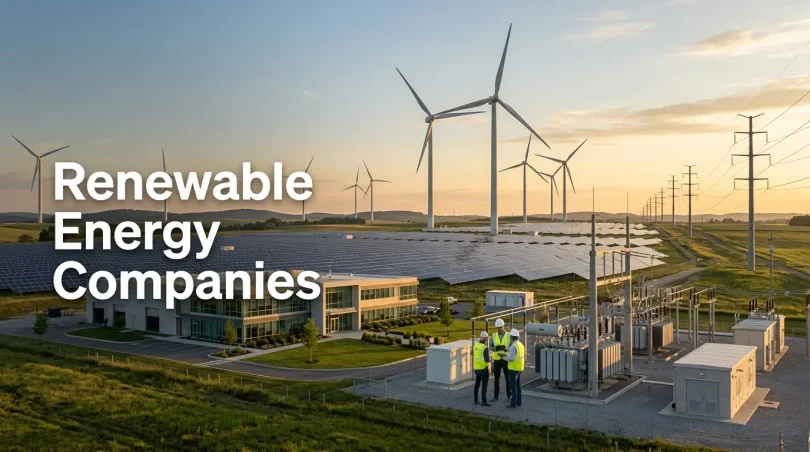

The top renewable energy companies in 2026 are NextEra Energy, Iberdrola, Brookfield Renewable, Enel Green Power, Ørsted, Adani Green Energy, GE Vernova, Vestas, First Solar, Cypress Creek Renewables, Recurrent Energy, Fervo Energy, and Eavor leading the sector across solar, wind, hydropower, geothermal, energy infrastructure, and turbine manufacturing.
Which one is “best” depends on what you’re measuring: operating capacity, financial scale, global reach, technology leadership, or recent 2026 milestones. This guide ranks all 13 companies using those factors and explains what makes each one stand out.
How We Selected These Companies
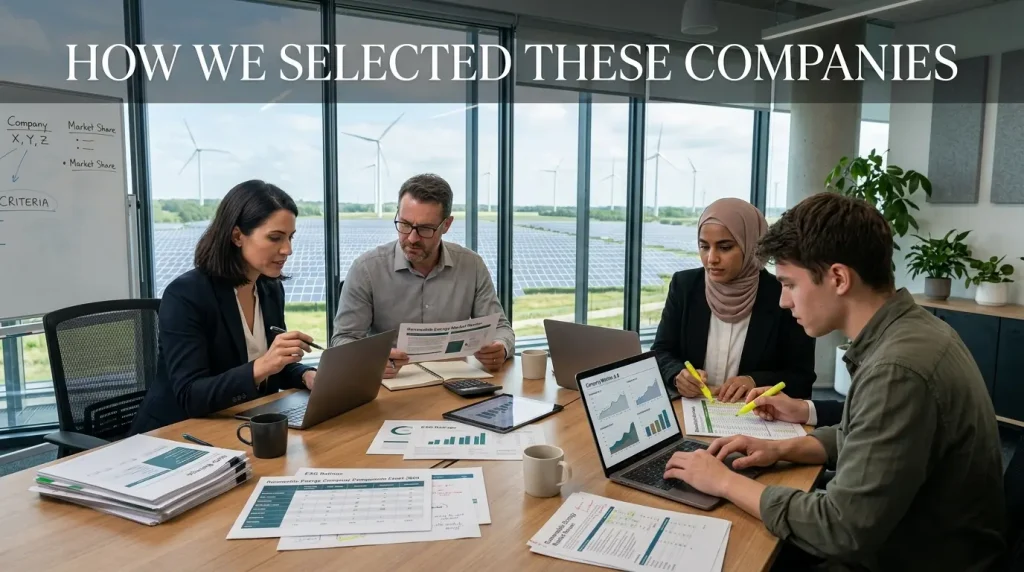
The list below isn’t a popularity contest. Companies were selected and ordered using a mix of:
- Operating capacity, not just announced pipelines. A company with 20 GW under construction but 2 GW actually generating revenue is ranked on the 2 GW.
- Financial and operational scale, including market capitalization, revenue, and balance sheet strength.
- Geographic and technology diversification across solar, wind, hydro, geothermal, and storage.
- Recent, dated developments, such as mergers, IPOs, and capacity milestones reported in 2026.
- Segment coverage, so the list includes utilities, project developers, equipment manufacturers, and emerging-technology players rather than just the biggest generators.
This isn’t a pure capacity ranking. A handful of companies near the bottom of the list, particularly the geothermal players, are included based on technology significance, commercial momentum, and strategic importance to the energy transition rather than raw gigawatts online today. Thirteen companies is enough to cover the sector properly, across generation, manufacturing, and emerging technology, without turning this into an exhaustive directory.
Top 13 Renewable Energy Companies in 2026, Ranked
1. NextEra Energy (United States)
NextEra Energy is one of the largest renewable power companies in the United States, and 2026 has been its biggest year yet. NextEra is one of the world’s largest producers of wind and solar energy, generating power through its Florida utility and its energy resources segment, which sells electricity under long-term power purchase agreements to other utilities and large corporate buyers.
On May 15, 2026, NextEra and Dominion Energy agreed to combine in an all-stock-plus-cash deal, with Dominion shareholders receiving a fixed cash amount plus NextEra shares for each Dominion share held. On July 15, 2026, the companies filed applications for approval of the combination with the Virginia State Corporation Commission, the North Carolina Utilities Commission, the Public Service Commission of South Carolina, the Federal Energy Regulatory Commission, and the Nuclear Regulatory Commission. Both companies have said the deal is expected to close in the second half of 2027, subject to shareholder votes and regulatory clearance. Once completed, the combined company would become the largest regulated electric utility business, serving roughly 10 million customer accounts across four states.
It’s worth being precise here: as of August 2026, this is a pending, regulated transaction, not a finished merger. Its outcome still depends on multiple state and federal approvals. See NextEra’s SEC filing on the regulatory applications.
2. Iberdrola (Spain)
Iberdrola operates one of the largest renewable energy portfolios in the world, reaching just over 56,500 megawatts of operational renewable capacity by mid-2026. Its business spans onshore and offshore wind, hydroelectric, solar, and battery storage across Spain, the UK, the US, and Latin America. Under its 2025–2028 strategic plan, the company has earmarked roughly €21 billion for renewables, concentrated mainly on projects already under construction. Its UK subsidiary, ScottishPower Renewables, is developing the East Anglia THREE offshore wind farm, one of the larger projects currently under construction in Europe.
3. Brookfield Renewable (Canada / Global)
Brookfield Renewable operates as a global infrastructure platform rather than a single-country utility. It owns and operates hydro, wind, solar, and storage assets across multiple continents, which gives it a diversified footprint that most single-technology companies can’t match. That diversification is a practical strength: when wind output dips in one region, hydro or solar elsewhere often picks up the slack, smoothing out revenue that would otherwise swing with the weather.
4. Enel Green Power (Italy)
Enel Green Power runs a renewable capacity of around 66 gigawatts across wind, solar, hydro, and geothermal assets, making it one of the largest renewable operators in Europe. Between 2025 and 2027, the company plans to invest close to $13.9 billion in renewables, alongside ongoing repowering work on older wind and solar sites to squeeze more output from existing land. Enel Green Power has also built Italy’s first floating solar installation as part of a hybrid plant in Venaus.
5. Ørsted (Denmark)
Ørsted is widely recognized as the world’s leading offshore wind developer, accounting for roughly 30% of global offshore wind capacity outside mainland China. The company completed a full transition away from fossil fuels by 2017, after starting out as a coal-heavy Danish state energy company. Its UK portfolio includes the Hornsea 1 and 2 offshore wind farms, and it currently operates around 10 GW of offshore wind capacity, with a target of 20 to 22 GW by 2030. Share prices for Ørsted fell sharply between 2022 and 2023 amid rising interest rates and higher supply chain costs, and the stock remains well below its earlier peak even as the underlying business has stabilized.
6. Adani Green Energy (India)
Adani Green Energy is India’s largest renewable energy company and one of the fastest-growing anywhere in the world. In the fiscal year ending March 2026, the company added just over 5 GW of new capacity, the highest single-year greenfield addition by any company globally outside China. On July 1, 2026, the company confirmed its total operational portfolio had crossed 20 GW (20,141.80 MW), anchored heavily by its Khavda renewable energy park in Gujarat, which the company describes as the world’s largest single renewable energy site. The milestone portfolio comprises roughly 14.2 GW of solar, 2.7 GW of wind, and 3.3 GW of wind-solar hybrid capacity, plus 3,551 MWh of commissioned battery storage. Adani Green is targeting 50 GW of operational capacity by 2030. See Adani Green’s official release.
7. GE Vernova (United States)
GE Vernova spun off from General Electric and has quickly become a heavyweight in wind turbine manufacturing and grid equipment. It isn’t a power generator in the traditional sense; it’s the company building hardware that other renewable energy companies rely on, from turbines to the grid equipment needed to actually connect new capacity to the network. If you’re mapping the supply chain behind the renewable build-out, GE Vernova sits near the top of it.
8. Vestas (Denmark)
Vestas covers the full wind turbine lifecycle, from manufacturing and installation to long-term servicing. It’s one of the oldest names in the sector, tracing back to a Danish blacksmith shop, and remains one of the largest turbine suppliers globally. Its earnings tend to swing more than a utility’s, since turbine manufacturing margins are sensitive to steel costs and supply chain pricing, while its service business runs on steadier, higher margins.
9. First Solar (United States)
First Solar takes a different manufacturing approach than most panel makers. Instead of the standard silicon-based cells most competitors use, it builds thin-film solar modules, which reduces its exposure to the silicon supply chain volatility that has rattled other manufacturers. That’s a genuine, practical differentiator rather than marketing language, and it’s a big part of why First Solar keeps showing up on utility-scale solar procurement lists in the US.
10. Cypress Creek Renewables (United States)
On the project development side, Cypress Creek Renewables owns roughly 2.4 GW of solar and storage capacity and secured financing for a 200 MW storage project in Texas expected to come online in 2026. Companies like this matter because they’re the ones actually building the physical infrastructure, not just financing it from a distance.
11. Recurrent Energy (United States)
Recurrent Energy, a subsidiary of Canadian Solar, specializes in solar and storage project development and has built a portfolio of more than 11 GWp of solar and close to 3.7 GWh of battery storage across 11 countries, including the US, Canada, China, Australia, and Brazil.
12. Fervo Energy (United States)
Fervo is the clearest example of how fast next-generation geothermal has moved from pilot project to public company in the space of a year. Fervo priced its IPO on May 12, 2026 and began trading on Nasdaq the next day, in an upsized offering that ultimately raised roughly $2.2 billion in gross proceeds, including the underwriters’ full over-allotment option. In March 2026, it signed a geothermal framework agreement with Google to support development of up to 3 gigawatts of geothermal capacity through 2033, on top of 658 megawatts of binding power purchase agreements already signed with buyers including Southern California Edison and Shell. Its flagship Cape Station project in Utah is targeting first power from its initial 100 MW phase in the fourth quarter of 2026, with a larger second phase planned to follow. The rapid jump from a small pilot project a few years ago to a multi-billion-dollar public company with gigawatt-scale corporate offtake is one of the more notable stories in the sector this year. See Fervo’s IPO pricing announcement.
13. Eavor (Canada)
Eavor is developing closed-loop geothermal technology that keeps fluids contained in a sealed underground system, sending water into deep wells to absorb heat and drawing it back up through a separate well, rather than pumping already-heated water or steam directly to the surface. The company achieved first electricity production at its pilot site in Geretsried, Germany, in December 2025, an important proof point for the technology at commercial scale. Eavor has raised more than $200 million in funding to date and continues to draw non-dilutive support, including an $8 million Alberta government award in July 2026 aimed at improving access to deeper, hotter geothermal resources.
Quick Comparison
| Company | Business Type | Main Technology | Geographic Reach | 2026 Development |
|---|---|---|---|---|
| NextEra Energy | Utility | Wind, solar | US | Pending Dominion merger, filed for regulatory approval |
| Iberdrola | Utility | Wind, solar, hydro | Spain, UK, US, Latin America | 56.6 GW operational, €21B renewables plan |
| Brookfield Renewable | Infrastructure platform | Hydro, wind, solar, storage | Global | Continued multi-technology diversification |
| Enel Green Power | Utility | Wind, solar, hydro, geothermal | Italy, global | ~66 GW capacity, floating solar pilot |
| Ørsted | Developer/operator | Offshore wind | Denmark, UK, global | ~10 GW operating, targeting 20–22 GW by 2030 |
| Adani Green Energy | Utility/developer | Solar, wind, hybrid | India | Crossed 20 GW operational capacity |
| GE Vernova | Manufacturer | Turbines, grid equipment | Global | Core supplier to utility-scale projects |
| Vestas | Manufacturer | Wind turbines | Global | Full-lifecycle turbine manufacturing and servicing |
| First Solar | Manufacturer | Thin-film solar | US, global | Continued utility-scale procurement wins |
| Cypress Creek Renewables | Project developer | Solar, storage | US | 200 MW Texas storage project financed for 2026 |
| Recurrent Energy | Project developer | Solar, storage | US, Canada, China, Australia, Brazil | 11+ GWp solar, ~3.7 GWh storage portfolio |
| Fervo Energy | Independent power producer | Enhanced geothermal | US | IPO, 3 GW Google framework agreement |
| Eavor | Technology developer | Closed-loop geothermal | Canada, Germany | First electricity at Geretsried pilot |
How to Evaluate a Renewable Energy Company
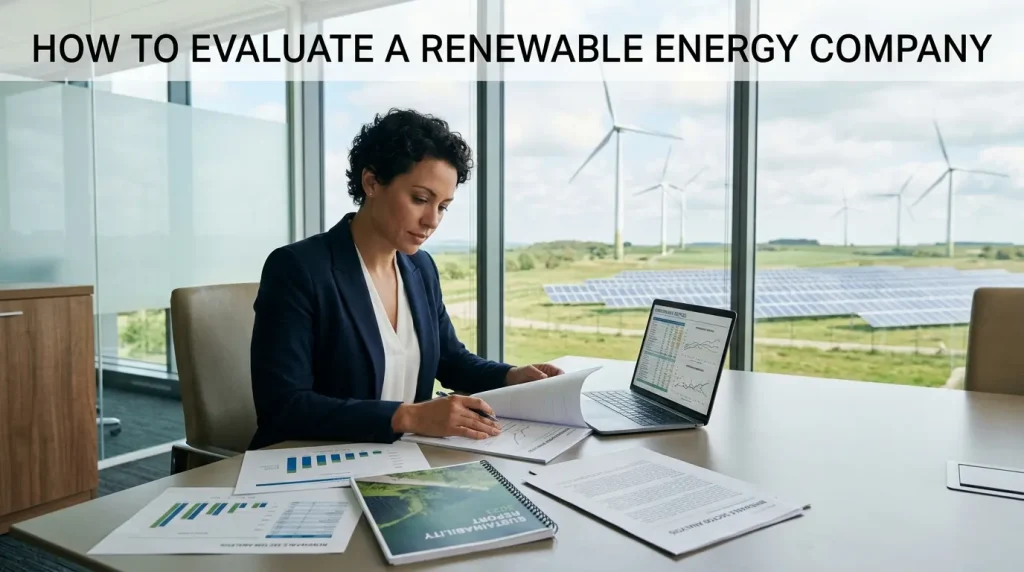
If you’re deciding which renewable energy company deserves your attention, whether as an investor, a vendor, or a job seeker, here’s what actually matters in practice:
- Installed capacity vs. contracted capacity. A company might advertise a huge project pipeline, but what’s actually built and generating revenue is what counts.
- Revenue model. Utilities earn steady, regulated income. Developers earn lump sums when they sell finished projects. Manufacturers depend on order volume and commodity pricing.
- Balance sheet strength. Renewable projects are capital-intensive. A company loaded with debt during a high interest rate environment can struggle even when its underlying technology is sound.
- Geographic and technology diversification. Companies spread across solar, wind, storage, and multiple regions tend to weather policy shifts and weather-related output swings better than single-technology players.
- Policy exposure. Tax credits, subsidies, and grid interconnection rules vary by country and even by state. A company heavily reliant on one policy regime carries more risk than one operating across several.
A common mistake is focusing on headline capacity figures without checking whether those projects are actually operational, contracted, and generating revenue, rather than sitting in a development pipeline that may take years to materialize.
Where the Industry Is Actually Headed
According to the International Energy Agency’s World Energy Investment 2025 report, global energy investment is on track to reach a record $3.3 trillion in 2025, and clean energy technologies, including renewables, storage, and grids, now account for roughly two-thirds of that figure at around $2.2 trillion. The same report projects solar alone will draw about $450 billion in 2025, making it the single largest line item in global energy investment, ahead of any other technology or fuel source.
Part of what’s driving this is demand nobody predicted a decade ago. Data centers and AI infrastructure are pushing power demand higher, and companies like Google and Meta are now signing long-term offtake agreements directly with geothermal and renewable developers to secure firm, round-the-clock clean power. That’s a meaningful shift from a decade ago, when corporate renewable buying was mostly about offsetting emissions rather than securing capacity.
For a business or investor watching this space, the practical takeaway is that scale alone isn’t the differentiator anymore. The companies pulling ahead are the ones combining generation capacity with storage, grid flexibility, and diversified, contracted revenue streams.
Final Thoughts
The renewable energy sector isn’t a single story anymore. It’s utilities like NextEra Energy and Iberdrola consolidating scale, manufacturers like GE Vernova and Vestas building the physical backbone, and newer public companies like Fervo proving out technologies that barely existed commercially a few years ago.
If you’re researching this space for a business decision, don’t just look at the biggest name. Match the company type to what you actually need, whether that’s stable utility exposure, manufacturing partnerships, or early access to emerging technology like enhanced geothermal.
Frequently Asked Questions
Which companies are among the world’s largest renewable energy producers?
By operational capacity, Iberdrola, Enel Green Power, NextEra Energy, and Adani Green Energy are among the largest, each operating tens of gigawatts of wind, solar, hydro, or hybrid capacity across multiple countries.
Is NextEra Energy the same as Next Era Energy?
Yes. “NextEra Energy” is the official company name, though it’s sometimes searched or written as “next era energy.”
Has the NextEra-Dominion merger been completed?
No, as of August 2026 it is still pending. The companies filed for regulatory approval in July 2026 and expect the deal to close in the second half of 2027, subject to shareholder votes and clearance from state and federal regulators.
What’s the difference between a renewable energy company and a solar company?
A solar company focuses specifically on solar panel manufacturing, installation, or solar power generation. A renewable energy company is broader and can include wind, hydro, geothermal, biomass, and storage alongside or instead of solar.
Is fusion considered renewable energy?
Not in the traditional sense. Renewable energy specifically refers to sources that naturally replenish, such as solar, wind, hydro, geothermal, and biomass. Fusion is often grouped alongside renewables in broader “clean energy” or “energy transition” discussions because it produces power without carbon emissions, but it isn’t classified as renewable.
Are renewable energy companies a good investment in 2026?
Per the IEA’s 2025 investment report, global investment in clean energy technologies is on track to roughly double fossil fuel investment in 2025, and demand from data centers and electrification is accelerating growth. That said, individual company performance still depends on balance sheet health, policy exposure, and project execution, so it’s worth researching specific companies rather than treating the sector as a single bet.
What is enhanced or closed-loop geothermal, and why does it matter?
Traditional geothermal only works in a handful of geologically ideal locations. Companies like Fervo and Eavor are using new drilling and closed-loop system designs to access geothermal heat in a much wider range of locations, which is part of why large buyers like Google have started signing multi-gigawatt agreements with these companies.
How do renewable energy companies make money?
It depends on the business model. Utilities earn regulated income from selling electricity. Developers earn revenue by building and then selling completed projects. Manufacturers sell equipment like turbines, panels, and batteries to the companies building out capacity.
What should I look for before investing in a renewable energy company?
Check installed and contracted capacity, not just announced pipelines, along with debt levels relative to project financing needs, geographic and technology diversification, and how exposed the company is to a single country’s subsidy or tax credit policy.
You May Also Like It:
Xcel Power Shut Off: Everything You Need to Know About PSPS Outages
Consumers Energy Power Outage: How to Report, Track, and Stay Safe
Green Power Energy: The Complete Guide to Clean, Renewable Electricity
Power vs Energy: What Is the Difference and Why Does It Matter?