

Introduction: Your Energy, Your Choice
Most people pay their electricity bill without ever questioning who supplies their power. But in many parts of the United States, you actually have a choice. You can stick with your local utility, or you can switch to a different energy supplier and potentially save money every single month.
One popular option that many households and businesses explore is a public power energy supplier. Whether that means a community-owned public utility or a retail energy supplier operating in a deregulated market, understanding how these options work puts real power back in your hands.
This guide covers everything you need to know. From what public power is, to how deregulated energy markets work, to what you should look for before signing any contract.
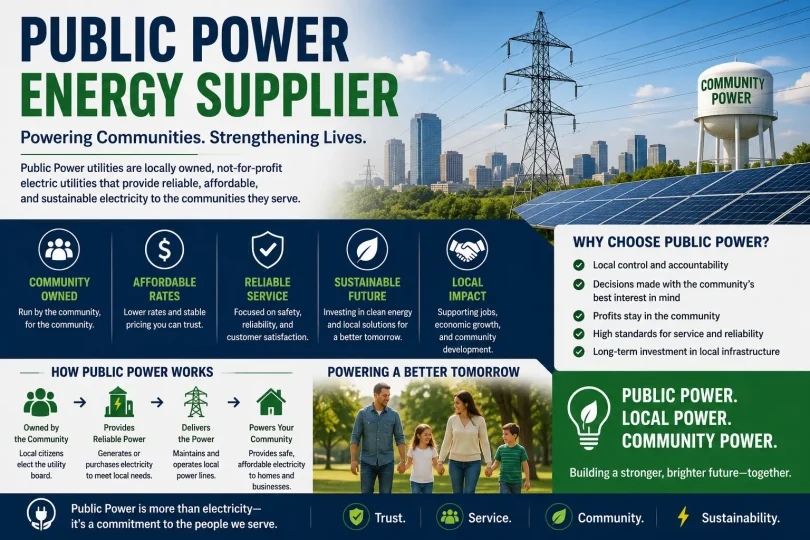
What Is a Public Power Energy Supplier?
The term “public power energy supplier” refers to two related but distinct things:
1. Community-Owned Public Utilities
These are not-for-profit electric utilities owned and operated by local communities. Think of them like public schools or public libraries. They exist to serve the community, not to generate profits for shareholders.
According to the American Public Power Association, public power utilities serve more than 55 million Americans across 2,000 communities in 49 states. Cities like Austin, Nashville, Los Angeles, and Seattle all get electricity from public power utilities.
Key facts about community-owned public utilities:
- They are governed by local city councils or elected boards, so residents have a direct voice in how the utility is run and what rates it charges.
- They operate as not-for-profit entities, meaning any surplus revenue goes back into the infrastructure or the community rather than to investors.
- Customers of public power utilities typically experience around 90 fewer minutes of power outages per year compared to customers of private utilities.
- On average, public power utilities return 5.1% of electric operating revenues to their communities through taxes, fees, and special services.
- In 2023, about 41% of power generated by public power came from non-carbon-emitting sources, including solar, wind, and hydropower.
2. Retail Energy Suppliers Operating Under the Name “Public Power”
There is also a company called Public Power, a subsidiary of Crius Energy, that provides electricity and natural gas to residential and commercial customers in several states including Connecticut, Illinois, Maryland, New York, New Jersey, Ohio, Pennsylvania, and Washington, DC. This company has been operating since 2008 and offers competitive fixed-rate electricity plans in deregulated energy markets.
Both types are worth understanding, and this guide covers both.
How Deregulated Energy Markets Work
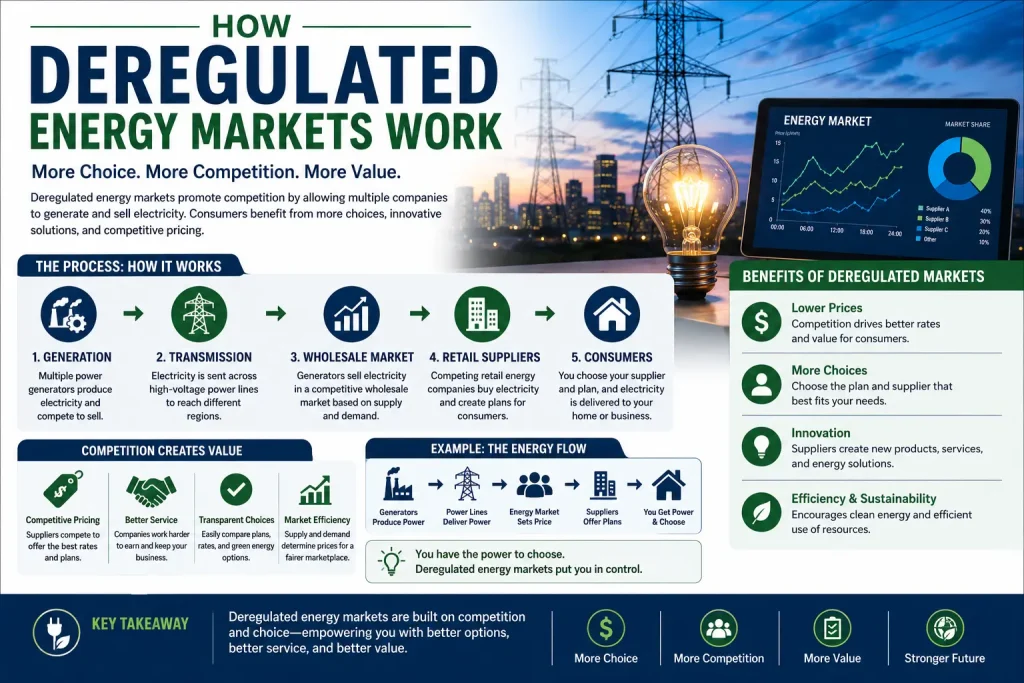
To understand why you can choose your energy supplier at all, you need to know a little history.
For most of the 20th century, a single utility company controlled everything: generating electricity at power plants, transmitting it across high-voltage lines, and delivering it to homes and businesses. Customers had no choice. They paid whatever the utility charged.
That started to change in the 1990s. In 1996, the Federal Energy Regulatory Commission (FERC) issued Order 888, which required utility companies to open their transmission lines to competitors. This landmark ruling introduced real competition into the energy market and gave consumers the power to choose their electricity supplier.
Today, the energy market in deregulated states works like this:
- Energy suppliers (like Public Power and others) generate or purchase electricity on the wholesale market and sell it directly to you at a set rate.
- Your local utility still owns and maintains the physical infrastructure: the power lines, meters, and pipes. They still deliver your electricity and respond to outages, no matter which supplier you use.
- You choose who supplies your electricity based on price, contract terms, renewable options, and customer service.
In short: the wires never change. The supplier does.
As of 2026, more than 17 states plus Washington, DC, offer some form of electricity choice for residential and commercial customers. These include Ohio, Pennsylvania, Connecticut, Illinois, Maryland, New York, and New Jersey.
Public Power vs. Private Utilities: Key Differences
Many people wonder whether a community-owned public power utility is better than a private one. Here is a straightforward breakdown:
| Feature | Public Power Utility | Private/Investor-Owned Utility |
|---|---|---|
| Ownership | Community/government | Private shareholders |
| Goal | Service to community | Profit for investors |
| Rates | Generally lower | Generally higher |
| Reliability | 90 fewer outage minutes/year | More frequent outages |
| Accountability | Local elected boards | State regulators |
| Community investment | Returns 5.1% to community | Returns less than public power |
| Funding | Municipal bonds | Private capital markets |
Public power infrastructure is often funded through tax-exempt municipal bonds. This means community members themselves invest in local energy infrastructure, like new generation equipment and transmission upgrades, and earn interest as the utility repays the loan. That is a much more community-centered model than what private utilities typically offer.
What States Have Deregulated Energy Markets?
Not every state lets you choose your energy supplier. Here is a quick overview of where energy choice is currently available (as of 2026):
States with full or partial electricity choice: Connecticut, Delaware, Illinois, Maine, Maryland, Massachusetts, Michigan, Montana, New Hampshire, New Jersey, New York, Ohio, Oregon, Pennsylvania, Rhode Island, and Texas, plus Washington, DC.
States with natural gas choice only: Georgia is one notable example. It has full residential natural gas choice but remains regulated for electricity.
Ohio has one of the highest residential switching rates in the country, driven largely by government aggregation programs. Pennsylvania was among the first states to restructure in 1997 and has over 50 licensed suppliers. Texas deregulated in 1999 and is widely seen as a model for competitive energy markets.
If you live in a regulated state, you do not have the option to choose a retail energy supplier. Your local utility sets your rates, and a state public utility commission oversees those rates to ensure they are fair.
How Public Power (the Company) Works: Plans and Features
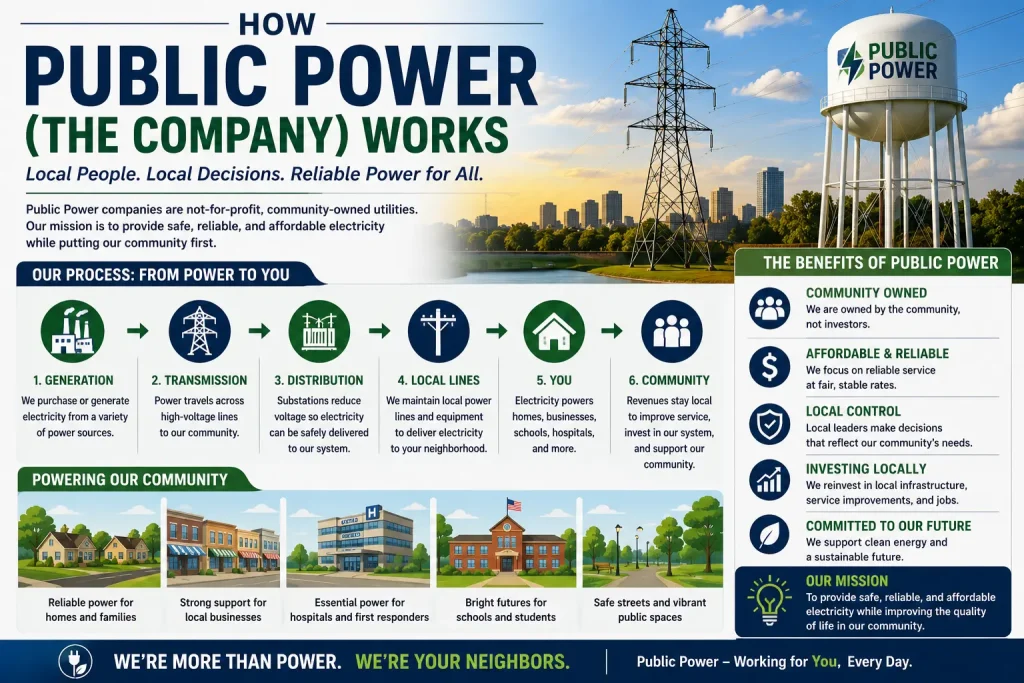
If you live in a deregulated state and want to explore Public Power as a retail energy supplier, here is what you can expect:
Fixed-Rate Plans
Public Power specializes in fixed-rate electricity plans. With a fixed rate, your price per kilowatt-hour (kWh) stays the same for the entire contract period. This is a big deal because it protects you from seasonal price spikes and utility rate hikes.
Many customers in Ohio and Pennsylvania have found fixed-rate plans from Public Power to be competitive against the utility’s “price to compare” (PTC) rate. For example, a 12-month fixed rate plan in Ohio has been offered at around 8.4 cents per kWh, which can compare favorably against utility default rates.
No Enrollment Fees
Most Public Power electricity plans come with no enrollment fees. That means you can start saving without any upfront costs.
Early Termination Fees
If you cancel your plan before the contract ends (and you are not moving), you may pay an early termination fee. In Pennsylvania, this fee is $50 for residential customers. Fees may vary in other states, so always read the contract terms before signing.
Power Perks Rewards Program
Public Power offers a rewards program called Power Perks. Through this program, customers can earn up to 40% cash back when shopping at partner stores. For every $25 earned, participants receive a Double Up Reward redeemable for a shopping, dining, or entertainment card, or a prepaid Visa card. Customers can double the value of their reward (up to $50) when redeeming for energy-efficient products. This is a practical perk that goes beyond just saving on your electricity rate.
Referral Program
Public Power also runs a referral program called Share the Power. If you refer friends or family who sign up, you can earn additional rewards.
Customer Service
Public Power’s customer service is available daily from 8am to 11pm Eastern Time. You can reach them by email at [email protected] or by phone at 888-354-4415.
How to Switch to a Public Power Energy Supplier
Switching energy suppliers is much simpler than most people expect. Here is how the process works:
Step 1: Check if energy choice is available in your area. Enter your zip code on a comparison site or your state’s official energy shopping tool (like PAPowerSwitch in Pennsylvania) to see which suppliers serve your address.
Step 2: Find your current rate. Look at your most recent electricity bill. Find the supply charge listed in cents per kWh. This is the number you will compare against offers from retail suppliers.
Step 3: Compare plans. Filter options by rate type (fixed or variable), contract length, green energy options, and fees. Sites like Choose Energy, ElectricityPlans.com, and your state’s official comparison tool let you compare side by side.
Step 4: Sign up. You can enroll online or by phone in minutes. Your new supplier will handle activating your account.
Step 5: Keep your existing utility for delivery. Your local utility still delivers your electricity. If there is an outage, you still call them. Nothing about the physical delivery changes.
Important note: The actual switch does not happen immediately. It takes effect at your next meter read, which is typically within one to two billing cycles.
There is no service interruption during the switch. The same power lines deliver your electricity. The only thing that changes is who supplies it and what you pay.
Fixed Rate vs. Variable Rate: Which Is Better?
This is one of the most important decisions when choosing an energy plan.
Fixed-Rate Plans
- Your rate per kWh stays the same for the whole contract term.
- You are protected from market price swings and seasonal spikes.
- Great for budgeters who want predictable bills.
- Usually requires a contract of 6, 12, 18, or 24 months.
- May include an early termination fee if you cancel early.
Variable-Rate Plans
- Your rate changes month to month based on wholesale energy market prices.
- Can be cheaper during low-demand seasons.
- Risky during summer or winter peaks when energy demand surges.
- Usually has no long-term contract and no cancellation fee.
- Hard to budget around because bills fluctuate unpredictably.
For most residential customers, a fixed-rate plan offers more stability and peace of mind. If you live in a state like Ohio or Pennsylvania, where utility rates are expected to rise, locking in a competitive fixed rate now can mean consistent savings over the length of the contract.
Tips for Saving Money on Your Energy Bill
Beyond choosing the right energy supplier, here are practical strategies to cut your electricity costs:
1. Compare rates every time your contract ends. When your fixed-rate contract is nearly up, shop around again. Do not let it roll into a variable month-to-month rate without checking what else is available.
2. Time your switch strategically. If your state utility is raising its price to compare rate, switching before the hike takes effect can lock in immediate savings.
3. Look beyond the rate. Factor in monthly recurring charges (MRC), early termination fees, enrollment fees, and any rewards programs. A plan with a slightly higher per-kWh rate but a strong rewards program might be better overall.
4. Explore renewable energy plans. Many suppliers offer green energy plans or carbon-free options, often at little to no extra cost. If reducing your carbon footprint matters to you, these plans are worth exploring.
5. Use energy-efficient appliances and habits. Switching suppliers reduces your per-unit cost. Using less energy reduces your total bill. Do both.
6. Check for government assistance programs. Programs like HEAP (Home Energy Assistance Program) and the Winter Crisis Assistance Program exist to help households manage high energy bills, especially during cold months. Cleveland Public Power, for example, opens its Winter Crisis program each year through March to assist eligible customers.
Common Questions About Public Power Energy Suppliers
Will switching energy suppliers affect my power reliability?
No. Your local utility still owns and maintains the power lines and responds to outages. Switching suppliers does not affect the physical delivery of your electricity at all.
What happens if my energy supplier goes out of business?
Your local utility will automatically supply your electricity as a default, protecting you from any interruption. State regulators ensure this safety net is always in place.
Can I switch back to my utility if I do not like my new supplier?
Yes. In most deregulated states, you can switch back to your local utility or choose a different supplier at any time, though you may owe an early termination fee if you are still within a fixed-rate contract.
Is public power available everywhere in the US?
Community-owned public utilities operate in 49 states. However, retail energy choice (the ability to choose your supplier) is only available in states with deregulated markets. Hawaii is the only state with no public power utilities at all.
Does switching cost anything?
Switching is typically free. Most suppliers do not charge enrollment fees. The only cost you might face is an early termination fee if you cancel a fixed-rate plan before it ends.
Why Community-Owned Public Power Matters
Beyond the practical bill savings, community-owned public power utilities reflect a different philosophy about energy. They exist to serve people, not profits.
Public power utilities employ more than 100,000 people in local jobs across the US. They invest in their communities through charitable programs, educational initiatives, and local infrastructure improvements. Their infrastructure is funded through municipal bonds, which means the community itself invests in and benefits from its energy system.
In regions where federal hydropower is available, public power utilities can purchase wholesale hydropower generated from federal dams at cost and pass those savings directly to customers. That is a benefit private utilities rarely offer their customers.
And when emergencies happen, community-owned utilities often outperform private ones. Because their boards are locally accountable and their customers are their neighbors, the incentive to restore service quickly is deeply personal.
Final Thoughts: Is Switching to a Public Power Energy Supplier Worth It?
If you live in a deregulated state, the answer is almost certainly yes, at least worth exploring. Comparing plans takes a few minutes, costs nothing, and can save you hundreds of dollars over the course of a year.
If you live in a community served by a community-owned public power utility, you are likely already paying less than customers of private utilities. You also have more of a say in how your energy is managed, where it comes from, and what happens to the money you pay for it.
Either way, understanding how your energy system works gives you the information you need to make smarter decisions. Use comparison tools, check your current rate, and do not be afraid to switch if a better deal is available.
You May Also Like It:
CNC Machining Tolerances: The Complete Expert Guide
MIG vs TIG Welding: Complete Guide to Differences and Procedures




[…] Public Power Energy Supplier: What It Is and How It Works […]