
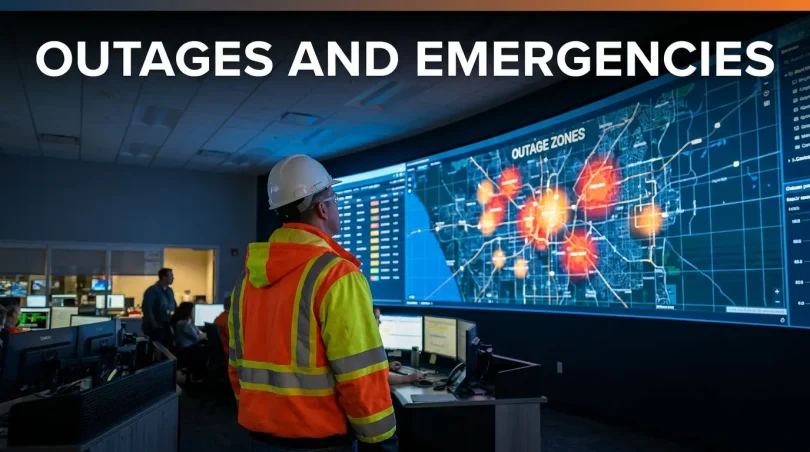

To view current outages, go to the NV Energy outage map at maps.nvenergy.com or visit the Outages and Emergencies page on nvenergy.com. You can also text your address to 24365, call 1-855-343-4118, or use the NV Energy mobile app. For a power outage in Las Vegas specifically, NV Energy serves all of Clark County, and outages are usually caused by extreme heat, high winds, equipment failure, or planned Public Safety Outage Management (PSOM) shutoffs during wildfire risk periods.
Losing power is stressful, especially in a desert climate where summer temperatures regularly cross 110°F. Whether your lights just went out in Las Vegas, Reno, Henderson, or Elko, this guide walks you through everything related to outages and emergencies: how to check real-time outage data, how to report an outage, why NV Energy outages happen, and what to do while you wait for restoration. Every section below is written to answer the exact questions people search for, so you can get a direct answer fast instead of scrolling through a utility website.
How to View Current Outages on the NV Energy Map
If you want to view current outages, NV Energy’s live outage map is the fastest way to see what is happening in your area. Here is how to use it correctly:
- Go to the official NV Energy outage map at maps.nvenergy.com/outagemap.
- Enter your street address, city, or zip code in the search bar.
- The map will show a colored marker or shaded zone if an outage is affecting your location.
- Click on the marker to see the number of customers affected, the cause (if known), and the estimated time of restoration (ETR).
- Refresh the page periodically, since ETRs update as crews assess the damage on site.
A detail most guides skip: the outage map pulls data directly from NV Energy’s outage management system, so it reflects confirmed outages, not just reported ones. If your specific home has lost power but your neighbors have not, the map may not show anything until you actually report it. That is why reporting your outage (covered below) still matters even if the map looks clear.
You can also check outage counts county by county through third-party trackers like PowerOutage.us, which aggregates NV Energy data across all 19 Nevada counties it serves, covering roughly 1.4 million tracked customers. This is useful if you want a broader view of whether an outage is isolated to your block or part of a larger regional event.
Power Outage in Las Vegas: What Causes It and How Common It Is
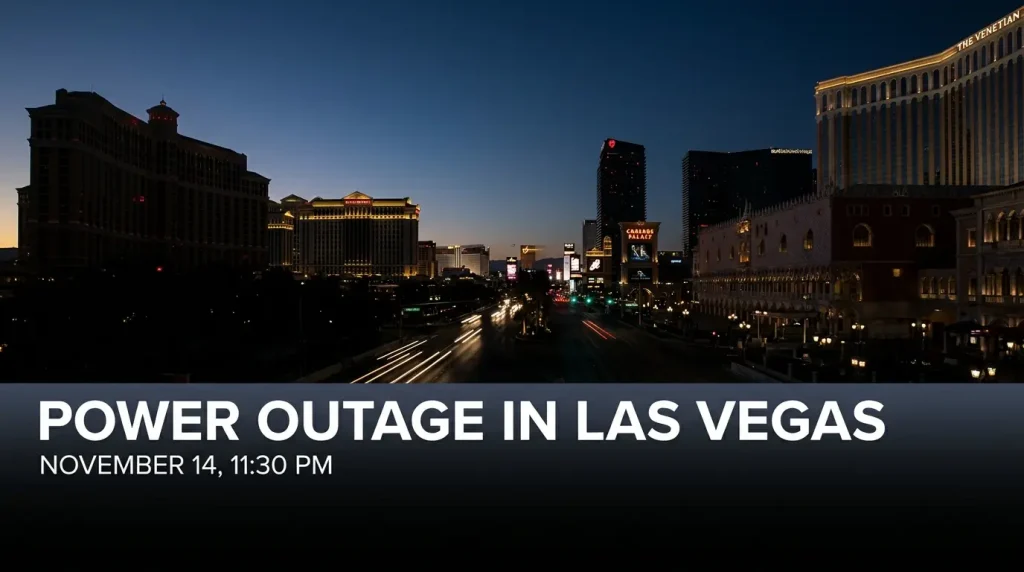
A power outage in Las Vegas is rarely random. Based on NV Energy’s own outage patterns and reporting from local news and grid analysts, outages in the Las Vegas Valley generally fall into four categories:
- Extreme heat and peak demand. Summer afternoons and evenings, when millions of air conditioners run at once, put the heaviest strain on the grid. High temperatures also stress transformers and cables, increasing the chance of equipment faults, particularly in older infrastructure.
- High winds and dust. Wind can cause tree branches or debris to contact power lines, triggering automatic protective devices that cut power to isolate the fault before it spreads.
- Equipment failure. Aging transformers, underground cable faults, and substation issues account for many localized outages, especially in older neighborhoods.
- Vehicle accidents and human factors. A car striking a utility pole is one of the most common causes of sudden, localized blackouts in urban Las Vegas.
Outages are most frequent in summer, when demand peaks in the late afternoon and evening. Spring and fall generally see fewer interruptions because both temperature and electricity demand are lower. If you are experiencing a power outage in Las Vegas right now, checking the outage map first will usually tell you whether it is a single-address issue (worth reporting) or a wider event already being worked on by crews.
How to Report an NV Energy Outage
If your power is out and it is not already showing on the map, report it right away so a repair ticket is created for your address. NV Energy gives customers several ways to do this:
- Online: Submit an outage report through the Report an Outage tool on nvenergy.com.
- Phone: Call the 24/7 outage and emergency line. Southern Nevada customers can call (702) 402-5555, and Northern Nevada customers can call (775) 834-4444. These lines operate around the clock specifically for outage and emergency calls, separate from regular billing hours.
- Text message: Text your address to NV Energy’s outage reporting short code so the system can log the location without you needing to call in.
- Mobile app: The NV Energy app lets you report an outage, track restoration status, and receive push notifications tied to your account address.
Before reporting, check your own breaker panel first. A tripped breaker or blown fuse inside your home can look exactly like a utility outage, and ruling that out saves you a wasted service call.
NV Energy Outage Map vs. PowerOutage.us: Which Should You Use
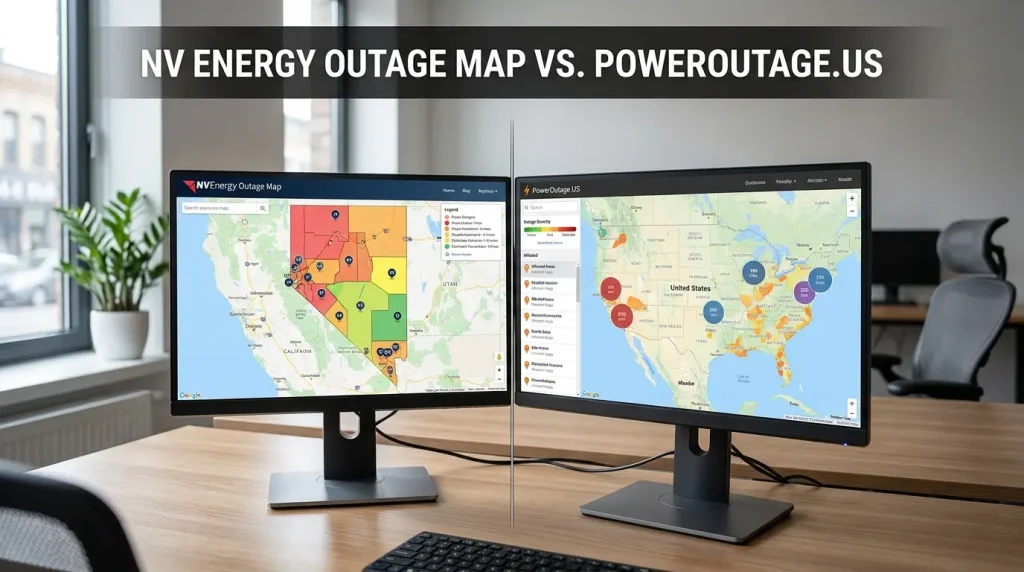
Both tools serve a similar purpose but pull data differently:
| Feature | NV Energy Outage Map | PowerOutage.us |
|---|---|---|
| Data source | Direct from NV Energy’s outage management system | Aggregated NV Energy data |
| Address-level search | Yes | Limited (county-level detail) |
| Estimated restoration time | Yes, per outage | No |
| County-by-county comparison | No | Yes, across all 19 counties |
| Best for | Checking your specific home or business | Understanding the scale of a regional event |
If you need to know when your power will come back on, use the official NV Energy map. If you want to see how widespread an event is across Clark, Washoe, or other counties, PowerOutage.us gives a faster county-level overview.
NV Energy SMS Text Alerts: How to Sign Up
Signing up for NV Energy’s voice, email, and SMS text alerts means you find out about outages before you even notice the lights are off, since notifications are tied to your account address rather than requiring you to check the map manually.
- Log in to your NV Energy online account or create one if you do not already have it.
- Go to your notification or alert preferences.
- Enter your mobile number and opt in to SMS text alerts.
- Choose which alerts you want: outage notifications, restoration updates, and PSOM (wildfire safety shutoff) warnings.
- Confirm the opt-in by replying to the verification text.
There is no direct charge from NV Energy for these alerts, though standard message and data rates from your mobile carrier may apply. You can text HELP to the most recent alert for support, or STOP at any time to opt out. Message frequency varies depending on how often outages or planned events affect your specific address, so residents in wildfire-prone or storm-prone zones will typically receive more messages than those in low-risk areas.
Public Safety Outage Management (PSOM): Planned Wildfire Shutoffs
One thing many outage guides leave out entirely: not every NV Energy outage is unplanned. Public Safety Outage Management, or PSOM, is a proactive wildfire-prevention program. During periods of extreme fire weather, defined by high wind gusts (typically above 45-50 mph), low humidity, and dry vegetation, NV Energy may deliberately de-energize transmission and distribution lines in high-risk zones to prevent equipment from sparking a wildfire.
Here is how a PSOM event typically unfolds:
- Forecasting: NV Energy meteorologists monitor a composite risk index that combines wind speed, humidity, and vegetation dryness (the burning index) to identify potential PSOM conditions days in advance.
- Watch issued: A PSOM Watch means conditions could require a shutoff if the forecast holds or worsens.
- Warning issued: A PSOM Warning means a shutoff is imminent unless weather conditions improve significantly. Affected customers are notified by phone, text, and email, typically between 48-24 hours and again 12-4 hours before the shutoff.
- Power shut off: Lines are de-energized in the designated zone for the duration of the extreme weather event.
- Inspection: Once conditions pass, crews must visually inspect 100% of the affected lines for damage, vegetation contact, or debris before it is safe to restore power. This step alone can take 12 to 24 hours.
- Restoration: Power is restored as each section is cleared, meaning restoration can happen gradually across a zone rather than all at once.
Because of the mandatory inspection step, a PSOM outage can last anywhere from one day to several days, even after the weather itself has cleared. NV Energy typically opens Customer Resource Centers in affected communities during extended PSOM events, offering device charging, water, and outage updates. If you live in a designated PSOM zone (common in areas like Mt. Charleston, Kyle Canyon, Angel Peak, and parts of the Carson Valley), it is worth signing up for alerts specifically so you get advance warning rather than being caught off guard.
How NV Energy Prioritizes Power Restoration
Understanding the restoration order helps set realistic expectations during a widespread outage:
- Critical infrastructure first: Hospitals, water treatment plants, emergency services, and communication centers are restored first because public safety depends on them.
- Main transmission lines next: Repairing high-capacity lines that feed entire substations restores power to the largest number of customers at once.
- Distribution lines and neighborhood feeders: Once transmission is stable, crews work outward to individual feeders serving neighborhoods and business districts.
- Individual service lines last: Isolated outages affecting a single home or a small cluster of homes are typically addressed after larger-scale restoration is complete, unless a medical emergency requires priority.
If your ETR keeps shifting, it usually means crews are still working through this sequence and cannot give a precise time until the upstream lines feeding your area are confirmed stable.
What to Do During a Power Outage
- Report it, even if you assume others already have, since ticket volume helps NV Energy gauge the scope of an event.
- Unplug sensitive electronics to protect them from a power surge when service is restored.
- Keep refrigerator and freezer doors closed. A full freezer stays cold for about 48 hours if unopened; a fridge holds safe temperatures for about 4 hours.
- Never use a generator indoors or in a garage. Carbon monoxide from portable generators can be fatal within minutes in an enclosed space.
- Stay away from downed power lines. Always assume a fallen line is live, keep at least 35 feet away, and call 911 first before contacting NV Energy’s emergency line.
- Check on neighbors who may depend on medical equipment or have limited mobility, especially during extreme heat.
- Have a backup plan for medical devices, including charged backup batteries or a plan to relocate to a cooling center during extended summer outages.
Frequently Asked Questions
How do I view current outages in my area?
Visit the NV Energy outage map at maps.nvenergy.com, enter your address, and the map will display whether an outage is active, how many customers are affected, and the estimated restoration time.
Why is my power out in Las Vegas right now?
The most common causes are extreme heat driving up air conditioning demand, high winds affecting power lines, aging equipment failures, and occasionally vehicle accidents damaging poles or transformers. Check the outage map first to see if a cause has already been identified for your area.
What number do I call to report an NV Energy outage?
Southern Nevada customers can call (702) 402-5555, and Northern Nevada customers can call (775) 834-4444. Both lines take outage and emergency calls 24 hours a day.
How long do NV Energy outages usually last?
Localized outages from equipment faults are often resolved within a few hours. PSOM wildfire safety shutoffs can last one to several days because of the mandatory line inspection process before power can be safely restored.
Is a PSOM outage the same as a regular power outage?
No. A PSOM event is a planned, preventive shutoff to reduce wildfire risk during extreme weather, while a regular outage is typically caused by equipment failure, weather damage, or an accident. PSOM events come with advance notice; unplanned outages do not.
How do I sign up for NV Energy outage alerts?
Log in to your NV Energy account, go to your notification settings, and opt in to SMS, email, or voice alerts. You will then be notified about outages, restoration updates, and PSOM warnings tied to your service address.
Can I see NV Energy outages without creating an account?
Yes. The public outage map and the report-an-outage tool on nvenergy.com do not require an account, though signing in lets you track restoration status tied to your specific address.
You May Also Like It:
Xcel Power Shut Off: Everything You Need to Know About PSPS Outages
Consumers Energy Power Outage: How to Report, Track, and Stay Safe
Green Power Energy: The Complete Guide to Clean, Renewable Electricity
Power vs Energy: What Is the Difference and Why Does It Matter?





[…] Emergency backup during utility outages […]