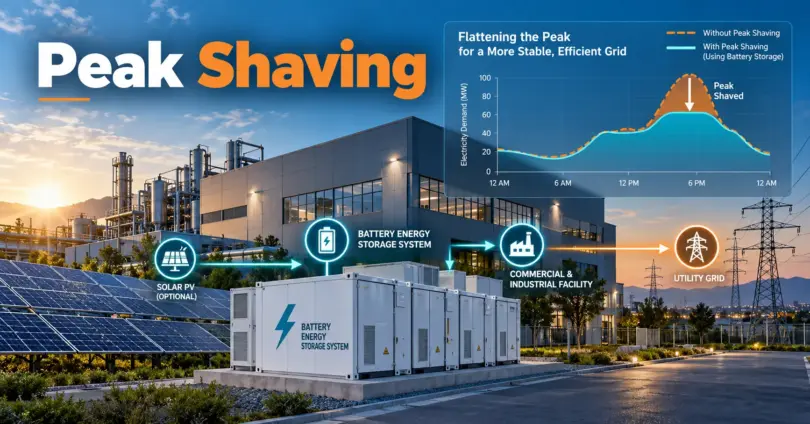

What Is Peak Shaving?
Peak shaving is the practice of reducing the highest level of electricity a facility draws from the grid during a billing period, usually by using stored energy, on-site generation or smarter control of equipment during short periods of high demand. The goal is to flatten the “peaks” in a load profile so that the utility sees a lower maximum demand, which in turn lowers demand charges and reduces strain on electrical infrastructure.
It is important to understand what peak shaving is not. It does not necessarily reduce the total kilowatt-hours (kWh) a building uses. It reduces the maximum kilowatts (kW) it pulls at any one moment. For many commercial and industrial customers, that single highest 15- or 30-minute reading can drive a large share of the monthly bill.
This guide explains why peak demand matters, how peak shaving works, the main methods, how to calculate potential savings, which industries benefit most, how to implement a strategy, and what limitations to watch for.
Why Peak Electricity Demand Matters
Electricity systems are built and priced around their busiest moments. Understanding how peaks are measured and billed explains why shaving them can be so valuable.
Understanding Peak Demand and Electricity Usage
Electricity consumption has two separate dimensions:
- Energy (kWh): the total amount of electricity used over time, like the distance driven on a trip.
- Demand (kW): the rate at which electricity is drawn at a given moment, like the top speed reached during the trip.
Peak demand is the highest average power draw recorded during a defined interval, commonly 15 or 30 minutes, within a billing cycle. A factory that starts several large motors at once, or an office building running air conditioning at full load on a hot afternoon, can create a short spike that sets the peak for the entire month even if the rest of the month is far lower.
How Demand Charges Affect Electricity Bills
Many utilities charge commercial and industrial customers in two parts: an energy charge based on kWh and a demand charge based on the highest kW recorded in the billing period. Demand charges exist because the utility must size generation, transmission, transformers and local lines to serve each customer’s potential maximum draw.
Demand charges can be a significant part of a commercial bill, sometimes a third or more depending on the tariff and load shape. Some tariffs also include:
- Time-of-use demand charges, which apply only to peak draw during specified hours
- Ratchet clauses, which set future minimum billing demand based on a past peak (for example, a percentage of the highest peak in the previous 11 months)
- Coincident peak charges, which are based on usage at the moment the overall grid peaks
Because one short spike can set the charge for a whole month, reducing that spike can produce disproportionate savings. For a deeper explanation of tariff structures, see our dedicated guide to electricity demand charges.
The Role of Peak Shaving in Energy Management
Peak shaving is one of several energy management strategies. It targets the maximum demand number rather than total consumption or the time of day energy is used. It sits alongside energy efficiency (using less energy), load shifting (moving usage to cheaper times) and demand response (reducing load when the utility requests it). Used together, these approaches help organizations control costs and make better use of the electrical infrastructure they already have.
How Does Peak Shaving Work?
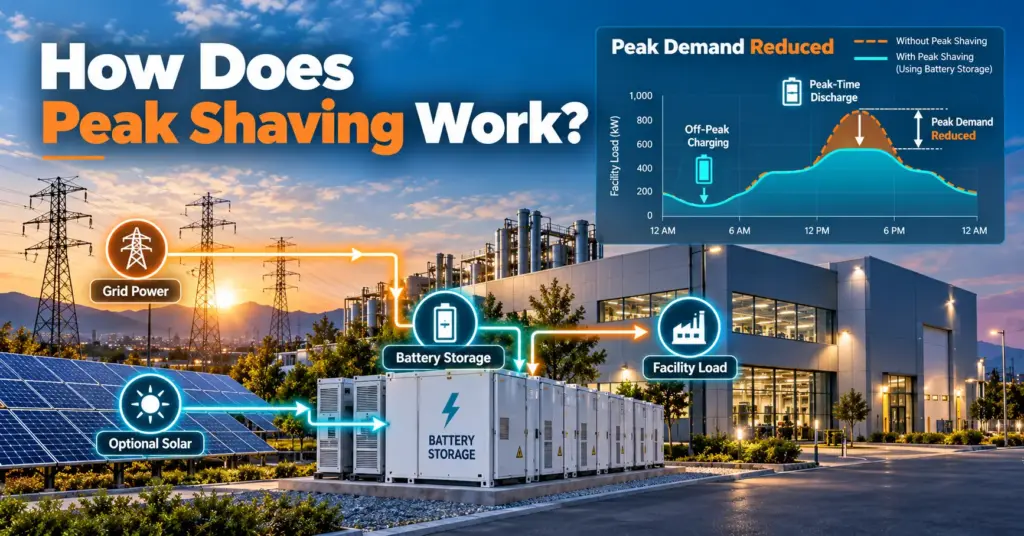
The process follows a simple logic: find the peaks, supply part of that load from somewhere other than the grid, and verify that the grid draw stayed under a target limit.
Identifying Peak Electricity Demand
The first step is understanding when and why peaks occur. Facilities typically use:
- Utility bills, which show the billed peak kW for each month
- Interval data from smart meters, usually in 15-minute increments
- Sub-metering on major equipment such as chillers, compressors, furnaces or EV chargers
Analysts look for how often peaks happen, how long they last, what time of day they appear and which equipment causes them. A few narrow spikes are far easier and cheaper to shave than a broad, long plateau of high demand.
Reducing Grid Power During Peak Periods
Once a target is set, the facility reduces grid draw at the critical moments. Common approaches include:
- Discharging a battery to supply part of the load
- Using on-site solar generation
- Starting a backup or on-site generator
- Temporarily reducing or delaying non-essential loads
- Staggering equipment start-up so motors and heaters do not all start together
An energy management system usually monitors the load in real time and acts automatically when demand approaches the set threshold.
Measuring Peak Demand Reduction
Success is measured by comparing the billed peak demand with and without the strategy. Facilities track:
- Monthly peak kW before and after implementation
- The number of times the system had to intervene
- Remaining headroom between actual peaks and the target limit
- Dollar savings from lower demand charges
Because a single missed spike can erase a month of savings, accurate metering and forecasting matter as much as the equipment itself.
Common Peak Shaving Methods
No single method is best for every site. The right choice depends on the load profile, tariff, space, budget and sustainability goals.
Battery Energy Storage Systems (BESS)
Batteries charge when demand and prices are low and discharge when the facility approaches its peak. They respond in milliseconds, are quiet, produce no on-site emissions and can be controlled automatically. This is the most widely discussed modern peak shaving method. A detailed treatment of battery technology and design belongs in our dedicated battery energy storage guide.
Solar Power and Battery Integration
Solar panels reduce grid consumption during daylight hours, but solar alone is not guaranteed to shave the peak. A cloud, a late-afternoon peak after sunset, or a spike during low production can still set the billed demand. Pairing solar with a battery solves this: the battery can store excess solar output and discharge at the moments that matter. Our dedicated article on solar-plus-storage covers system design in more detail.
Load Shifting and Equipment Scheduling
Some operations can move flexible loads away from peak times. Examples include running dishwashers, pumps, compressors, battery chargers or industrial processes at different hours, pre-cooling a building before the afternoon peak or staggering the start-up of large equipment. This approach often requires little capital but depends on operational flexibility. See the comparison later in this article and our dedicated load shifting guide.
Smart Energy Management Systems
An energy management system (EMS) combines metering, forecasting and control. It can watch real-time demand, predict upcoming peaks, send signals to curtail or delay loads, and decide when to charge or discharge a battery. Even without new hardware, better visibility and automation can reveal low-cost savings.
On-Site Power Generation
Diesel, natural gas or other generators, and combined heat and power (CHP) systems, can supply part of the load during peaks. They can deliver large amounts of power, but fuel costs, emissions, noise, maintenance and local air-quality rules often limit their use. In many cases, batteries and load control are preferred, with generators kept as a backup.
Peak Shaving With Battery Energy Storage
Batteries are the focus of most modern peak shaving projects, so a short overview of the key concepts helps. For full technical detail, refer to our dedicated battery sizing and storage articles.
How Batteries Charge and Discharge
A battery charges from the grid during low-load periods, or from solar when available, and discharges when the building’s load exceeds a chosen threshold. The control system sets a target limit, for example 800 kW. When the facility load climbs above that level, the battery supplies the difference so the grid meter never exceeds the limit.
After the peak passes, the battery recharges at a rate that keeps grid demand below the target. Recharging too aggressively can create a new peak, so the charging schedule matters.
Battery Capacity vs. Power Rating
Two specifications determine whether a battery can do the job:
- Power rating (kW): how much power the battery can deliver at one moment. This determines how many kW of peak you can shave.
- Energy capacity (kWh): how much total energy it stores. This determines how long it can sustain that shaving.
A battery rated at 200 kW and 400 kWh can discharge 200 kW for about two hours, assuming usable capacity. If the peak lasts longer than the energy capacity allows, the battery will run out and the demand spike will return.
Choosing the Right Battery Size for Peak Shaving
At an introductory level, sizing involves four questions:
- How many kW above the target limit does the load rise?
- How long do these peak events last?
- How often do they occur?
- Do savings justify the cost of the additional capacity?
Often the highest few kilowatts of a peak occur for very short periods, so a modest battery can capture most of the savings, while shaving the final peaks may require a disproportionately larger system. Analyzing interval data and a load duration curve helps find the best point between cost and benefit. Our sizing guide goes through this process step by step.
Battery Efficiency and Cycle Life Considerations
- Round-trip efficiency: typically in the range of 85% to 95% for many modern lithium-ion systems, meaning some energy is lost between charging and discharging.
- Depth of discharge: the share of capacity that can be used regularly without excess wear.
- Cycle life: the number of charge-discharge cycles before capacity falls to a specified level. Peak shaving may cycle a battery less than daily energy arbitrage, but spikes, temperature and charging rates still affect its lifetime.
- Warranty terms: these often specify throughput, years or capacity retention.
These factors affect the real payback, which is why they should be included in any financial estimate.
Peak Shaving vs. Load Shifting vs. Peak Load Management
These terms are often used interchangeably, but they describe different goals and methods.
Key Differences in Energy Management Strategies
- Peak shaving reduces the maximum power drawn from the grid, using storage, generation or load reduction. Its goal is to lower the peak kW.
- Load shifting moves energy use from high-cost or high-demand periods to lower-cost periods. Total energy use stays about the same, but timing changes.
- Peak load management is the broader umbrella. It includes any strategy that controls demand during peak periods, including shaving, shifting, curtailment and demand response.
When to Use Each Approach
- Use peak shaving when demand charges are high and short spikes drive the bill.
- Use load shifting when you have flexible processes and time-of-use energy rates.
- Use broader peak load management when you want a coordinated strategy that combines technology, scheduling and utility programs.
In practice, a facility may use several at once. For example, it might shift flexible loads to off-peak hours and use a battery to shave the remaining spikes.
Comparison Table: Peak Shaving vs. Load Shifting
| Feature | Peak Shaving | Load Shifting |
|---|---|---|
| Main goal | Lower the highest kW drawn from the grid | Move energy use to cheaper or less busy times |
| Primary savings | Demand charges | Time-of-use energy charges |
| Effect on total kWh | Usually little change (small losses with batteries) | Usually little change |
| Typical tools | Batteries, on-site generation, EMS, load curtailment | Scheduling, process changes, thermal storage, pre-cooling |
| Operational impact | Often invisible to operations | Often requires changes to operations |
| Capital cost | Often moderate to high if storage is used | Often low to moderate |
| Best for | Sites with sharp, short demand spikes | Sites with flexible loads and time-based rates |
Benefits of Peak Shaving for Businesses and Industries
Lower Electricity Demand Charges
The most direct benefit is lower demand charges. Because charges are billed per kW of peak, even a modest reduction can generate meaningful monthly and annual savings, particularly where rates are high or ratchet clauses lock in costs.
Improved Energy Cost Predictability
When peaks are controlled, bills vary less from month to month. This makes budgeting easier and reduces the risk of unexpected spikes caused by one unusual operating event.
Reduced Strain on Electrical Infrastructure
Lower peaks can reduce stress on transformers, switchgear and service connections. In some cases, peak shaving can help a facility add equipment, such as EV chargers or new production lines, without immediately paying for a costly service upgrade.
Better Integration of Renewable Energy
Batteries and smart controls help smooth the variability of solar generation and let businesses use more of their own clean energy. This can improve the financial return of on-site renewables.
Potential Grid and Environmental Benefits
When many customers reduce peak demand, utilities may need fewer peaking power plants, which are often more expensive and carbon-intensive. Actual environmental benefits depend on the local grid mix, how the battery is charged and how it is operated, so they should be evaluated site by site rather than assumed.
Peak Shaving Calculation With a Practical Example
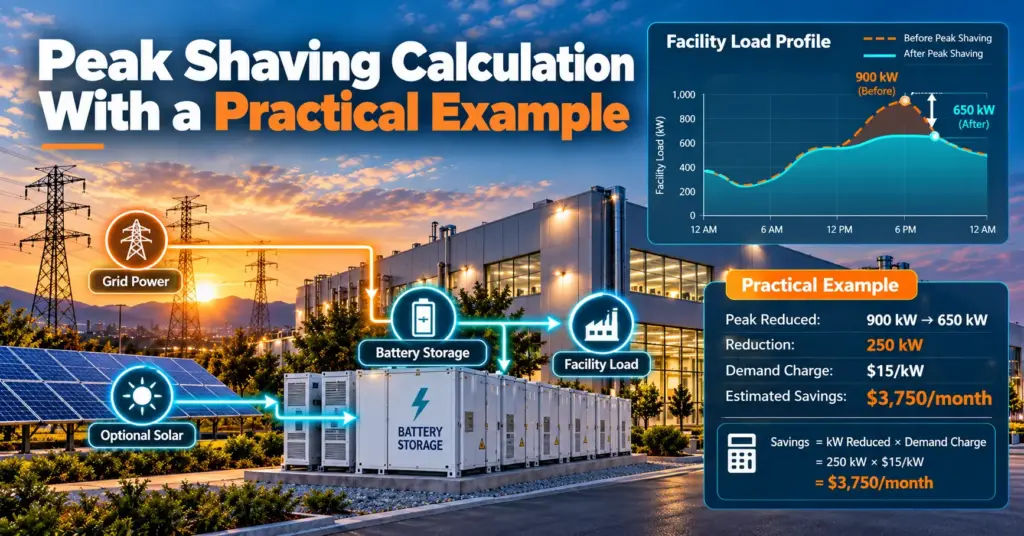
This section gives an introductory calculation. Real projects should use detailed interval data and the exact utility tariff.
Peak Demand Reduction Formula
The basic formulas are:
- Peak demand reduction (kW) = Original peak demand (kW) − New peak demand (kW)
- Required battery energy (kWh) ≈ Peak reduction (kW) × Peak duration (hours)
- Nameplate battery energy (kWh) = Required usable energy ÷ Usable depth of discharge
Battery efficiency and reserve margins add further adjustments.
Calculating Potential Demand Charge Savings
Monthly demand charge savings = Peak reduction (kW) × Demand charge rate ($/kW-month)
Annual savings = Monthly savings × 12, adjusted for seasonal tariffs and months when the peak shaving target cannot be met.
Example of Peak Shaving in a Commercial Facility
Assume the following illustrative figures, which are not quotes for any real system:
- Current monthly peak demand: 1,000 kW
- Target peak demand: 800 kW
- Demand charge: $15 per kW per month
- Typical peak event duration above 800 kW: up to 2 hours
- Usable depth of discharge: 90%
- Round-trip efficiency: 90%
- Energy price used for charging: $0.10 per kWh
Step 1: Peak reduction. 1,000 kW − 800 kW = 200 kW.
Step 2: Monthly savings. 200 kW × $15 = $3,000 per month.
Step 3: Annual savings. $3,000 × 12 = $36,000 per year.
Step 4: Battery size. A 200 kW discharge for 2 hours requires 400 kWh of usable energy. Dividing by 0.90 depth of discharge gives roughly 445 kWh nameplate capacity, so a system near 200 kW / 450 kWh would be the starting point.
Understanding Battery Operating Costs and Savings
Batteries have costs beyond the purchase price:
- Efficiency losses: to deliver 400 kWh, about 444 kWh must be drawn when charging at 90% efficiency. The 44 kWh loss on about 22 working days costs roughly 44 × 22 × $0.10 ≈ $97 per month in this example.
- Maintenance, monitoring and software fees
- Degradation: capacity declines over time, which may require oversizing or replacement
- Insurance, permitting and interconnection costs
Net savings in this example are therefore a little under $2,900 per month before maintenance and other costs. If the installed cost were $180,000 (an illustrative figure only), the simple payback would be about 5 years. Incentives, tax credits, lower or higher battery costs, and the exact tariff can change this significantly, so each project requires its own analysis. For detailed methods, see our dedicated demand charge calculation guide.
Peak Shaving Applications Across Different Industries
Manufacturing and Industrial Facilities
Industrial plants often have large motors, compressors, furnaces and welding equipment that create short, intense spikes. Starting several machines simultaneously can set the monthly peak. Batteries and staggered scheduling are common solutions, and the savings can be substantial because industrial demand charges are usually high.
Commercial Buildings and Office Complexes
HVAC systems usually drive peaks in offices, malls and hospitals, especially on hot afternoons. Peak shaving can combine pre-cooling, building automation and batteries to control the load without affecting occupant comfort.
Data Centers and Warehouses
Data centers have steady, high loads but also cooling-related variations, while warehouses may see peaks from refrigeration, conveyors and charging of electric forklifts. Because reliability is critical, batteries are often considered for both peak shaving and backup power, although the two functions must be balanced so reserve energy is always available.
Electric Vehicle Charging Stations
Fast chargers can draw very large amounts of power in short bursts, which creates high demand charges even if utilization is low. Batteries can buffer these spikes, and smart charging software can limit the total draw across multiple chargers.
Solar-Powered Commercial Facilities
Facilities with rooftop or ground-mounted solar can use batteries to store excess midday generation and use it when demand peaks later in the day. This improves self-consumption and protects against peaks that occur when solar output is low.
How to Implement a Peak Shaving Strategy
Analyze Electricity Bills and Load Profiles
Collect 12 months of bills and, if possible, interval data. Confirm how the utility defines and bills demand, including time windows, ratchets and seasonal rates. Many organizations discover that the tariff itself determines which approach is most valuable.
Identify Peak Demand Patterns
Analyze when peaks happen, how long they last and what equipment drives them. Determine whether peaks are predictable, such as daily HVAC loads, or random, such as occasional equipment starts. Predictable peaks are easier to shave reliably.
Select Suitable Peak Shaving Technology
Choose among low-cost operational changes, energy management software, batteries, solar-plus-storage or generators. A common approach is to start with scheduling and controls, then add storage only for the remaining peaks that justify the capital cost.
Estimate Costs, Savings, and Payback Period
Build a financial model that includes equipment, installation, interconnection, software, maintenance, degradation, incentives and expected demand charge savings. Test scenarios with different tariffs and operating conditions, and include a margin for uncertainty.
Monitor and Optimize System Performance
After commissioning, track actual peaks, battery state of charge, missed events and savings monthly. Adjust the target limit, charging schedule and control rules as operations or tariffs change. Continuous monitoring is what keeps the savings real over time.
Challenges and Limitations of Peak Shaving
Initial Equipment and Installation Costs
Batteries, power electronics, controls and installation can require significant upfront investment. Projects may also face permitting, fire-code, interconnection and space requirements that increase cost and time.
Battery Degradation and Maintenance
Batteries lose capacity over time, and heat, high charge rates and frequent cycling can accelerate this. Maintenance, software updates and eventual replacement should be part of the long-term budget.
Unpredictable Peak Demand Patterns
If peaks are random, long or much larger than expected, a system sized for typical events may fail to cover them. Because one missed peak can set the monthly charge, poor forecasting can reduce savings considerably.
Utility Tariff and Demand Charge Restrictions
Savings depend entirely on the tariff. Low demand charges, changing rate structures, rules on interconnection or storage, and restrictions on exporting power can all reduce or remove the business case. Always confirm current rules with your utility and local regulations before investing.
Frequently Asked Questions About Peak Shaving
What is peak shaving in electricity?
Peak shaving is reducing the maximum power a facility draws from the grid, usually by using batteries, solar, generators or load control during short periods of high demand. Its main purpose is to reduce demand charges and ease strain on electrical infrastructure.
What is the difference between peak shaving and load shifting?
Peak shaving lowers the highest kW draw, while load shifting moves energy use from expensive or busy periods to cheaper or quieter ones. Peak shaving mainly targets demand charges, and load shifting mainly targets time-based energy rates.
Can solar panels be used for peak shaving?
Yes, but with limits. Solar reduces grid use when the sun is shining, which can lower peaks that occur during the day. However, peaks that occur in the evening or during cloudy conditions may not be reduced, so solar is often combined with batteries or controls for reliable results.
How does a battery reduce peak electricity demand?
A battery stores energy when demand is low and discharges when the facility’s load rises above a target limit. The battery supplies the extra power, so the grid meter records a lower maximum demand.
Does peak shaving reduce total energy consumption?
Usually not. It reduces the highest instantaneous demand rather than total kWh. With batteries, total consumption may rise slightly because of round-trip efficiency losses, though demand charge savings can still outweigh this cost.
Is peak shaving suitable for residential buildings?
It is less common because most homes are not billed demand charges. However, some utilities offer demand-based or time-of-use residential rates, and large multi-family buildings may be billed on demand. Home batteries are more often used for backup power and time-of-use savings.
How much money can peak shaving save?
Savings depend on the demand charge rate, the size of the peak reduction and how reliably the target is met. In the example above, reducing a peak by 200 kW at $15/kW-month saves about $36,000 per year, but results vary widely. A detailed analysis of your tariff and load data is needed for a reliable estimate.
Conclusion: Is Peak Shaving Worth It?
Peak shaving can be a powerful way to cut electricity costs when demand charges are high and peaks are short, frequent and predictable. It also supports better use of solar power, can postpone electrical upgrades and gives organizations more control over their energy costs.
It is not a universal solution. The business case depends on your tariff, load profile, equipment costs and operational flexibility. The best approach is to start with data: study your bills and interval load profile, identify what drives your peaks, begin with low-cost controls and scheduling, and then evaluate batteries or solar-plus-storage for the remaining spikes.
You May Also Like It:
Green Power Energy: The Complete Guide to Clean, Renewable Electricity
Power vs Energy: What Is the Difference and Why Does It Matter?
Public Power Energy Supplier: What It Is and How It Works
Xcel Power Shut Off: Everything You Need to Know About PSPS Outages