

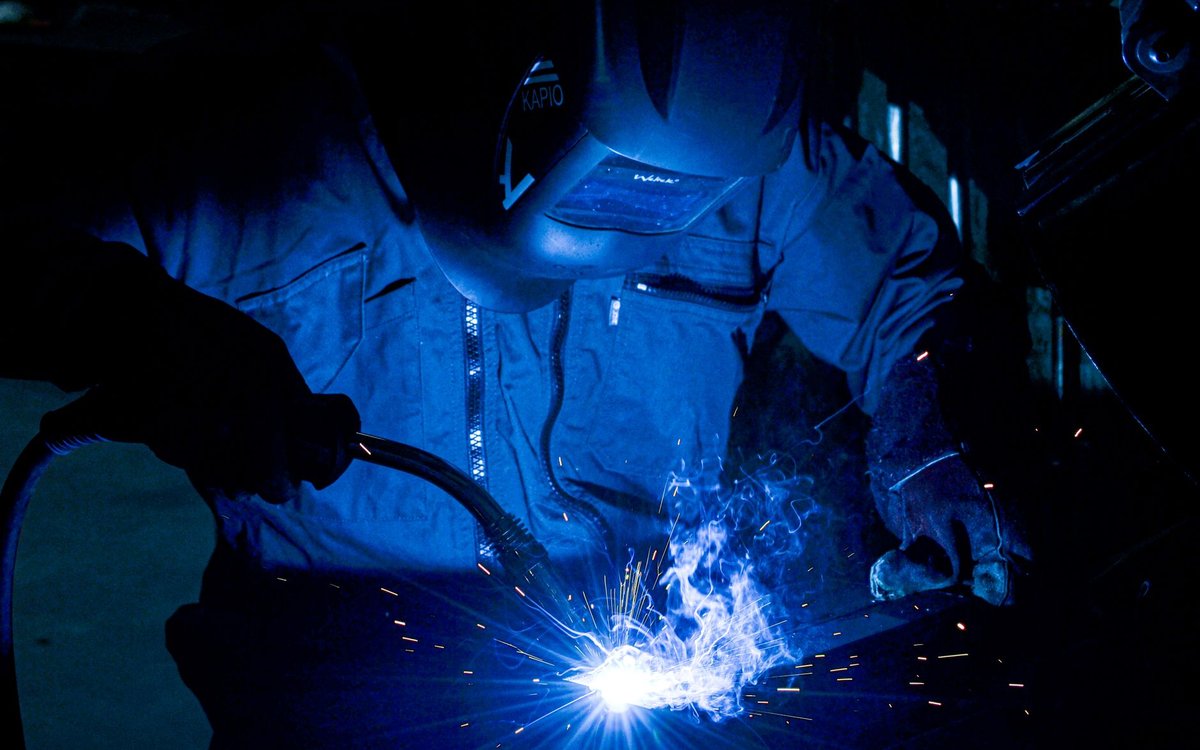
Stick welding is one of the oldest and most widely used welding processes in the world. It joins metal using an electric arc and a flux-coated electrode, needs no shielding gas, and works outdoors, on rusty steel, and in places where other welding methods struggle. That is why it is still the first choice for pipeline welding, structural steel, and repair work.
Stick welding, also called shielded metal arc welding (SMAW), is a manual arc welding process that joins metal using a flux-coated electrode. An electric arc melts the electrode and the base metal, while the burning flux creates shielding gas and slag that protect the weld pool. It needs no external gas, so it works well outdoors and on thick steel.
What Is Stick Welding (SMAW)?
Stick welding is a manual arc welding process that uses a consumable electrode coated in flux to lay the weld. The electrode is a metal rod, usually 9 to 18 inches long, with a chemical coating called flux around a solid metal core. The welder holds the rod in an electrode holder, strikes an arc against the workpiece, and the intense heat melts both the rod and the base metal into a joint that hardens into a strong weld as it cools.
The flux coating does two important jobs. As it burns, it releases a cloud of shielding gas around the arc and the weld pool. The melted flux also forms a layer of liquid slag that floats on top of the molten pool. Together, the gas and slag protect the hot metal from oxygen and nitrogen in the air, which would otherwise leave the weld full of pores and weak spots.
Because the electrode provides its own shielding, stick welding needs no gas cylinder, no wire feeder, and no complex setup. That simplicity is the main reason it is still taught first in many welding schools.
You will also see the process called SMAW (Shielded Metal Arc Welding, the formal name used in AWS standards), MMA (Manual Metal Arc Welding, the common term in the UK, Europe, Australia, and India), or simply arc welding — stick welding is one type of arc welding, along with MIG and TIG.
How Stick Welding Works, Step by Step
Stick welding works by keeping a short electric arc burning between the tip of the electrode and the workpiece. The arc reaches temperatures of up to 7,000°F, more than hot enough to melt steel. Here is what happens, step by step:
- Set up the circuit. The welder connects the ground clamp to the workpiece and clamps an electrode into the electrode holder, completing the electrical circuit.
- Set the amperage. The welder dials in the current to match the electrode diameter and the thickness of the metal.
- Strike the arc. The welder scratches or taps the electrode tip against the metal, like striking a match, then lifts it slightly to ignite the arc.
- The weld pool forms. The arc melts the base metal and the electrode tip, creating a small pool of liquid metal.
- Flux shields the weld. The flux coating burns, releasing shielding gas, and melts into slag that covers the weld pool.
- Travel along the joint. The welder moves the electrode steadily along the joint, keeping a short arc length and a drag angle of about 15–20 degrees.
- Clean the slag. Once the weld cools, the hardened slag is chipped off and brushed clean to reveal the finished weld.
Arc length is the skill that matters most. Hold the arc too long and the shielding weakens and spatter increases; hold it too short and the electrode can freeze onto the workpiece.
AC or DC: Polarity Explained
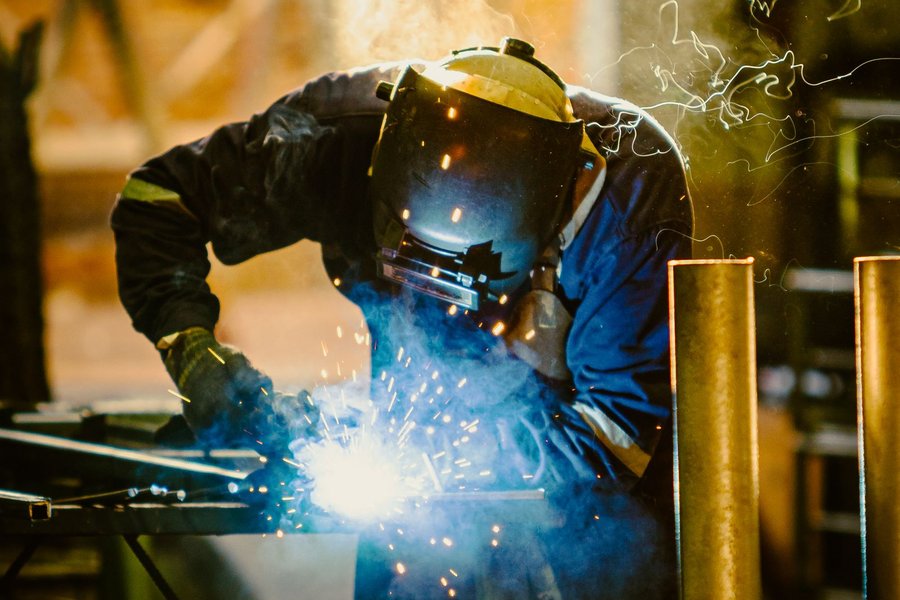
A stick welder can run on alternating current (AC) or direct current (DC). DC is preferred for most work because it gives a smoother, more stable arc with less spatter. With DC, the welder can also choose polarity, which changes where the heat goes:
- DCEP (DC electrode positive), also called reverse polarity: the electrode holder connects to the positive terminal. More heat goes into the workpiece, giving deeper penetration. Most electrodes, including E6010 and E7018, run on DCEP.
- DCEN (DC electrode negative), also called straight polarity: the electrode holder connects to the negative terminal. More heat stays in the electrode, so the rod melts faster and deposits more metal, but penetration is shallower.
AC machines are simpler and cheaper, and some electrodes, such as E6011 and E6013, run well on AC. Always check the manufacturer’s recommendation, because the wrong polarity can cause a weak or ugly weld.
Stick Welding Equipment You Need
Stick welding needs very little equipment. A complete setup has just a few parts, and our guide to essential welding tools covers the full checklist:
- Power source (welder): a constant-current machine, AC, DC, or AC/DC. Modern inverter welders are light and portable.
- Electrode holder: an insulated clamp that grips the rod and carries the welding current.
- Ground clamp: connects the workpiece to the return side of the circuit. A poor ground causes an unstable arc, so the clamp should bite onto clean, bare metal.
- Electrodes: flux-coated rods, chosen to match the base metal and the job.
- Personal protective equipment (PPE): an auto-darkening welding helmet (shade 9–13 depending on current), flame-resistant jacket or leather sleeves, insulated leather gloves, and safety boots. The arc produces intense ultraviolet light and hot spatter, so no skin should be left exposed.
- Cleaning tools: a chipping hammer and a wire brush for removing slag after every pass.
Choosing Amperage and Duty Cycle
Two machine settings confuse beginners, so here they are in simple terms.
Amperage controls how hot the arc is. Every electrode has a recommended amp range printed on the box, based on the rod diameter. A common 1/8-inch (3.2 mm) E7018 rod, for example, usually runs between 90 and 140 amps. Too little amperage and the rod sticks; too much and the metal burns through and spatter flies everywhere. When in doubt, start in the middle of the range and adjust after a test bead on scrap metal.
Duty cycle tells you how long a welder can run before it needs to cool down, measured over a 10-minute period. A machine rated at a 60% duty cycle at 150 amps can weld for 6 minutes out of every 10 at that setting, then needs 4 minutes to rest. For repair work and learning, a 20–40% duty cycle is usually enough.
Common Electrodes: E6010, E6013, E7018
The rod decides how deep the weld penetrates, how the bead looks, which positions you can weld in, and how strong the finished joint is. Most stick welding on carbon steel uses one of three electrodes.
How to Read Electrode Numbers (AWS Classification)
Stick electrodes are classified under the American Welding Society (AWS) system, and the four-digit code tells you almost everything you need to know. Take E7018 as an example:
- E stands for electrode.
- The first two digits (70) show the tensile strength of the weld metal in thousands of pounds per square inch — E7018 is rated at 70,000 psi.
- The third digit (1) shows the welding positions. A “1” means all positions; a “2” means flat and horizontal fillet positions only.
- The fourth digit (8) shows the flux coating type and the current it runs on. An “8” means a low-hydrogen coating for AC or DCEP.
E6010 — Deep Penetration, Pipelines and Root Passes
E6010 has a cellulose flux coating that burns fiercely, giving very deep penetration. It runs on DCEP and works in all positions. It is the standard choice for the root pass on cross-country pipelines and for welding through rust, paint, and dirt. The trade-off is a rougher bead and more spatter.
E6013 — The Beginner-Friendly, All-Purpose Rod
E6013 has a rutile (titanium dioxide) flux coating that produces a smooth, neat bead with light penetration. It runs on AC or DC, strikes easily, and is forgiving of a shaky hand, which makes it the best rod for beginners and general repair work on clean, thin to medium steel.
E7018 — The Industry Standard for Structural Steel
E7018 is a low-hydrogen electrode and the default rod for structural steel, pressure vessels, and thick sections. It produces strong, crack-resistant welds and works in all positions on DCEP. The one rule with E7018 is storage: the flux absorbs moisture from the air, and damp rods cause hydrogen cracking. Keep E7018 rods dry, ideally in a rod oven.
| Electrode | Flux coating | Current | Penetration | Best for |
|---|---|---|---|---|
| E6010 | Cellulose | DCEP | Deep | Pipeline root passes, dirty or rusty steel |
| E6013 | Rutile | AC or DC | Light | Beginners, general repair, thin sheet metal |
| E7018 | Low hydrogen | DCEP (AC OK) | Medium–deep | Structural steel, pressure vessels, thick sections |
Stick Welding vs MIG vs TIG
Stick welding, MIG (GMAW), and TIG (GTAW) are the three main arc welding processes, and each one suits different work.
| Feature | Stick (SMAW) | MIG (GMAW) | TIG (GTAW) |
|---|---|---|---|
| Shielding | Flux coating, no gas | External gas cylinder | External gas cylinder |
| Wind resistance | Excellent | Poor | Very poor |
| Speed | Slow–medium | Fast | Slow |
| Skill needed | High | Low–medium | Very high |
| Best thickness | 3 mm and above | Thin to medium | Thin, precision work |
| Equipment cost | Lowest | Medium | Highest |
| Best for | Outdoor, repair, pipelines, thick steel | Shop fabrication, thin sheet, fast production | Stainless, aluminium, clean precision joints |
Choose stick welding when the work is outdoors, the steel is thick or dirty, or the job site has no room for gas bottles. Choose MIG for speed on clean, thin material in a workshop, and TIG when the weld must look perfect, such as on stainless steel or aluminium. For a detailed head-to-head of the other two processes, see our guide to MIG vs TIG welding.
Pros and Cons of Stick Welding
Advantages
- Works outdoors in wind. No shielding gas means wind cannot blow the protection away, which is why stick is the standard for construction sites and field repair.
- Tolerates dirty metal. It welds through rust, paint, and mill scale far better than MIG or TIG, which need clean surfaces.
- Cheap and portable. A basic inverter stick welder costs far less than a MIG or TIG setup and runs from a generator on remote sites.
- Very versatile. Changing the electrode lets one machine weld carbon steel, stainless steel, cast iron, and hard-facing alloys.
- Simple setup. No gas cylinders, regulators, or wire feeders to maintain.
Disadvantages
- Slower than MIG. Each electrode lasts only about a minute or so of arc time, so the welder stops often to change rods, and every pass must be chipped clean of slag.
- Needs more skill. Arc length, travel angle, and rod manipulation all affect quality directly, so beginners take longer to produce good welds than with MIG.
- More spatter and cleanup. Stick welding produces more spatter and slag than the other processes, which adds finishing work.
- Not good for thin sheet. Welding metal thinner than about 3 mm is difficult because the arc can easily burn through.
- Lower deposition rate. It lays down less metal per hour than MIG, so labour costs more on long production welds.
Best Uses of Stick Welding
Stick welding is the right process whenever the job is heavy, outdoors, or far from a workshop — pipelines, structural steel, repair work, shipbuilding, and heavy fabrication such as pressure vessels and tanks. In short, if the metal is thick, the location is outdoors, or the surface is less than perfect, stick welding is usually the best tool for the job.
Tips for Beginners
- Practise on scrap first. Run beads on scrap plate to set your amperage before touching the real job.
- Keep a short arc. Hold the rod tip close to the weld pool, about the width of the rod’s core wire away from the metal.
- Watch the weld pool, not the arc. The shape and size of the molten pool tell you whether your speed and angle are right.
- Chip slag between passes. On multi-pass welds, clean every pass before starting the next one, or slag gets trapped inside the joint.
- Store electrodes dry. Damp rods cause porosity and cracking, especially E7018.
- Get proper training. A short welding training course will teach you faster and more safely than trial and error.
Frequently Asked Questions
Is stick welding good for beginners?
Yes, it is a reasonable starting point because the equipment is inexpensive and the process forgives dirty metal. The learning curve is steeper than MIG, though, because you must control arc length and travel angle by hand. Most beginners can lay a decent bead after a few practice sessions on scrap metal.
What is the difference between stick welding and arc welding?
Arc welding is the general name for any welding process that uses an electric arc to melt metal. Stick welding (SMAW) is one type of arc welding; MIG and TIG are others. So all stick welding is arc welding, but not all arc welding is stick welding.
Can you stick weld thin metal?
It is difficult. Stick welding works best on steel 3 mm thick and above. Below that, the arc tends to burn through the sheet. For thin metal, MIG or TIG is a better choice. If you must stick weld thin sheet, use a small-diameter E6013 rod at the lowest workable amperage.
What polarity should I use for stick welding?
Most stick electrodes run on DCEP (electrode positive), which gives deeper penetration. That includes E6010 and E7018. E6013 and E6011 also run well on AC. Always check the manufacturer’s recommendation, because the wrong polarity causes a weak weld and excessive spatter.
Can stick welding be done in the wind?
Yes, and this is one of its biggest advantages. Because the flux coating creates its own shielding gas right at the arc, normal wind does not harm the weld the way it destroys a MIG or TIG weld. Very strong gusts can still disturb the arc, but stick welding handles outdoor conditions better than any other arc process.
How thick can stick welding weld?
With the right joint preparation and multiple passes, stick welding can join steel of virtually any thickness. In practice, a single pass comfortably covers about 3–10 mm. Thicker sections use a root pass followed by hot, fill, and cap passes, standard procedure for pipelines and structural joints.
Conclusion
Stick welding (SMAW) has been joining metal for a century because it is simple, tough, and forgiving. A flux-coated electrode, a basic power source, and a steady hand are all it takes to weld thick steel outdoors, repair heavy equipment, or lay pipeline root passes. It is slower than MIG and takes more skill to master, but no other process matches it for portability.


2 Comments