
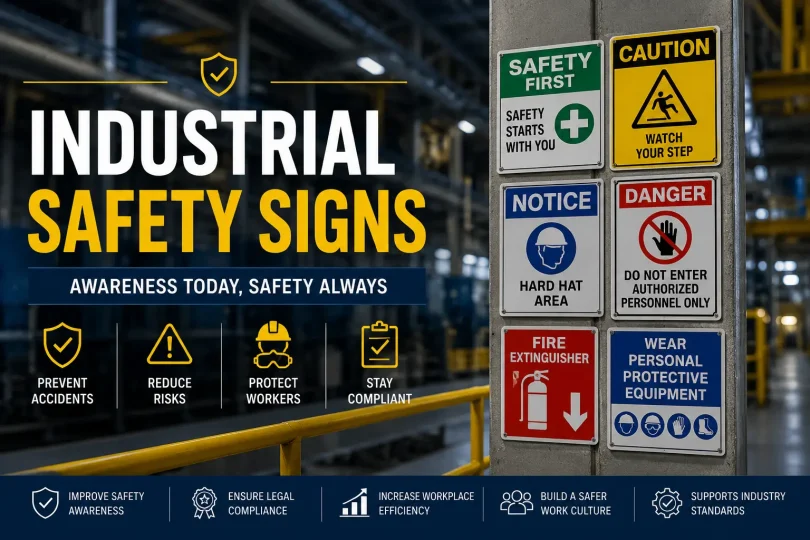

Every industrial facility, whether it is a manufacturing plant, warehouse, construction site, or chemical processing unit, depends on one simple but powerful communication tool to keep workers safe: the industrial safety sign. These signs are not decorative additions to a workplace. They are a frontline defense system that warns, instructs, guides, and protects employees, visitors, and contractors from hazards that could otherwise cause serious injury or death.
This guide brings together everything a safety manager, facility owner, procurement officer, or EHS (Environment, Health and Safety) professional needs to know about industrial safety signs. It covers definitions, categories, color codes, shapes, regulatory standards such as OSHA, ANSI Z535, and ISO 7010, correct placement, materials, and practical buying advice. The goal is to give you a single, in depth resource that explains every important keyword and concept related to industrial safety signage in full detail.
What Are Industrial Safety Signs?
Industrial safety signs are standardized visual notices, made up of colors, shapes, symbols (pictograms), and sometimes short text, that communicate a safety message quickly and clearly in a workplace. Their purpose is to alert people to hazards, tell them what action they must take, show them what is prohibited, or guide them toward safety equipment and emergency exits.
The core idea behind industrial safety signs is speed of understanding. A worker walking through a factory floor may only glance at a sign for a second or two. In that short moment, the sign’s color, shape, and pictogram must convey the message without requiring the person to stop and read a paragraph of instructions. This is why safety signage relies so heavily on standardized colors and symbols rather than long written explanations.
Industrial safety signs generally fall into three broad functional categories:
- Equipment maintenance and operating instructions: signs that explain how to safely operate, shut down, or maintain machinery.
- Safety instructions and warnings: signs that highlight risks such as chemical exposure, electrical hazards, or the location of protective equipment like eyewash stations.
- Directional and informational signs: signs that guide workers to exits, assembly points, or general facility information.
Why Industrial Safety Signs Matter
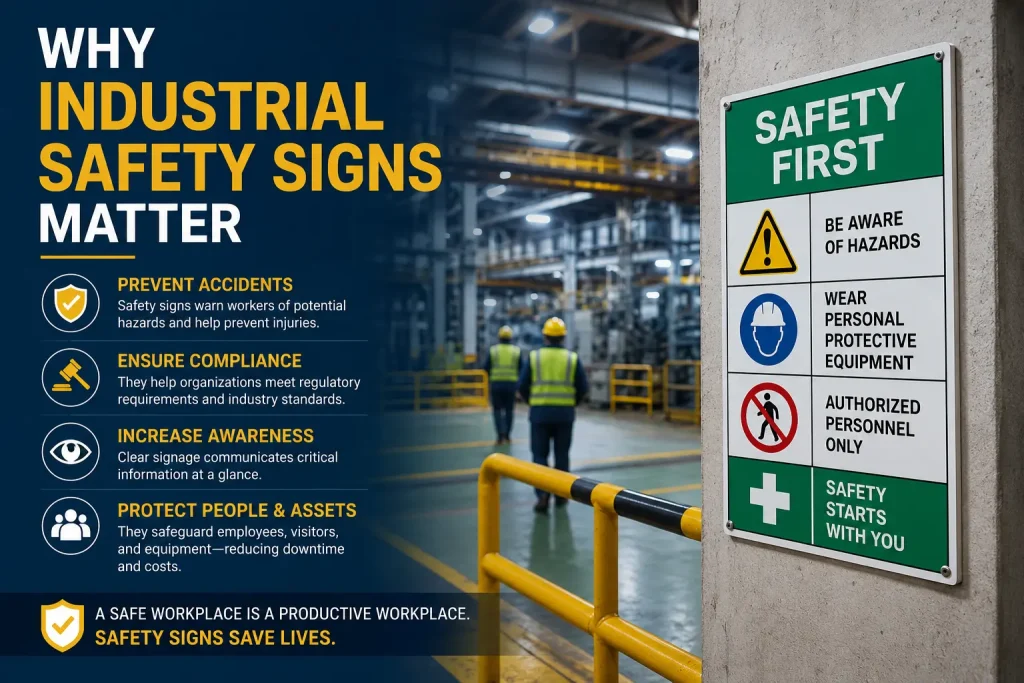
Workplace injuries remain a persistent problem across manufacturing, construction, energy, and logistics industries. A large share of these incidents happen because a hazard was not clearly identified, or because a worker was unfamiliar with the symbols used at a particular site. Industrial safety signs address this gap directly.
1. Accident and Injury Prevention
The most immediate benefit of industrial safety signs is that they reduce the chance of accidents by making hazards visible before someone is exposed to them. A clearly placed “high voltage” warning sign, for example, prevents an untrained worker from approaching live electrical equipment.
2. Regulatory Compliance
Many industries are legally required to display specific types of signage. In the United States, the Occupational Safety and Health Administration (OSHA) mandates signage under 29 CFR 1910.145 wherever certain hazards or protective equipment requirements exist. Failing to comply can result in citations, fines, and increased liability in the event of an accident.
3. Liability Reduction
If an accident occurs and it can be shown that proper, visible, and compliant safety signage was in place, a company is generally in a stronger legal position than one that neglected signage. Courts and insurers often look at whether reasonable warning was given before an incident took place.
4. Faster Emergency Response
During a fire, chemical spill, or medical emergency, seconds matter. Clearly marked emergency exits, fire equipment locations, and first aid stations allow workers to react quickly and calmly instead of wasting critical time searching for help.
5. Communication Across Language Barriers
Modern industrial workforces are often multilingual. Because safety signs rely on standardized shapes, colors, and pictograms rather than text alone, they can be understood by workers regardless of their native language, which is one reason international standards like ISO 7010 exist.
Types of Industrial Safety Signs (Full Definitions)
Industrial safety signs are typically grouped into distinct categories, each with its own color, shape, and purpose. Below is a full breakdown of every major type, along with what each keyword actually means in practice.
1. Prohibition Signs
Definition: Prohibition signs tell workers what they must NOT do in a specific area. They represent an action that is forbidden because it could create a hazard.
Design: A red circle with a diagonal line across a white background, with a black pictogram showing the prohibited action.
Examples: No smoking, no open flame, no entry for unauthorized persons, no drinking water, do not touch, no pedestrian access.
Where used: Near flammable storage areas, restricted machinery zones, gas pipelines, and hazardous material storage rooms.
2. Warning and Caution Signs
Definition: Warning signs alert workers to a hazard that exists in the area but does not necessarily require the same level of urgency as a danger sign. Caution signs specifically indicate a possible hazard or unsafe practice that could lead to minor to moderate injury.
Design: A yellow triangle with a black border and a black pictogram or text. Some caution signs use a black panel with yellow lettering on a yellow background.
Examples: Slippery surface, hot surface, electrical hazard, falling objects, forklift traffic, toxic material.
Where used: Near wet floors, hot machinery, loading docks, high shelving areas, and chemical handling stations.
3. Mandatory Signs
Definition: Mandatory signs instruct workers about an action they must take before entering an area or performing a task. Unlike prohibition signs, which tell people what not to do, mandatory signs tell them what is required.
Design: A blue circle with a white pictogram.
Examples: Wear eye protection, wear a hard hat, wear ear protection, wear high visibility clothing, use handrail, wash hands before returning to work.
Where used: Entrances to workshops, construction zones, chemical laboratories, and areas with high noise levels.
4. Danger Signs
Definition: Danger signs indicate an immediate and severe hazard that could result in serious injury or death if precautions are not followed. This is the highest level of alert in the OSHA signal word hierarchy.
Design: Black, red, and white color combination, usually with the word “DANGER” in bold white letters on a red background, followed by a black text panel describing the hazard.
Examples: High voltage, confined space, explosive materials, unguarded machinery.
Where used: Only for the most severe, life threatening hazards. Overusing danger signs for minor risks reduces their effectiveness, which is why OSHA recommends reserving them for genuinely critical situations.
5. Emergency and Safe Condition Signs
Definition: These signs point workers toward safety equipment, escape routes, and safe locations during an emergency. They are sometimes called “safe condition signs” because they represent something positive: a path to safety rather than a hazard to avoid.
Design: A green square or rectangle with a white pictogram or text.
Examples: Emergency exit, assembly point, first aid station, eye wash station, emergency shower.
Where used: Along escape routes, near stairwells, close to medical stations, and at designated outdoor gathering points.
6. Fire Safety Signs
Definition: Fire safety signs identify the exact location of firefighting equipment and alert workers to fire related hazards.
Design: A red square or rectangle with a white pictogram, similar in color to prohibition and danger signs but distinguished by its shape.
Examples: Fire extinguisher, fire hose reel, fire alarm call point, fire assembly point, flammable material storage.
Where used: Near extinguishers, hose cabinets, fire alarm panels, and flammable liquid storage rooms.
7. Notice and Information Signs
Definition: Notice signs communicate general information that is not directly tied to an accident or injury risk. They provide procedural or administrative details.
Design: Typically blue or white background with black text, though styles vary by facility.
Examples: Visitor check in required, authorized personnel only, maintenance schedule, general facility rules.
8. Biological and Radiation Hazard Signs
Definition: These specialized signs warn of exposure risks from biological agents (such as bloodborne pathogens) or ionizing and non-ionizing radiation, both of which can cause serious long term health effects.
Design: Biological hazard signs typically use the internationally recognized trefoil biohazard symbol in black or purple on a yellow or white background. Radiation signs use the black and yellow trefoil radiation symbol.
Where used: Laboratories, medical waste areas, X-ray rooms, and facilities using radioactive materials or isotopes.
The Safety Sign Color Coding System
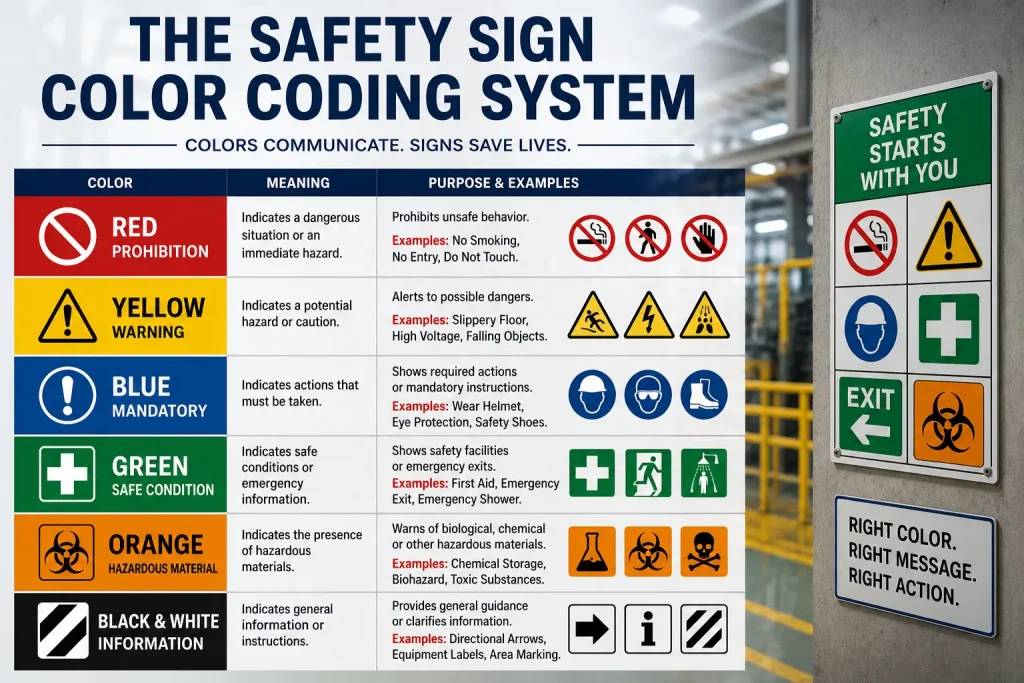
Color is the fastest way a human brain processes a safety message, often faster than reading text. Both OSHA and ISO standards assign specific meanings to each color used in industrial safety signage.
- Red: Danger, stop, prohibition, and fire equipment. Red signals the highest level of risk or an action that is strictly forbidden.
- Orange: Moderate hazards, such as sharp edges or moving equipment parts, often used in warning contexts related to machinery.
- Yellow: Caution and general warning. Yellow and black combinations are used for hazards that require attention but are not immediately life threatening.
- Blue: Mandatory actions and general notices. Blue tells a worker what they are required to do.
- Green: Safe conditions, emergency exits, first aid, and safety equipment locations.
- Black and white: Often used for informational or administrative signage that does not represent an immediate hazard.
Shapes and What They Mean
In addition to color, shape plays a critical role in international sign recognition systems like ISO 7010, since shape can often be identified even before color is fully perceived, especially in low visibility conditions.
- Circle: Used for prohibition (with a diagonal bar) and mandatory signs (solid blue). A circle communicates either “not allowed” or “required.”
- Triangle: Used for warning and caution signs. The triangular shape has long been associated with alertness and hazard awareness.
- Square or rectangle: Used for emergency, safe condition, fire equipment, and general information signs.
Standards and Regulations Governing Industrial Safety Signs
Understanding the regulatory landscape is essential for any business that wants to remain compliant and reduce liability.
OSHA (Occupational Safety and Health Administration)
OSHA regulation 29 CFR 1910.145 sets requirements for specifications, application, and use of accident prevention signs and tags in general industry workplaces in the United States. OSHA classifies signs by severity using signal words: Danger, Warning, Caution, and Notice, and requires that wording be accurate, concise, and easy to understand from a safe viewing distance.
ANSI Z535 (American National Standards Institute)
ANSI Z535 is the domestic American standard that governs the design, colors, and wording format of safety signs. It works alongside OSHA regulations and defines the exact color combinations, signal word panels, and layout rules that many US manufactured signs follow.
ISO 7010 (International Organization for Standardization)
ISO 7010 is the global standard for pictogram based safety signs, designed to communicate hazards using symbols rather than words so that meaning is not lost across language barriers. It organizes signs into five categories, each with a registered letter prefix:
- P-series: Prohibition signs
- W-series: Warning signs
- M-series: Mandatory signs
- E-series: Emergency and safe condition signs
- F-series: Fire equipment signs
ISO 7010 also works together with ISO 3864, which defines the exact colorimetric values, minimum color coverage percentages, and geometric proportions each sign must follow. For example, warning triangles must have the yellow background cover at least half of the total sign area, while prohibition signs require the red circle and bar to cover at least 35 percent of the sign.
Many international and multinational facilities use ISO 7010 pictograms alongside ANSI Z535 text panels so that the sign is both universally recognizable and explicitly clear in English, satisfying compliance requirements in multiple regions at once.
Where and How to Place Industrial Safety Signs
Correct placement is just as important as choosing the right sign. A perfectly designed sign that is placed in the wrong location or is not visible from a safe distance provides little protection.
- Position signs at the point of hazard, close enough that a worker sees the warning before entering the danger zone, not after.
- Maintain a consistent mounting height across the facility so employees develop a habit of looking for signage at eye level.
- Ensure visibility from the required distance. ISO 3864-1 provides a formula for calculating minimum sign height based on expected viewing distance, ensuring text and pictograms remain legible even from a safe range.
- Avoid overcrowding one area with too many signs, which can create visual clutter and cause workers to ignore or overlook important warnings.
- Keep signs well lit and unobstructed by equipment, shelving, or dust buildup, especially in industrial environments where grime accumulates quickly.
- Update signage immediately when a process, chemical, or piece of equipment changes, since an outdated sign can be more dangerous than no sign at all.
Materials Used in Industrial Safety Signs
The material a sign is made from affects its durability, visibility, and suitability for different environments.
- Aluminum signs: Rust resistant and highly durable, ideal for outdoor use, construction sites, and areas exposed to weather.
- Vinyl and adhesive signs: Flexible and easy to apply to machinery, doors, and equipment surfaces, commonly used indoors.
- Rigid plastic signs: Cost effective and lightweight, suitable for general indoor facility use.
- Reflective and photoluminescent signs: Designed for low light or emergency conditions, such as power outages, allowing exit routes and equipment locations to remain visible.
- Magnetic signs: Useful for temporary applications, such as marking equipment that is only occasionally out of service.
Benefits of Industrial Safety Signs
- Reduce workplace accidents and associated medical costs.
- Support compliance with OSHA, ANSI, and ISO requirements.
- Lower legal and insurance liability by demonstrating due diligence.
- Improve overall workplace organization by clearly marking zones, hazards, and equipment locations.
- Build a stronger safety culture, since visible signage reinforces training and daily awareness.
- Support multilingual and diverse workforces through pictogram based communication.
Industries That Rely Heavily on Industrial Safety Signs
- Manufacturing and heavy machinery plants
- Construction and infrastructure projects
- Oil, gas, and chemical processing facilities
- Warehousing and logistics centers
- Mining operations
- Laboratories and pharmaceutical facilities
- Food processing plants
- Power generation and utility sites
How to Choose the Right Industrial Safety Sign
- Identify the actual hazard first. Do not select a sign from a catalog before understanding the real risk present in that specific area.
- Match the sign type to the hazard category: prohibition, warning, mandatory, danger, or emergency.
- Choose a standard that fits your regulatory environment, whether that is OSHA and ANSI for US facilities or ISO 7010 for international operations.
- Select the right material based on indoor versus outdoor use, exposure to chemicals, and expected wear.
- Confirm sign size against the required viewing distance so text and pictograms remain readable.
- Avoid decorative or unofficial signage that does not reflect a genuine safety requirement, since irrelevant signs dilute the seriousness of real warnings.
Common Mistakes Companies Make With Safety Signage
- Placing signs too far from the actual hazard, reducing their warning effectiveness.
- Using faded, damaged, or outdated signs that workers have learned to ignore.
- Mixing inconsistent sign standards across a single facility, which confuses employees.
- Failing to train new employees on what specific symbols and colors mean.
- Overusing high alert signs like “Danger” for minor risks, which weakens their impact over time.
The Role of Employee Training
Signage alone is not enough. Employees must be trained to recognize, understand, and respond appropriately to every sign in their workplace. Effective safety programs combine:
- Onboarding sessions that walk new employees through every sign type used on site.
- Refresher training whenever new equipment, chemicals, or processes are introduced.
- Visual audits to confirm signs remain visible, accurate, and undamaged.
- Clear reporting channels so workers can flag missing or unclear signage.
Frequently Asked Questions
What are the four main types of industrial safety signs?
The four primary categories recognized under most standards are prohibition signs, warning signs, mandatory signs, and emergency or safe condition signs. Fire equipment signs are sometimes counted as a fifth distinct category under ISO 7010.
What color indicates the highest level of danger?
Red indicates the highest level of danger, prohibition, or the location of fire fighting equipment.
Is ISO 7010 mandatory in the United States?
No, ISO 7010 is a voluntary international standard. OSHA does not require it specifically, but signs that follow ISO 7010 satisfy OSHA’s general requirement under 29 CFR 1910.145 to post signs identifying hazards.
How do I know what size sign I need?
Sign size should be based on the expected viewing distance. Larger viewing distances require taller pictograms and larger text so the sign remains legible from a safe range.
Can safety signs reduce a company’s legal liability?
Yes. Properly placed, compliant, and visible safety signage can demonstrate that an employer took reasonable steps to warn workers of hazards, which can strengthen a company’s position in the event of an accident or legal claim.
Conclusion
Industrial safety signs are a small investment with an outsized impact on workplace safety, legal compliance, and operational efficiency. By understanding the different categories, from prohibition and warning signs to mandatory, emergency, and fire safety signs, and by following recognized standards such as OSHA, ANSI Z535, and ISO 7010, facility managers can build a signage system that genuinely protects workers rather than simply satisfying a checklist. The most effective safety programs combine correctly designed signs, proper placement, durable materials, and consistent employee training, ensuring that every worker understands exactly what each sign means the moment they see it.
You May Also Like It:
CNC Machining Tolerances: The Complete Expert Guide
Prototype CNC Machining: The Complete Expert Guide
Steel Grade: The Complete Guide to Understanding Every Type of Steel





[…] Industrial Safety Signs […]