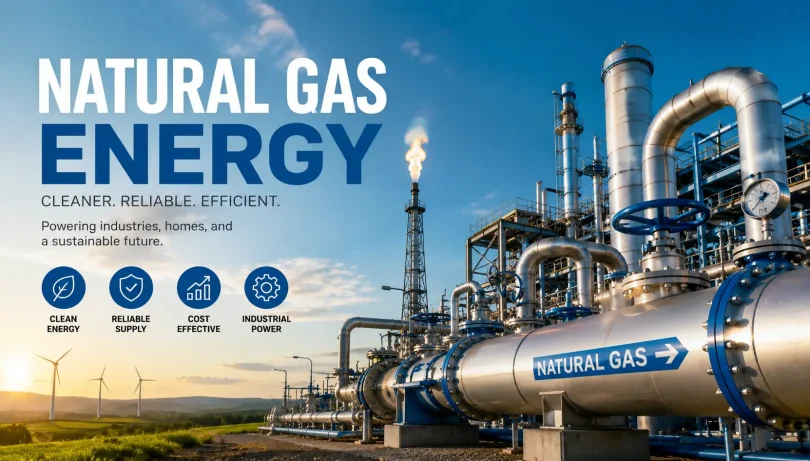

Natural gas energy powers a huge share of the world’s homes, industries, and power plants. It heats houses in winter, fuels electricity grids, and runs factories around the clock. Yet most people who rely on it every day know very little about how it works, where it comes from, or how it compares to other fuels like propane.
This guide breaks down everything you need to know about natural gas energy in plain language: its advantages and disadvantages, how it stacks up against propane, whether it counts as a renewable resource, and even a strange but important safety fact, whether natural gas is heavier or lighter than air. Every section is written to give you real, usable information rather than surface level answers.
TL;DR Summary
Natural gas energy is a nonrenewable fossil fuel made mostly of methane. It is cheaper and burns cleaner than coal or oil, offers high appliance efficiency, and is delivered through underground pipelines, but it still releases methane during leaks and cannot be replenished once reserves run out. Compared to propane, natural gas is generally cheaper and lighter than air, while propane is more energy-dense and heavier than air. Natural gas is used for home heating, cooking, electricity generation, manufacturing, and more, and it is expected to remain a major part of the global energy mix even as renewable sources continue to grow.
Quick Facts Box
| Category | Details |
|---|---|
| Fuel Type | Fossil fuel |
| Main Component | Methane (CH4) |
| Renewable? | No, nonrenewable |
| Cleaner than Coal? | Yes, roughly 50 percent less CO2 |
| Delivered by Pipelines? | Yes, through underground transmission and distribution lines |
| Density vs Air | Lighter than air (specific gravity approximately 0.55 to 0.65) |
| Common Uses | Home heating, cooking, electricity, manufacturing, chemicals, transportation |
What Is Natural Gas Energy?
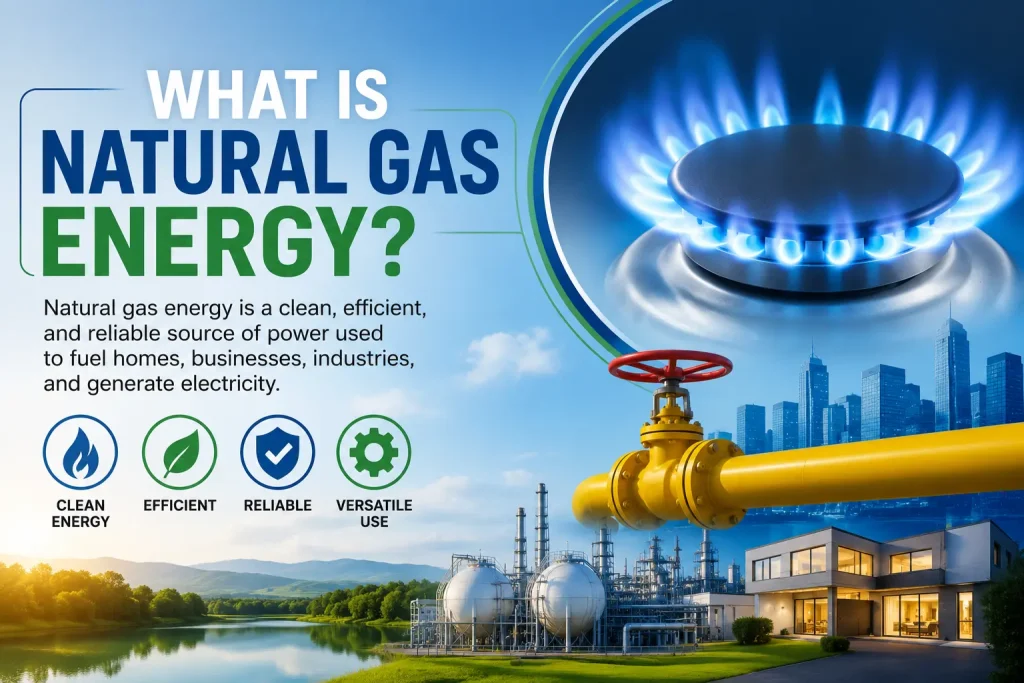
Natural gas is a fossil fuel found deep underground in porous rock formations, often alongside oil deposits. It formed over millions of years as heat and pressure broke down the remains of ancient plants and marine organisms. Chemically, it is mostly methane (CH4), along with smaller amounts of ethane, propane, and butane.
Once extracted, natural gas travels through processing plants where it is cleaned of water, oils, and other impurities. From there it moves through a vast network of interstate and local pipelines until it reaches homes, businesses, and power stations. In the United States, natural gas currently supplies roughly a third of total energy consumption, and it plays an even larger role in electricity generation.
Because it burns cleaner than coal or oil, is relatively affordable, and has an established delivery infrastructure, natural gas energy has become one of the most widely used fuels on the planet. But like every energy source, it comes with real trade offs, which is exactly what the rest of this guide covers.
Common Uses of Natural Gas
Natural gas energy shows up in far more places than most people realize. In homes, it is used for space heating, water heaters, and gas stoves, making it a daily part of cooking and comfort. On a larger scale, power plants burn natural gas to generate electricity for entire cities, often serving as a flexible backup to solar and wind.
Industries rely heavily on natural gas too. Manufacturing plants use it to power machinery, dry materials, and generate process heat, while the chemical industry uses natural gas as a raw material to produce fertilizers, plastics, and other everyday products. It also plays a role in transportation, where compressed natural gas (CNG) and liquefied natural gas (LNG) fuel buses, trucks, and some fleet vehicles as cleaner alternatives to gasoline and diesel.
From kitchens to power grids to factory floors, natural gas remains one of the most versatile fuels in use today.
Advantages of Natural Gas
Natural gas earns its popularity for good reasons. Here are the core advantages that make it a preferred energy choice for households, utilities, and industries.
1. Lower Cost Compared to Other Fossil Fuels
Natural gas is generally cheaper per unit of energy than oil, coal, or propane in most markets, thanks to abundant domestic reserves and mature extraction technology such as hydraulic fracturing. This keeps heating bills and industrial energy costs lower for millions of consumers.
2. Cleaner Combustion
When burned, natural gas releases significantly less carbon dioxide, sulfur dioxide, and particulate matter than coal or oil. Industry estimates suggest natural gas produces around 50 percent less CO2 than coal and about 30 percent less than oil for the same energy output, making it one of the cleanest burning fossil fuels available today.
3. High Efficiency
Modern natural gas furnaces and appliances routinely reach efficiency ratings between 81 and 98 percent, meaning very little energy is wasted during combustion. This translates directly into lower fuel consumption and reduced monthly costs.
4. Abundant and Reliable Supply
Natural gas reserves are large and well distributed globally. Government energy agencies estimate reserves capable of supplying current demand for decades, which supports price stability and reduces the risk of sudden shortages compared to more geographically concentrated fuels.
5. Supports Renewable Energy Integration
Solar and wind power do not generate electricity around the clock. Natural gas power plants can ramp up or down quickly, providing a dependable backup during cloudy days, calm winds, or peak demand hours. This makes natural gas an important bridge fuel while renewable infrastructure continues to expand.
6. Easy Storage and Transport
Natural gas can be transported through pipelines or shipped internationally as liquefied natural gas (LNG), which is cooled to a liquid state that takes up far less volume. This flexibility makes it easier to move across regions and countries compared to solid fuels like coal.
7. Domestic Production and Energy Security
Many countries, including the United States, produce large amounts of natural gas domestically. This reduces dependence on imported fuel, supports local jobs, and strengthens national energy security.
Disadvantages of Natural Gas
No energy source is perfect, and understanding the disadvantages of natural gas is just as important as knowing its benefits. Below are the most significant natural gas disadvantages that consumers, policymakers, and industries need to weigh carefully.
1. It Is a Non-Renewable Resource
Natural gas takes millions of years to form and cannot be replenished on any human timescale. Once current reserves are depleted, they are gone for good, which raises long-term questions about sustainability.
2. Methane Leaks and Greenhouse Gas Impact
While natural gas burns cleaner than coal, unburned methane released during extraction, processing, and transport is a far more potent greenhouse gas than carbon dioxide. Methane has a global warming potential that is roughly 28 to 34 times greater than CO2 over a century, and even higher over shorter timeframes. Leaks across the supply chain remain a serious environmental concern that regulators continue to monitor closely.
3. Environmental Risks from Extraction
Hydraulic fracturing, or fracking, is used to extract gas trapped in shale rock formations. This process has been linked to water contamination near drilling sites, increased seismic activity in some regions, and disruption of local ecosystems.
4. Still a Fossil Fuel
Despite being cleaner than coal and oil, natural gas is still a carbon-emitting fossil fuel. It does not offer a path to zero emissions on its own and cannot fully replace the long-term need for renewable energy sources.
5. Infrastructure Dependency
Homes and businesses without access to gas pipelines cannot easily use natural gas, and building new pipeline infrastructure is expensive and time-consuming. This limits its practicality in rural or remote areas.
6. Safety Concerns
Natural gas is highly flammable, and undetected leaks can lead to fires or explosions. Because natural gas itself is odorless, utility companies add a distinctive sulfur-like smell (using a chemical called mercaptan) so leaks can be detected quickly.
7. Price Volatility
Although generally affordable, natural gas prices can still fluctuate based on seasonal demand, geopolitical events, and supply disruptions, which can lead to unpredictable heating and utility costs during certain periods.
Pros and Cons of Natural Gas: Quick Comparison
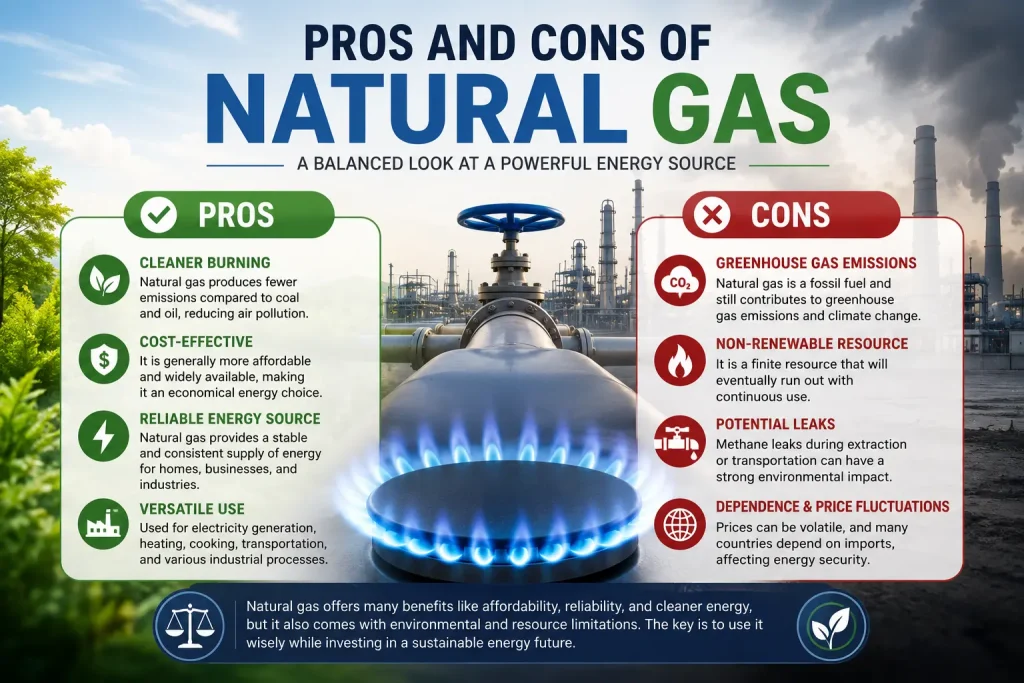
For a fast overview, here is a side by side summary of the pros and cons of natural gas covered above.
| Advantages | Disadvantages |
|---|---|
| Lower cost than oil, coal, and propane | Non-renewable resource |
| Burns cleaner than coal and oil | Methane leaks contribute to global warming |
| High appliance efficiency (81 to 98 percent AFUE) | Fracking can cause environmental damage |
| Abundant, well-distributed global reserves | Still a fossil fuel with carbon emissions |
| Supports renewable energy as a backup source | Requires pipeline infrastructure |
| Easy to store and transport, including as LNG | Highly flammable if leaks go undetected |
| Strengthens domestic energy security | Prices can fluctuate seasonally |
Understanding both sides helps households and businesses make informed choices about heating systems, appliances, and long-term energy planning.
Natural Gas vs Propane: Which One Is Better?
Natural gas and propane are often compared because both are used for home heating, cooking, and water heating. However, they differ significantly in composition, delivery, cost, and efficiency.
Composition and Delivery
Natural gas is delivered continuously through underground pipelines directly into homes and never needs to be stored on site. Propane, on the other hand, is a liquefied gas stored in an above-ground or buried tank on the property and refilled periodically by delivery trucks.
Energy Content (BTU Comparison)
Propane is more energy-dense than natural gas. One cubic foot of propane delivers roughly 2,500 BTUs, compared to about 1,030 BTUs for the same volume of natural gas. This means appliances burn less propane by volume to produce the same amount of heat, even though propane is typically priced higher per unit.
Cost Comparison
In most regions with existing pipeline access, natural gas costs less per unit of usable heat than propane. Average monthly heating costs with natural gas typically run around 30 to 60 dollars, while propane heating can range from 90 to 200 dollars per month, depending on location and appliance efficiency. However, in rural areas without natural gas lines, propane often becomes the more practical and sometimes more economical option once installation and infrastructure costs are factored in.
Environmental Impact
Both are considered relatively clean fossil fuels compared to coal or oil. Propane produces slightly less carbon dioxide per unit of energy and is not a greenhouse gas itself when it leaks, since it does not linger in the atmosphere the way methane does. Natural gas, however, emits methane during leaks, which has a stronger short-term warming effect.
Safety and Handling
Propane is heavier than air and will sink and pool near the ground during a leak, while natural gas is lighter than air and rises and disperses quickly. Each requires different placement of gas detectors: propane detectors are installed low, near the floor, while natural gas detectors are placed near the ceiling.
Which Should You Choose?
If your home already has access to a natural gas pipeline, it is usually the more affordable and convenient option. If you live in a rural area without pipeline access, or you need a portable and flexible fuel source, propane is often the more practical choice despite its higher per-unit price.
Is Propane Natural Gas?
This is one of the most common points of confusion, and the short answer is no, propane is not natural gas, although the two are closely related.
Propane is actually a byproduct that is separated out during natural gas processing and petroleum refining. Raw natural gas extracted from underground contains methane along with smaller amounts of ethane, propane, and butane. Processing plants remove these heavier hydrocarbons, including propane, so that the natural gas delivered through pipelines is almost pure methane.
In simple terms:
- Natural gas is composed mainly of methane and is delivered as a gas through pipelines.
- Propane is a separate hydrocarbon (C3H8) that is extracted from raw natural gas or crude oil, then compressed into a liquid for storage in tanks.
Because of this relationship, propane is sometimes called liquefied petroleum gas (LPG), and while it shares an origin with natural gas, it behaves very differently in terms of density, storage, and combustion characteristics, as outlined in the comparison above.
Is Natural Gas Renewable or Nonrenewable?
Natural gas is a nonrenewable energy source. It forms from the compressed remains of ancient marine organisms and plants that were buried under layers of sediment and subjected to intense heat and pressure over millions of years. Because this natural process takes such an extraordinarily long time, natural gas cannot be replenished within a human lifetime once it is extracted and consumed.
This classification places natural gas in the same category as coal and oil, the other two major fossil fuels. All three share a common origin story rooted in ancient organic matter, and all three are considered finite resources.
That said, natural gas is often described as a bridge fuel in discussions about the transition toward renewable energy. Because it burns cleaner than coal and can quickly complement solar and wind power when those sources are not generating electricity, many energy planners view it as a practical stepping stone toward a lower-carbon grid, even though it does not qualify as renewable itself.
It is worth noting that a distinct product called renewable natural gas (RNG) does exist. RNG is produced from decomposing organic waste in landfills, wastewater treatment plants, and agricultural operations, and it is chemically similar to conventional natural gas. However, RNG is a separate, engineered product and should not be confused with the geologically formed natural gas that this guide focuses on.
Is Natural Gas Heavier Than Air?
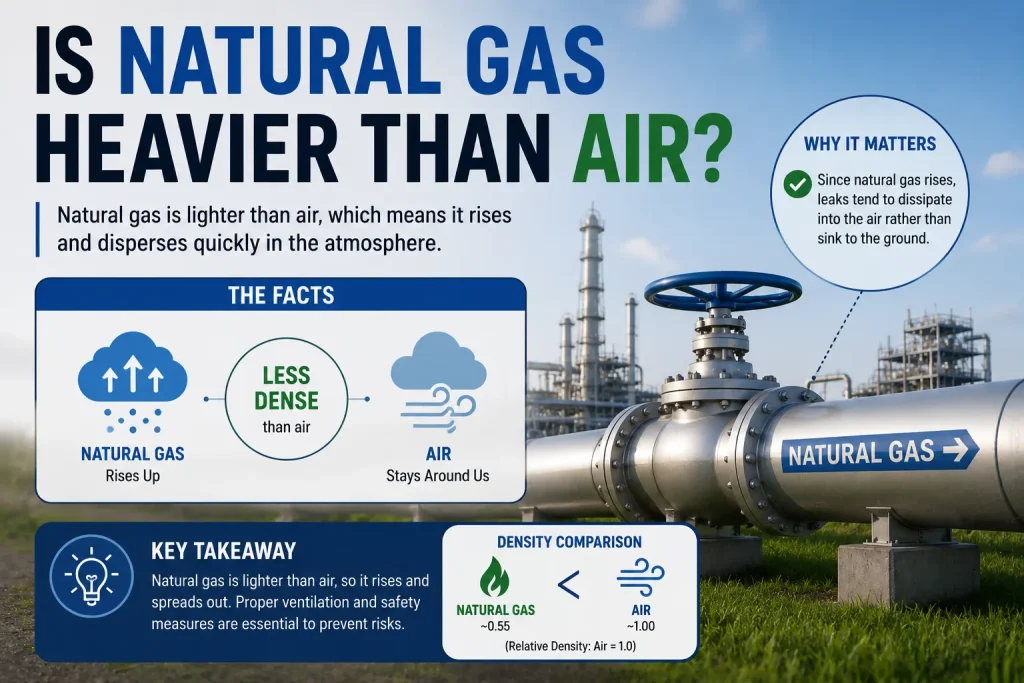
No, natural gas is lighter than air, and this property has real safety implications for anyone who uses it at home or at work.
The Science Behind It
Natural gas is composed mostly of methane (CH4), which has a molecular weight of approximately 16 grams per mole. Air, by comparison, is a mixture dominated by nitrogen and oxygen, with an average molecular weight of about 29 grams per mole. Because methane molecules weigh significantly less, natural gas as a whole has a lower density than the surrounding air, with a specific gravity of roughly 0.55 to 0.65 relative to air.
In practical terms, the density of air is about 1.2 kilograms per cubic meter, while methane sits at roughly 0.7 kilograms per cubic meter under standard conditions.
Why This Matters for Safety
Because natural gas is lighter than air, a leak inside a building will rise toward the ceiling and upper areas of a room rather than settling near the floor. This behavior directly affects how safety systems are designed:
- Natural gas detectors should be installed high on walls or on ceilings, where leaking gas is most likely to accumulate.
- If a leak is suspected, opening high windows or vents allows the gas to escape upward and outward rather than building up to dangerous concentrations.
- This is the opposite of propane, which is heavier than air and sinks toward the floor, requiring detectors to be placed near the ground instead.
While being lighter than air helps natural gas disperse more quickly in open or ventilated spaces, it does not eliminate risk entirely. In enclosed areas with poor airflow, gas can still accumulate near ceilings and reach flammable concentrations, which is why professional installation, regular maintenance, and properly placed detectors remain essential.
How Natural Gas Reaches Your Home
Understanding the journey natural gas takes can help clarify why it is priced and delivered the way it is.
Natural Gas
     ↓
 Processing
     ↓
  Pipeline
     ↓
   Homes
     ↓
Power Plant
- Extraction: Natural gas is drawn from underground reservoirs, often using drilling and, in the case of shale gas, hydraulic fracturing.
- Processing: At a processing plant, natural gas is purified by removing water, oil, and other impurities that could damage pipelines or appliances.
- Transmission: Once cleaned, the gas travels through large interstate or intrastate transmission pipelines across long distances.
- Distribution: Local utility companies direct the gas into smaller distribution pipelines known as mains.
- Delivery: Service lines connect the mains to individual homes and businesses, delivering a continuous, on-demand supply without the need for on-site storage tanks.
This infrastructure is one of the reasons natural gas remains more convenient than propane in areas where pipelines already exist, since customers never have to schedule deliveries or monitor tank levels.
Natural Gas and the Future of Energy
As countries work to reduce carbon emissions, natural gas occupies a complicated middle ground. It produces fewer emissions than coal and oil, making it attractive as a transitional fuel, yet it remains a finite, carbon-emitting resource that cannot serve as a permanent long-term solution on its own.
Several developments are shaping its future role:
- Methane leak reduction: Stricter regulations and improved monitoring technology are being deployed to detect and reduce methane leaks across extraction and distribution networks.
- LNG expansion: Liquefied natural gas allows countries without pipeline access to import natural gas by ship, expanding its global reach and supporting energy security in more regions.
- Renewable natural gas (RNG): Captured from organic waste, RNG offers a lower-carbon alternative that can be blended into existing natural gas infrastructure without major equipment changes.
- Hybrid energy systems: Many utilities now pair natural gas plants with solar and wind installations, using gas as a flexible backup that fills gaps when renewable generation drops.
For the foreseeable future, natural gas energy is likely to remain a significant part of the global energy mix, even as renewable sources continue to grow.
Frequently Asked Questions
Is natural gas better than electricity for home heating?
Natural gas heating is often cheaper to operate than standard electric resistance heating, especially in colder climates, though modern heat pumps can be competitive in milder regions with lower electricity rates.
Can natural gas appliances be converted to propane, or vice versa?
Yes, most appliances can be converted between the two fuels using a conversion kit, but this should always be done by a licensed professional to ensure safety.
Why does natural gas smell like rotten eggs if it is naturally odorless?
Utility companies intentionally add a chemical called mercaptan to natural gas so that leaks can be detected quickly by smell, since pure natural gas has no odor of its own.
Is natural gas safer than propane?
Both fuels are considered safe when installed and maintained correctly. Natural gas disperses upward and dissipates faster in open spaces due to being lighter than air, while propane requires different safety precautions since it sinks and pools near the ground.
Will the world run out of natural gas?
Current estimates suggest existing reserves can support demand for several more decades, but because natural gas is nonrenewable, long-term energy planning increasingly includes a shift toward renewable alternatives.
Final Thoughts
Natural gas energy plays a central role in how homes are heated, how factories operate, and how electricity grids stay balanced. Its advantages, affordability, cleaner combustion, high efficiency, and reliable supply, explain why it remains so widely used. At the same time, its disadvantages, including methane emissions, extraction risks, and its status as a nonrenewable resource, are real factors that deserve honest consideration.
Whether you are comparing natural gas vs propane for your home, trying to understand if natural gas is renewable or nonrenewable, or simply curious whether natural gas is heavier than air, the goal should always be making informed decisions based on accurate information. As the energy landscape continues to evolve, natural gas will likely remain an important, if imperfect, part of the transition toward a cleaner energy future.
References
- U.S. Energy Information Administration (EIA)
- International Energy Agency (IEA)
- U.S. Environmental Protection Agency (EPA)
You May Also Like It:
CNC Machining Tolerances: The Complete Expert Guide
MIG vs TIG Welding: Complete Guide to Differences and Procedures