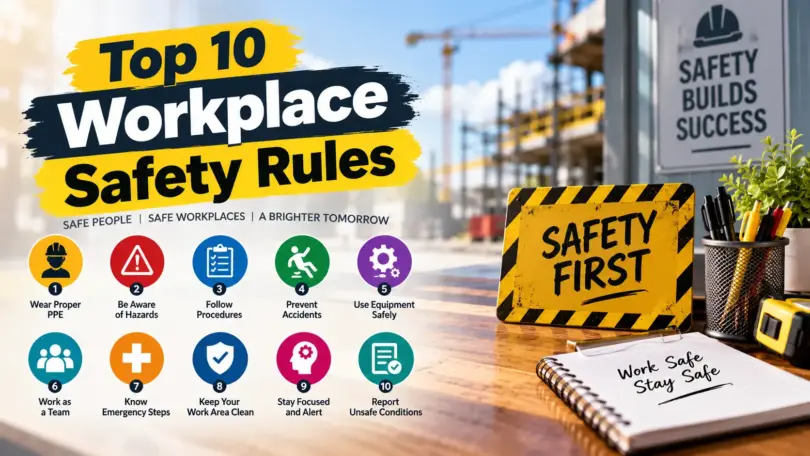

Workplace safety rules are structured protocols that reduce operational hazards, protect employee health and keep the organization compliant with regulations such as OSHA (or the equivalent labor and safety laws in your country). A safe workplace moves from a reactive mindset, where action starts after someone is hurt, to a proactive culture of continuous risk management.
Whether you run a heavy manufacturing plant, manage a busy medical center or oversee a corporate office, the ten rules below form the foundation of an incident-free workplace. Each rule explains why it matters, what to do, which mistakes to avoid and how to put it into practice from the next shift.
Why Workplace Safety Rules Matter
Every injury has a human cost: pain, lost income and stress for the worker and their family. It also has a business cost: lost production time, investigation effort, higher insurance and compensation claims, damaged equipment and falling morale. Prevention is almost always cheaper and far kinder than response.
Safety professionals often describe the best protection as a hierarchy of controls. In order of effectiveness, you should first eliminate the hazard, then substitute something safer, then use engineering controls (guards, ventilation), then administrative controls (procedures, training, scheduling), and only then rely on PPE. Keep this order in mind as you read the rules: PPE is essential, but it is the last barrier, not the first.
1. Maintain Comprehensive Hazard Awareness
Every employee must be trained to recognize and evaluate the threats specific to their work. You cannot avoid a hazard you do not see, and hazards change as tools, materials, weather and people change.
Action items
- Complete a Job Hazard Analysis (JHA) before starting any unfamiliar task: list the steps, identify the hazard at each step and decide on the control.
- Look in all directions before you begin: active machinery, overhead loads, moving vehicles, electrical sources, chemical lines, noise and uneven surfaces.
- Hold a short pre-shift briefing to share the day’s specific risks, such as a crane lift, hot work or a wet floor.
- Learn the warning signs, colors and labels used in your facility so you can read a hazard at a glance.
Common mistake
Assuming a familiar task is a safe task. Most incidents on routine jobs happen because conditions changed and nobody re-checked.
Why it works: continuous hazard identification stops incidents before they interrupt people and production.
2. Enforce Mandatory Personal Protective Equipment (PPE) Usage
Required safety gear is non-negotiable. PPE is your last line of defense against physical, chemical and biological threats, so it must be the right type, the right size and in good condition.
Action items
- Inspect your PPE before every shift: hard hats, safety glasses, gloves, hearing protection, respirators, steel-toed boots and high-visibility vests.
- Replace anything cracked, deformed, faded, torn or heavily worn immediately. Damaged PPE gives a false sense of security.
- Match the equipment to the hazard. Safety glasses are not chemical splash goggles, and a dust mask is not a respirator.
- Make sure PPE fits properly and is stored clean and dry. Respirators in particular need correct fitting and maintenance.
- Supervisors should lead by example and wear PPE every time they enter a designated area.
Common mistake
Removing PPE “just for a minute” because it is uncomfortable. If gear is uncomfortable, report it so a better-fitting option can be provided.
3. Implement Strict Housekeeping and Cleanliness Rules
Slips, trips and falls are among the leading causes of avoidable injuries in every industry. A cluttered space is an inherently dangerous space, and poor housekeeping also adds fire risk and blocks emergency access.
Action items
- Follow a clean-as-you-go policy: put tools back, remove packaging and dispose of waste as you work.
- Keep walkways, stairs, emergency exits, fire extinguishers and electrical panels clear of debris, cords and stock at all times.
- Clean up fluid leaks and chemical spills the moment they occur, and place a wet-floor sign until the surface is dry.
- Route cables safely using covers or overhead routing instead of across walkways.
- Store heavy items low and lighter items high, and never stack materials beyond a stable height.
- Keep lighting adequate in corridors, stairwells and storage areas.
4. Report All Hazards and Near-Misses Immediately
Waiting to report a loose railing or a faulty wire until an accident happens is a costly mistake. A strong safety culture gives everyone the right, and the responsibility, to speak up. A near-miss is an event that did not cause injury or damage but easily could have.
Action items
- Use your facility’s incident-reporting system to flag unsafe conditions to your supervisor right away. If a hazard is serious, stop the work and keep others away.
- Treat every near-miss like a recorded injury: record what happened, find the root cause (for example with the “5 Whys” method) and assign a fix with an owner and a date.
- Close the loop. Tell the person who reported the problem what was done about it, so they keep reporting.
- Leadership should make reporting free of blame. People stop reporting when they fear punishment.
5. Follow Lockout/Tagout (LOTO) and Energy Isolation Controls
When machinery is being serviced or cleaned, an unexpected startup or the release of stored energy can cause severe, life-changing injuries. Lockout/tagout makes sure equipment stays off until the work is finished.
Action items
- Never repair or clean a machine until the zero-energy state is verified using approved LOTO devices.
- Follow the standard sequence: prepare, shut down, isolate, apply lock and tag, release stored energy, verify isolation. Stored energy includes electrical, hydraulic, pneumatic, thermal, gravity and spring tension.
- Each authorized worker applies their own personal lock. Only the person who applied the lock may remove it.
- Before restarting, check that tools are removed, guards are back in place and everyone is clear of the machine.
- Review the written energy-control procedure for each machine and audit it regularly.
Common mistake
Relying on a switch or a tag alone. A tag is a warning, not a physical barrier, and a switch can be turned on by someone else or fail. Always lock and verify.
6. Practice Proper Ergonomic Safety and Lifting Form
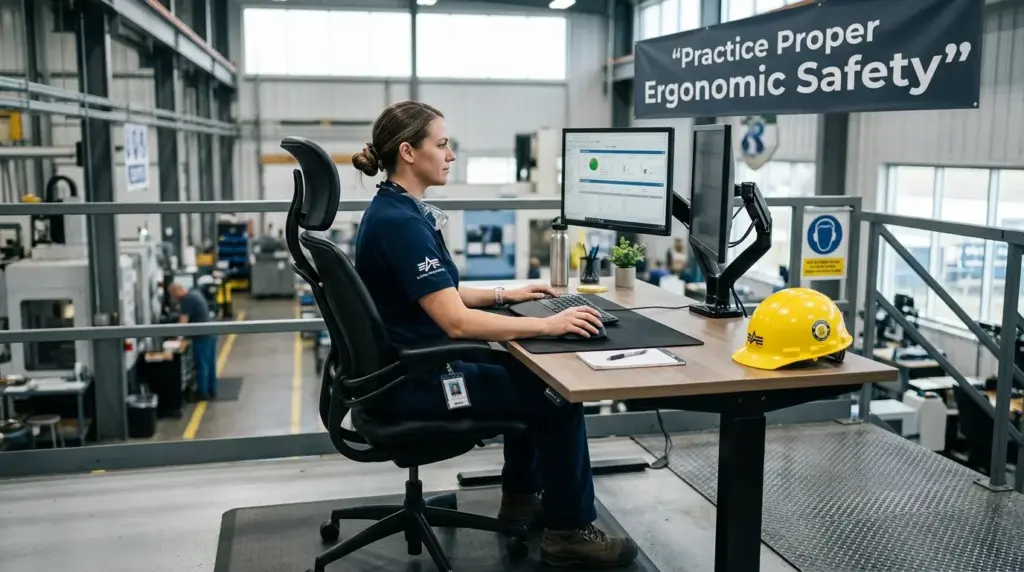
Musculoskeletal disorders caused by poor lifting technique, repetitive motion or badly set-up workstations are a major source of lost workdays and compensation claims across every sector, from warehouses to offices.
Safe lifting
- Check the load first: its weight, shape and grip points, and the path you will walk. If it is too heavy or awkward, get help or use a trolley, hoist or forklift.
- Bend at the knees, not the waist. Keep your back straight, feet shoulder-width apart and the load close to your torso.
- Lift with your legs, avoid twisting your body, and turn by moving your feet.
- Set the load down the same way you picked it up.
Desk and workstation ergonomics
- Place the top of the monitor at or slightly below eye level, about an arm’s length away.
- Sit with your feet flat on the floor or on a footrest, knees at about 90 degrees and your lower back supported.
- Keep wrists straight and elbows close to the body when typing or using a mouse.
- Stand, stretch and change posture at regular intervals, and look away from the screen periodically to rest your eyes.
7. Never Operate Equipment Without Official Training
Using a specialized tool or machine without authorization and certification invites disaster. Training turns written procedures into safe habits.
Action items
- If you have not been formally trained and authorized to operate a specific forklift, lathe, press, crane or chemical system, do not touch it. Ask your supervisor.
- Complete refresher training on a regular schedule and whenever equipment, software, processes or regulations change.
- Perform a pre-use check on equipment and tag out anything defective so nobody uses it.
- Keep training records up to date so certifications never lapse unnoticed.
- New hires, contractors and temporary workers need site-specific safety induction before they begin work.
8. Master the Emergency Evacuation Plan
When a crisis strikes, such as a structural fire, toxic gas leak, medical emergency or natural disaster, panic can cost lives. Clear, rehearsed direction saves them.
Action items
- Study your building’s evacuation plan and know at least two exit routes from your work area.
- Memorize the locations of exits, fire extinguishers, first-aid kits, eye-wash stations, emergency showers and the assembly point.
- Take part in every fire drill and treat it as real. Walk, do not run, and do not use lifts during a fire.
- Know who your floor wardens and first-aiders are, and how to raise the alarm.
- Make sure the plan accounts for visitors and for people who need extra assistance to evacuate.
9. Manage Fatigue by Taking Scheduled Breaks
Exhaustion reduces focus, slows reaction time and increases basic mistakes. Fatigue is a safety hazard in its own right, particularly for drivers, machine operators and anyone doing repetitive or precision work.
Action items
- Take your scheduled breaks to rest your mind and body, especially during physically heavy or high-concentration tasks.
- Stay hydrated through the shift to reduce dizziness, brain fog and muscle cramps, and eat regular meals.
- Tell your supervisor if you are too tired to work safely. Do not push through the warning signs: microsleeps, yawning, drifting attention and blurred vision.
- Employers should design shift patterns that allow adequate rest between shifts and limit excessive overtime.
- In hot environments, add shade, cool water and extra rest breaks to prevent heat illness.
10. Eliminate Shortcuts and Maintain Total Sobriety
Speed must never be prioritized over human safety. Bypassing a machine guard or skipping a safety step to finish faster is a gamble with your life and the lives of your coworkers.
Action items
- Follow every step of the standard operating procedure (SOP). If a procedure is impractical, report it so it can be corrected rather than ignored.
- Never remove, disable or work around guards, interlocks, alarms or safety devices.
- Keep a zero-tolerance approach to alcohol, illegal drugs and impairing medication while on duty. If a prescription may affect your alertness, tell your supervisor so your duties can be adjusted.
- Do not use mobile phones while operating vehicles or machinery.
- Everyone has the authority to stop work if something looks unsafe, without fear of blame.
Workplace Safety Categories and Standards at a Glance
The table below shows how the main safety categories connect to compliance requirements and the hazards they prevent. Exact legal requirements vary by country and industry, so always check the rules that apply to your site.
| Safety category | Regulatory focus area | Primary hazards addressed | Related rules |
|---|---|---|---|
| Mechanical safety | Machine guarding and lockout/tagout | Amputations, crushing injuries, unexpected startups | 5, 7, 10 |
| Environmental safety | Housekeeping, walking surfaces, fire prevention and evacuation | Slips, trips, falls, fire and smoke inhalation | 3, 8 |
| Chemical safety | Hazard communication and Safety Data Sheets (SDS) | Toxic exposure, chemical burns, explosions | 1, 2, 4 |
| Ergonomic safety | Correct lifting and workstation fit | Chronic back strain, repetitive motion injuries | 6, 9 |
| Human factors | Training, fatigue management and fitness for duty | Errors from fatigue, impairment or lack of competence | 7, 9, 10 |
Daily Safety Checklist
Print this list or use it in a daily huddle. If you cannot tick every item, fix the gap before you start work.
- I know today’s tasks and their main hazards.
- My PPE is inspected, fits correctly and is in good condition.
- My work area is clean, and exits and electrical panels are clear.
- Machines I will service are locked out and verified at zero energy.
- I am trained and authorized for every piece of equipment I will use.
- I know my exits, assembly point and the nearest first-aid kit.
- I am rested, hydrated and fit to work.
- I will report any hazard or near-miss straight away.
Frequently Asked Questions
What are the most important workplace safety rules?
The ten most important rules are: recognize hazards, wear the right PPE, keep the workplace clean, report hazards and near-misses, follow lockout/tagout, lift and work ergonomically, operate only equipment you are trained on, know the emergency plan, manage fatigue, and never take shortcuts or work impaired.
What is a near-miss and why should it be reported?
A near-miss is an unplanned event that did not cause injury or damage but easily could have. Reporting it lets the organization find and fix the root cause before someone is actually hurt.
What is lockout/tagout (LOTO)?
Lockout/tagout is a procedure that keeps machinery from starting up or releasing stored energy during maintenance or cleaning. Each authorized worker applies a personal lock and tag to the energy-isolating device, verifies zero energy, and is the only person who removes that lock.
How often should safety training be repeated?
Give refresher training whenever equipment, processes or regulations change, after an incident or near-miss reveals a knowledge gap, and at regular intervals set by your safety program and local regulations.
Do office workplaces need safety rules too?
Yes. Offices have risks such as slips and trips, poor ergonomics, overloaded electrical outlets, blocked exits and fire. Housekeeping, ergonomics, reporting and emergency evacuation rules apply to every workplace.
The Bottom Line
A safe workplace is not built on luck. It is engineered through consistent, predictable discipline. Build these ten rules into daily huddles, shift handovers, training plans and company policy, and make sure leaders model them first. When management and workers share responsibility for safety, every employee can go home safely at the end of the day.
This guide offers general safety information and does not replace the laws, standards or site-specific procedures that apply to your workplace. Consult a qualified safety professional for your specific situation.
You May Also Like It:
Industrial Safety Shoes: How to Pick a Pair That Fits Your Hazards
OSHA 10 vs OSHA 30: Which Certification Do You Actually Need?
Emergency Preparedness: The Complete Guide to Protecting People, Property, and Operations