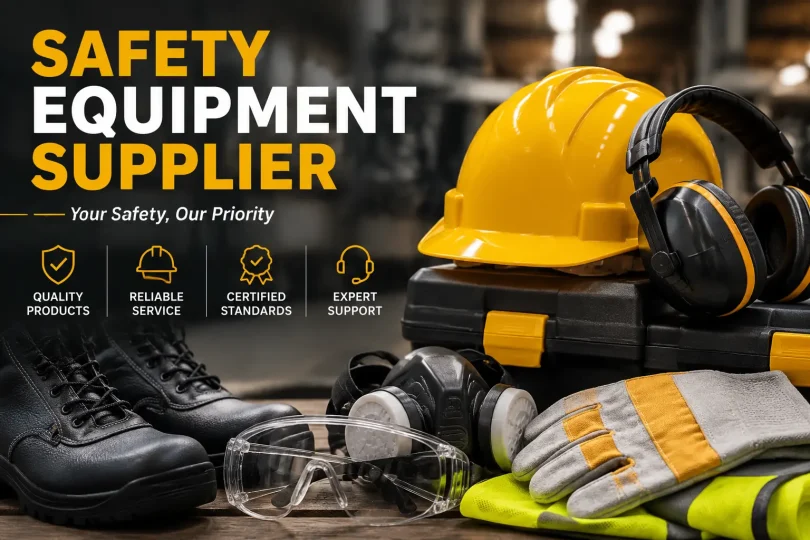

The best safety equipment supplier should offer OSHA-compliant PPE, reliable product quality, competitive pricing, fast shipping, and knowledgeable customer support. For businesses, the right supplier should also provide products suited to specific workplace hazards, including fall protection, head and eye protection, respiratory equipment, protective clothing, and workplace safety supplies.
When choosing a supplier, compare product certifications, inventory, pricing, delivery options, customer service, and industry experience. For urgent requirements, look for a safety equipment supplier near you that offers same-day pickup or local delivery.
What a Safety Equipment Supplier Actually Does
A safety equipment supplier, sometimes called a PPE supplier or personal protective equipment supplier, sources, stocks, and distributes workplace safety equipment from manufacturers to businesses. That includes hard hats, safety glasses, respirators, gloves, hearing protection, fall protection systems, high visibility apparel, gas detection devices, first aid supplies, and emergency response equipment such as eyewash stations and fire extinguishers.
The strongest suppliers do more than fulfill orders. They help you interpret which OSHA standard applies to your facility, recommend the correct ANSI rated product for a specific hazard, manage recurring stock so you never run short on gloves or respirator cartridges, and provide documentation you can hand to an auditor. Weak suppliers simply take your order and ship a box.
Supplier vs Distributor: What Is the Difference?
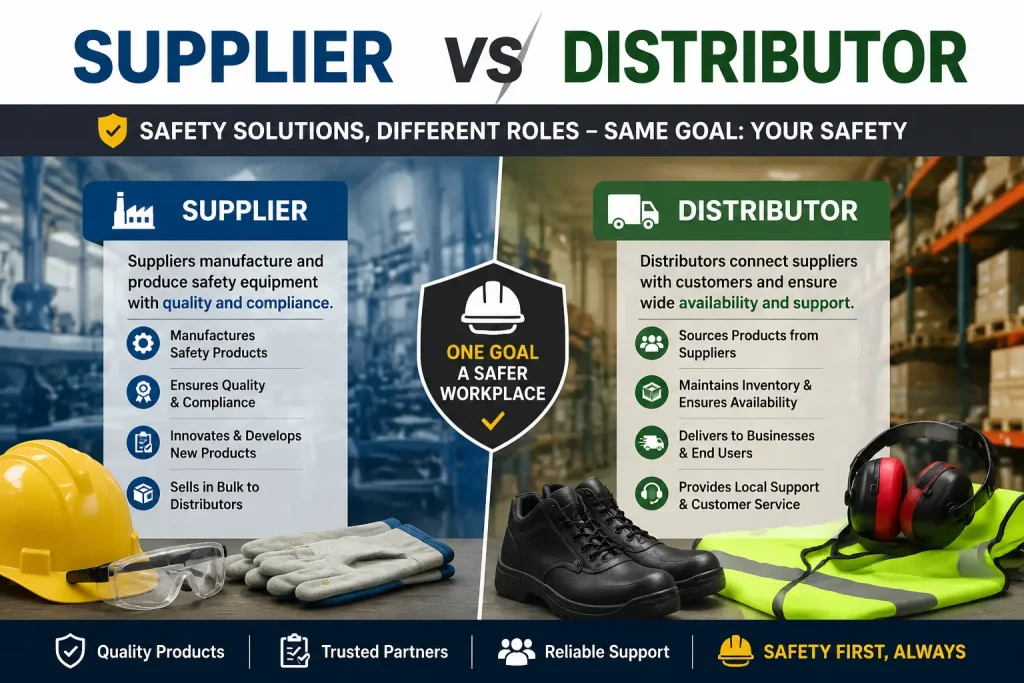
The terms are often used interchangeably, but there is a meaningful distinction worth understanding before you sign a vendor agreement.
- A manufacturer produces the safety product itself, such as 3M making respirators or MSA making gas detectors.
- A distributor, also called a PPE distributor, buys in volume from multiple manufacturers and resells to businesses, usually holding the physical inventory in regional warehouses.
- A supplier is the broader term that can refer to either a manufacturer or a distributor, essentially anyone positioned to supply you with safety products.
In practice, most businesses work with distributors because a single account gives access to dozens of brands at once instead of managing separate relationships with every manufacturer. When comparing options, ask directly whether a company manufactures its own line, distributes third party brands, or does both, since that answer affects pricing, lead times, and how much technical support you can expect.
Online vs Local Supplier: Which One Fits Your Business?
Online, national suppliers such as Grainger or Global Industrial offer the deepest catalogs, published pricing, and fast nationwide shipping. They are ideal for routine, predictable restocking of standard workplace safety equipment.
Local suppliers offer advantages a national catalog cannot replicate: same day pickup during an urgent shortage, in-person fitting for respirators and harnesses, and a relationship with a rep who already knows your facility’s hazards. This is exactly why so many procurement teams still search for a safety equipment supplier near me instead of relying solely on a national account.
Many companies land on a hybrid model: a national account for routine PPE, paired with a local commercial safety equipment supplier for urgent or specialized needs. There is no universally correct answer; it depends on your order volume, how unpredictable your demand is, and how quickly you need replacement gear on site.
How to Verify a Safety Equipment Supplier Before You Buy
Before signing a purchase order or a vendor contract, run these checks:
- Ask for certificates of conformity on any product category you plan to order regularly, not just a sample item.
- Confirm business registration and insurance. A legitimate industrial PPE supplier should carry general liability and product liability coverage and be willing to share proof.
- Check for verifiable customer references, ideally from businesses in your own industry, since a supplier’s strength in healthcare PPE does not guarantee the same strength in construction safety supplies.
- Look up their standing with manufacturers. Authorized dealers are listed on manufacturer websites; if a supplier claims to sell a major brand but is not listed as an authorized reseller, ask why.
- Review their return, warranty, and recall process. A supplier who cannot explain what happens if a batch is recalled is not one you want holding your safety stock.
Safety Equipment Supplier Certifications to Look For
A credible supplier should be able to speak fluently about the certifications behind their catalog, and ideally hold relevant business certifications themselves, such as:
- ISO 9001 for quality management systems
- WBENC or minority owned business certification, relevant for companies with supplier diversity requirements
- Authorized distributor status directly from manufacturers like 3M, Honeywell, or MSA
- Compliance with ANSI/ISEA 125, the voluntary standard covering PPE conformity assessment and market surveillance
Asking a supplier to walk you through their certifications is one of the fastest ways to separate a serious commercial safety equipment provider from a reseller simply relisting products from a marketplace.
Top Safety Equipment Suppliers in the USA (2026 Comparison)
Below is an honest comparison of the suppliers and manufacturers that come up most often in industrial procurement. This reflects publicly available information about product range, specialization, and reputation, not a paid placement.
| Supplier | Best Industry | Shipping | Branches | Same Day Pickup | Price Level | Website |
|---|---|---|---|---|---|---|
| Grainger | General industry, facilities | Next day, most US zip codes | 250+ US branches | Yes, at branch locations | Mid to premium | grainger.com |
| Global Industrial | Multi category procurement | 1 to 3 days | Limited physical branches | No | Mid range | globalindustrial.com |
| MSC Industrial Supply | Manufacturing | 1 to 2 days | 100+ US branches | Yes, select locations | Mid to premium | mscdirect.com |
| R.S. Hughes | Aerospace, automotive, manufacturing | 1 to 3 days | 40+ US branches | Yes, at branch locations | Premium | rshughes.com |
| Uline | Warehousing, general workplace safety | Next day, most orders | 12+ distribution centers | No | Mid range | uline.com |
| IndustrialSafety.com | General PPE, standard compliance | 1 to 3 days | Online only | No | Budget to mid range | industrialsafety.com |
| Airgas | Welding, gas detection | 1 to 2 days | 900+ US locations | Yes, at branch locations | Mid to premium | airgas.com |
| Eagle Manufacturing / Justrite | Chemical and fire safety | Varies by order size | Manufacturer direct | No | Premium | justrite.com |
| PK Safety | Specialty gear, gas monitor service | 1 to 3 days | Online plus service center | No | Mid range | pksafety.com |
| DeFusco Industrial Supply | Masonry, tile, flooring trades | 1 to 3 days | Online, ships US and Canada | No | Mid range | defusco.com |
Manufacturers whose products commonly appear across these suppliers’ catalogs include 3M, Honeywell, MSA Safety, DuPont, MCR Safety, Protective Industrial Products, Bullard, and Pyramex. When comparing suppliers, it is often more useful to ask which brands they stock and how deep that stock runs, rather than comparing supplier names alone.
Bulk Purchasing and Wholesale Pricing
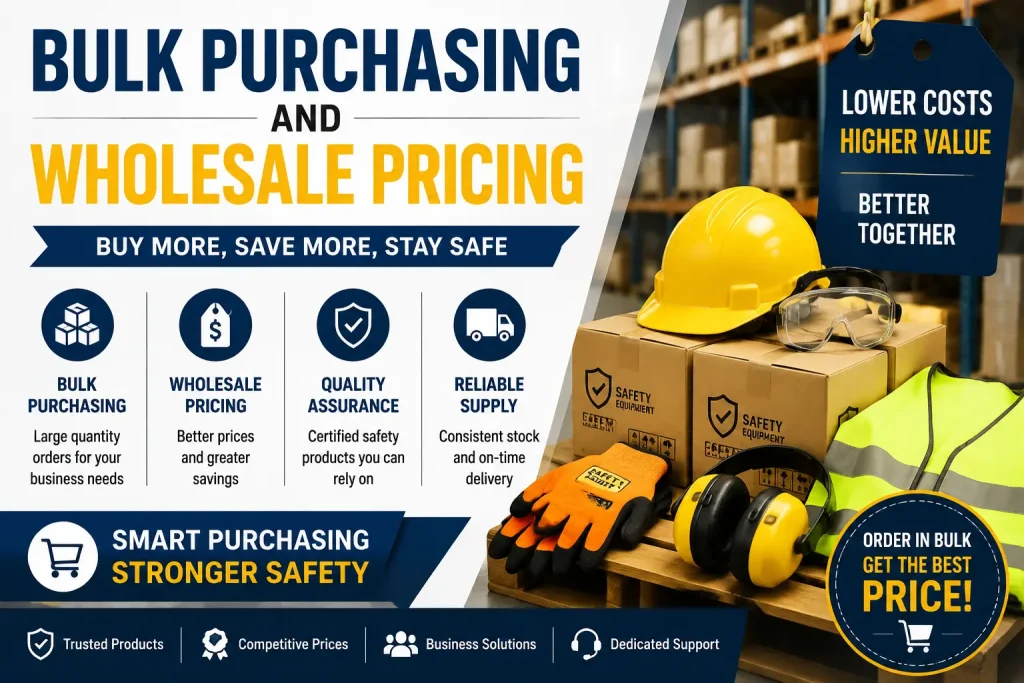
Most industrial safety suppliers offer tiered wholesale pricing once order volume crosses a threshold, commonly starting around case quantities and increasing at pallet or full truckload levels. Before committing to a bulk order:
- Ask whether pricing tiers are published or negotiated case by case.
- Confirm whether bulk pricing requires a minimum annual spend or a signed purchasing agreement.
- Check shelf life on items like respirator cartridges and disposable gloves before buying in large quantities, since expired stock is a common and avoidable waste of budget.
- Ask about drop shipping to multiple job sites if you manage several locations, since this can eliminate a layer of internal redistribution.
Bulk purchasing works best for predictable, recurring items such as gloves, safety glasses, and disposable respirators. It works less well for sized items like harnesses and boots, where overordering a size that does not fit your workforce simply becomes dead stock.
Custom Branded PPE
Many suppliers now offer custom branding on high visibility vests, hard hats, and safety apparel, printing a company logo for site identification, contractor compliance, or brand consistency on client facing job sites. This typically adds a per unit fee and a minimum order quantity, so it is most cost effective for companies ordering standardized workwear across many employees rather than small or highly variable orders. If custom branded gear matters to you, confirm turnaround time separately from standard shipping time, since branding is usually a separate production step.
Vendor Contracts and Safety Audits
Larger organizations, especially those with multiple facilities, often move beyond one off purchase orders into a formal vendor contract. A well structured contract should define:
- Guaranteed lead times and penalties for late fulfillment
- Fixed or capped pricing for a defined term
- Responsibility for recall notifications and replacement stock
- Rights to conduct a supplier safety audit, particularly for suppliers providing life critical gear such as fall protection or respiratory equipment
A supplier safety audit reviews the vendor’s own quality control process, warehouse handling conditions, and documentation trail from manufacturer to your loading dock. This is standard practice in regulated industries like pharmaceuticals and aerospace, and it is increasingly common in general manufacturing and construction procurement as companies tighten their own compliance programs.
Procurement Checklist for Workplace Safety Equipment
Use this checklist when evaluating or re-evaluating any safety products supplier:
- [ ] Hazard assessment completed and documented for the relevant work area
- [ ] Correct standard identified for each PPE category, for example ANSI Z87.1 or NIOSH approval
- [ ] Supplier certificates of conformity on file for each product line
- [ ] Confirmed authorized dealer status for major brands carried
- [ ] Pricing tiers and wholesale terms reviewed in writing
- [ ] Return, warranty, and recall procedures understood
- [ ] Lead times confirmed against your actual usage rate, not just advertised shipping speed
- [ ] Local pickup option identified for emergency shortages
- [ ] Vendor contract reviewed for penalty clauses and audit rights
- [ ] Training and fit testing support confirmed for items like respirators and harnesses
Industrial Safety Supplies: What Every Facility Should Have on Hand
Regardless of which supplier you choose, most facilities need coverage across these categories:
- Eye and face protection: ANSI Z87.1 safety glasses, goggles, and face shields for debris, chemical splash, or radiation exposure
- Respiratory protection: NIOSH certified respirators, with fit testing for tight fitting models
- Head protection: Type I or Type II hard hats rated Class E, G, or C depending on electrical exposure
- Hearing protection: Earplugs or earmuffs rated for environments exceeding 85 decibels
- Hand protection: Gloves matched to the specific hazard, whether cut resistance, chemical permeation, or thermal protection
- Fall protection: Harnesses, lanyards, anchors, and guardrails for work at six feet or higher
- Foot protection: ASTM F2413 rated boots, with EH rating where electrical hazards exist
- Emergency response: Eyewash stations reachable within ten seconds, emergency showers, and stocked first aid kits
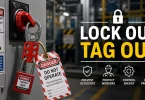
- Lockout/tagout supplies: Standardized locks and tags for machinery maintenance
Maintaining consistent industrial safety supplies across all of these categories is what actually keeps an OSHA inspection uneventful, rather than any single premium purchase.
Understanding OSHA and ANSI Compliance When Buying Safety Supplies
OSHA’s Part 1910 governs general industry while Part 1926 covers construction, and the specific clause that applies to your facility determines which safety equipment you legally need. A supplier worth working with should be able to point to the exact standard behind a recommendation rather than a vague claim that a product is “OSHA approved,” a phrase OSHA itself has stated is misleading since the agency does not certify individual products.
ANSI and NIOSH certifications are the actual benchmarks. Hard hats must meet ANSI Z89.1, safety eyewear must meet ANSI Z87.1, and respirators must carry NIOSH approval. Fall protection components are additionally expected to meet ANSI Z359.2 for annual review and documentation. Employers are also responsible for maintaining hazard assessments, training records, and inspection logs, and a supplier that offers templates or digital tools for this recordkeeping saves your safety team significant time, particularly given that fall protection violations alone accounted for nearly 5,900 federal citations in fiscal year 2025.
Frequently Asked Questions
What is the difference between a safety equipment supplier and a manufacturer?
A manufacturer produces the safety product itself, such as 3M producing respirators or MSA producing gas detectors. A supplier or distributor sources products from one or many manufacturers and sells them to businesses, often bundling multiple brands so a buyer can order everything from one invoice.
How do I find a reliable safety equipment supplier near me?
Start by checking whether national distributors like Grainger or Global Industrial operate a local branch in your area, then compare that against regional or trade specific suppliers who may offer faster in-person service, custom fitting, or same day pickup for urgent needs.
What certifications should safety equipment have?
This depends on the product category. Eyewear should carry ANSI Z87.1, hard hats ANSI Z89.1, respirators NIOSH approval, protective footwear ASTM F2413, and cut resistant gloves ANSI/ISEA 105. Fall protection systems should be reviewed against ANSI Z359.2 on a routine schedule. Always ask a supplier to confirm the specific certification mark on the product itself rather than accepting a general claim of compliance.
Can I buy PPE in bulk, and does it actually save money?
Yes, most industrial PPE suppliers offer wholesale pricing at case, pallet, or truckload quantities. It saves money on predictable, non sized items like gloves and disposable respirators, but bulk buying sized items such as boots or harnesses can backfire if the sizes do not match your workforce, so it is worth forecasting actual usage before committing to a large order.
Are cheaper safety supplies ever worth the risk?
Rarely. Substandard PPE that mimics certification markings without meeting the actual test standard has become a documented problem in the industry, which is why sourcing directly from a supplier that can produce compliance documentation matters more than shaving a few dollars off a unit price.
How often should safety equipment be replaced?
Hard hats are generally replaced every two to five years depending on manufacturer guidance and visible wear, gloves as soon as tears or chemical degradation appear, and any fall protection gear immediately after exposure to a fall or significant stress, regardless of visible damage.
Can one supplier handle both PPE and facility safety equipment like eyewash stations or fire extinguishers?
Yes. Many of the larger distributors intentionally position themselves as single source providers so that PPE, emergency response equipment, and general commercial safety equipment can be ordered together, reducing the number of vendor relationships a procurement team has to manage.
Final Takeaway
The right safety equipment supplier is one that treats your order like a compliance decision, not a transaction. Whether you choose a national PPE distributor like Grainger or Global Industrial, a specialist industrial PPE supplier like Eagle Manufacturing or R.S. Hughes, or a local commercial safety equipment supplier you found by searching for a safety equipment supplier near me, run every candidate through the same test: can they document the standard behind every product, can they support your recordkeeping, and can they get you what you need before a shortage becomes a shutdown. Suppliers that pass all three are the ones actually worth building a long term vendor relationship with.
You May Also Like It:
CNC Machining Tolerances: The Complete Expert Guide
MIG vs TIG Welding: Complete Guide to Differences and Procedures