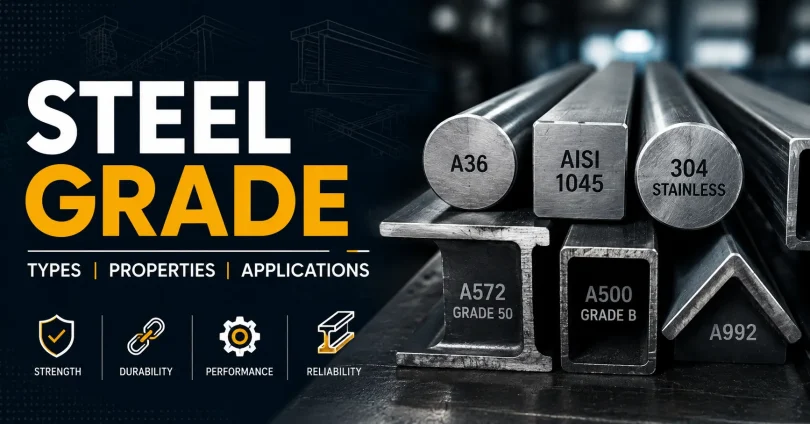

Pick up any piece of metal in a factory, a hospital, a car, or a bridge, and there is a very good chance it is steel. But not all steel is the same. The grade stamped on a material certificate tells you exactly what that steel can and cannot do. Get it right, and your structure lasts decades. Get it wrong, and you face premature failure, corrosion, or a project that goes over budget trying to fix a material mismatch.
This guide explains steel grades and types of steel in plain language. Whether you are a buyer, a fabricator, a structural engineer, or simply someone who wants to understand the materials around them, everything you need is here.
What Is a Steel Grade?
A steel grade is a standardized label that describes a specific combination of chemical composition, mechanical properties, and sometimes the processing method used to produce that steel. Think of it like a specification code: when you order ASTM A36 from a mill in Ohio or a supplier in Germany, you know exactly what yield strength, carbon content, and weldability you are getting, regardless of who made it.
Steel grades exist because steel is not a single material. It is a family of thousands of materials. According to the World Steel Association, there are over 3,500 recognized grades of steel. Each one exists because a specific combination of properties was needed for a specific purpose.
A grade tells you:
- What elements are in the steel and in what proportions
- How strong it is (tensile strength, yield strength)
- How hard it is and whether it can be hardened further
- How it responds to welding, machining, and forming
- What environments it can handle without corroding or failing
Without grades, engineers and buyers would have no shared language. A steel grade is that common language.
How Steel Is Classified: The Two Main Systems
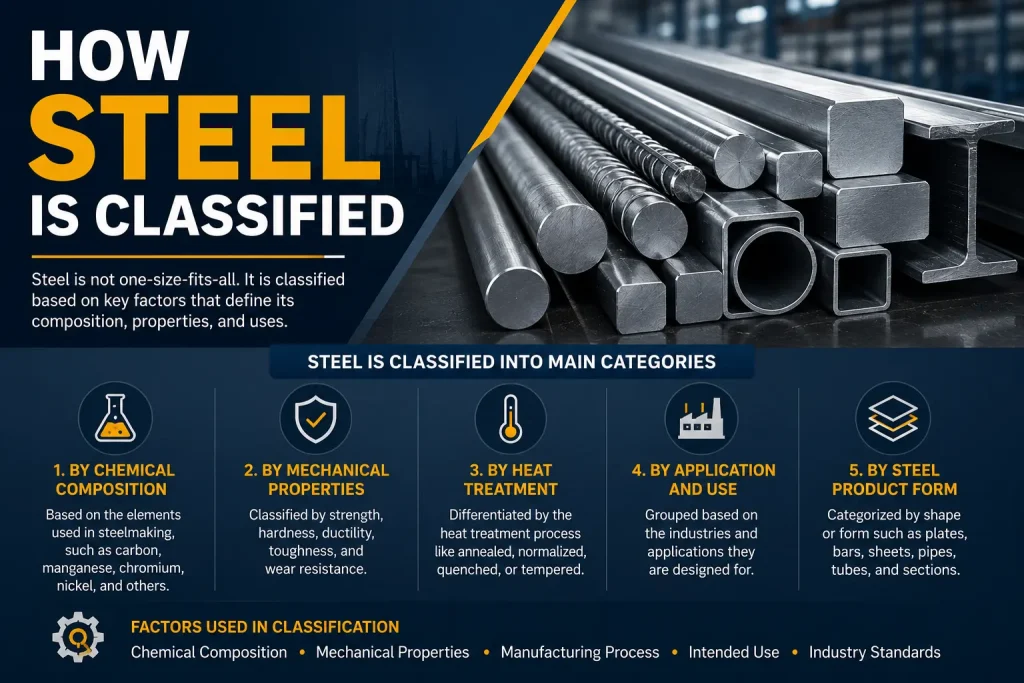
Two primary grading systems dominate the industry, particularly in North America. Understanding how they work helps you read material certifications and product datasheets without confusion.
AISI/SAE System
The American Iron and Steel Institute (AISI) and the Society of Automotive Engineers (SAE) developed a joint four-digit numbering system that is still the most widely used standard for carbon and alloy steels.
Here is how to read those four digits:
- The first digit indicates the steel family (1 = carbon steel, 2 = nickel steel, 3 = nickel-chromium, 4 = molybdenum-based, and so on)
- The second digit indicates the percentage of the primary alloying element
- The last two digits indicate the carbon content in hundredths of a percent
So a grade marked 4140 tells you: it is a molybdenum-based alloy steel (4), with approximately 1% chromium-molybdenum (1), and it contains 0.40% carbon (40). Once you know the key, the number speaks for itself.
ASTM System
ASTM International uses alphanumeric codes that emphasize performance and application rather than chemical composition. The prefix “A” identifies iron and steel products, followed by a sequential number.
ASTM A36, for example, simply tells you this is a structural steel that meets specific strength and weldability requirements. The ASTM system is commonly used in construction and structural applications because it focuses on what the steel can do, not just what is in it.
International Equivalents
Outside North America, the EN (European), ISO, JIS (Japanese), and GB (Chinese) systems are widely used. These do not always align perfectly with ASTM or SAE grades. A steel that is similar to ASTM A36 in composition might have slightly different mechanical properties when produced to EN S275. Always verify against the actual specification rather than assuming direct interchangeability across systems.
Types of Steel
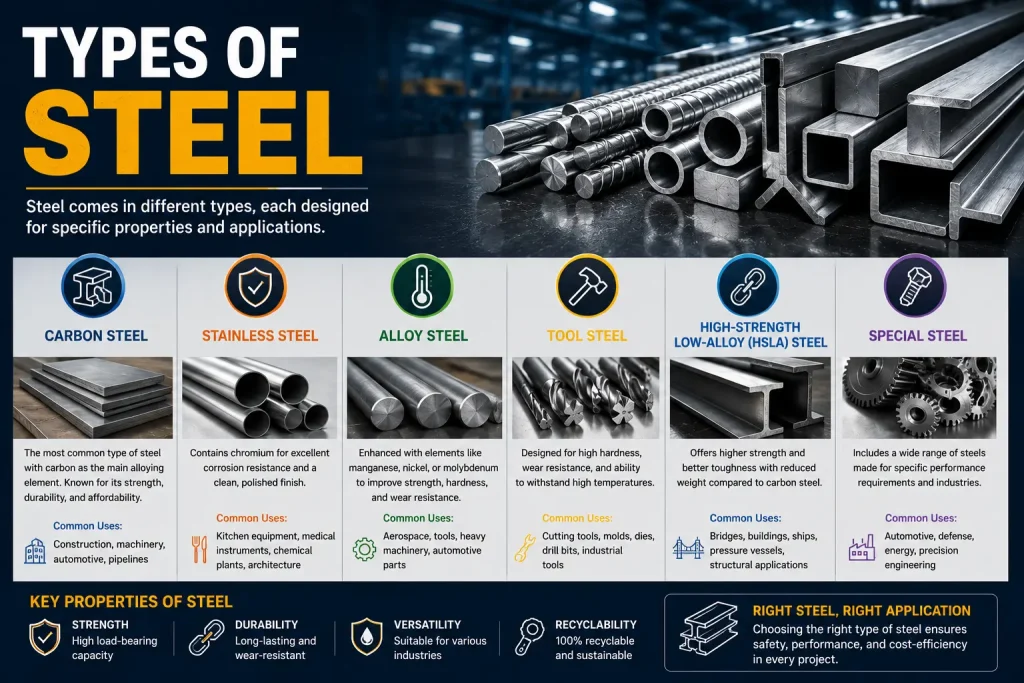
Steel is broadly divided into four main types. Each type covers a range of grades with different properties and applications. Understanding the four types gives you the framework to navigate the wider world of specific grades.
Carbon Steel
Carbon steel is the workhorse of the steel world. It accounts for roughly 90% of all steel produced globally, and for good reason: it is strong, relatively inexpensive, and available in vast quantities.
Carbon steel contains primarily iron and carbon, with minimal amounts of other elements (generally less than 1% each of manganese, silicon, and copper). The amount of carbon in the steel is the single biggest factor determining its properties: more carbon means more hardness and strength, but less ductility and weldability.
Carbon steel is divided into three subcategories:
Low carbon steel (mild steel)
Carbon content: 0.04% to 0.30%
This is the most common steel in the world. It is easy to weld, easy to form, and cheap to produce. The trade-off is that it is not particularly hard and has limited wear resistance.
Common grades include ASTM A36, SAE 1018, and SAE 1020. You will find low carbon steel in structural beams, bolts, sheet metal, vehicle body panels, pipelines, and general construction.
One thing most guides do not mention: the low carbon content means mild steel cannot be meaningfully hardened by heat treatment. If you need a harder surface, you need case hardening (carburizing) rather than through-hardening.
Medium carbon steel
Carbon content: 0.31% to 0.60%, with manganese between 0.60% and 1.65%
Medium carbon steel offers a balance between strength and ductility that makes it ideal for mechanical components. It can be heat treated to improve hardness, which mild steel cannot.
Common grades include SAE 1040, 1045, and 4140. You will find medium carbon steel in gears, axles, crankshafts, railway wheels, and heavy machinery parts. Grade 1045 in particular is one of the most specified medium carbon steels because it responds well to heat treatment and machines cleanly.
High carbon steel
Carbon content: 0.61% to 1.50%
High carbon steel is hard and strong, but it becomes increasingly brittle as the carbon content rises. It needs careful handling during welding (pre-heating and controlled cooling are usually required) because the high carbon content makes it prone to cracking.
Common grades include SAE 1075, 1090, 1095, and the tool steel variants A2, D2, and H13. Applications include springs, cutting tools, wire ropes, and knife blades. Grade 1095 is particularly popular among knifemakers because it holds a sharp edge exceptionally well.
Alloy Steel
Alloy steel is carbon steel with one or more additional elements intentionally added to improve specific properties. Those elements can include chromium, nickel, molybdenum, vanadium, tungsten, manganese, silicon, and others.
The reason manufacturers add these elements is precise: each one changes the steel’s behavior in a particular way.
- Chromium increases hardness and corrosion resistance
- Molybdenum improves high-temperature strength and creep resistance
- Nickel increases toughness and impact resistance, especially at low temperatures
- Vanadium refines grain structure and improves fatigue resistance
- Manganese increases strength and hardenability
Common alloy steel grades and what they do:
Grade 4130 (chromoly steel) contains chromium and molybdenum. It is strong, weldable, and tough, making it popular in aircraft frames, bicycle frames, and motorsport roll cages.
Grade 4140 adds more carbon than 4130, pushing tensile strength higher. It is used extensively in oil and gas, aerospace, and heavy machinery for shafts, tooling, and pressure vessels.
Grade 4340 is one of the toughest alloy steels available. The addition of nickel alongside chromium and molybdenum gives it exceptional toughness at high strength levels. It is used for aircraft landing gear, drive shafts, and highly stressed fasteners.
Grade 8620 is a case-hardening alloy steel. The core remains tough and ductile while the surface can be carburized to extreme hardness. Gears and camshafts rely on exactly this combination.
One detail competitors commonly overlook: alloy steels are sometimes divided into low-alloy (total alloying content below 8%) and high-alloy (above 8%) steels. Most of the grades described above are low-alloy steels. High-alloy steels shade into specialty categories like tool steels and stainless steels.
Stainless Steel
Stainless steel is defined by one characteristic above all others: a minimum of 10.5% chromium by weight. That chromium reacts with oxygen in the air to form a thin, invisible oxide layer on the surface. This passive layer is what gives stainless steel its corrosion resistance. Damage the layer and it reforms automatically, as long as the environment is not too aggressive.
What most introductory guides miss is that stainless steel is not one material. It is a family of five distinct microstructural types, each with very different properties.
Austenitic stainless steel
Austenitic grades contain 16 to 26% chromium and 6 to 22% nickel, which stabilize the austenite crystal structure at room temperature. This makes them non-magnetic, highly ductile, and unable to be hardened by heat treatment (though they can be work-hardened).
Grade 304 (18% chromium, 8% nickel) is the most widely produced stainless steel in the world. It handles most corrosive environments well, is easy to weld, and is used in kitchen equipment, food processing, pharmaceutical piping, and architectural applications.
Grade 316 adds molybdenum (2 to 3%), which significantly improves resistance to chloride pitting. It is the correct choice for marine environments, coastal structures, and applications involving chloride-containing chemicals. Using 304 where 316 is needed is one of the most common and costly material selection mistakes in the industry.
Grade 304L and 316L are low-carbon versions of their parent grades. The reduced carbon prevents carbide precipitation during welding, which can deplete the chromium near weld zones and cause corrosion along the heat-affected area. Whenever you are welding stainless steel without post-weld heat treatment, an L grade is usually the right call.
Ferritic stainless steel
Ferritic grades contain 10.5 to 30% chromium with very little nickel. They are magnetic, have limited weldability, and cannot be hardened by heat treatment. What they offer is good corrosion resistance at lower cost than austenitic grades, because they use less nickel.
Grade 430 is the most common ferritic stainless, used in automotive trim, kitchen appliances, and decorative applications. Grade 409 is used extensively in automotive exhaust systems because of its heat resistance and low cost.
Martensitic stainless steel
Martensitic grades have higher carbon content (0.1 to 1.2%) and lower chromium (11.5 to 18%) than austenitic grades. They are magnetic and, crucially, can be hardened and tempered by heat treatment. This makes them the only stainless grades suitable for applications requiring both some corrosion resistance and significant hardness.
Grade 410 is used for fasteners, valves, and pump components. Grade 420, sometimes called “blade grade,” is the standard for cutlery and surgical instruments. It can be polished to a mirror finish and holds a usable edge. Grade 440C, with the highest carbon content in the family, achieves a Rockwell hardness of approximately 58 HRC, making it one of the hardest stainless grades available and the preferred choice for high-quality bearing balls and precision knives.
Duplex stainless steel
Duplex stainless steel has a mixed microstructure of roughly equal parts austenite and ferrite. This combination delivers the best properties of both phases: the toughness and weldability of austenite, combined with the strength and stress corrosion resistance of ferrite.
The practical result is that duplex grades have approximately twice the yield strength of standard 304 austenitic steel, with superior resistance to chloride stress corrosion cracking, which is a failure mode that can destroy austenitic grades in marine and chemical environments.
Grade 2205 (22% chromium, 5% nickel, 3% molybdenum) is the workhorse duplex grade. It is widely used in offshore oil and gas equipment, desalination plants, chemical processing, and marine structures. In environments where 316 stainless fails due to chloride exposure, 2205 is typically the upgrade.
One important limitation: duplex steels should not be used above 300 degrees Celsius. Extended exposure to higher temperatures causes embrittlement through sigma phase precipitation. This is not covered by most introductory steel guides and is a real pitfall in high-temperature process engineering.
Precipitation hardening (PH) stainless steel
PH grades achieve very high strength through a low-temperature aging heat treatment, rather than through quenching and tempering. The aging process causes fine strengthening particles to precipitate within the alloy’s matrix.
Grade 17-4 PH (17% chromium, 4% nickel) is the most common. After aging, it can achieve tensile strengths exceeding 1,000 MPa while retaining reasonable corrosion resistance. It is used in aerospace components, pump shafts, and high-performance fasteners where both strength and corrosion resistance are required. The fact that the final heat treatment is low-temperature means dimensional distortion is minimal, which matters greatly for precision components.
Tool Steel
Tool steel is engineered for one purpose: to make tools. It must be hard enough to cut, shape, or form other materials without deforming or wearing down. To achieve this, tool steels contain significant amounts of tungsten, molybdenum, cobalt, vanadium, and chromium, which provide hardness, wear resistance, and in some cases, the ability to retain hardness at elevated temperatures.
Tool steels are grouped into families based on their primary property:
Water-hardening (W series): The simplest and cheapest tool steels. Hardened by quenching in water. Suitable for low-temperature applications. W1 and W2 are used for woodworking tools and simple cutting implements.
Cold-work tool steels (A, D, and O series): Used for dies, punches, and cutting tools that operate at room temperature.
- A2 is an air-hardening grade with good toughness and moderate wear resistance. It is a popular all-around cold-work steel.
- D2 has high carbon and high chromium content, giving it exceptional wear resistance. It is harder to machine and less tough than A2, but it outlasts it significantly in abrasive applications.
- O1 is an oil-hardening grade with excellent machinability and dimensional stability, making it popular for precision gauges and measuring tools.
Hot-work tool steels (H series): Designed to resist softening at elevated temperatures. H13 is the most common hot-work steel, used for die-casting dies, extrusion tooling, and forging dies that must withstand repeated thermal cycling.
High-speed steels (M and T series): The benchmark for cutting tools. M2 is the most widely used high-speed steel globally. It retains hardness at temperatures that would soften ordinary tool steels, which is critical when a drill bit or milling cutter generates heat through cutting. M2 is used for drill bits, end mills, taps, and saw blades.
A detail that most guides skip entirely: tool steels require very precise heat treatment. The hardening temperature window for many grades is narrow, sometimes only 15 to 20 degrees Celsius wide. Over-heating causes grain growth and reduced toughness. Under-heating produces insufficient hardness. This is why professional heat treatment is almost always recommended over DIY approaches for critical tool steel components.
Steel Grade Comparison: Quick Reference Table
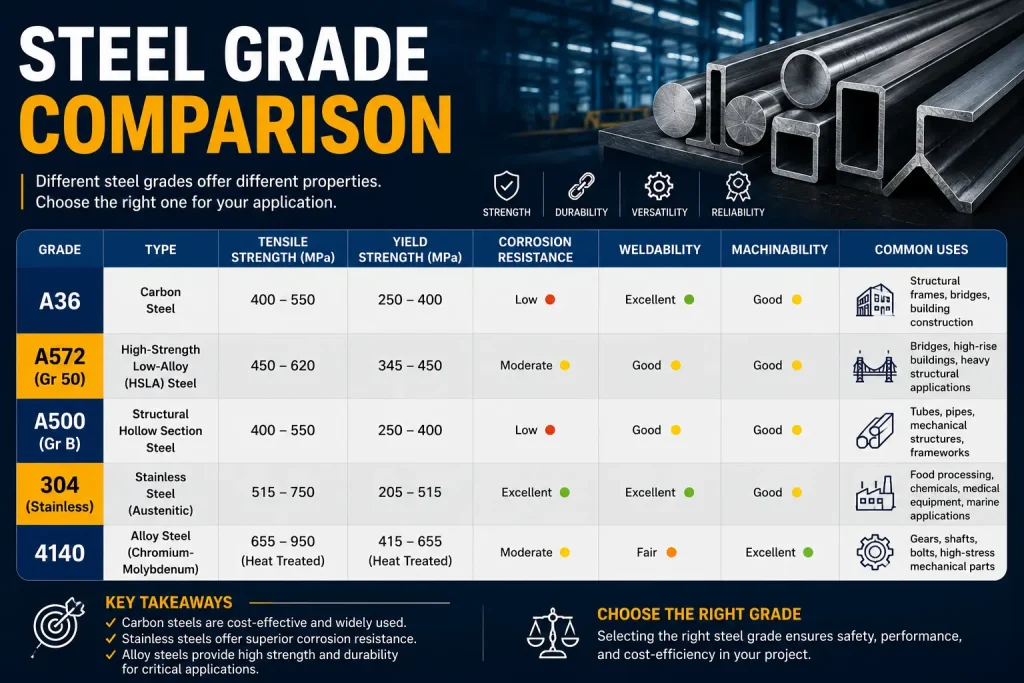
| Grade | Type | Carbon % | Key Properties | Typical Applications |
|---|---|---|---|---|
| A36 | Carbon (low) | 0.26 max | Weldable, ductile | Structural beams, bridges |
| 1018 | Carbon (low) | 0.18 | Good machinability | Bolts, shafts, machine parts |
| 1045 | Carbon (medium) | 0.45 | Balanced strength | Gears, axles, crankshafts |
| 4130 | Alloy | 0.30 | Strong, weldable | Aircraft, motorsport frames |
| 4140 | Alloy | 0.40 | High tensile strength | Tooling, oil and gas |
| 4340 | Alloy | 0.40 | Exceptional toughness | Landing gear, drive shafts |
| 304 | Austenitic SS | 0.08 max | Corrosion resistant | Kitchen equipment, piping |
| 316 | Austenitic SS | 0.08 max | Chloride resistant | Marine, medical, chemical |
| 2205 | Duplex SS | 0.03 max | High strength + corrosion | Offshore, desalination |
| 17-4 PH | PH stainless | 0.07 max | Very high strength | Aerospace, pump shafts |
| D2 | Tool (cold-work) | 1.55 | Extreme wear resistance | Dies, punches |
| H13 | Tool (hot-work) | 0.40 | Thermal fatigue resistance | Die casting, extrusion |
| M2 | High-speed | 0.85 | Retains hardness at heat | Drill bits, milling cutters |
How Heat Treatment Changes Everything
One thing most steel grade guides cover poorly is that the grade itself only tells you part of the story. How the steel is heat treated after production can dramatically change its properties.
Annealing softens steel and relieves internal stresses. It makes steel easier to machine and form. Carbon steels are annealed by heating above the critical temperature and cooling slowly.
Normalizing produces a more uniform grain structure than annealing. Normalized steel is slightly harder and stronger than annealed steel of the same grade.
Quenching and tempering is how high-strength steel components are produced. The steel is heated to the hardening temperature, then rapidly cooled (quenched) in water, oil, or air depending on the grade. This creates a very hard but brittle martensite structure. Tempering then reheats the steel to a lower temperature to reduce brittleness while retaining most of the hardness. The combination of quench and temper is how grades like 4140 and 4340 achieve their high mechanical performance.
Case hardening (carburizing) is used on low-carbon alloy steels like 8620 and 9310. The surface is exposed to a carbon-rich atmosphere at high temperature, causing carbon to diffuse into the surface layer. The core remains tough and ductile while the surface becomes hard and wear resistant. This is exactly what gears need: a hard surface to resist tooth wear, and a tough core to resist impact loading.
Precipitation hardening (used for PH stainless steels and maraging steels) involves a solution treatment followed by low-temperature aging. The aging step causes strengthening particles to form within the microstructure without the distortion caused by high-temperature quenching.
How to Choose the Right Steel Grade
Every guide gives you lists of grades. Very few help you actually choose between them. Here is a practical framework.
Step 1: Define the mechanical requirements. What is the minimum yield strength needed? Does the component see impact loads? Is fatigue life critical? These answers narrow the type and carbon level.
Step 2: Consider the environment. Is there moisture, salt, chemicals, or high temperature? If the answer to any of these is yes, stainless or alloy steel becomes necessary. Mild steel will corrode in wet environments without surface protection.
Step 3: Think about fabrication. Does the part need to be welded? High-carbon steels and martensitic stainless steels are difficult to weld without cracking. If welding is involved, lower-carbon grades or L-grade stainless options are often safer choices.
Step 4: Factor in machinability. Grades like 1018 and 12L14 (a free-machining steel with added lead or bismuth) machine quickly and cleanly. Highly alloyed tool steels are harder to machine and require slower feeds and speeds.
Step 5: Balance cost against performance. A36 costs a fraction of 316 stainless. If the environment does not demand corrosion resistance, using stainless is wasted money. Conversely, specifying mild steel in a chloride environment to save money upfront often costs far more in premature replacement and repair.
Step 6: Check the international standard. If your project uses specifications from multiple countries, verify that the “equivalent” grade in another system actually matches on all relevant properties. Grade names that sound similar do not always perform identically.
Common Steel Grade Selection Mistakes
These errors appear repeatedly in fabrication shops, engineering offices, and procurement departments. Knowing them in advance saves real cost and real risk.
Using 304 stainless in chloride environments. Grade 304 is resistant to general corrosion but vulnerable to chloride pitting. Coastal structures, marine fittings, and anything exposed to deicing salts or seawater should use 316 or, in more demanding situations, a duplex grade like 2205.
Welding high-carbon steel without preheat. Steels with carbon equivalent above approximately 0.40% require preheating before welding to slow the cooling rate in the heat-affected zone and prevent hydrogen cracking. Skipping preheat on medium or high carbon steel is one of the most common causes of weld cracking.
Specifying mild steel where case hardening was intended. Low-carbon steel cannot be through-hardened. If you need a wear-resistant surface, you need a grade designed for carburizing (such as 8620) or a medium-carbon steel that responds to heat treatment.
Assuming all tool steels are the same. D2 and A2 are both cold-work tool steels, but they behave very differently. D2 has far better wear resistance but less toughness. A2 takes more impact before chipping. Selecting based on the name “tool steel” without specifying the exact grade is asking for inconsistent results.
Using duplex stainless above 300 degrees Celsius. Duplex grades, including 2205, are excellent below this temperature. Above it, extended exposure causes embrittlement. For high-temperature service, austenitic grades like 316 or 310 are the correct choice.
Frequently Asked Questions
What does the steel grade number mean?
In the AISI/SAE system, the four-digit number encodes the steel type and carbon content. For example, 4140 means: molybdenum-based alloy steel (4), approximately 1% of alloying elements (1), 0.40% carbon (40). In the ASTM system, the letter and number indicate a category and a performance specification rather than a chemical recipe.
What is the strongest steel grade?
Strength depends on how you define it. Maraging steels (such as 18Ni 300 grade) achieve tensile strengths above 2,000 MPa, making them among the strongest commercially available steels. For structural applications, high-strength low-alloy (HSLA) steels like A514 and S690 offer tensile strengths up to 760 MPa with good toughness and weldability.
What is the most common steel grade?
For general structural use, ASTM A36 is the most widely used grade in the United States. Globally, the equivalent S275 (European standard) covers a similar application space. For stainless steel, Grade 304 dominates by volume.
Can steel grade be changed after manufacturing?
The chemical composition cannot be changed, but mechanical properties can be significantly altered through heat treatment. Quenching and tempering can double the yield strength of certain alloy steels compared to their annealed condition. This is why the same grade can appear in multiple “conditions” with different property levels.
What is the difference between ASTM A36 and A572?
Both are structural steels, but A572 Grade 50 has a higher yield strength (50 ksi vs 36 ksi for A36) and can be used where weight reduction is needed. A572 costs slightly more but allows thinner sections to carry the same loads, which can reduce total steel weight and cost on large projects.
What does the “L” mean in 304L or 316L stainless steel?
The “L” stands for low carbon. Reducing the carbon content below 0.03% prevents the formation of chromium carbides during welding, which would otherwise deplete the chromium near the weld zone and reduce corrosion resistance. L grades are preferred for welded assemblies that will not undergo post-weld solution annealing.
Final Word: Grade Is Not Just a Number
A steel grade is a promise. It tells you that the material behaves in a known, predictable way under specific conditions. That predictability is what makes steel the most widely used structural material in the world.
The practical lesson is this: the difference between specifying the right grade and the wrong one is not always visible. A structure built with the wrong steel can look identical to one built with the right steel, right up until the point where it does not. Corrosion appears. A tool chips. A weld cracks.
Spend time on grade selection. Match the grade to the actual conditions: mechanical load, environment, fabrication method, and service life requirement. And when in doubt, the cost of reviewing a specification with a materials engineer is always smaller than the cost of replacing a failed component.
You May Also Like It:
CNC Machining Tolerances: The Complete Expert Guide
MIG vs TIG Welding: Complete Guide to Differences and Procedures