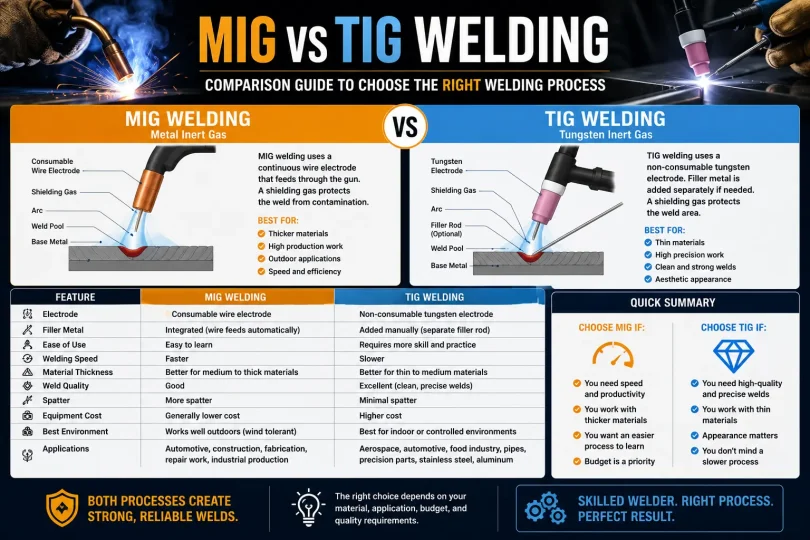
What Is the Difference Between MIG and TIG Welding?
MIG stands for Metal Inert Gas welding. It is faster and easier, making it ideal for beginners, thick metals, and high-volume work.
TIG stands for Tungsten Inert Gas welding. It is slower but offers greater precision and cleaner finishes, especially for thin metals and aluminum.
Choose MIG for speed and simplicity and TIG for precision and high-quality finishes.
| Factor | MIG Welding | TIG Welding |
|---|---|---|
| Best for | Thick metals, production work | Thin metals, aluminum, precision jobs |
| Skill level | Beginner-friendly | Steep learning curve |
| Speed | Fast | Slow |
| Weld quality | Good, functional | Clean, cosmetic-grade |
| Filler feed | Automatic (wire) | Manual (separate rod) |
If you are new to welding or trying to choose the right process for your project, the MIG vs TIG welding debate is one of the first and most important decisions you will face. Both are forms of arc welding, both use shielding gas, and both can join a wide variety of metals. But beyond those surface similarities, these two processes are fundamentally different in technique, equipment, skill level, cost, and the kind of results they produce.
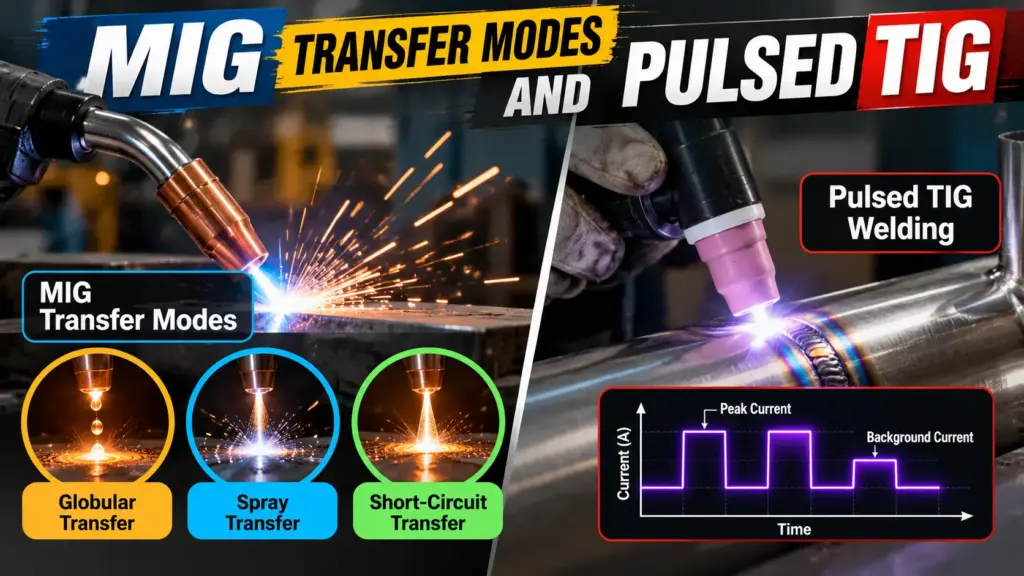
MIG welding stands for Metal Inert Gas welding. Its technical name is Gas Metal Arc Welding (GMAW). In this process, a consumable wire electrode is automatically fed through a welding gun, melts into the joint, and creates the weld. The wire acts as both electrode and filler material simultaneously.
TIG welding stands for Tungsten Inert Gas welding. Its technical name is Gas Tungsten Arc Welding (GTAW). TIG uses a non-consumable tungsten electrode to generate the arc, while the welder manually feeds a separate filler rod with the other hand. In some cases, TIG welding can be performed without filler metal at all, fusing the base metals directly together.
The core question is not which process is better in absolute terms. The real question is: which process is better for your specific material, project size, quality requirements, and skill level? This guide answers exactly that.
A Quick History: Where Did MIG and TIG Welding Come From?
Both welding processes were developed in the 1940s as breakthrough solutions for joining aluminum and magnesium alloys, materials that traditional welding methods could not handle adequately. TIG welding was developed first, offering the precision required for aircraft manufacturing during World War II. MIG welding followed shortly after, designed to bring similar arc welding capabilities to higher-volume industrial production. Both processes have been refined continuously over the past eight decades and remain the two most widely used gas-shielded arc welding methods in the world today.
MIG Welding Explained: How It Works

MIG welding operates through a semi-automatic or fully automatic arc. Here is what happens during a MIG weld:
A solid wire electrode, wound on a spool, is fed continuously through the welding gun at a controlled speed called the Wire Feed Speed (WFS). As the wire exits the gun, an electrical arc forms between the wire tip and the base metal. This arc generates intense heat, melting both the wire and the surface of the base metal. The melted wire flows into the joint as filler material, and the two pieces of metal fuse together as the weld cools.
A shielding gas flows simultaneously through the gun to protect the molten weld pool from atmospheric contamination. The most common shielding gas mixture for MIG welding is 75% argon and 25% CO2. The CO2 component serves an important purpose: it stabilizes the arc and improves penetration, making MIG welding more effective on thicker materials. However, CO2 also increases spatter compared to pure argon.
The MIG welder controls the weld primarily through machine settings: voltage, wire feed speed, and travel speed. The welder guides the gun with one hand while maintaining the correct distance between the gun tip and the workpiece. This one-handed operation is a significant practical advantage, particularly for beginners and high-volume production work.
What Metals Can You Weld with MIG?
MIG welding can be used on aluminum, stainless steel, and steel, and on every thickness from 26-gauge sheet metal to heavy-duty structural plates. It is also adaptable to different welding positions including flat, horizontal, vertical, and overhead, which contributes to its popularity across industries.
TIG Welding Explained: How It Works

TIG welding requires considerably more operator involvement. Here is the process:
A non-consumable tungsten electrode in the TIG torch generates the arc. Because the tungsten electrode does not melt into the weld, the welder holds the torch in one hand and a separate filler rod in the other. With one foot simultaneously controlling a foot pedal that modulates the amperage in real time, TIG welding is genuinely a three-limb coordinated activity. This independent control over heat, filler feed, torch angle, and travel speed is exactly what gives TIG welding its exceptional precision.
The operator adds filler metal manually, or in fusion welding, uses no filler at all but works the surrounding material into the joint. Foot pedal or fingertip amperage control allows real-time heat modulation. Precise heat input minimizes distortion, especially on thin sections.
The shielding gas for TIG welding is 100% argon, or a blend of argon with helium in specialized applications. CO2 is never used in TIG welding because of its reactive properties. CO2 promotes tungsten oxide formation, and tungsten oxide prematurely wears down a tungsten electrode.
What Metals Can You Weld with TIG?
TIG welding handles the broadest range of metals of any common welding process. It is the preferred choice for stainless steel, aluminum, titanium, copper, magnesium, nickel alloys, and other exotic or non-ferrous metals. It is also the process of choice for thin materials where precise heat control is critical to avoiding burn-through.
MIG vs TIG Welding: The Complete Comparison
1. Electrode Type
This is the most fundamental technical difference between the two processes.
The most observable difference between MIG and TIG welding is in its use of an electrode. MIG welding process uses a continuously fed consumable wire electrode to join two pieces of metal. TIG uses a non-consumable tungsten electrode with a separate filler metal.
In MIG welding, the wire is both the electrode and the filler, which simplifies the process enormously. In TIG welding, the electrode and filler are separate, which adds complexity but grants the welder precise independent control over each variable.
2. Shielding Gas
Welding gas: TIG welding uses argon gas to prevent tungsten deterioration. Meanwhile, MIG welding uses a blend of argon and CO2 because carbon dioxide stabilizes the arc and provides better penetration.
The gas flow rates also differ. A MIG welder typically runs its gas at 35 to 50 cubic feet per hour, while a TIG welding gun requires a gas flow at 15 to 25 cubic feet per hour.
3. Weld Strength
TIG welded joints are considered stronger than MIG welds. This is because TIG welders produce a narrow, focused arc that is better at penetrating the metal. Also, TIG beads done right are clean and usually contain few defects like holes in the bead. Defects weaken a weld, so fewer of them mean a stronger joint.
That said, both processes can produce structurally sound welds when executed correctly. The strength advantage of TIG is most pronounced in critical applications such as aerospace components, pressure vessels, and structural pipe welding.
4. Weld Speed
For production, MIG welders offer better speed. TIG welding produces clean, good-looking welds, but at a price. TIG welders cannot move the weld puddle and supply enough filler rod as fast as a MIG welder.
In large industrial operations requiring continuous long runs of weld bead, MIG is the dominant choice specifically because of this speed advantage. The productivity gap between MIG and TIG widens significantly as project scale increases.
5. Weld Appearance and Aesthetics
Weld aesthetics: TIG beads are professional and good-looking because there are fewer splatters and discolorations, which can be solved with light polishing. However, it doesn’t mean that MIG welds are ugly because a good welder can produce beads that match the project’s requirements.
For applications where the visible appearance of the weld is critical, such as architectural metalwork, decorative fabrication, food processing equipment, and medical devices, TIG is the clear choice. MIG welds may require grinding and finishing to achieve a comparable appearance.
6. Operator Skill Required
MIG welding is widely regarded as the easier process to learn. The automated wire feed means the welder only needs to maintain the correct gun angle and travel speed. Most beginners can produce acceptable MIG welds within a few weeks of consistent practice.
TIG welding, on the other hand, is a specialized technique that requires the use of both hands and one foot, all doing separate things. Mastering TIG welding typically takes months to years of dedicated practice. It is often taught at advanced levels in welding programs and is the benchmark skill that separates journeyman welders from true craftspeople.
7. Cost Comparison
Equipment costs:
TIG welding costs include the initial equipment setup at $3,000 or more, protective equipment, and consumables like filler material and shielding gas. Professional TIG welding costs more per hour than MIG welding due to the greater level of expertise required.
Entry-level MIG welding machines are available for as little as $300 to $500, making MIG far more accessible for beginners and hobbyists. Quality professional MIG machines range from $800 to $2,500 depending on capacity and features.
Consumable costs:
Consumables for TIG welding including tungsten electrodes, filler metal rods, and shielding gas are generally more expensive than those for MIG. However, the consumption of these materials is often lower in TIG, which can balance costs over the long term.
Labor costs:
The speed of MIG welding also translates into lower labor costs, as welders can complete more welds in a given amount of time. In contrast, TIG welding is a much slower process that’s focused on detail.
8. Power Source
MIG welding uses a DC (direct current) power source, which provides arc stability, minimizes spatter, and works well on thinner metals. TIG welding offers both DC and AC (alternating current) options. This flexibility allows TIG welders to work with a wider range of metals, including aluminum, making it the preferred choice for complex materials.
The AC capability of TIG machines is particularly important for aluminum welding, where AC current provides the oxide-cleaning action that aluminum requires for a sound weld.
9. Spatter and Cleanup
MIG welding produces noticeably more spatter than TIG welding. Small droplets of molten metal may spray onto surrounding surfaces and must be removed before painting, coating, or finishing. TIG welding produces virtually no spatter, meaning the weld area is clean and requires minimal post-weld cleanup. This is a significant practical advantage in precision fabrication and industries with strict cleanliness requirements.
10. Material Thickness
MIG welding handles a wider range of material thicknesses in a single pass and is particularly effective on thicker stock. TIG welding excels on thin materials, where its precise heat control prevents burn-through and warping. Material thickness is a key factor: TIG is ideal for thin materials up to 6 mm, while MIG can effectively handle greater thicknesses.
Side-by-Side Comparison Table: MIG vs TIG Welding
| Feature | MIG Welding | TIG Welding |
|---|---|---|
| Full Name | Gas Metal Arc Welding (GMAW) | Gas Tungsten Arc Welding (GTAW) |
| Electrode Type | Consumable wire | Non-consumable tungsten |
| Filler Material | Integrated in wire | Separate rod, fed manually |
| Shielding Gas | Argon + CO2 blend | 100% argon (or argon/helium) |
| Power Source | DC only | AC and DC |
| Weld Speed | Fast | Slow |
| Weld Strength | Strong | Stronger |
| Weld Appearance | Good, may need cleanup | Excellent, minimal cleanup |
| Spatter | Moderate to high | Virtually none |
| Material Thickness | Thin to very thick | Very thin to medium |
| Skill Level Required | Beginner to intermediate | Intermediate to advanced |
| Equipment Cost | Lower ($300 to $2,500) | Higher ($1,000 to $5,000+) |
| Labor Cost | Lower | Higher |
| Best For | Production, thick metals, beginners | Precision, thin metals, exotic alloys |
| Common Industries | Automotive, construction, manufacturing | Aerospace, food processing, art |
Which Metals Work Best with MIG vs TIG Welding?
Understanding which metals are best suited to each process is essential for choosing correctly.
Mild Steel and Carbon Steel
Both MIG and TIG welding work well on mild steel and carbon steel. Mild steel: Both processes work well, but MIG welding offers faster production. For most general fabrication and construction work involving mild steel, MIG is the practical choice due to its speed and lower cost.
Stainless Steel
Both processes can be used on stainless steel, but they produce different results. TIG welding stainless steel provides a beautiful, corrosion-resistant finish ideal for food processing equipment, marine projects, and decorative work. MIG welding stainless steel is faster but may produce welds that require additional cleaning to maintain corrosion resistance.
Aluminum
Aluminum can be welded with both processes, but each requires specific techniques. MIG welding aluminum typically requires a spool gun or push-pull wire feed system to prevent the soft aluminum wire from tangling. TIG welding aluminum requires AC current to break through the tough aluminum oxide layer. MIG welding aluminum is good for thicker aluminum sections. TIG is preferred for thin aluminum sheet and applications where appearance and precision are critical.
Exotic and Non-Ferrous Metals
For titanium, copper, magnesium, and nickel alloys, TIG welding is almost always the correct choice. Exotic metals: TIG welding shines when working with titanium, copper, and other specialty alloys. These materials are sensitive to heat and contamination, and the precise control of TIG welding is essential for achieving acceptable weld quality.
Cast Iron
MIG welding is generally better suited for cast iron, as the process allows for higher heat input and faster deposition. Cast iron is brittle and requires careful preheat and post-weld heat treatment regardless of process, but MIG is typically the faster and more practical option.
MIG vs TIG Welding Applications by Industry

Automotive Industry
The automotive industry uses both processes extensively, but for different purposes. MIG welding is used for body panels, chassis construction, and exhaust system fabrication where speed matters. TIG welding is used for precision parts, custom exhaust work, roll cages, and any application where weld quality and appearance are critical. High-performance and custom vehicle builders rely heavily on TIG welding.
Aerospace Industry
Aerospace manufacturing is one of TIG welding’s strongest domains. TIG welding shines in precision and is a preferred choice for applications demanding intricacy and accuracy, such as aerospace and medical industries. Aircraft components require welds that are free of defects, visually inspectable, and capable of withstanding extreme stress and temperature variations. TIG welding’s ability to produce defect-free welds on exotic alloys like titanium and aluminum makes it indispensable in this sector.
Construction and Structural Fabrication
Construction work heavily favors MIG welding. MIG welding finds extensive applications in industries such as construction, including structural steel, heavy machinery, and pipelines. The speed and efficiency of MIG welding allow construction crews to complete large volumes of structural welds without sacrificing acceptable quality.
Food and Beverage Processing
Food processing equipment must meet strict hygiene standards. Weld surfaces must be smooth, crevice-free, and corrosion-resistant to prevent bacterial growth. TIG welding’s clean, spatter-free welds on stainless steel are the standard in this industry, and orbital TIG welding (automated TIG) is used extensively for hygienic pipe welding in food, dairy, and pharmaceutical plants.
Shipbuilding
Shipbuilding uses MIG welding for hulls and structural components due to the enormous volume of welding required and the thickness of the steel involved. TIG welding is reserved for critical areas requiring high-quality, inspectable welds.
Artistic and Decorative Metalwork
Sculptors, architects, and custom fabricators who prioritize visual appearance almost universally prefer TIG welding. Artistic or architectural metalwork is typically TIG welded, as it combines high aesthetic standards with low production volumes and high end-product value.
Manufacturing and Sheet Metal Fabrication
General manufacturing uses both processes depending on the application. MIG welding dominates high-volume production lines. TIG welding is used for precision assemblies, thin sheet metal, and parts requiring minimal post-weld finishing.
Pros and Cons of MIG Welding
Advantages of MIG Welding
Speed and productivity. MIG welding is significantly faster than TIG welding. The automated wire feed allows for continuous long runs without stopping to reload filler material, making it ideal for high-volume production environments.
Ease of learning. MIG welding is widely considered the most beginner-friendly arc welding process. New welders can produce structurally acceptable welds within weeks of starting to practice. The one-handed operation and machine-controlled variables reduce the coordination demands on the operator.
Versatility across thicknesses. MIG welding is effective on both thin sheet metal and heavy structural sections, handling a broader range of material thicknesses than most other processes in a single setup.
Lower equipment cost. Entry-level MIG machines are affordable and widely available. The consumables (wire and gas) are relatively inexpensive, and the equipment is durable and low-maintenance.
One-handed operation. Because the MIG gun feeds wire automatically, the welder has one free hand to position the workpiece, hold fixtures, or support the gun for better control.
Adaptable to robotic automation. MIG welding is the dominant process in robotic welding cells due to its speed and the ease of programming consistent parameters.
Disadvantages of MIG Welding
Higher spatter. MIG welding produces more spatter than TIG, which means more time spent on cleanup and finishing before painting or coating.
Less precision. The faster, less controlled nature of MIG welding makes it unsuitable for very thin materials where heat management is critical. Burn-through on thin sheet metal is a common issue for less experienced MIG welders.
Sensitive to wind and drafts. MIG welding uses a higher gas flow rate and the gas envelope is less stable outdoors. Wind can disrupt the shielding gas coverage and lead to porous, contaminated welds.
Weaker appearance. MIG welds are structurally sound but generally less visually refined than TIG welds. For applications where the weld will be visible and appearance matters, MIG welds typically require grinding and finishing work.
Less suitable for exotic metals. MIG welding is not ideal for titanium, copper, and many non-ferrous alloys. The lack of precise heat control and the gas mixture limitations make it unsuitable for these sensitive materials.
Pros and Cons of TIG Welding
Advantages of TIG Welding
Superior weld quality. TIG welding produces the highest quality welds of any common arc welding process. The narrow, focused arc provides deep penetration, and the precise control over heat input minimizes defects such as porosity, inclusions, and lack of fusion.
Exceptional precision. The ability to independently control the arc, heat input, and filler feed makes TIG welding the process of choice wherever dimensional accuracy and weld integrity are critical. This is why TIG is the standard in aerospace, medical device manufacturing, and precision fabrication.
Minimal spatter and cleanup. TIG welding produces virtually no spatter. The weld area requires minimal post-weld cleanup, which reduces overall project time and cost in applications where finishing work is significant.
AC and DC capability. TIG machines can operate on both alternating and direct current, enabling them to weld aluminum and other non-ferrous metals that require AC oxide-cleaning action. This makes TIG welding the most versatile arc welding process in terms of material range.
Beautiful weld appearance. TIG welds are smooth, uniform, and visually refined. Many TIG welders take pride in producing “stack of dimes” bead profiles that require no finishing at all.
No filler required in some cases. TIG welding can fuse base metals together without any filler material in autogenous or fusion welds. This is useful for certain thin gauge applications and can simplify the process.
Disadvantages of TIG Welding
Steep learning curve. TIG welding requires coordination of both hands and a foot simultaneously, each performing independent tasks. Developing this coordination to a level of consistent, quality production takes substantial time and practice.
Slow speed. TIG welding is generally slower than MIG welding, making it less suitable for high-volume production. The slow linear travel speed and the need to stop and reposition the filler rod periodically make TIG significantly less productive per hour than MIG on most applications.
Higher cost. TIG equipment, consumables, and labor all cost more than their MIG equivalents. The investment is justified by the quality produced, but it makes TIG less practical for budget-conscious projects.
Surface preparation requirements. TIG welding demands meticulously clean base metal. Contamination from oil, rust, paint, or mill scale will cause weld defects and tungsten contamination. Thorough surface preparation before welding is not optional.
Not suitable for very thick materials. While TIG can weld thicker sections with multiple passes, it is not efficient on heavy plate work. MIG or other higher-deposition processes are far more practical for thick material applications.
MIG vs TIG Welding: Which One Should You Choose?
The answer depends on four key factors: your material, your project requirements, your skill level, and your budget.
Choose MIG Welding When:
You are working on large-scale projects that require long runs of weld bead and high productivity. You are welding mild steel, carbon steel, or thicker aluminum sections. You are a beginner or intermediate welder who needs to produce consistent, acceptable quality welds without years of practice. Your priority is speed and cost-effectiveness over absolute weld quality. You are working in automotive, construction, manufacturing, or shipbuilding. Your equipment budget is limited and you need an affordable setup that can handle a wide range of jobs.
Choose TIG Welding When:
You require the highest possible weld quality with minimal defects and excellent mechanical properties. You are working with thin materials, exotic alloys, titanium, copper, or other non-ferrous metals. The appearance of the weld is important and no grinding or finishing should be necessary. You are working in aerospace, food processing, medical manufacturing, or artistic metalwork. You have the skill level or willingness to invest time in developing the advanced coordination TIG requires. Your application demands precise heat control to prevent distortion on thermally sensitive materials.
Can You Use Both?
In professional and industrial settings, MIG and TIG welding are often used together on the same project. A common technique in critical pipe welding is to perform the root pass with TIG welding for maximum fusion and quality, then complete the fill and cap passes with MIG welding for productivity. Root passes in critical pipe welding can be TIG welded, followed by MIG, for higher productivity with certainty of gas/fluid tightness and joint contamination reduction.
Equipment Overview: What You Need for Each Process
MIG Welding Equipment
A complete MIG welding setup requires the following core components:
MIG welding machine. The power source, wire feeder, and controls are typically integrated into a single unit. Settings include voltage and wire feed speed.
MIG welding gun. The gun delivers the wire, electricity, and shielding gas to the weld. Contact tips inside the gun transfer current to the wire.
Wire spool. Solid wire electrodes are available in various diameters and compositions for different base metals.
Shielding gas cylinder. An argon/CO2 blend is standard for most steel applications.
Ground clamp. Attached to the workpiece to complete the electrical circuit.
Consumables. Contact tips, nozzles, and diffusers require periodic replacement as they wear.
TIG Welding Equipment
A TIG welding setup is more complex and includes:
TIG welding machine. Must be capable of both AC and DC output for full material versatility. Higher-end machines include high-frequency arc starting, pulse capability, and programmable parameters.
TIG torch. Air-cooled torches work for lower-amperage applications. Water-cooled torches are required for sustained high-amperage TIG welding to manage heat buildup in the torch.
Tungsten electrodes. Available in various compositions for different materials and current types. Thoriated, ceriated, and pure tungsten electrodes each have specific applications. Tungsten must be maintained by grinding or balling the tip as appropriate.
Filler rods. Cut lengths of filler metal (typically around 36 inches long) matched to the base metal being welded.
Foot pedal or fingertip control. Allows real-time amperage adjustment during the weld, essential for heat management on thin or variable-thickness materials.
Shielding gas cylinder. Pure argon or an argon/helium blend.
Back purge equipment. For welding stainless steel, titanium, and other oxidation-sensitive metals, the back side of the weld must be shielded from air using back purge argon gas, particularly in pipe and tube applications.
Beginner Tips: Starting with MIG or TIG Welding
If You Are Starting with MIG Welding
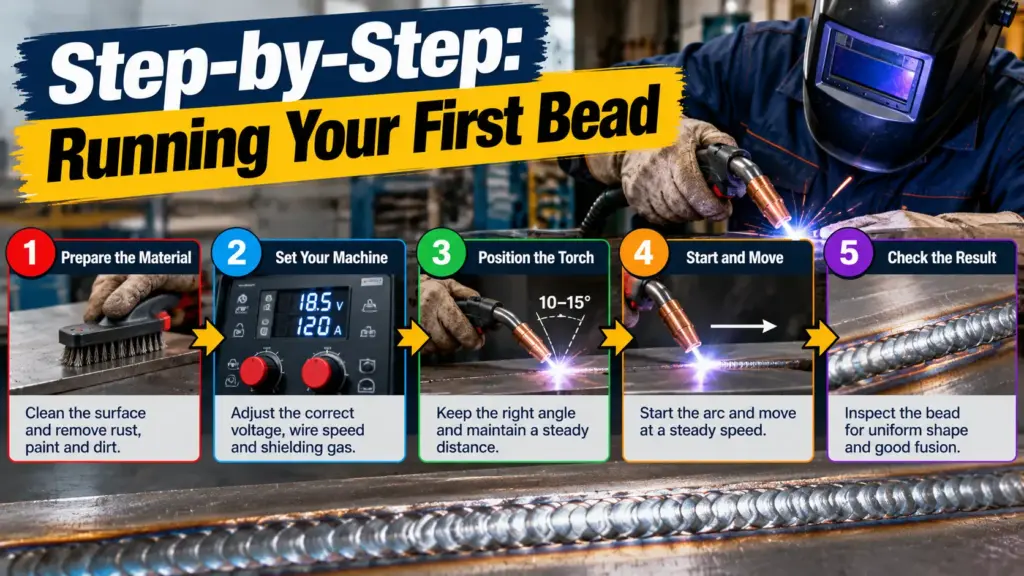
Set your machine parameters correctly for the material thickness and wire diameter before striking an arc. The most common beginner mistake is incorrect voltage and wire feed speed combination, which produces either cold, poorly fused welds or excessive spatter and burn-through. Maintain a consistent travel speed and keep the gun angle consistent. Practice on flat plate before attempting vertical or overhead positions. Clean your base metal thoroughly before welding. Even MIG welding is sensitive to heavy contamination, rust, and mill scale.
If You Are Starting with TIG Welding
Begin with a simple flat bead on steel plate, using DC current, before attempting to weld any joints. Focus on maintaining a consistent arc length between the tungsten and the base metal. Even a small variation in arc length significantly affects heat input and bead width. Practice dipping the filler rod into the leading edge of the weld pool with a smooth, rhythmic motion. Use the foot pedal to increase amperage when starting the arc and reduce it as the metal heats up. Clean your base metal to bare, shiny metal before every TIG weld. Contamination is far less forgiving in TIG than in MIG.
Common Mistakes in MIG and TIG Welding (And How to Avoid Them)
Common MIG Welding Mistakes
Incorrect stick-out. The distance from the contact tip to the workpiece (stick-out) affects arc stability and bead shape. Too long creates a cold, irregular bead. Too short causes wire to stub into the puddle. Maintain consistent stick-out for the wire diameter being used.
Ignoring contamination. Welding through rust, paint, or oil contaminates the weld and produces porosity. Always grind or wire-brush the base metal to clean, bare metal before welding.
Wrong gas or gas flow. Using the wrong shielding gas mixture for the material, or incorrect flow rate, leads to porosity and contamination. Verify gas settings before welding.
Moving too fast or too slow. Travel speed directly controls bead width and penetration. Inconsistent travel speed produces uneven beads and potential lack of fusion.
Common TIG Welding Mistakes
Contaminating the tungsten. If the tungsten electrode contacts the filler rod or the weld pool, it becomes contaminated, disrupting the arc and potentially contaminating the weld. A contaminated tungsten must be reground or replaced before continuing.
Incorrect tungsten preparation. For DC welding, the tungsten should be ground to a pointed taper. For AC aluminum welding, the tip should form a small ball. Using the wrong tungsten preparation for the current type degrades arc quality.
Insufficient surface cleaning. TIG welding demands the cleanest base metal of any common welding process. Use a dedicated stainless steel wire brush and acetone or dedicated metal cleaner before every TIG weld.
Inconsistent arc length. Moving the torch too far from the workpiece causes arc wandering and loss of heat control. Too close causes tungsten contamination. Practice maintaining a consistent arc length equal to approximately the diameter of the tungsten electrode.
Poor filler rod timing. Adding filler rod while the puddle is too cold produces cold lap defects. Adding filler to an overheated puddle produces a large, irregular bead. Learn to read the puddle and add filler at the correct temperature.
Frequently Asked Questions About MIG vs TIG Welding
Which is stronger, MIG or TIG welding?
TIG welding generally produces stronger welds due to its narrower, more focused arc providing better penetration and fewer weld defects. Both processes can produce structurally sound welds for most applications when performed correctly by a skilled operator.
Which is easier to learn, MIG or TIG?
MIG welding is significantly easier to learn. Most beginners can produce acceptable MIG welds within a few weeks. TIG welding requires mastery of simultaneous two-hand and foot coordination and typically takes months to years to develop proficiency.
Which is more expensive, MIG or TIG?
TIG welding is more expensive in terms of equipment, consumables, and labor. Entry-level MIG machines start around $300 to $500. Professional TIG machines start around $1,000 to $3,000 or more. Professional TIG welding labor also commands a higher hourly rate than MIG welding.
Can I weld aluminum with MIG or TIG?
Yes to both, but with different requirements. MIG aluminum welding requires a spool gun or push-pull system and pure argon shielding gas. TIG aluminum welding requires an AC-capable machine and pure argon. TIG produces superior results on thin aluminum sheet. MIG is faster on thicker aluminum sections.
Is TIG welding always better than MIG welding?
Not at all. TIG welding is better for precision, quality, and exotic materials. MIG welding is better for speed, thick materials, beginners, and high-volume production. The best process is always the one most appropriate for the specific application.
What does GMAW mean?
GMAW stands for Gas Metal Arc Welding, which is the technical name for MIG welding.
What does GTAW mean?
GTAW stands for Gas Tungsten Arc Welding, which is the technical name for TIG welding.
Can I use the same machine for both MIG and TIG?
Some multi-process welding machines can perform both MIG and TIG welding, along with stick welding, in a single unit. These are practical for welders who need both capabilities without purchasing multiple machines.
Final Verdict: MIG vs TIG Welding
There is no single correct answer to the MIG vs TIG welding debate. These are complementary tools, not competing ones.
MIG welding wins decisively in speed, ease of learning, equipment affordability, and suitability for thick materials and high-volume production. It is the backbone of automotive manufacturing, construction, and industrial fabrication worldwide.
TIG welding wins decisively in weld quality, precision, material versatility, aesthetic finish, and suitability for exotic metals and thin materials. It is the standard in aerospace, food processing, medical manufacturing, and precision fabrication.
The most skilled professional welders are proficient in both processes, understanding exactly when each process is the right tool for the job. If you are just starting out, begin with MIG welding to build your fundamental arc welding skills. Once you are comfortable with MIG, invest the time and practice required to develop TIG welding competency. Together, these two skills will make you capable of tackling virtually any metal fabrication challenge.
You May Also Like It:
CNC Machining Tolerances: The Complete Expert Guide