
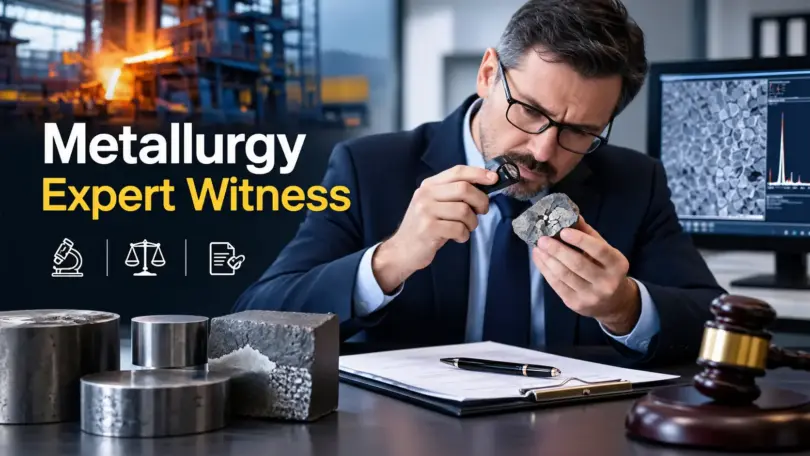

A metallurgy expert witness is a materials scientist or metallurgical engineer who examines failed metal components fractured parts, corroded pipelines, cracked welds, or failed implants and provides an independent, testimony-ready opinion on why the failure happened. In litigation and arbitration, courts and counsel rely on this opinion to determine whether the cause was a manufacturing or material defect, a design flaw, environmental exposure, or misuse, and the strength of that opinion depends as much on how the physical evidence was preserved and tested as on the expert’s credentials.
Why “Metallurgy Expert” Is Too Broad a Search Term
Attorneys often treat this as one category of expert. It isn’t. Someone who spent three decades running quality control in a steel mill may know very little about titanium alloys used in orthopedic implants. A pipeline corrosion specialist can struggle badly on a fastener fatigue case in an aerospace bracket.
Retained experts get dismantled on cross not because the underlying science was wrong, but because their particular sub-specialty didn’t line up with the actual failure mode in the case. That mismatch rarely shows up on a CV that just lists “30 years in metallurgy.”
Before you start searching, figure out which lane your case actually falls into. The field splits into several practice areas that rarely overlap in a single expert’s daily work:
- Fracture and fatigue analysis – bolts, welds, shafts, structural steel
- Corrosion and environmental degradation – pipelines, marine hardware, chemical plant equipment
- Materials compliance and manufacturing defects – alloy specification, heat treatment, casting quality
- Welding and joining evaluation – weld procedure, filler metal selection, post-weld heat treatment
- Extractive and process metallurgy – mining, ore processing, refining disputes (a different world entirely from failure analysis)
- Medical device and implant metallurgy – biocompatible alloys like titanium, nitinol, and cobalt-chrome
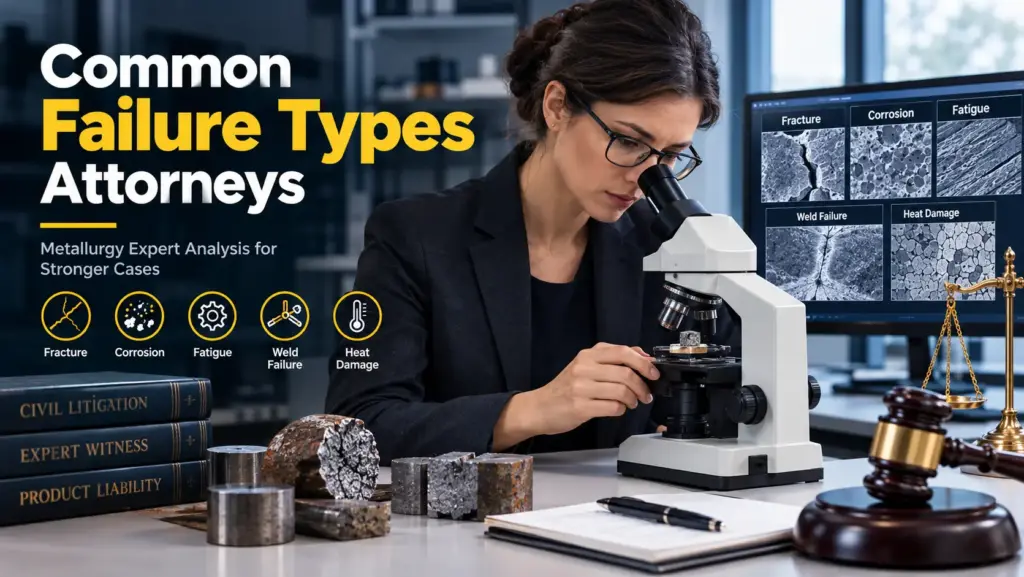
Common Failure Types Attorneys Actually Run Into
Fatigue Failure
This is the failure mode juries grasp fastest once it’s explained well: a part cracks slowly over thousands of repeated stress cycles, long before anyone notices anything wrong. Under magnification, the telltale sign is beach marks or striations concentric ridges on the fracture face that resemble tree rings.
Field note: Defense teams frequently argue “sudden overload” to avoid a design-defect finding, since overload implies misuse rather than a flaw baked into the product from the start. A skilled metallurgist can usually distinguish the two within the first SEM session, because overload fractures show dimpled, ductile tearing instead of striations. If your expert can’t walk a jury through that distinction in plain language, that’s worth catching during the first consult not during cross-examination.
Stress Corrosion Cracking (SCC)
Attorneys without a metallurgy background miss this constantly. SCC happens when a susceptible alloy sits under tensile stress in a specific corrosive environment chlorides, hydrogen sulfide, or certain process chemicals and cracks form with almost no visible warning. No rust, no pitting, just a part that looks fine until it snaps.
Oil and gas litigation runs into this constantly with downhole tubing and pipeline welds. If your expert’s report only says “corrosion” without naming the specific environmental trigger, push back. Generic corrosion opinions get excluded far more often than ones tied to a documented environment and alloy susceptibility.
Hydrogen Embrittlement
Often confused with SCC, but the mechanism and the liable party can be entirely different. Hydrogen gets introduced during electroplating, welding, or acid pickling, and it makes high-strength steel brittle from the inside, sometimes triggering delayed fracture days or weeks after the part entered service.
This distinction matters enormously for causation. If hydrogen embrittlement traces back to a plating subcontractor’s process rather than the original steel manufacturer, liability shifts entirely to a different defendant. Very few generalist experts catch this without being specifically asked to test for it.
Manufacturing and Casting Defects
Porosity, non-metallic inclusions, cold shuts, segregation. These flaws get baked in at the foundry or mill, long before the part ever reaches a customer. Metallographic cross-sectioning under a microscope reveals them, and it’s one of the most decisive pieces of physical evidence in a products liability case it’s hard to argue around a cross-section photograph showing a void inside a supposedly solid casting.
Weld Failures
Underbead cracking, lack of fusion, porosity, incorrect filler metal, missing post-weld heat treatment. Weld cases sit in their own niche within metallurgy, and an expert needs working knowledge of AWS welding procedure specifications (WPS) and procedure qualification records (PQR) on top of general metallurgical training, or they’ll struggle badly under cross on the industry standard that applied.
What Real Cases Look Like: Two Illustrative Examples
Here’s how these mechanisms actually played out in litigation because attorneys evaluating an expert benefit from seeing the reasoning chain, not just the vocabulary.
A major pipeline rupture in a residential area traced back to a decades-old weld seam. Metallurgists retained by multiple parties performed fracture surface examination, chemical composition testing, and microstructural analysis on the recovered pipe segment. The findings pointed to incomplete weld penetration and inclusions from the original manufacturing process, combined with steel that showed low toughness and susceptibility to brittle fracture under pressure fluctuation. The technical conclusion that proper hydrostatic testing could have caught the defect decades earlier became central to establishing the utility’s liability and shaped a settlement running into the hundreds of millions.
A pressure vessel rupture at an industrial facility followed a very different mechanism. The operator argued unexpected operating conditions caused the failure. A metallurgist retained by the injured parties ran SEM analysis and chemical composition testing on the ruptured steel and found it didn’t meet the specified ASTM standard. The steel showed clear signs of hydrogen embrittlement, traced to a missing post-weld heat treatment step following an earlier repair. That single missing process step, explained clearly to a jury, became the deciding factor in the verdict.
The pattern in both: the expert’s opinion held up because it connected a specific physical finding to a specific, documentable process failure not a vague “the metal was bad” conclusion.
Common Mistakes That Sink These Cases
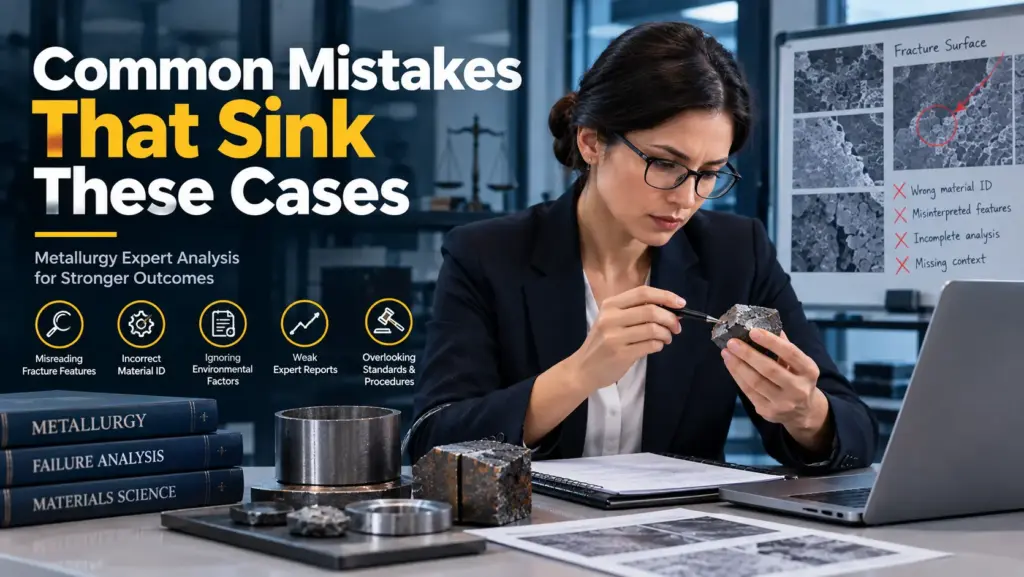
- Waiting too long to preserve the failed part. Metal oxidizes. Every day a fractured component sits exposed to air and moisture, the fracture surface degrades, and details the expert needs (striation spacing, corrosion products, origin markings) can be lost or contaminated. Get the part into controlled, dry storage the same week as the incident if at all possible.
- Letting broken pieces get reassembled or handled. Fitting fracture surfaces back together, even briefly to see how the part broke, can physically damage the microscopic features an expert relies on. Treat a fractured component like a crime scene, not a puzzle to solve by hand.
- Skipping the exemplar component. Without an intact, unused version of the same part for comparison, an expert has no baseline for what “normal” looks like. This is the single most avoidable gap in evidence packages, and it often weakens an otherwise strong opinion.
- Agreeing to a joint testing protocol too late. Destructive testing (sectioning, hardness testing, chemical analysis) permanently alters evidence. If opposing counsel isn’t given notice and a chance to observe, results can be challenged or excluded outright on spoliation grounds. Get a written, mutually agreed protocol before anything destructive happens.
- Choosing an expert on price per hour instead of testimony history. A cheaper expert who’s never survived a Daubert challenge can end up costing far more than a pricier one with a clean admissibility record.
- Not asking about equipment access. Some experts are consultants who subcontract SEM work or chemical analysis to a third-party lab. That’s not disqualifying by itself, but you need to know it up front, since it affects both cost and how tightly the expert controls chain of custody.
- Assuming “metallurgist” and “materials scientist” are interchangeable for every case. Metallurgy narrows specifically to metals and alloys. Materials science is the broader umbrella that also covers polymers, ceramics, and composites. If your failure involves a gasket, a plastic housing, or a glass panel alongside a metal component, a pure metallurgist may not be equipped to cover the whole failure, and you may need a materials science generalist or a second expert instead.
What the Failure Analysis Process Actually Looks Like
Understanding the sequence helps you set realistic timelines with clients and judges.
- Background gathering – material specs, manufacturing records, maintenance history, incident circumstances, and an exemplar part if one exists.
- Visual and macroscopic inspection – low-power examination (roughly 1-50x) to locate the fracture origin and document the as-received condition before anything is touched.
- Nondestructive testing (NDT) – methods like magnetic particle inspection, dye penetrant testing, radiography, or ultrasonic testing to find hidden discontinuities without damaging the part.
- Microscopic examination via SEM – scanning electron microscopy at magnifications up to 50,000x to classify the fracture type, often paired with EDS (Energy Dispersive X-ray Spectroscopy) to identify surface contaminants or corrosive elements.
- Destructive testing – tensile, hardness, impact, and fatigue testing, plus metallographic sectioning to examine internal grain structure.
- Chemical analysis – confirming the alloy composition matches its stated specification, using spectrometry or X-ray fluorescence.
- Conclusion and report – tying the physical evidence to a defensible opinion on cause and, where relevant, contributing factors like misuse or deferred maintenance.
A rushed analysis that skips straight to destructive testing before completing steps 2 and 3 is one of the fastest ways to get a report challenged. Judges and opposing experts notice when the sequence looks backwards.
| Testing Method | What It Reveals | Destructive? |
|---|---|---|
| Visual / Macroscopic Exam | Fracture origin, overall pattern | No |
| NDT (PT, MPI, UT, RT) | Hidden cracks, discontinuities | No |
| SEM / EDS | Fracture mechanism, surface contaminants | Minimally |
| Metallographic Sectioning | Grain structure, inclusions, heat treatment history | Yes |
| Mechanical Testing | Strength, hardness, toughness vs. spec | Yes |
| Chemical Analysis (spectrometry, XRF) | Alloy composition, contamination | Sometimes |
Where These Experts Actually Get Used
Beyond the generic “product liability” label, these case types come up constantly:
- Construction defect litigation – rebar corrosion, structural steel connections, crane and scaffolding failures
- Aviation and aerospace – fastener failures, landing gear components, turbine blade cracking
- Medical device litigation – hip and knee implant fractures, spinal hardware failures, often involving titanium or cobalt-chrome alloys
- Oil and gas – pipeline ruptures, downhole tubing failures, valve and flange corrosion
- Marine and offshore – propeller shaft fatigue, hull plate corrosion, mooring chain failures
- Consumer products – ladder failures, bicycle frame fractures, tool and equipment breakage
- Industrial accidents – crane hooks, chain and sling failures, pressure vessel ruptures, boiler failures
- Railroad and transportation – rail fatigue, wheel and axle failures, coupling defects
- Fire and explosion investigations – metallurgical analysis of components affected by extreme heat to help determine origin and cause
- Patent and trade secret disputes – analysis of material composition and processing methods in IP litigation involving metals technology
- Mining and extractive metallurgy disputes – a distinct sub-field covering ore processing, mineral valuation, and mine engineering, separate from forensic failure analysis
What Qualifications Should Actually Move the Needle
A PhD looks good on paper. It’s not the whole story. When vetting an expert, these carry more real weight in a courtroom than the letters after their name:
- A documented Daubert or Frye track record. Ask directly how many times this person has been challenged and what the outcome was. Vague answers or silence here is a red flag worth pursuing.
- Active membership and committee work with organizations like ASM International, ASTM International, NACE (now AMPP), or AWS not just a name on a membership roster from a decade ago.
- Hands-on lab access, not just report-writing. An expert who personally runs the SEM and metallographic work answers cross-examination questions about methodology far more convincingly than one relying entirely on a technician’s data.
- Specific alloy family experience matching your case: titanium for implants, high-strength low-alloy steel for structural work, duplex stainless for offshore, rather than generalized “20 years in metals.”
- Plain-English communication ability. Jurors don’t know what a “trans-granular crack” means. An expert who can explain fatigue striations with a simple, relatable analogy will out-perform a more credentialed expert who talks past the jury.
- Relevant sub-specialty certifications when the case calls for them, such as Certified Welding Inspector (CWI) for weld failure cases, or NDT Level II/III certifications for cases turning on inspection methodology.
FAQ
How much does a metallurgy expert witness cost?
Rates typically range from roughly $225 to $600+ per hour depending on experience and specialty, with review and deposition fees often priced separately from courtroom testimony time. Complex SEM and chemical analysis work adds lab costs on top of the expert’s hourly rate.
How long does a metallurgical failure analysis take?
A straightforward case with good evidence preservation can take four to six weeks. Cases requiring extensive mechanical testing, multiple rounds of NDT, or coordination with opposing counsel on a joint testing protocol can stretch to three or four months.
Can a metallurgist testify about both the cause of failure and the resulting damages?
Yes, many metallurgy experts quantify remaining service life, strength loss, or repair-versus-replacement costs alongside their causation opinion, though some attorneys prefer a separate damages expert to keep the technical testimony focused.
What’s the difference between a metallurgist and a materials engineer for litigation purposes?
Metallurgists specialize specifically in metals and alloys, while materials engineers cover a broader range including polymers, ceramics, and composites. For a purely metal-on-metal failure, a metallurgist’s narrower focus usually carries more weight with a judge evaluating expert qualifications, though a mixed-material failure may call for the broader background instead.
Do I need the original failed part, or can photos and reports work?
Photos alone rarely support a defensible opinion. Courts and opposing experts expect physical examination of the actual component whenever it’s available, since fracture surface details simply can’t be fully captured in a photograph.
What happens if the failed part was already discarded or repaired before an expert got involved?
This doesn’t automatically kill the case, but it significantly weakens it. An expert can sometimes work from exemplar parts, maintenance records, and photographs, though the resulting opinion will typically carry more caveats and be more vulnerable to challenge on cross.
Should I hire a testifying expert or a consulting expert first?
Many attorneys start with a consulting expert, whose work stays privileged and non-discoverable, to evaluate case merit before designating a testifying expert. This is especially useful when liability isn’t yet clear and you want an honest early read without tipping your hand to opposing counsel.
Can opposing counsel’s expert observe destructive testing?
Generally yes, and it’s advisable to invite them. Excluding opposing counsel from destructive testing is one of the more common grounds for a spoliation motion, which can result in sanctions or the exclusion of your expert’s findings entirely.
Is a mining or extractive metallurgist the same as a failure analysis metallurgist?
No, and this trips up attorneys unfamiliar with the field. Extractive metallurgy covers ore processing, mineral valuation, and mine engineering an entirely different skill set from forensic failure analysis on finished metal components. Searching generically for “metallurgy expert” without specifying failure analysis can return the wrong type of expert entirely.
You May Also Like It:
Steel Grade: The Complete Guide to Understanding Every Type of Steel
Powder Metallurgy Steel: The Complete Guide to Process, Properties, and Uses
Metallurgy Testing Laboratory: The Complete Guide to Metallurgical Testing Services
Metallurgy Technology: Definition, Types, Processes, and Applications






[…] Metallurgy Expert Witness: A Practical Guide for Attorneys Hiring One […]