
Introduction
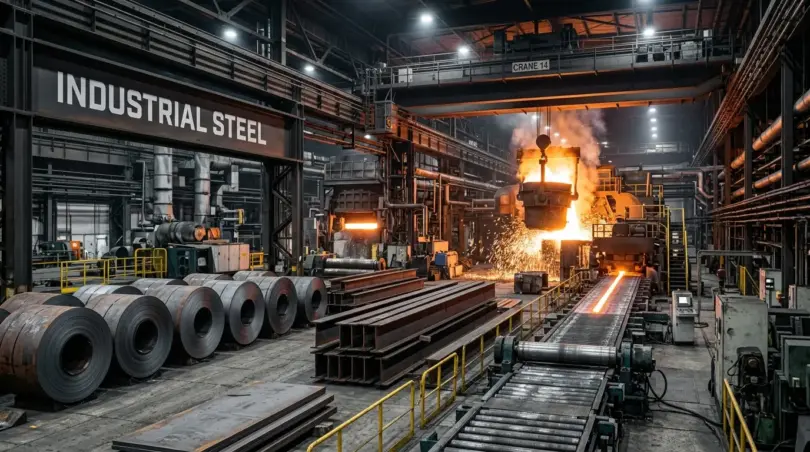
Industrial steel is high-strength, certified steel used for load-bearing, high-stress, and harsh-environment applications such as buildings, bridges, machinery, pipelines, and vehicles. It is the most widely used engineering metal in the world.
Look around any modern city and you are looking at steel. It holds up skyscrapers, spans bridges, and forms the frames of factories. It runs through the rails that carry freight, the pipelines that move energy, and the vehicles that take people to work.
Global production is around 1.9 billion tonnes a year, and demand keeps growing as countries build infrastructure and manufacturers modernize. Whether you are an engineer specifying materials, a procurement manager comparing industrial steel suppliers, or a student, this guide covers what industrial steel is, its main grades, its uses, how it is processed, and where the industry is heading.
What Is Industrial Steel? (Definition and Core Properties)
Industrial steel, also called industrial grade steel or heavy-duty steel, is an iron-carbon alloy made and certified to meet strict standards for strength, chemistry, and traceability. It is built for demanding jobs where failure is not an option.
Steel is an alloy of iron and carbon, usually with small amounts of other elements. What separates industrial grade steel from a generic product is predictability. A bridge girder or pressure vessel cannot be “probably strong enough.” Industrial steel is produced to specifications such as ASTM, EN, and JIS, which define its chemical composition and mechanical behavior.
What Are the Properties of Industrial Steel?
The key properties of industrial steel are high tensile strength, durability, ductility, weldability, wear and corrosion resistance, and recyclability.
- High tensile strength: Resists being pulled apart, critical for cables, beams, and frames.
- Durability: Withstands years of cyclic loading, vibration, and impact.
- Ductility and toughness: Bends and absorbs energy before failing, rather than snapping suddenly.
- Weldability and machinability: Can be joined, cut, and shaped into nearly any form.
- Wear and corrosion resistance: Resists abrasion, moisture, and chemicals, depending on grade and coating.
- Recyclability: Can be remelted repeatedly without losing its essential properties.
These properties explain why steel has been the default choice for heavy construction and manufacturing for over a century.
Key Types and Grades of Industrial Steel
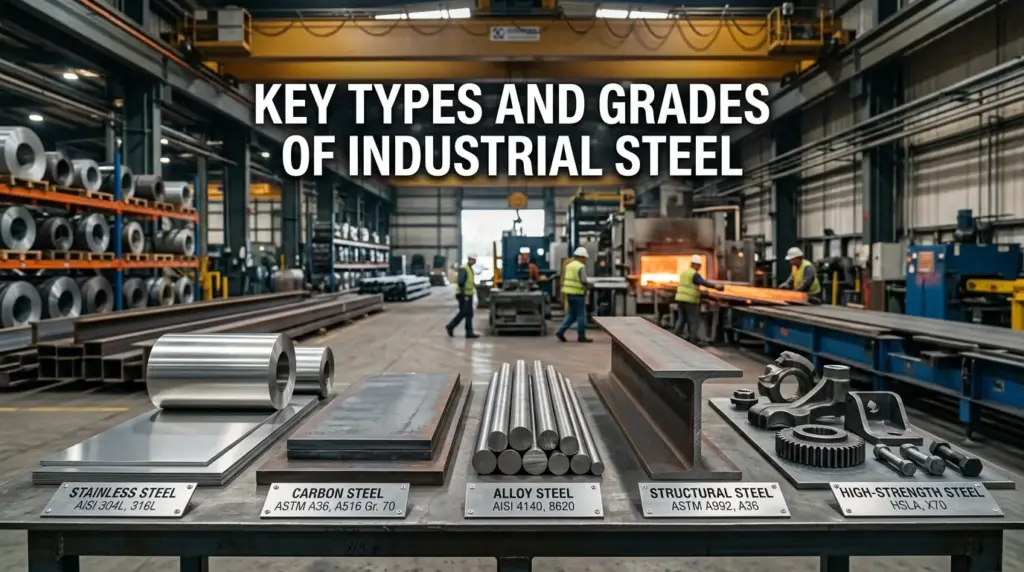
The four main types of industrial steel are carbon steel, stainless steel, alloy steel, and tool steel. Each is tuned for different jobs, and matching the grade to the application avoids paying for performance you do not need.
What Are the Most Common Industrial Steel Grades?
The most common industrial steel grades are low-carbon (mild) steel, 304 and 316 stainless steel, and low-alloy steels. These cover most structural, process, and manufacturing needs. The sections below explain where each family fits.
Carbon Steel: The Workhorse
Carbon steel is the most widely used industrial steel, valued for its strength, low cost, and ease of fabrication. It is grouped by carbon content:
- Low-carbon (mild) steel: Easy to weld and form, used for plates, sheets, and general fabrication.
- Medium-carbon steel: Stronger and harder, used for gears, axles, and rails.
- High-carbon steel: Hardest and most wear-resistant, but less ductile.
Carbon steel dominates structural steel work (beams, columns, angles) as well as pipelines and storage tanks.
What Is the Difference Between Structural Steel and Industrial Steel?
Structural steel is a subset of industrial steel. It refers specifically to shapes and grades used in building frameworks and load-bearing structures. Industrial steel is the broader category, covering structural members, machinery components, tooling, and process equipment.
Stainless Steel: Corrosion Resistance
Stainless steel is steel containing at least 10.5% chromium, which forms a self-healing oxide layer that resists rust. This makes stainless steel industrial use common wherever hygiene or chemical exposure matters:
- Chemical and petrochemical plants: Resists aggressive process fluids.
- Food and beverage processing: Easy to clean and non-contaminating.
- Pharmaceutical and medical equipment: Meets hygiene standards.
- Marine and coastal installations: Withstands salt exposure.
Austenitic grades 304 and 316 are the most common. Grade 316 adds molybdenum for better resistance to chlorides and salt.
Alloy Steel: Engineered for Extremes
Alloy steel is carbon steel with added elements such as nickel, chromium, molybdenum, vanadium, or manganese to improve strength, toughness, or heat resistance. Low-alloy steels contain under about 5% added elements, while high-alloy steels contain more.
Each element tunes a property: nickel improves low-temperature toughness, molybdenum helps with heat, and vanadium boosts strength. A high-strength alloy can match the load capacity of plain carbon steel at lower weight, which matters in automotive parts, pressure vessels, drivetrains, and power equipment.
Tool Steel: Built for Hardness
Tool steel is a high-hardness steel designed to cut, shape, and form other materials while resisting wear and heat. It is used for cutting blades, drill bits, dies, punches, and injection molds. It costs more per kilogram than structural grades, but its longevity in tooling usually justifies the price.
Major Industrial Applications of Steel
Industrial steel is used mainly in construction, manufacturing and heavy machinery, and energy and transportation. These three sectors account for most global steel demand, and industrial steel applications extend well beyond them.
Construction and Infrastructure
Construction is the largest consumer of steel, using it for skyscrapers, bridges, stadiums, airports, and warehouses. Steel frames offer a high strength-to-weight ratio, allowing tall buildings with open floor plans. Bridges use steel girders and cables to span long distances.
Industrial steel buildings such as warehouses, distribution centers, and plants are popular because steel framing goes up fast, can be prefabricated off-site, and offers wide clear spans. Rebar also gives concrete the tensile strength it lacks.
Manufacturing and Heavy Machinery
In manufacturing, steel forms machine frames, conveyors, press tools, robotic cells, storage racks, and material-handling equipment. It is the structural base of nearly every factory.
Heavy machinery such as excavators, cranes, and mining equipment relies on abrasion-resistant plate and high-strength alloys. Steel’s stiffness also keeps machines precise, since a frame that flexes cannot hold tight tolerances. This is why steel for manufacturing remains hard to replace.
Energy and Transportation
Steel is essential to energy and transportation, from oil rigs, pipelines, and wind turbine towers to railways, ships, trucks, and shipping containers. These applications need steel that tolerates pressure, temperature swings, and corrosion.
Wind turbine towers can rise well over 100 meters and are typically built from rolled steel plate. In transport, rail track is a major application, and global trade depends on millions of steel containers.
Industrial Steel Processing and Fabrication
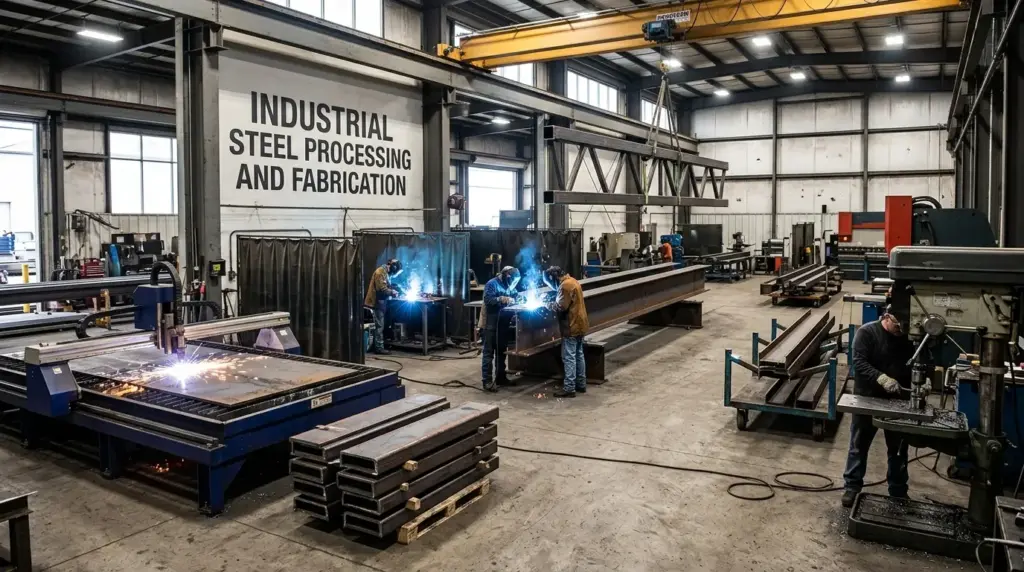
Industrial steel fabrication is the process of turning raw mill products into finished parts through rolling, cutting, bending, welding, machining, and coating. Raw steel leaves the mill as slabs, billets, or blooms, then moves through these stages:
- Rolling and forming: Hot rolling produces plates, bars, I-beams, H-beams, and channels. Cold rolling refines dimensions and finish.
- Tubing and piping: Industrial steel tubing and pipes are made seamless (pierced from solid billets) or welded (formed from strip or plate), and specified by pressure, diameter, and wall thickness.
- Cutting: Plasma, laser, oxy-fuel, waterjet, and saw cutting suit different thicknesses and tolerances.
- Bending: Press brakes, rollers, and tube benders shape curves and angles.
- Welding and assembly: Weld quality determines the integrity of the final structure.
- Machining: CNC milling, turning, and drilling achieve exact dimensions.
- Finishing and coating: Galvanizing, painting, and powder coating protect against corrosion, while quenching and tempering adjust hardness and toughness.
What Is Custom Industrial Steel Fabrication?
Custom industrial steel fabrication is the production of steel parts built to a customer’s drawings rather than standard catalog sizes. When choosing a custom steel manufacturing partner, check their certifications, inspection capabilities, and ability to trace materials to mill test reports.
Industrial Steel Price per Ton
There is no fixed industrial steel price per ton, because prices change constantly with raw material costs, grade, product form, and market demand. Published figures can become outdated within weeks.
The main cost factors are:
- Raw materials: Iron ore, scrap, coking coal, and energy.
- Grade and alloy content: Stainless and alloy steels cost more than mild steel.
- Product form: Plate, coil, tube, and structural shapes are priced differently.
- Processing and coating: Heat treatment, galvanizing, and fabrication add cost.
- Order volume and location: Larger orders and nearby delivery lower the unit price.
- Trade policy and demand: Tariffs and market conditions shift prices.
For accurate figures, request quotes from several reputable suppliers.
Future Trends: Sustainability and “Green Steel”
Green steel is steel produced with significantly lower carbon emissions, using methods such as recycled scrap, electric arc furnaces, and hydrogen-based ironmaking. It is central to the future of the steel industry, because steelmaking accounts for roughly 7-8% of global CO₂ emissions.
Recycling and Electric Arc Furnaces
Electric arc furnaces (EAFs) melt scrap steel using electricity, using far less energy and emitting much less carbon than making steel from virgin ore. Steel is one of the most recycled materials in the world. Growing scrap supply and cleaner grids make EAF production a key route to eco-friendly industrial steel.
Hydrogen and Low-Carbon Production
Green steel manufacturing replaces coal in ironmaking, most notably by using hydrogen to reduce iron ore through direct reduced iron (DRI) processes. When the hydrogen comes from renewable energy, the process emits water vapor instead of CO₂. Other approaches include carbon capture and biomass-based reductants. Several producers are building pilot and commercial-scale plants.
What This Means for Buyers
Buyers increasingly ask suppliers for environmental product declarations (EPDs) and recycled-content data as demand for lower-carbon steel grows. Low-emission steel may carry a premium today, but the gap is expected to narrow as production scales. Higher-strength grades also help, since designers can use less material for the same job.
Conclusion
Industrial steel remains irreplaceable because no other material matches its combination of strength, durability, versatility, and recyclability at scale. From carbon steel beams and stainless process vessels to high-strength alloys and tool steels, each family serves a specific purpose, and choosing the right grade delivers the best performance and value.
The material is also evolving. Better fabrication, stronger alloys, and the shift toward green steel are making the industry cleaner and more efficient. As infrastructure expands and manufacturing grows more sophisticated, industrial steel will remain central to global growth and innovation.