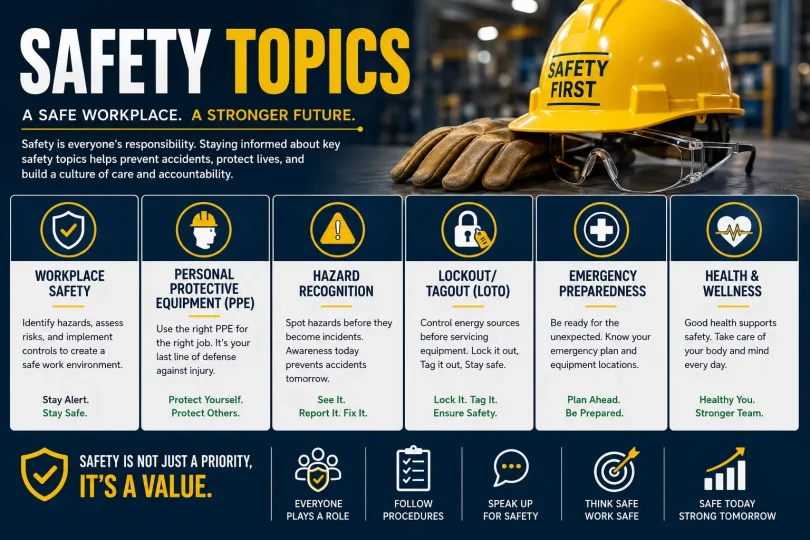

Workplace safety topics are the specific hazards and procedures covered in regular safety talks, toolbox meetings, and training sessions. Choosing the right topics keeps these conversations relevant instead of repetitive, and directly supports OSHA training compliance requirements.
What this guide covers:
- Definition of safety topics and how they connect to OSHA safety topics and OSHA toolbox talks
- Ready-to-use meeting structures
- Real workplace injury data
- Common mistakes to avoid
- A pre-meeting checklist
Why it matters:
- Regular safety talks are required across industries from construction sites to warehouse floors
- Well-chosen topics improve engagement and retention among workers
- Poorly chosen or repetitive topics reduce compliance effectiveness and worker attention
This guidance is built on OSHA hazard communication and training standards, combined with published workplace injury data reflecting both regulatory requirements and practical, field-tested approaches.
What Are Safety Topics?
Safety topics are short, focused subjects covering a specific workplace hazard, procedure, or best practice, used as the basis for a safety meeting, toolbox talk, or training session. A safety topic is not a full training course. It is a single, narrow subject, such as ladder safety or electrical hazard awareness, chosen to match the actual work being done that day or week.
A well-chosen safety topic has three parts: the hazard itself, the practical steps workers should take to avoid it, and an opening for discussion so the team can raise real situations they have encountered. Safety topics are used across construction, manufacturing, warehousing, utilities, and office environments, and the format scales from a two-minute daily reminder to a longer weekly or monthly session.
Why Safety Topics and Toolbox Talks Matter: The Data
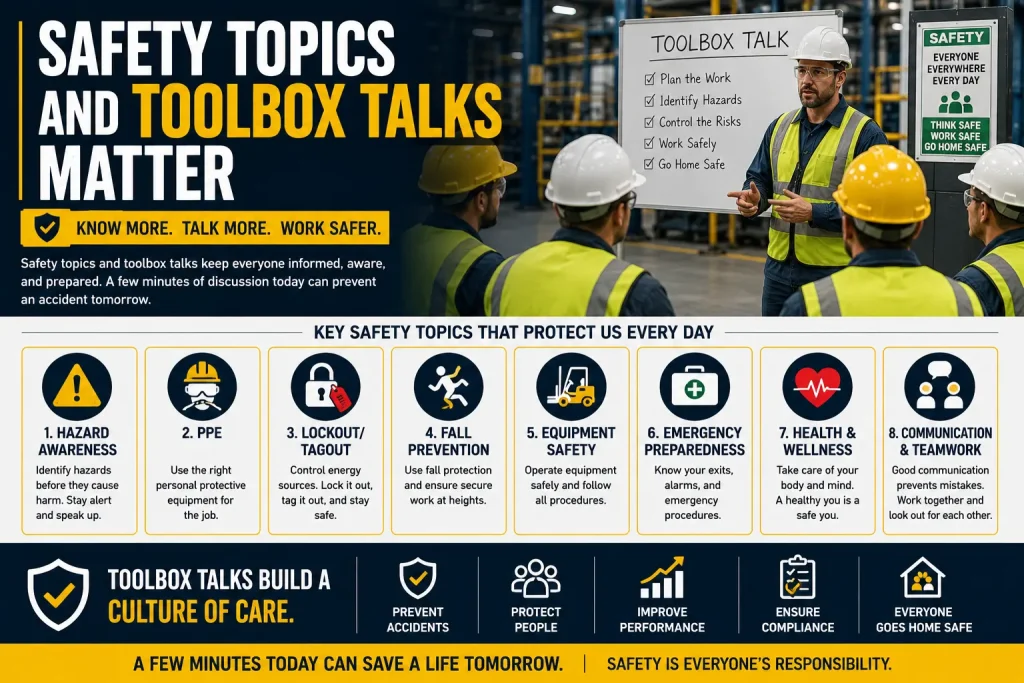
Workplace injuries remain a persistent and expensive problem across every major industry. Warehouse injury rates run at roughly 4.8 cases per 100 workers, more than double the all-industry average, and forklift-related incidents alone are linked to somewhere between 35,000 and 62,000 injuries every year in the United States. Slips, trips, and falls account for a large share of non-fatal warehouse injuries, and falls from ladders and elevated platforms remain one of the leading causes of fatal workplace accidents.
Regular safety topics and toolbox talks are one of the lowest-cost, highest-frequency tools available to reduce these numbers. A short daily or weekly conversation keeps hazard awareness current, gives workers a structured chance to report near-misses, and creates a documented record that a company actively trained its team on recognizing and avoiding unsafe conditions. While OSHA does not mandate toolbox talks by name in every standard, they directly support compliance with training requirements such as 29 CFR 1926.21(b)(2), which requires employers to instruct employees in recognizing and avoiding unsafe conditions.
Expert Insight
Safety topics work best when they are tied to the actual task happening that day rather than pulled at random from a generic list. A toolbox talk on fall protection delivered right before a crew climbs scaffolding carries far more weight, and produces better retention, than the same topic delivered out of sequence weeks later. Supervisors who rotate topics based on the week’s actual work order, rather than cycling through a fixed calendar regardless of task, consistently report higher engagement and more reported near-misses, which is usually a sign the safety culture is actually working rather than just going through the motions.
Types of Safety Topics
Safety topics generally fall into a few recognizable categories depending on their purpose and setting.
| Category | Focus | Typical Setting | Example Topics |
|---|---|---|---|
| OSHA Safety Topics | Regulatory hazard categories | Any OSHA-covered workplace | Hazard communication, PPE, fall protection |
| Industrial Safety Topics | Plant and manufacturing hazards | Factories, warehouses, production floors | Machine guarding, lockout/tagout, forklift safety |
| OSHA Toolbox Talks | Short, daily or weekly hazard briefings | Construction, field crews, jobsites | Ladder safety, electrical hazards, hand protection |
| Safety Topics for Meetings | Broader safety discussions | Scheduled team or department meetings | Incident review, safety culture, near-miss reporting |
| Safety Topics for Work | General workplace safety | Offices, mixed environments | Ergonomics, fire safety, emergency procedures |
OSHA Safety Topics
OSHA safety topics refer to the hazard categories and subject areas that the Occupational Safety and Health Administration itself highlights as priorities on its official safety and health topics resources. These typically include hazard communication and chemical labeling, personal protective equipment, fall protection, electrical safety, lockout/tagout, and confined space entry. Because these categories map directly to OSHA standards, building your meeting schedule around OSHA safety topics is one of the most reliable ways to make sure your training record lines up with what an inspector or auditor will actually look for.
Industrial Safety Topics
Industrial safety topics are safety subjects specific to plant, factory, and warehouse environments where powered equipment, heavy machinery, and material handling create hazards not typically found in office settings. Common industrial safety topics include machine guarding, lockout/tagout procedures, forklift and powered industrial truck safety, confined space entry, chemical handling, and struck-by and caught-in-between hazards around moving equipment. Because industrial environments combine multiple hazard types in the same shift, industrial safety topics are usually rotated more frequently than general office safety topics, often on a daily basis in high-risk facilities.
OSHA Toolbox Talks
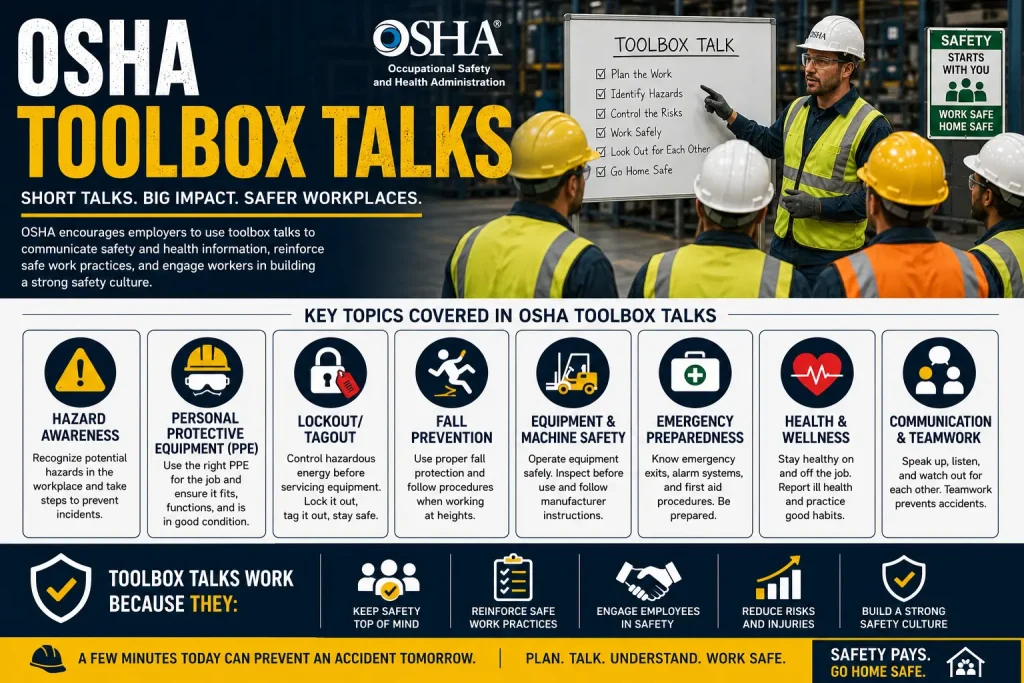
OSHA toolbox talks are brief, informal safety discussions, typically two to fifteen minutes long, held at the start of a shift to cover a single hazard relevant to that day’s work. The format is informal by design: a supervisor or experienced worker leads a short discussion, covers the hazard and the practical steps to avoid it, and invites the crew to share relevant experiences before work begins. Documentation matters here. A proper toolbox talk record includes the date, the topic, the presenter’s name, and a sign-in sheet for everyone present, since this record is what demonstrates training compliance if OSHA or an internal auditor ever asks for proof.
Safety Topics for Meetings vs OSHA Toolbox Talks
These two formats are often confused, but they serve different purposes.
| Aspect | Safety Topics for Meetings | OSHA Toolbox Talks |
|---|---|---|
| Length | 15 to 60 minutes | 2 to 15 minutes |
| Frequency | Weekly or monthly | Daily or per shift |
| Format | Structured, often with a presentation or agenda | Informal, conversational |
| Depth | Covers a topic in detail, may include policy review | Covers one hazard briefly, tied to the day’s task |
| Documentation | Meeting minutes, attendance record | Sign-in sheet with topic and presenter |
A safety meeting is the right format when you need to review an incident in depth, roll out a new policy, or cover a topic that needs more than a few minutes. A toolbox talk is the right format for a quick, task-specific reminder right before work starts. Most mature safety programs use both together, running weekly or monthly meetings for broader safety topics for work alongside daily toolbox talks for immediate task hazards.
Safety Topics for Work: General Workplace List
Not every workplace deals with forklifts or confined spaces, and general safety topics for work still matter in offices, retail, and mixed environments.
- Ergonomics and workstation setup
- Fire safety and evacuation procedures
- Slips, trips, and falls
- Emergency contact and first aid procedures
- Stress and mental health awareness
- Proper lifting technique
- Electrical cord and equipment safety
- Heat and cold stress awareness by season
- Active shooter and workplace violence response
- Housekeeping and clutter-related hazards
How to Choose and Run an Effective Safety Topic
- Match the topic to the actual work: Pick a subject connected to the task happening that day or week rather than a random item off a generic list.
- Keep it short and focused: A daily toolbox talk works best at two to five minutes on a single hazard, while a scheduled safety meeting can run longer if it covers policy or an incident review.
- Open with the hazard, not the rule: Explain what can actually go wrong before reciting the regulation, since workers retain hazard-first framing better than rule-first framing.
- Invite discussion: Ask the team if they have seen the hazard in question recently, since real examples make the topic stick.
- Document every session: Record the date, topic, presenter, and attendance, and attach any materials used, so the talk counts as evidence of training if it is ever needed.
- Rotate topics deliberately: Avoid repeating the same two or three subjects out of convenience, since predictable topics lose engagement over time.
- Use seasonal and regulatory triggers: Bring in heat stress topics before summer, cold stress before winter, and any topic tied to a recent regulatory update as soon as it is announced.
Common Mistakes When Choosing Safety Topics
- Picking topics at random: Using whatever comes to mind instead of matching the topic to the day’s actual hazards.
- Reading straight from a script: Delivering the talk word for word without eye contact or discussion kills engagement fast.
- Skipping documentation: Holding a talk but failing to log the date, topic, and attendees, which leaves no proof of training if it is ever questioned.
- Repeating the same few topics: Cycling through only three or four familiar subjects, which workers start to tune out.
- Ignoring seasonal hazards: Failing to swap in heat stress, cold stress, or weather-specific topics as conditions change.
- Treating toolbox talks and safety meetings as the same thing: Using a two-minute format for a subject that actually needs a full policy discussion, or dragging a quick daily reminder into a twenty-minute lecture.
- Not inviting feedback: Running a one-way lecture instead of asking the crew what hazards they are actually seeing.
Before Your Next Safety Meeting: Checklist
- [ ] Topic selected to match today’s or this week’s actual work
- [ ] Format decided (quick toolbox talk vs full safety meeting)
- [ ] Hazard, prevention steps, and discussion questions prepared
- [ ] Seasonal or recent regulatory triggers checked
- [ ] Presenter assigned and materials ready
- [ ] Sign-in sheet or attendance record prepared
- [ ] Time allotted appropriate to format (2 to 5 minutes for daily talks, 15 to 60 minutes for meetings)
- [ ] Documentation plan confirmed for filing after the session
- [ ] Next topic tentatively scheduled to keep rotation fresh
Frequently Asked Questions
What is the difference between a safety topic and a toolbox talk?
A safety topic is the subject itself, such as ladder safety or hazard communication. A toolbox talk is the short, informal meeting format used to deliver that topic, typically lasting two to fifteen minutes at the start of a shift.
Does OSHA require toolbox talks?
OSHA does not name toolbox talks specifically in most standards, but regular hazard training is required under standards such as 29 CFR 1926.21(b)(2), and toolbox talks are a common, practical way employers demonstrate that ongoing training.
How often should safety topics be covered?
High-hazard industries such as construction and manufacturing typically hold a toolbox talk daily or at the start of every shift, while lower-risk workplaces may hold safety topics for meetings weekly or monthly. Consistency matters more than a specific minimum frequency.
What are good industrial safety topics for a manufacturing plant?
Common industrial safety topics include machine guarding, lockout/tagout, forklift and powered industrial truck safety, confined space entry, chemical handling, and struck-by hazards around moving equipment.
Do I need to document safety topics and toolbox talks?
Yes. A proper record should include the date, topic, presenter, and a sign-in sheet for attendees. This documentation is what proves training occurred if OSHA or an internal auditor requests evidence.
Final Thoughts
Safety topics are only as effective as the consistency and relevance behind them. Whether you are pulling from OSHA safety topics to stay aligned with regulatory priorities, running daily OSHA toolbox talks on a jobsite, covering industrial safety topics on a manufacturing floor, or planning broader safety topics for meetings and safety topics for work in an office setting, the same principles apply: match the topic to the actual hazard, keep the format appropriate to the setting, document every session, and rotate subjects so the team stays engaged rather than tuning out. Use the checklist above before your next session so the habit sticks.
You May Also Like It:
CNC Machining Tolerances: The Complete Expert Guide
Prototype CNC Machining: The Complete Expert Guide
Steel Grade: The Complete Guide to Understanding Every Type of Steel