
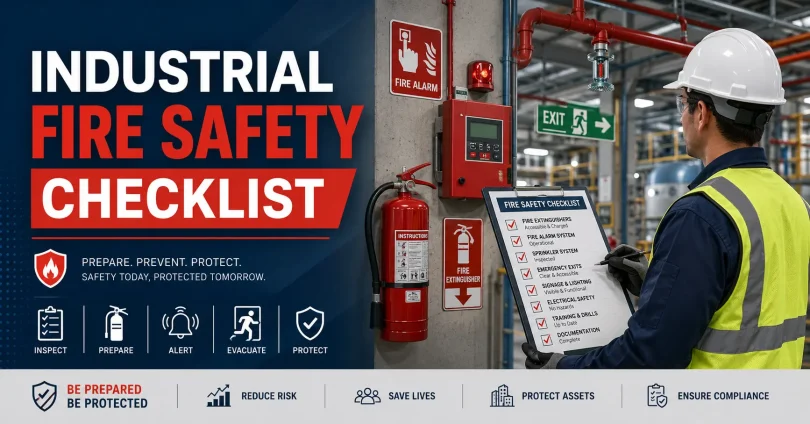

An industrial fire safety checklist is the single most effective tool a facility manager has for catching hazards before they become citations, insurance claims, or worse. Industrial environments carry more fire risk than a typical office: flammable liquids, hot work, high-voltage electrical systems, dense storage racks, and constant equipment operation all raise the stakes.
This guide gives you a complete, regulation-backed industrial fire safety checklist, explains the OSHA and NFPA standards behind each item, and shows you how often each check needs to happen so your facility stays audit-ready year-round.
Why an Industrial Fire Safety Checklist Matters
The numbers make the case on their own. In the United States, a fire department responds to a fire roughly every 24 seconds (NFPA, Fire Loss in the United States). Structure fires alone account for the large majority of civilian fire deaths, injuries, and property damage each year, even though they make up a minority of total fire incidents.
For an industrial facility, the risk is not just human safety. A failed inspection can trigger an insurance coverage exclusion, a lease violation, and, if a fire does occur, personal liability for whoever signed the last inspection log. A structured checklist turns fire prevention from a vague good intention into a documented, repeatable process that protects people, property, and the business itself.
The Regulations Behind the Checklist
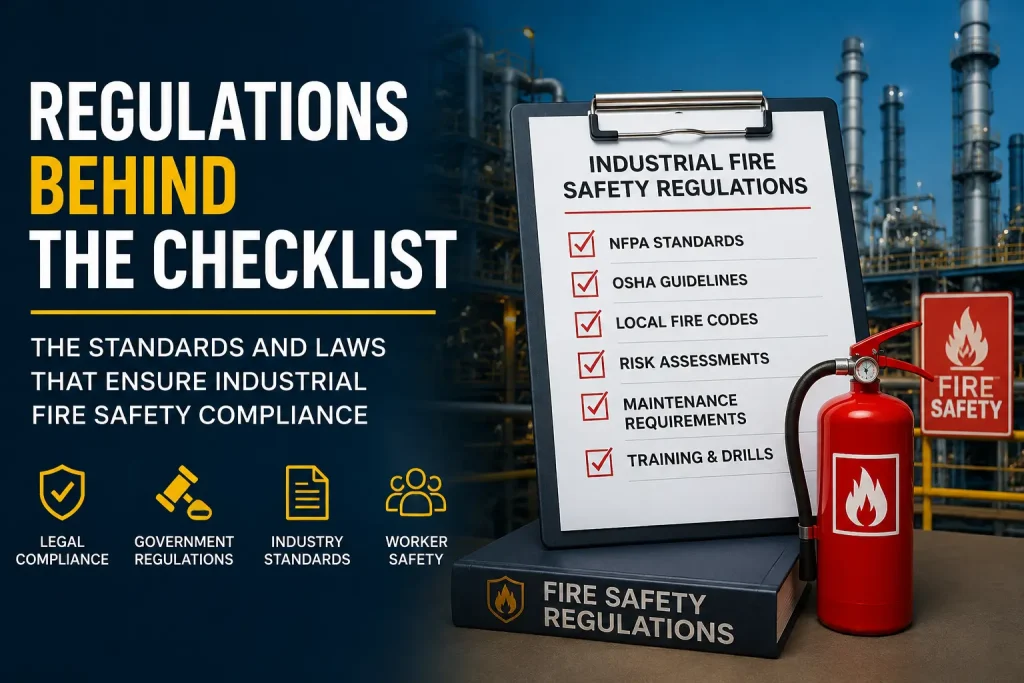
A generic checklist is only useful if it is actually built on the rules that inspectors and insurers check against. In the United States, two frameworks work together:
- OSHA (29 CFR 1910) sets the legal minimum for how employers must protect workers. Key sections include 1910.157 (portable fire extinguishers), 1910.106 (flammable and combustible liquids), 1910.119 (process safety management for highly hazardous chemicals), 1910.38 (emergency action plans), and 1910.39 (fire prevention plans).
- NFPA codes set the technical standard for how systems must be designed, installed, and maintained. Common references include NFPA 10 (portable fire extinguishers), NFPA 13 (sprinkler systems), NFPA 25 (inspection, testing, and maintenance of water-based systems), NFPA 70 (electrical safety, including hazardous location classification), NFPA 72 (fire alarm and detection systems), and NFPA 101 (life safety code, covering egress and emergency lighting).
In practice, OSHA sets the legal floor and many local fire marshals enforce NFPA standards on top of it, so a facility needs to satisfy both. Non-compliance is not a minor issue either: as of 2026, OSHA’s maximum penalties are $16,550 per serious, other-than-serious, or posting-requirement violation, $16,550 per day for failure to abate, and $165,514 per willful or repeated violation (OSHA Penalties, effective after Jan. 15, 2026).
The Complete Industrial Fire Safety Checklist
Use the categories below as the backbone of your inspection. Each one maps to a specific regulatory requirement rather than a generic best practice.
1. Fire Extinguishers
- Extinguishers are placed within 75 feet of Class A hazards and 50 feet of Class B hazards, per OSHA 1910.157(d).
- Mounting height does not exceed 5 feet to the handle (3.5 feet for units over 40 lbs).
- Access is not blocked by equipment, pallets, or storage, per NFPA 10 Section 6.1.3.8.
- Pressure gauge reads in the operable range and the pin and tamper seal are intact.
- Monthly visual inspection is documented with initials or a digital log entry.
- Annual maintenance has been performed by a qualified technician, with internal examination every 6 years and hydrostatic testing every 5 or 12 years depending on extinguisher type.
- Extinguisher type matches the hazard class present in that area, including Class K coverage near any commercial cooking equipment.
2. Fire Alarm and Detection Systems
- Smoke and heat detectors are unobstructed and free of dust, paint overspray, or physical damage.
- The control panel shows no active trouble or supervisory signals.
- The system is tested and inspected according to NFPA 72 schedules, and monitored by a UL-listed central station where required.
- Manual pull stations are visible, unobstructed, and clearly marked.
3. Sprinkler and Suppression Systems
- Sprinkler heads are free of paint, corrosion, and physical damage, with the required clearance below the head, typically 18 inches for standard systems and up to 36 inches for ESFR and large-drop heads.
- Control valves are in the open position and secured or supervised against tampering.
- Inspection, testing, and maintenance follow NFPA 25 intervals for gauges, valves, and water flow tests.
- Fire pumps, where present, are functionally tested and records are current.
- Special hazard systems, such as foam, clean agent, or CO2 systems, are inspected on their required cycle.
4. Emergency Exits and Egress
- All exits and exit paths are clear of obstructions, storage, and equipment.
- Exit signs are illuminated and legible from 100 feet, with no burned-out or flickering lamps.
- Emergency lighting passes a monthly 30-second functional test and a full annual 90-minute battery-capacity test, per NFPA 101 Section 7.9.3, providing a minimum of 1 foot-candle at floor level along the egress path.
- Fire doors close and latch properly and are never wedged or propped open.
- Travel distance to the nearest exit meets NFPA 101 life safety code limits for the occupancy type.
5. Electrical Safety
- Outlet, switch, and junction box covers are in place with no exposed wiring.
- No extension cords or multi-plug adapters are used as permanent wiring.
- No damaged cords, plugs, or outlets are in service.
- Electrical panels have a minimum 30-inch clearance and are clearly identified.
- Equipment in classified hazardous locations meets NFPA 70 requirements for the applicable Class and Division or Zone, including approved intrinsically safe or explosion-proof equipment.
6. Flammable and Combustible Materials Storage
- Flammable liquids are stored in approved safety cans or cabinets, per OSHA 1910.106.
- Outside of an approved storage cabinet or inside storage room, quantities are kept within OSHA’s exempt limits: no more than 25 gallons of Category 1 (Class IA) liquids in containers, or up to 120 gallons of Category 2–4 liquids, per fire area. A single approved storage cabinet is limited to 60 gallons of Category 1–3 liquids (120 gallons for Category 4 only), per 1910.106(d)(3).
- Containers are closed when not in use and grounded or bonded during transfer to prevent static ignition.
- Combustible storage is kept at least 24 inches below the ceiling, or 18 inches where sprinklers are present.
- Oily or greasy rags are placed in self-closing, listed containers rather than left loose.
7. Hot Work and Ignition Sources
- A hot work permit system is in place and used for welding, cutting, or grinding operations.
- Fire watch personnel and a charged extinguisher are present during and after hot work, per standard practice.
- Combustibles are cleared or shielded within the required radius of the hot work area.
- Compressed gas cylinders are secured upright, capped when not in use, and stored away from heat sources.
8. Housekeeping
- No accumulation of combustible waste, packaging, or dust in production or storage areas.
- Dumpsters are kept at least 5 feet from combustible walls or structures, with covers closed.
- Aisles and access roads remain unobstructed for both daily operations and emergency vehicle access.
- Combustible dust, where applicable, is controlled per facility-specific NFPA combustible dust standards.
9. Emergency Lighting and Signage
- Address numbers are posted and clearly visible for responding fire crews.
- Hazardous materials and utility shut-off locations are clearly marked.
- Emergency contact information is posted at building entrances or near main panels.
10. Training and Emergency Action Plans
- A written emergency action plan exists under OSHA 1910.38, covering evacuation routes, procedures, and accountability.
- A fire prevention plan exists under OSHA 1910.39, identifying major fire hazards and control measures.
- All employees receive general fire safety education, and any employee designated to fight incipient-stage fires receives hands-on training under 1910.157(g).
- Evacuation drills are conducted at least annually for general industry, with quarterly drills recommended for high-hazard areas.
- Training records and drill documentation are current and accessible.
Inspection Frequency at a Glance
| Item | Frequency | Who Performs It |
|---|---|---|
| Fire extinguisher visual check | Monthly | Employer/designated staff |
| Fire extinguisher full service | Annual | Certified technician |
| Extinguisher internal exam (stored-pressure) | Every 6 years | Certified technician |
| Extinguisher hydrostatic test | Every 5 or 12 years | Certified technician |
| Sprinkler/water-based system ITM | Per NFPA 25 schedule | Certified technician |
| Fire alarm/detection testing | Per NFPA 72 schedule | Certified technician |
| Emergency lighting functional test | Monthly (30-second test) | Facility staff |
| Emergency lighting full-capacity test | Annual (90-minute test) | Facility staff or technician |
| Evacuation drill | At least annual, quarterly for high-hazard sites | Facility/EHS team |
| Emergency action plan review | Annual, or after any plan change | EHS/management |
How to Conduct an Industrial Fire Safety Inspection
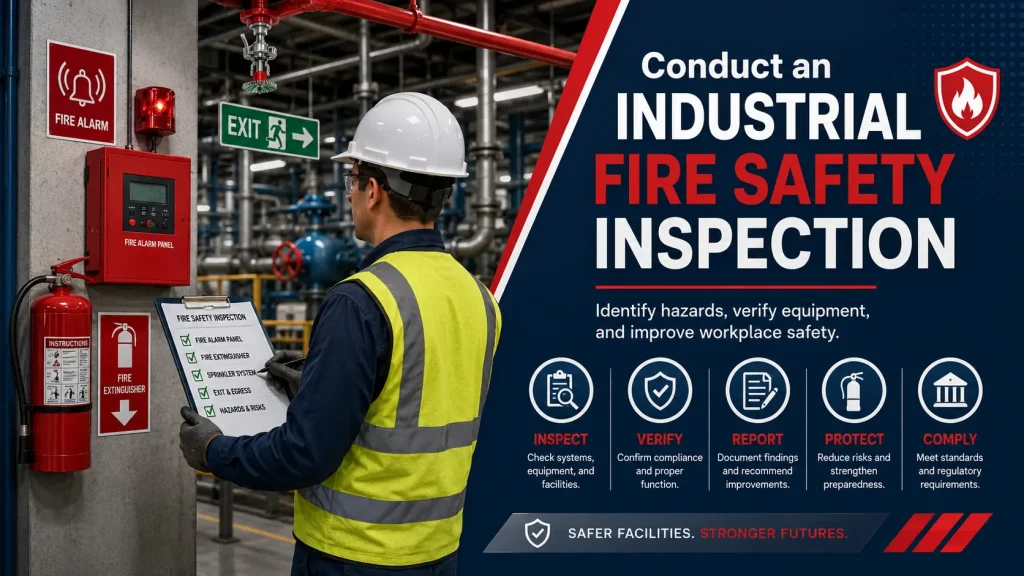
- Review the last inspection report before walking the floor, so you can verify that previously flagged items were actually corrected.
- Walk the facility systematically, moving area by area rather than jumping between systems, to avoid missing sections of the building.
- Document with photos for every flagged item, not just a checkbox, since photo evidence speeds up corrective action and supports insurance and audit records.
- Rate severity for each finding, distinguishing between a critical life-safety issue and a lower-priority maintenance item.
- Assign corrective action owners and deadlines immediately, rather than leaving findings in a report that nobody is accountable for.
- Verify closure on the next inspection cycle before considering an item resolved.
Common Violations and Why They Happen
Certain issues show up repeatedly across OSHA inspection data and insurance audits:
- Blocked extinguisher access. Pallets, boxes, or equipment placed in front of an extinguisher are one of the most frequent findings.
- Missing or expired inspection tags. A missing monthly initial or annual service tag is treated the same as a missed inspection, even if the check was actually performed.
- Overdue internal examinations or hydrostatic testing. These long-cycle requirements are easy to lose track of without a digital reminder system.
- No documented training records. Verbal-only training does not satisfy OSHA 1910.157(g) or NFPA 10 Section 7.1, which both require documented instruction.
- Propped-open fire doors. Convenience during daily operations frequently overrides the fire door’s self-closing function, defeating its purpose.
Paper Checklists vs Digital Checklists
Paper-based inspections still work, but they create real gaps: records get lost, photo evidence is inconsistent, and tracking long-cycle requirements like 6-year internal exams across dozens of extinguishers becomes a manual burden. Digital checklist tools address this by attaching photo documentation to each item, auto-generating compliance records, and creating corrective action work orders the moment something is flagged. For a single-site facility, a well-organized paper or spreadsheet system can still be sufficient. For multi-site portfolios, digital systems make it dramatically easier to prove compliance if a fire marshal or insurance auditor asks for records.
Frequently Asked Questions
What should an industrial fire safety checklist include?
At minimum, it should cover fire extinguishers, alarm and detection systems, sprinkler and suppression systems, emergency exits, electrical safety, flammable material storage, hot work controls, housekeeping, emergency lighting, and training and emergency action plans.
How often should a fire safety inspection be done in an industrial facility?
Fire extinguishers need a monthly visual check and annual professional service. Sprinkler and alarm systems follow NFPA 25 and NFPA 72 schedules, emergency lighting needs a monthly 30-second test plus an annual 90-minute test, and a full facility fire safety audit is typically conducted annually, with more frequent checks in high-hazard areas.
What OSHA standard covers fire extinguishers?
OSHA 29 CFR 1910.157 is the primary federal standard, and it works alongside NFPA 10, the technical standard for extinguisher selection, placement, and maintenance.
What happens if a facility fails a fire safety inspection?
Consequences can include OSHA citations and penalties (up to $165,514 per willful or repeated violation as of 2026, per OSHA’s penalty schedule), insurance coverage exclusions, lease violations, and, in the event of an actual fire, potential personal liability for whoever signed off on the last inspection.
Is an emergency action plan legally required?
Yes, under OSHA 1910.38, an emergency action plan is required whenever another OSHA standard the employer is subject to calls for one, which covers most industrial workplaces given how many standards trigger this requirement.
Final Thoughts
An industrial fire safety checklist only works if it is built on real regulatory requirements and actually followed on a set schedule, not just filled out once and filed away. Treat it as a living compliance record: document everything with photos, assign clear ownership for corrective action, and track long-cycle requirements like hydrostatic testing so nothing falls through the cracks. Facilities that treat fire safety inspections this way are the ones that pass audits, keep insurance coverage intact, and, most importantly, keep people safe.
You May Also Like It:
CNC Machining Tolerances: The Complete Expert Guide
MIG vs TIG Welding: Complete Guide to Differences and Procedures




[…] Industrial Fire Safety Checklist […]
[…] Specifications for machinery, electrical, and fire safety […]