
Reading time: about 12 minutes | For: engineers, buyers, facility managers, and students
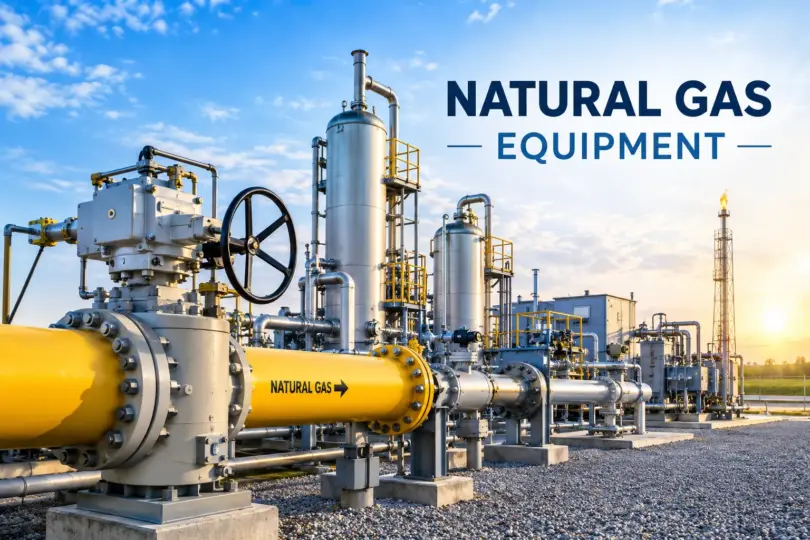
Natural gas equipment is any device or system used to process, control, measure, store, transport, or safely deliver natural gas. Common examples are pressure regulators, valves, compressors, meters, filters and separators, pipeline components, and leak detectors. Together they move gas from the wellhead to homes, businesses, factories, and power plants.
Natural gas travels a long way before it reaches a stove, a boiler, or a turbine. It is cleaned, pressurized, moved through pipelines, reduced to safe pressures, measured, and finally burned in end-use equipment. Every step depends on specialized hardware.
What Is Natural Gas Equipment?
Natural gas equipment is the hardware that handles gas at every stage, from extraction to final use. It does five main jobs:
- Processes raw gas by removing water, liquids, and impurities
- Controls pressure and flow
- Measures volume and flow rate
- Stores gas in tanks, underground formations, or pipeline systems
- Delivers gas safely to the point of use
Together these devices form the natural gas system. Raw gas from a well contains water vapor, heavier hydrocarbons, dust, and sometimes corrosive compounds such as hydrogen sulfide, so it cannot go straight into a pipeline or burner. Processing equipment cleans it, distribution equipment moves and regulates it, and safety equipment protects people and property.
Scale matters too. A home may need only a small regulator, a meter, and a stove. A gas processing plant may run large compressors, separators, and dehydration units around the clock. The principles are the same, but size, pressure, and safety demands differ.
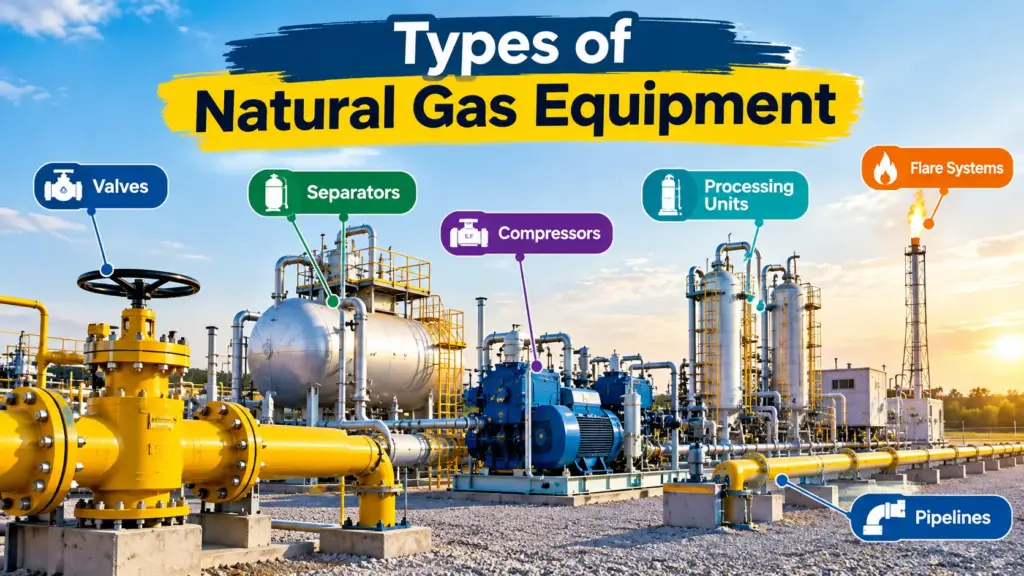
Types of Natural Gas Equipment.
1. Natural Gas Regulators
What it does: reduces high inlet pressure to a lower, steady outlet pressure. Pipelines carry gas at high pressure for efficient transport, but appliances and burners need much lower pressure to run safely. A regulator senses downstream pressure and adjusts an internal valve to hold the outlet stable as demand changes.
- Direct-operated: simple and compact, used in homes and small businesses.
- Pilot-operated: better for high flow and tight control, common in industrial and utility stations.
- Two-stage: reduce pressure in two steps for more stable output.
Where you find them: city gate stations, district stations, industrial plants, and at the meter of almost every connected building.
2. Natural Gas Valves
What it does: starts, stops, directs, and throttles gas flow. A gas shut-off valve is also one of the most important safety devices, because it isolates a section during maintenance or an emergency.
- Ball valves: quarter-turn operation and a tight seal, widely used for shut-off.
- Gate valves: full-bore on/off service in pipelines.
- Globe valves: precise flow control.
- Plug valves: common in distribution systems.
- Check valves: prevent reverse flow.
- Safety relief valves: release gas to protect equipment from overpressure.
- Solenoid valves: electrically operated, used with burners and automated systems.
Industrial gas valves must be rated for the pressure, temperature, and gas composition they will face.
3. Natural Gas Compressors
What it does: raises gas pressure so it can move through pipelines, enter storage, or reach processing units. Over long distances pressure drops because of friction, so compressor stations are placed along transmission lines to restore it.
- Reciprocating: piston-driven, good for high pressure ratios and smaller flows.
- Centrifugal: rotating impellers, suited to high flow in large pipelines.
- Rotary screw: used in gathering systems and mid-size industrial applications.
Compressors are driven by gas engines, gas turbines, or electric motors, and they need more maintenance than most other equipment in the system.
4. Natural Gas Meters
What it does: measures how much gas is consumed or transferred. Meters matter for billing, process control, and leak detection, because unexplained losses show up in the numbers.
- Diaphragm: standard for homes and small businesses.
- Rotary: medium commercial and industrial loads.
- Turbine: larger, steady flows.
- Ultrasonic: uses sound waves, no moving parts, high accuracy.
- Orifice and Coriolis: common in custody transfer and process measurement.
The right meter depends on flow range, accuracy needs, pressure, and gas cleanliness.
5. Natural Gas Filters and Separators
Dust, pipe scale, liquid droplets, and other contaminants can damage valves, meters, burners, and compressors. Three types of equipment protect against them:
- Filters remove solid particles from the gas stream.
- Separators remove liquids such as water and condensate. Common designs are gravity separators, cyclone separators, and coalescing filters.
- Dehydration equipment removes water vapor so it does not form hydrates (ice-like solids) or cause corrosion. Typical systems use glycol absorption or solid desiccant beds.
Clean, dry gas improves safety, equipment life, and combustion quality.
6. Natural Gas Pipeline Equipment
Pipeline equipment keeps the network running, controlled, and observable. Key components include:
- Steel and polyethylene pipes, with fittings such as elbows, tees, flanges, and couplings
- Isolation valves and block valve stations
- Pressure and temperature sensors
- Pipeline pigs, which clean and inspect the inside of the line
- Cathodic protection systems, which slow external corrosion
- SCADA and remote monitoring systems that track pressure and flow in real time
Monitoring equipment lets operators spot pressure drops, unexpected flow changes, and other early warning signs.
7. Natural Gas Leak Detection Equipment
Natural gas is flammable and can build up in enclosed spaces. Utilities add an odorant (usually a sulfur-based compound) so people can smell leaks, but electronic detection is also essential.
- Fixed detectors monitor plants, boiler rooms, and kitchens continuously.
- Portable detectors are used by technicians during inspections.
- Infrared and laser-based detectors find leaks from a distance.
- Gas monitoring systems trigger alarms or automatically close shut-off valves.
Natural Gas Equipment Examples
Here are common examples across the system:
| Equipment | What it does | Typical setting |
|---|---|---|
| Gas pressure regulator | Reduces and stabilizes pressure | Homes, stations, factories |
| Natural gas flow meter | Measures consumption or flow | Utilities, industry |
| Pipeline shut-off valve | Isolates a pipeline section | Transmission and distribution lines |
| Gas compressor | Raises pressure for transport or storage | Compressor stations, plants |
| Gas filtration system | Removes particles and liquids | Pipelines, processing plants |
| Industrial gas burner | Burns gas for heat | Furnaces, kilns, dryers |
| Gas leak detector | Detects leaks and triggers alarms | Plants, kitchens, boiler rooms |
| Gas-fired boiler | Produces hot water or steam | Buildings, factories, hospitals |
A note on “natural gas examples”: the phrase can mean examples of the gas itself, such as methane-rich pipeline gas, shale gas, or biogas upgraded to pipeline quality. It can also mean examples of the equipment that handles it, which is what the table above covers.
How Does Natural Gas Equipment Work?
The equipment works as a chain, with each stage preparing the gas for the next:
- Production and processing. Gas is extracted from wells and sent to processing plants, where water, condensate, and contaminants are removed.
- Filtration and impurity removal. Filters, separators, and dehydration units clean and dry the gas.
- Compression and pressure regulation. Compressors raise pressure for long-distance transport. Regulators lower it when gas enters lower-pressure networks.
- Pipeline transportation. Gas moves through transmission and distribution pipelines while valves and monitoring systems control and watch the flow.
- Metering and flow monitoring. Meters record volume for billing, process control, and loss tracking.
- Delivery to end-use equipment. Gas reaches burners, boilers, furnaces, turbines, and appliances at the correct pressure.
Safety devices such as relief valves, leak detectors, and automatic shut-offs operate at several points along the chain.
Industrial Uses of Natural Gas Equipment
Manufacturing
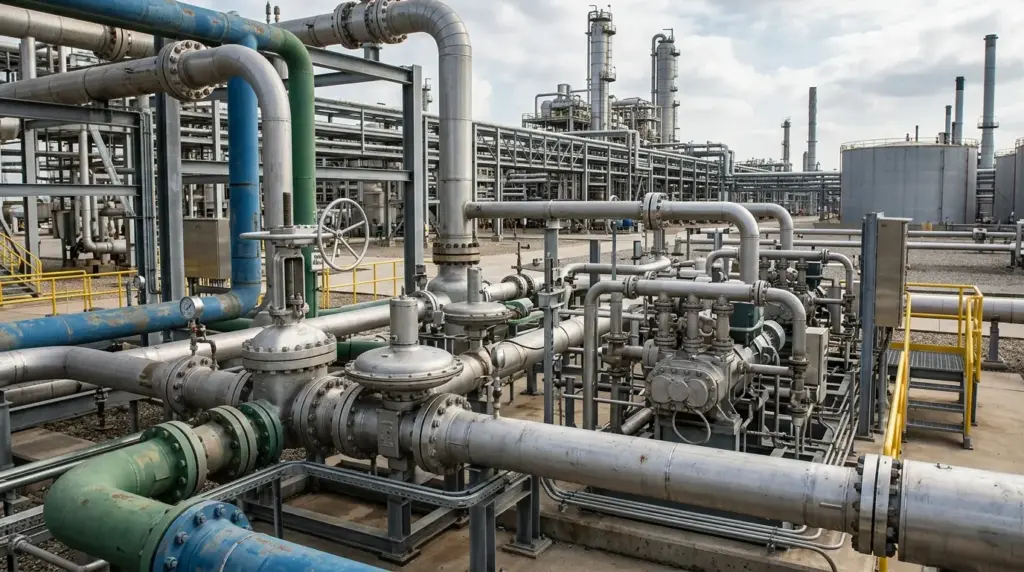
Factories use natural gas for process heat, valued for clean combustion and steady temperature control. Typical uses are furnaces, kilns, dryers, ovens, and steam boilers in steel, glass, ceramics, textiles, food processing, and chemicals. Regulators, meters, filters, burners, and safety shut-off systems usually work together at these sites.
Power Generation
Gas-fired power plants burn natural gas in turbines and engines. They need reliable fuel delivery: filtration and conditioning skids, pressure regulation, metering stations, and fast-acting shut-off valves. Gas turbines are sensitive to liquids and particles in fuel, so fuel gas conditioning is critical.
Commercial Buildings
Restaurants, hotels, hospitals, schools, and offices use natural gas for cooking, space heating, and hot water. Typical equipment includes commercial kitchen ranges, gas-fired boilers, water heaters, gas detectors, and emergency shut-off valves tied to ventilation or fire systems.
Gas Processing Plants
These plants prepare raw gas for sale. Separators remove liquids, dehydration units remove water, compressors boost pressure, and filters protect downstream equipment. Some plants also remove acid gases and recover natural gas liquids. Reliability and safety systems matter most here because of the volumes and pressures involved.
How to Choose the Right Natural Gas Equipment
Selection is mostly about matching equipment to real operating conditions. Check these six factors:
- Gas pressure and flow rate. Know your minimum and maximum demand. Undersized equipment restricts flow, and oversized equipment can control poorly at low demand.
- Material and gas compatibility. Seals, diaphragms, and metals must suit the gas composition, including any moisture or corrosive components.
- Temperature and environment. Outdoor, offshore, hazardous-area, and high-humidity sites may need special ratings and protective housings.
- Capacity and efficiency. Look at turndown range, pressure drop, and fuel efficiency, not just upfront price.
- Safety standards and certifications. Confirm the equipment meets the codes that apply in your country and industry, such as ISO, API, ASME, or local gas authority requirements.
- Maintenance and replacement. Consider spare parts availability, service access, and expected lifespan.
Choosing a supplier: when comparing natural gas equipment suppliers and manufacturers, ask for technical datasheets, test certificates, references from similar installations, and after-sales support terms. For critical systems, have a qualified gas engineer review the specification before you buy.
Natural Gas Equipment Safety and Maintenance
Common Problems
- Gas leaks: often caused by worn seals, loose fittings, or corrosion.
- Pressure fluctuations: can point to regulator problems, blocked filters, or demand changes.
- Blocked filters: reduce flow and increase pressure drop.
- Faulty regulators: may cause pressure that is too high, too low, or unstable.
- Metering errors: can result from dirt, wear, or incorrect sizing.
- Compressor issues: vibration, overheating, and worn parts are common without regular servicing.
Maintenance Tips
- Inspect regularly. Follow the manufacturer’s schedule and local regulations, since intervals vary by equipment type, pressure, and location.
- Test for leaks routinely. Use approved detectors or leak-test solution, never a flame.
- Replace filter elements based on differential pressure readings or the maintenance schedule.
- Check and calibrate meters, regulators, safety valves, and gas detectors as required.
- Use qualified technicians for installation, repair, and servicing. Gas work is not a do-it-yourself job.
- Keep records of inspections, repairs, and tests so trends are easy to spot.
If you smell gas: do not operate switches or light anything. Leave the area, then call your gas utility or emergency services from a safe distance.
Natural Gas Equipment vs. LPG Equipment
Natural gas and LPG (liquefied petroleum gas) equipment are not interchangeable without proper conversion.
| Factor | Natural gas | LPG |
|---|---|---|
| Main component | Methane | Propane and/or butane |
| Behavior in air | Lighter than air, rises | Heavier than air, settles low |
| Energy per unit volume | Lower | Higher |
| Typical supply | Pipeline network | Cylinders or bulk tanks |
| Operating pressure | Generally lower at appliances | Generally higher |
| Burner and orifice design | Larger orifices | Smaller orifices |
Because the fuels differ in energy content and pressure, burners, regulators, and orifices are designed for one or the other. Converting an appliance requires the correct kit and a qualified technician. Density also affects detector placement: natural gas detectors are usually mounted high, while LPG detectors are mounted low.
Frequently Asked Questions About Natural Gas Equipment
What is natural gas equipment?
It is any device or system used to process, control, measure, store, transport, or safely deliver natural gas, from wellhead to end use.
What are some examples of natural gas equipment?
Examples include pressure regulators, valves, compressors, meters, filters, separators, pipeline components, leak detectors, burners, and gas-fired boilers.
What equipment is used in natural gas processing?
Separators, dehydration units, filters, compressors, and in many plants, units for removing acid gases and recovering natural gas liquids.
What are the main components of a natural gas pipeline?
Pipes, fittings, isolation valves, compressor stations, regulator and metering stations, pigging facilities, corrosion protection systems, and monitoring and control systems.
What equipment controls natural gas pressure?
Pressure regulators reduce and stabilize pressure, and compressors increase it. Relief valves and pressure sensors protect the system from overpressure.
How is natural gas flow measured?
With gas meters such as diaphragm, rotary, turbine, ultrasonic, orifice, or Coriolis meters, chosen by flow range, pressure, and accuracy requirements.
What equipment is used to detect natural gas leaks?
Fixed and portable gas detectors, infrared and laser-based detectors, and gas monitoring systems that can raise alarms or trigger automatic shut-off valves.
How often should natural gas equipment be inspected?
It depends on the equipment, operating pressure, and local regulations. Many appliances and small systems are checked at least annually, while industrial systems often follow more frequent schedules set by the manufacturer, site risk assessment, and applicable codes.
Final Thoughts
Natural gas equipment is a connected system, not a set of separate parts. Regulators, valves, compressors, meters, filters, pipelines, and leak detectors each do a different job, and the system is only as reliable as its weakest component. Choose equipment that matches your real operating conditions, buy from reputable manufacturers, and keep up with inspections and maintenance.Back to top.
You May Also Like It:
Oil Smells Like Gas? 7 Causes, Warning Signs, and Fixes
Oil and Gas Regulatory Authority: What It Is, How It Works, and Why It Matters
Natural Gas Energy: A Complete Guide to Its Benefits, Drawbacks, and Role in the Modern World
Oil and Gas Asset Management: Complete Guide to Software and Best Practices