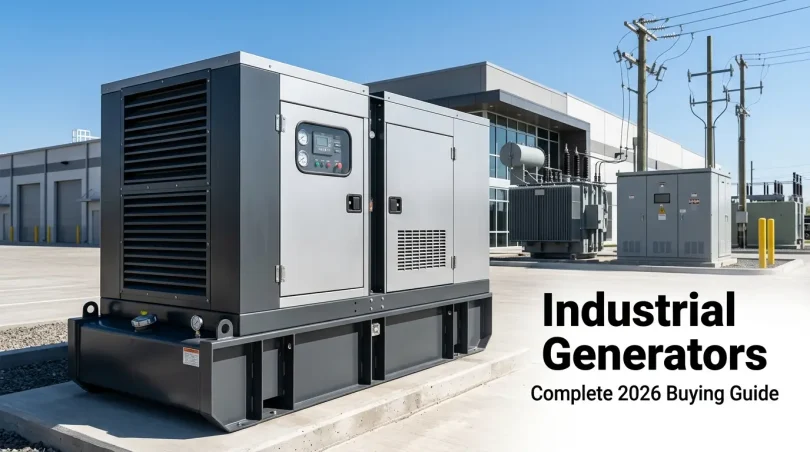

Industrial generators are heavy-duty power systems that provide reliable electricity for factories, hospitals, construction sites, warehouses, and other commercial facilities during outages or in off-grid locations. Most industrial generators range from 20 kW to several megawatts and run on diesel, natural gas, or dual-fuel systems.
This guide breaks down everything a facility manager, contractor, or business owner needs to know before buying an industrial generator in 2026 from power sizing and fuel type to brand comparisons, real-world pricing, and the regulations that govern installation.
Quick navigation: Use the Table of Contents below to jump directly to the section most relevant to your situation.
What Is an Industrial Generator?
An industrial generator sometimes called a generator set or genset is a heavy-duty power system engineered to produce large amounts of electricity for commercial, industrial, or critical infrastructure use. Unlike small portable units meant for camping or occasional home backup, industrial generators are built as a commercial backup generator or prime power generator for continuous, high-demand environments such as manufacturing plants, hospitals, data centers, and construction sites.
Most manufacturers place the “industrial” label on units producing anywhere from 20 kW up to several megawatts, though there is no single official cutoff. What matters more than exact wattage is build quality: reinforced enclosures, industrial-grade engines, and controls rated for long duty cycles.
In practice, the term overlaps with what people also call a standby generator, an emergency power supply (EPS), or an industrial power solution for critical facilities.
Generator Types at a Glance
| Type | Best For | Fuel | Typical Power Range |
|---|---|---|---|
| Diesel generator | Backup power, remote sites | Diesel | 20 kW to 2 MW+ |
| Natural gas generator | Continuous or standby use | Natural gas | 20 kW to 1 MW+ |
| Dual fuel / bi-fuel | Critical facilities | Diesel + gas | 50 kW to 2 MW+ |
| Portable jobsite generator | Contractors, construction sites | Petrol or diesel | 2 kW to 15 kW |
Main Types of Industrial Generators
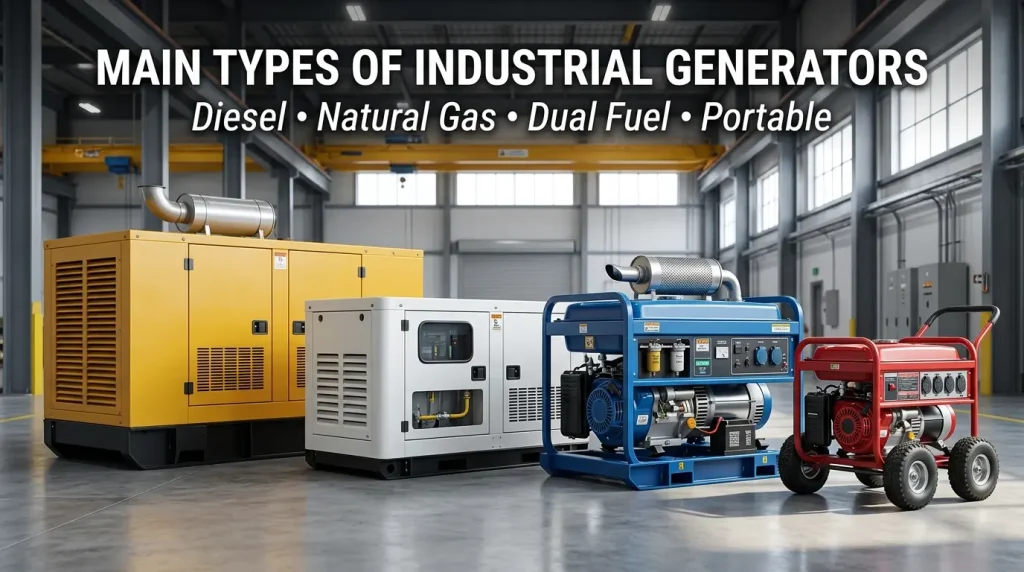
Diesel Industrial Generators
Diesel remains the most common choice for industrial power generators because diesel fuel is widely available, stores reasonably well, and delivers strong torque for heavy electrical loads. Diesel gensets typically range from 10 kW to over 2 megawatts and are the standard emergency generator for remote job sites, hospitals, and data centers that need guaranteed backup electricity.
Key advantage: Diesel engines are well-understood by service technicians nationwide, and parts availability is rarely an issue for tier-one brands like Caterpillar or Cummins.
Natural Gas Generators
Natural gas units connect directly to a gas line, removing the need for on-site fuel storage and refueling. They run cleaner and are a popular commercial generator option for facilities that already have gas infrastructure, though they depend on an uninterrupted gas supply which itself can fail during large-scale disasters.
Bi-Fuel and Dual-Fuel Systems
Some industrial generators combine diesel and natural gas, giving operators the flexibility to switch fuel sources depending on availability and cost. This setup is common in large industrial energy ecosystems where power outage protection cannot depend on a single fuel type. The tradeoff is higher upfront cost and more complex controls.
Portable and Jobsite Generators
At the smaller end sit portable units built for mobility rather than continuous duty typically what contractors call a construction generator. They trade raw capacity for ease of movement between job sites. Common brands in this category include Honda, Generac, Champion, and DeWalt.
Pros and Cons by Fuel Type
| Fuel | Pros | Cons |
|---|---|---|
| Diesel | High power output, reliable, long fuel shelf life, widely available | Louder, higher emissions, requires on-site storage and rotation |
| Natural gas | Cleaner burning, no fuel storage needed, lower per-hour fuel cost | Entirely dependent on gas network can fail during large outages |
| Dual fuel | Maximum flexibility, added redundancy, cost optimization | Higher upfront cost, more complex service requirements |
| Propane | Cleaner than diesel, portable storage possible | Lower energy density, more expensive at scale |
Industrial Generators vs. Construction Generators
People often search for “industrial generators” and “construction generators” as if they mean the same thing, but there are practical differences worth understanding.
A construction generator is typically a smaller, portable unit built to travel between job sites and power hand tools, lighting, and small equipment. A unit in the 2,000 to 7,000 watt range is standard for most contractors, and many choose gas-powered inverter models for their light weight and quiet operation.
A true industrial generator is often stationary or trailer-mounted, supplying continuous power to an entire facility or large piece of equipment. It is built for durability under constant load rather than portability.
That said, the line blurs on large construction projects. A bigger site running welders, compressors, and site trailers may need a 20 kW to 100 kW generator, which starts to overlap with what most would call an industrial power generator.
Top Industrial Generator Brands Compared
Choosing the right brand matters as much as choosing the right specs. Below is an honest comparison of the major manufacturers serving the U.S. industrial market.
| Brand | Country | Strengths | Weaknesses | Best For |
|---|---|---|---|---|
| Caterpillar (CAT) | USA | Exceptional durability, massive dealer network, proven at extreme duty cycles | Premium pricing, longer lead times on custom builds | Critical facilities, data centers, large industrial plants |
| Cummins | USA | Industry-leading diesel engines, excellent fuel efficiency, strong warranty | Complex service network in rural areas | Hospitals, manufacturing, oil & gas |
| Kohler | USA | Quiet operation, fast response time, strong residential and commercial line | Higher cost than competitors at mid-range kW | Hospitals, commercial buildings, data centers |
| Generac | USA | Best value at mid-range kW, widest product line in North America | Less suited for extreme industrial duty cycles | Small to medium businesses, warehouses |
| MTU (Rolls-Royce) | Germany | Premium build quality, optimized for large continuous duty | Very high cost, limited U.S. dealer network | Power plants, military, large data centers |
| Perkins | UK | Strong mid-range diesel line, good global parts availability | Less brand recognition in U.S. than CAT or Cummins | Construction, international projects |
| Honda (EB Series) | Japan | Quiet, OSHA-compliant, exceptional fuel efficiency, lightweight | Not suited for high-kW industrial continuous use | Jobsite/light commercial, contractors |
Quick pick: For most U.S. businesses needing a 100–500 kW standby system, Cummins and Kohler offer the best balance of reliability, service availability, and warranty value. For maximum uptime in life-safety applications (hospitals, data centers), Caterpillar remains the gold standard.
How Much Does an Industrial Generator Cost?
Cost is one of the most searched questions in this category, yet most guides avoid answering it directly. Here are realistic 2025–2026 price ranges for the U.S. market:
Generator Unit Cost (Equipment Only)
| Power Output | Typical Price Range | Common Use Case |
|---|---|---|
| 20–50 kW | $5,000 – $20,000 | Small business, retail, light commercial |
| 50–100 kW | $15,000 – $45,000 | Mid-size office, restaurant, small warehouse |
| 100–250 kW | $30,000 – $90,000 | Large warehouse, mid-size manufacturing |
| 250–500 kW | $75,000 – $200,000 | Hospital wing, data center, large plant |
| 500 kW – 1 MW | $150,000 – $500,000+ | Campus, large data center, industrial complex |
| 1 MW+ | $400,000 – $1M+ | Utility-scale, major infrastructure |
Prices vary by brand, fuel type, enclosure, controls package, and lead time. Diesel units tend to cost 10–20% more than equivalent natural gas models. Custom enclosures, soundproofing, and paralleling switchgear add cost.
Installation and Additional Costs
| Item | Estimated Cost |
|---|---|
| Automatic Transfer Switch (ATS) | $1,500 – $15,000 |
| Site preparation and foundation | $2,000 – $20,000 |
| Electrical installation (licensed electrician) | $3,000 – $25,000 |
| Fuel tank and fuel line (diesel) | $2,000 – $10,000 |
| Permits and inspections | $500 – $5,000 |
| First-year service contract | $500 – $3,000/year |
Rule of thumb: Budget 30–50% on top of the unit price to cover total installed cost. A $40,000 generator may cost $55,000–$60,000 fully installed and permitted.
Rental vs. Purchase Cost
If you need a generator for a temporary project or are evaluating needs before committing:
| Duration | Rental Cost (100 kW diesel, typical) |
|---|---|
| Daily | $300 – $600 |
| Weekly | $1,500 – $2,500 |
| Monthly | $4,000 – $7,000 |
Rental makes sense for construction projects under 6–12 months. For permanent backup power, ownership is nearly always more economical beyond the first year.
Real-World Applications
Industrial generators serve very different roles depending on the facility:
- Hospitals rely on backup generators classified under strict life-safety rules (NFPA 110), since failure during surgery or in an ICU is not an option. Most hospitals operate N+1 redundant configurations.
- Warehouses and distribution centers use standby generators to keep conveyor systems, security cameras, and lighting running during grid outages.
- Cold storage facilities depend on emergency power supply systems to prevent inventory loss when refrigeration units lose utility power even a two-hour outage can mean hundreds of thousands in spoilage.
- Manufacturing plants often use prime power generators to keep production lines running in areas with unreliable grid infrastructure.
- Oil and gas sites frequently operate entirely off-grid, making diesel gensets the primary power source rather than a backup.
- Telecom towers use small to mid-size industrial generators to maintain network uptime during regional outages.
- Mining operations depend on rugged diesel generators built to handle dust, vibration, and remote locations with no utility connection.
- Data centers typically deploy N+1 or 2N redundant generator configurations since even a few minutes of downtime can cost millions in lost transactions and SLA penalties.
- Event venues and stadiums use temporary or trailer-mounted generators for large events where utility power is insufficient.
How to Size an Industrial Power Generator
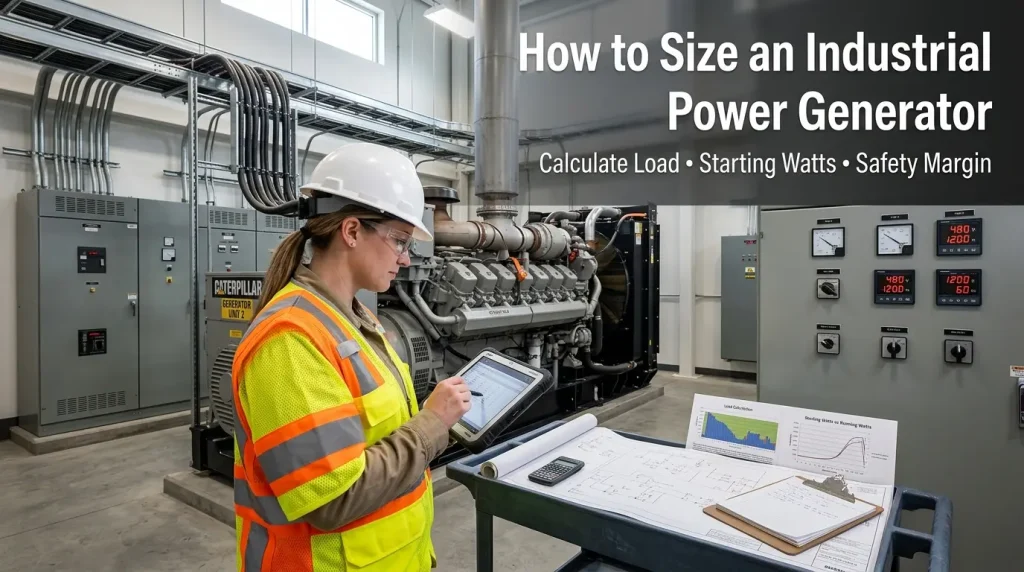
Getting the sizing right is the single most important step in the buying process. Oversizing wastes money; undersizing causes equipment damage and outage failures.
Step 1: Calculate Total Running Load
Add up the continuous wattage of every device the generator needs to power simultaneously. Include:
- Lighting systems (LED vs. fluorescent vs. HID wattage varies significantly)
- HVAC and refrigeration compressors
- Motors, pumps, and conveyors
- IT and data equipment (use UPS specs, not device labels)
- Security systems
Step 2: Account for Starting (Surge) Load
Motors, compressors, and pumps draw 3–7× their running wattage when they first start. Your generator must handle this surge without stalling. This is the most commonly missed calculation.
Example: A 10 hp air compressor running at 7,500 watts may pull 22,000–30,000 watts at startup. If you have three compressors starting simultaneously, your peak demand could be 90,000 watts even if total running load is only 22,500 watts.
Step 3: Add a Safety Buffer
Size your generator at 80% of rated output as your maximum continuous load. This:
- Extends engine life
- Prevents nuisance trips under load fluctuations
- Leaves headroom for future load growth
Step 4: Match to Duty Cycle
| Duty Cycle Rating | What It Means | Right Application |
|---|---|---|
| Standby | Occasional use, outages only | Hospitals, offices, data centers |
| Prime | Extended or continuous use with variable load | Construction, remote sites |
| Continuous | Constant load, 24/7 operation | Off-grid facilities, utilities |
Never use a standby-rated generator for continuous duty the engine and cooling systems are not designed for it and will fail prematurely.
Industrial Generator Buying Checklist
Use this checklist before issuing a purchase order or signing a rental agreement:
- Total running watts calculated for all connected equipment
- Starting / surge watts calculated for all motors and compressors
- 20% headroom factored into final sizing
- Fuel type selected based on site infrastructure and redundancy needs
- On-site fuel storage capacity confirmed (diesel only)
- Required runtime during a full utility outage defined
- Local noise ordinances checked and decibel limit confirmed
- Automatic Transfer Switch (ATS) compatibility verified
- Local and state EPA emissions compliance confirmed
- NFPA 110 requirements reviewed if this is a life-safety application
- Permit requirements confirmed with local AHJ (Authority Having Jurisdiction)
- Warranty terms compared across shortlisted brands
- Local authorized service center location confirmed
- First-year service contract priced and included in total budget
- Future load growth factored in (5–10 year horizon)
Common Buying Mistakes
- Buying on running watts alone ignoring starting current is the #1 cause of generator failures in the first year.
- Choosing fuel type based on upfront cost only a cheaper natural gas unit can be a liability if your gas line loses pressure during the exact event that kills your utility power.
- Skipping the Automatic Transfer Switch manually switching to generator power during an outage introduces dangerous delays and human error.
- No service contract most manufacturers recommend service every 100–250 run hours; unserviced generators fail exactly when you need them most.
- Ignoring future load growth a generator perfectly sized for today’s loads may be undersized in 3 years after equipment additions.
- Buying from a dealer with no local service capability a 48-hour wait for a service technician on a generator that powers a hospital or cold storage facility is unacceptable.
- Assuming every “industrial generator” meets the same duty cycle standard standby-rated and prime-rated units are fundamentally different machines.
- Not getting permits unpermitted generator installations can void warranties, trigger insurance issues, and create liability in the event of an incident.
Fuel Consumption Reference
Diesel fuel use rises with both generator size and load percentage. Use this as a planning reference always confirm exact figures against the manufacturer’s data sheet for your specific model.
| Generator Size | 25% Load | 50% Load | 75% Load | Full Load |
|---|---|---|---|---|
| 60 kW | 1.8 gal/hr | 2.9 gal/hr | 3.8 gal/hr | 4.8 gal/hr |
| 100 kW | 2.6 gal/hr | 4.1 gal/hr | 5.8 gal/hr | 7.4 gal/hr |
| 150 kW | 3.6 gal/hr | 5.9 gal/hr | 8.4 gal/hr | 10.9 gal/hr |
| 200 kW | 4.7 gal/hr | 7.7 gal/hr | 11.0 gal/hr | 14.4 gal/hr |
| 350 kW | 7.5 gal/hr | 12.9 gal/hr | 18.2 gal/hr | 24.4 gal/hr |
| 500 kW | 10.5 gal/hr | 18.0 gal/hr | 25.6 gal/hr | 34.0 gal/hr |
Figures are industry averages. Actual consumption varies by engine brand, ambient temperature, altitude, and load profile. Always verify with the manufacturer’s specification sheet before planning fuel storage.
Annual fuel cost estimate (100 kW diesel at 50% load, 200 hours/year emergency use):
- ~820 gallons ×
$4.00/gallon = **$3,280/year in fuel** relatively low for a standby application.
Key Features to Look For
- Fuel type and tank size based on required runtime unattended. A standard 150-gallon sub-base tank typically provides 24–36 hours of runtime on a 100 kW unit at 75% load.
- Automatic Transfer Switch (ATS) compatibility power switches within 10–30 seconds of an outage without manual intervention. Look for NEMA 3R rated ATS for outdoor installations.
- Noise output standard open-frame units run at 70–85 dB(A) at 23 feet. Sound-attenuated enclosures bring this down to 60–70 dB(A), which is required near residential areas or hospitals.
- OSHA and NFPA compliance mandatory for most commercial and life-safety installations in the U.S.
- Tier 4 Final emissions compliance required in most U.S. states for diesel generators above certain size thresholds. Verify your specific state’s rules with the EPA engine standards page.
- Serviceability engines from Cummins, John Deere, or Caterpillar have nationwide service networks. Obscure engine brands create parts sourcing problems.
- Enclosure and weatherproofing NEMA 3R for outdoor/exposed installations; NEMA 4X if corrosive environments (coastal, chemical plants).
- Digital control panel modern gensets include remote monitoring, fault codes, and auto-start capability via cloud dashboards (Kohler’s APM, Cummins InPower, CAT Electric Power).
- Paralleling capability for large facilities that may need to parallel two or more generators for redundancy or load sharing.
Standards and Regulations Worth Knowing
Industrial generators used for critical or life-safety power are governed by recognized standards. Understanding them helps buyers ask better questions and avoid compliance failures.
- NFPA 110 the standard for emergency and standby power systems. Covers installation, testing, and maintenance of backup generators used in hospitals, high-rises, and other life-safety applications. Required by most state building codes for applicable occupancies.
- OSHA 29 CFR 1926.402–1926.408 governs generators used on construction job sites, covering grounding, GFCI protection, and wiring.
- EPA Tier 4 Final Standards emissions limits on nonroad diesel engines. Most new generators sold in the U.S. must meet Tier 4 Final; older Tier 2/3 units may be restricted in certain air quality management districts (California CARB rules are stricter).
- ISO 8528 the international standard covering generator set performance, ratings, and testing methods used by manufacturers worldwide. When comparing specs, confirm ratings use the same ISO 8528 standard (standby vs. prime ratings differ significantly).
- NEC Article 700/701/702 National Electrical Code articles governing emergency, legally required standby, and optional standby systems relevant to how your generator is wired into the facility.
- Local AHJ requirements always confirm with your local Authority Having Jurisdiction before installation. Requirements vary by municipality, county, and state.
These standards do not replace advice from a licensed electrician. Compliance questions specific to your facility should go to a licensed master electrician or your local AHJ.
Maintenance Schedule That Extends Generator Life
Industrial generators are long-term capital investments. A consistent maintenance program is the single biggest factor in generator lifespan and reliability.
| Task | Frequency | Notes |
|---|---|---|
| Visual inspection (fluids, leaks, connections) | Weekly | Can be performed by trained in-house staff |
| Exercise generator under load | Monthly | Minimum 30 minutes at ≥30% rated load to prevent wet-stacking |
| Oil and filter change | Every 100–250 run hours | Diesel units vary; follow manufacturer spec |
| Air filter inspection/replacement | Every 200–500 hours | More frequently in dusty environments |
| Battery and charging system check | Quarterly | Dead batteries are the #1 cause of generator start failures |
| Coolant system check and flush | Annually | Replace coolant per manufacturer schedule |
| Full professional inspection | Annually | Licensed service technician, all systems |
| Load bank testing | Annually | Required by NFPA 110 for life-safety generators; tests full-load capability |
| Fuel quality test and rotation (diesel) | Every 6–12 months | Untreated diesel degrades; use fuel stabilizer or rotate supply |
Pro tip: The most common reason generators fail to start during an actual outage is battery failure not engine problems. Budget for battery replacement every 2–3 years regardless of whether they “seem fine.”
Rent vs. Buy: Which Makes Sense?
This decision comes down to duration, frequency of use, and cash flow.
Buy when:
- The generator will be used for standby power long-term (permanent installation)
- Annual usage exceeds 200 hours
- You need guaranteed availability during disasters when rental fleets are depleted
- You are in an industry with compliance requirements (hospitals, data centers) that require tested, maintained on-site equipment
Rent when:
- Project duration is under 6–12 months
- You need temporary power during a construction or renovation phase
- Load requirements are uncertain and you are not ready to size a permanent unit
- Capital budget is constrained and you need to preserve cash flow
Lease when:
- You want the benefits of ownership (permanent installation, guaranteed availability) without a large upfront capital outlay
- Tax treatment of operating lease vs. capital purchase matters for your business
Frequently Asked Questions
What size industrial generator do I need for a small business?
Most small businesses running lighting, refrigeration, and basic office equipment can manage with a generator in the 20 kW to 50 kW range, though the exact number depends entirely on your equipment list and starting load requirements. A 100 kW unit is a common choice for businesses that want headroom for expansion.
How much does an industrial generator cost?
Expect to pay $5,000–$20,000 for a 20–50 kW unit, $30,000–$90,000 for a 100–250 kW unit, and $75,000–$200,000+ for a 250–500 kW unit. Add 30–50% for full installation including the ATS, wiring, and permits.
What is the best industrial generator brand?
For critical facilities (hospitals, data centers), Caterpillar and Cummins are considered gold standards in the U.S. market. Kohler offers strong value and quiet operation. Generac is the best mid-range choice for commercial buildings and warehouses. Brand matters less than having a certified local service dealer nearby.
Are Honda generators industrial generators?
Honda’s EB series is marketed and used for job sites and light commercial applications, but it sits at the smaller end of the spectrum (typically under 10 kW). It is not suited for the 100 kW+ loads typical of industrial facilities. For jobsite work under 10 kW, Honda is one of the most reliable options available.
What is the difference between a construction generator and an industrial generator?
A construction generator is typically portable and under 15 kW, designed to move between job sites. An industrial generator is usually stationary or trailer-mounted, rated for 20 kW to several megawatts, and built for continuous or standby duty at a single facility.
How often should an industrial generator be serviced?
Oil changes every 100–250 run hours, quarterly battery checks, and a full professional inspection at least once per year. Life-safety generators (hospitals, high-rises) require annual load bank testing under NFPA 110.
Do industrial generators run on diesel or gas?
Both. Diesel is most common for large industrial gensets due to fuel availability and torque. Natural gas is popular where a gas line is already in place. Bi-fuel systems give the most flexibility.
Can an industrial generator run continuously?
Only if it is rated for prime or continuous duty. Standby-rated generators are designed for occasional outage use running them continuously degrades the engine significantly. Always check the duty cycle rating before purchasing.
How long does diesel fuel last in storage?
Untreated diesel typically starts degrading within 6–12 months. Adding a fuel stabilizer and storing in a clean, sealed tank extends this to 24+ months. For facilities that rarely exercise their generator, fuel rotation or treatment is essential.
What is the lifespan of an industrial generator?
A well-maintained industrial generator can run 15,000 to 30,000 hours before requiring a major overhaul. At typical standby use (100–200 hours/year), that is 75–300 years of service life theoretically in practice, 20–40 years before replacement economics favor a new unit.
How much fuel does a 100 kW generator use per hour?
A 100 kW diesel generator consumes approximately 7–8 gallons per hour at full load, dropping to around 2.5–3 gallons per hour at 25% load.
What size generator does a warehouse need?
A mid-size warehouse (100,000–200,000 sq ft) with lighting, conveyor systems, refrigeration, dock equipment, and security typically falls in the 100 kW to 500 kW range. Cold storage warehouses with heavy refrigeration loads typically need 250 kW or more.
Do industrial generators require permits?
In most U.S. states, yes. Permanent installations require electrical permits and sometimes environmental permits for emissions compliance. Some municipalities also require noise variance permits. Confirm with your local AHJ before ordering equipment.
What is wet-stacking on a diesel generator?
Wet-stacking occurs when a diesel generator runs for extended periods at low load (under 30% of rated capacity), causing unburned fuel and carbon to accumulate in the exhaust system. It reduces efficiency, creates black exhaust smoke, and can damage the engine over time. Prevent it by running the generator at a meaningful load during monthly exercise, or by using a load bank for testing.
What is an automatic transfer switch (ATS) and do I need one?
An ATS is a device that automatically detects a utility power failure and switches your facility to generator power typically within 10–30 seconds. For any commercial or industrial application, an ATS is considered standard. Manual transfer requires human presence and creates delay. Most local codes and insurance requirements mandate an ATS for standby power systems.
Final Thoughts
Picking the right industrial generator is not just about wattage. It is about matching fuel type, duty cycle, brand serviceability, and compliance requirements to how your business actually uses power whether that means running a construction generator for a few months on a job site or installing a permanent industrial power generator to protect a facility that cannot afford downtime.
Take the time to calculate your real load requirements (running watts plus starting surge), confirm fuel access, verify local permit requirements, and choose a brand with a certified service dealer in your area. A generator that cannot be serviced locally is a liability, not an asset.
When in doubt, work with a licensed electrician and a certified generator dealer. The cost of proper sizing and installation is always less than the cost of downtime.
.Sources: NFPA 110, EPA Nonroad Engine Standards, OSHA 29 CFR 1926, ISO 8528, EGSA Industry Data
You May Also Like It:
Consumers Energy Power Outage: How to Report, Track, and Stay Safe
Green Power Energy: The Complete Guide to Clean, Renewable Electricity
Power vs Energy: What Is the Difference and Why Does It Matter?