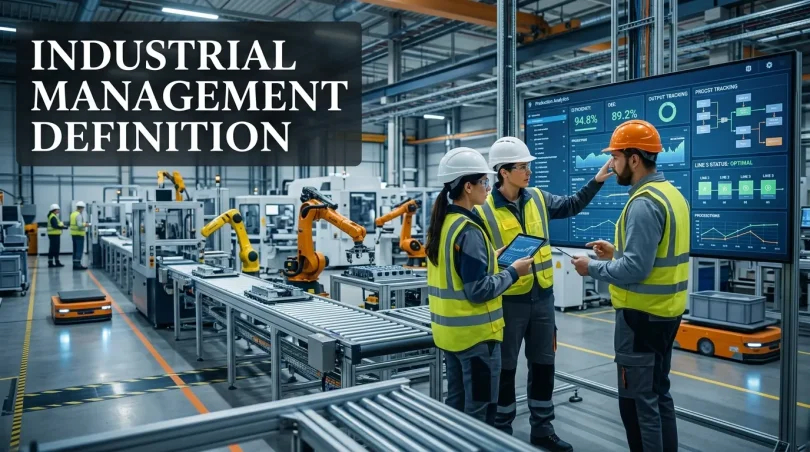

Industrial management is the discipline of planning, organizing, staffing, directing, and controlling the people, materials, machines, and methods inside an industrial operation to turn raw resources into finished goods as efficiently as possible. It sits at the intersection of engineering and business. That’s why you’ll find industrial managers running production floors, supply chains, and entire manufacturing plants, not just filling a desk role.
If you needed the textbook answer, you have it. Everything below is what the textbook leaves out.
The 4Ms: What Industrial Managers Are Actually Juggling
Every industrial management program teaches the same framework: Man, Material, Machine, and Method. What matters is how these four elements fight each other in practice.
- Man (people): Staffing shortages, shift scheduling conflicts, skill gaps on the floor. A machine can run 24/7, but the people operating it cannot.
- Material: Inventory that arrives late, gets damaged in transit, or simply doesn’t match the spec sheet.
- Machine: Equipment that needs maintenance windows nobody wants to schedule because it stops production.
- Method: The standard operating procedure that looked perfect on paper but breaks down the moment a new product variant enters the line.
The job isn’t choosing one of these to prioritize. It’s constantly rebalancing all four when one shifts, because they never move independently. Change a machine’s output speed and you’ve just changed staffing needs, material flow, and probably the method too.
Industrial Management vs. Similar-Sounding Fields
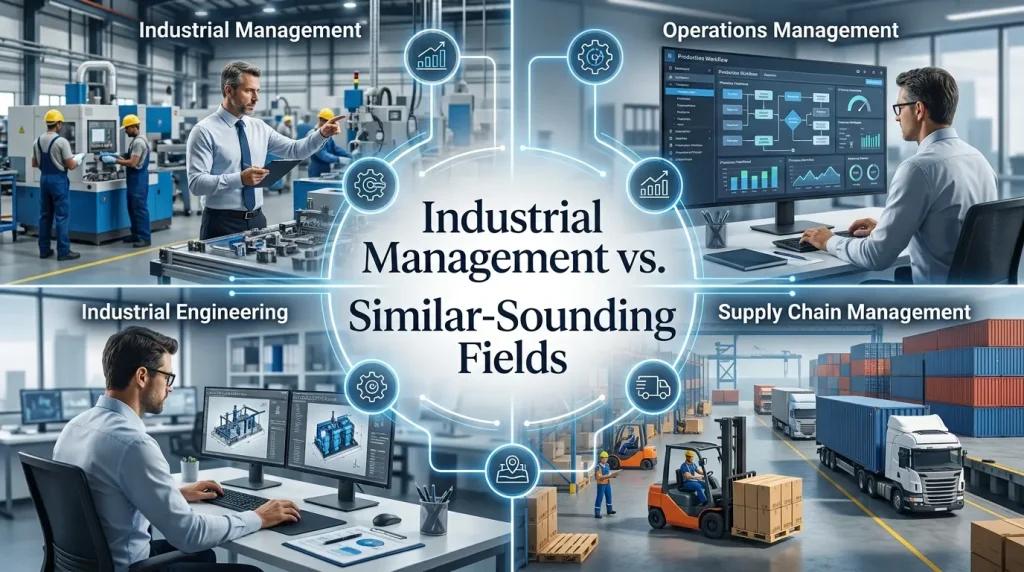
This is where most articles get sloppy. These four terms get used almost interchangeably online, but they’re not the same job.
| Field | Primary Focus | Typical Scope |
|---|---|---|
| Industrial Management | Coordinating people, machines, materials, and methods | Broadest scope; plant-wide or department-wide |
| Operations Management | Running day-to-day production or service delivery | Applies to factories, hospitals, or service businesses |
| Industrial Engineering | Designing and optimizing systems using engineering methods | Process design, not people management |
| Supply Chain Management | Moving materials from suppliers to customers | Logistics, procurement, and distribution flow |
An industrial engineer designs the layout of a production line. An industrial manager decides who staffs it, how shifts are scheduled, and what happens when it underperforms. Supply chain management deals with what flows in and out, not what happens on the floor itself.
In real hiring, these titles blur constantly. A “Plant Manager” posting might list pure industrial management, operations management, and supply chain oversight all in the same paragraph. Look at what the role actually controls, not what it’s called.
What This Looks Like on an Actual Production Floor
Picture a mid-size auto-parts plant running three shifts. A rush order comes in that needs to ship in five days instead of the usual twelve.
The industrial manager doesn’t just tell the floor to “work faster.” That’s the amateur move, and it usually backfires through burnout or quality defects. The sequence typically looks like this:
- Check machine capacity first. Can the current equipment physically produce the volume in the new timeframe, or does a bottleneck cap the whole plan?
- Re-run the staffing math. Overtime has diminishing returns after about two weeks. A weekend shift swap might solve it cheaper than overtime pay.
- Confirm material availability. No point speeding up a line that runs out of raw stock on day three.
- Adjust the method only if the first three hold. A temporary change in batch size, not a full process redesign, often closes the gap.
Industrial management is mostly about sequencing trade-offs correctly under time pressure. Textbook principles don’t capture that.
The Core Functions, Applied Rather Than Defined
Most sources list the five management functions and stop there. Here’s what each one demands in an industrial setting.
Planning means forecasting demand against machine downtime schedules, not just setting quarterly goals. A plant that ignores preventive maintenance windows in its production plan will hit a wall it never saw coming.
Organizing means physically laying out workstations so material doesn’t travel further than it needs to. Every extra ten feet a part travels adds cost that compounds across thousands of units.
Staffing goes beyond headcount. It means cross-training workers so a single absence doesn’t stall an entire line. Plants that rely on one specialist per critical task are one sick day away from a shutdown.
Directing in this context is about fast, clear communication when something breaks. The best industrial managers get a decision made and communicated to the floor in minutes, not hours.
Controlling means tracking defect rates, downtime hours, and cycle times against targets daily. Waiting for a monthly report to catch a quality problem means you’ve already shipped a month of defective product.
Tools Industrial Managers Actually Use in 2026
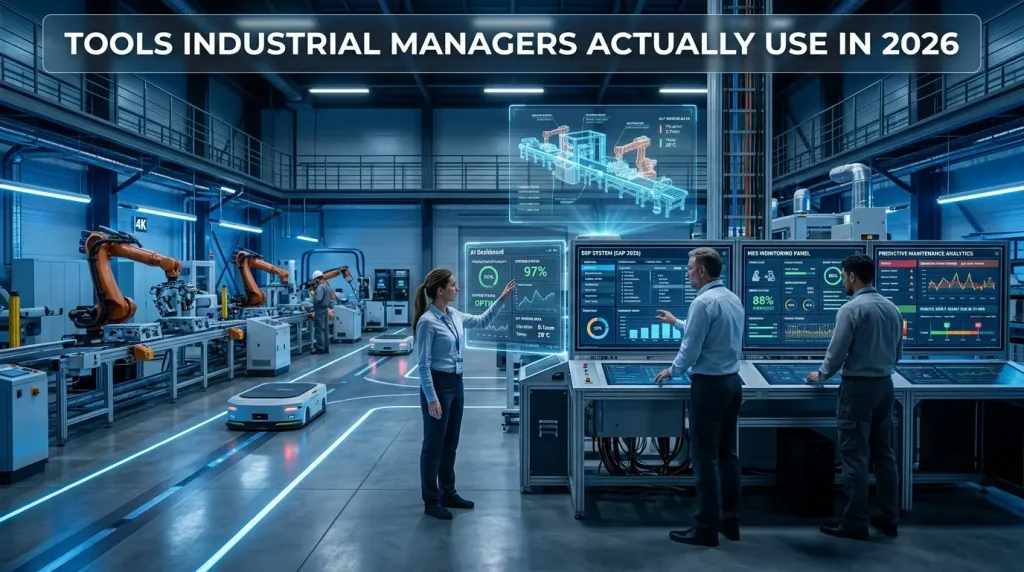
This is the section most definitions skip entirely.
- ERP systems (SAP, Oracle NetSuite, Microsoft Dynamics) tie inventory, production schedules, and finance together in one system.
- MES (Manufacturing Execution Systems) provide real-time tracking of what’s happening on the floor right now, not what happened last week.
- Lean and Six Sigma methods cut waste and reduce process variation. These are the actual day-to-day toolkit for most plant managers, not abstract theory.
- IIoT sensors on machines flag maintenance needs before a breakdown happens, not after.
- Digital twins, virtual models of a physical plant, let managers test schedule changes or layout shifts before touching the real floor.
None of these tools replace judgment. They give an industrial manager better information to make the same core trade-off decisions faster.
Career Paths and Certifications Worth Knowing
- Degrees: Bachelor’s programs blend engineering fundamentals with business coursework like finance, HR, and supply chain. Some universities house this under engineering; others under business, which changes the curriculum balance significantly.
- Certifications that carry weight: CPIM (Certified in Planning and Inventory Management) through ASCM, Six Sigma Green or Black Belt, and PMP (Project Management Professional) all appear frequently in plant and operations manager job postings.
- Common entry roles: Production supervisor, quality control coordinator, or industrial engineer before moving into plant manager or operations director positions.
- Where the work is: Manufacturing plants, but also warehousing, energy and utilities, pharmaceuticals, and large-scale food processing.
Mistakes That Trip Up Industrial Managers, Even Experienced Ones
- Treating every problem as a staffing problem. It’s the easiest lever to pull. But when the real issue is a machine bottleneck or a broken method, adding headcount just adds cost.
- Optimizing one station instead of the whole line. Speeding up one workstation creates a pile-up at the next one if the line isn’t balanced end to end.
- Ignoring maintenance data until something breaks. Reactive maintenance is almost always more expensive than the preventive schedule it was avoiding.
- Over-relying on dashboards without floor walks. A dashboard shows what the system was told to track. It won’t show you the worker quietly working around a broken process step.
FAQ
Is industrial management a good career?
Demand is solid and steady because manufacturing, logistics, and production industries always need people who can coordinate people and processes at scale. Pay and growth vary by industry and region, so research specific sectors rather than the field broadly.
Do I need an engineering degree for industrial management?
Not always. Many programs sit inside business schools and focus on organizational and operational skills over technical engineering design. Check the specific program’s course list before assuming it’s heavily technical.
What industries hire industrial managers?
Manufacturing is the obvious one, but warehousing, energy, food processing, pharmaceuticals, and large-scale logistics operations all hire for these skills. The role is less industry-specific than most people assume.
How is industrial management different from just being a “manager”?
A general manager oversees budgets, people, and strategy in any business context. An industrial manager applies that oversight specifically to production processes, machinery, and the physical flow of materials inside an operation.
What salary can an industrial manager expect?
In the United States, plant and operations managers typically earn between $70,000 and $130,000 annually. Senior roles in automotive or pharmaceutical manufacturing push higher. Entry-level supervisory positions start lower but scale quickly with certifications like Six Sigma or CPIM.
Can industrial management apply outside of factories?
Yes. Large-scale food processing, pharmaceutical production, utility operations, and hospital supply chains all use industrial management principles. Anywhere physical resources, equipment, and people need coordinating at scale, the discipline applies.
Does industrial management still matter with so much automation now?
Arguably more than before. Automated lines still need someone who understands how machines, materials, and people interact. When automation behaves unexpectedly, a manager who understands the full system finds the fix faster than one who only reads dashboards.
How has AI changed industrial management recently?
AI-driven demand forecasting and predictive maintenance have shifted a lot of reactive decision-making into proactive planning. Managers who can act on real-time sensor data and machine learning outputs now have a clear edge over those still relying on end-of-shift reports.
You May Also Like It:
CNC Machining Tolerances: The Complete Expert Guide
Prototype CNC Machining: The Complete Expert Guide
Steel Grade: The Complete Guide to Understanding Every Type of Steel