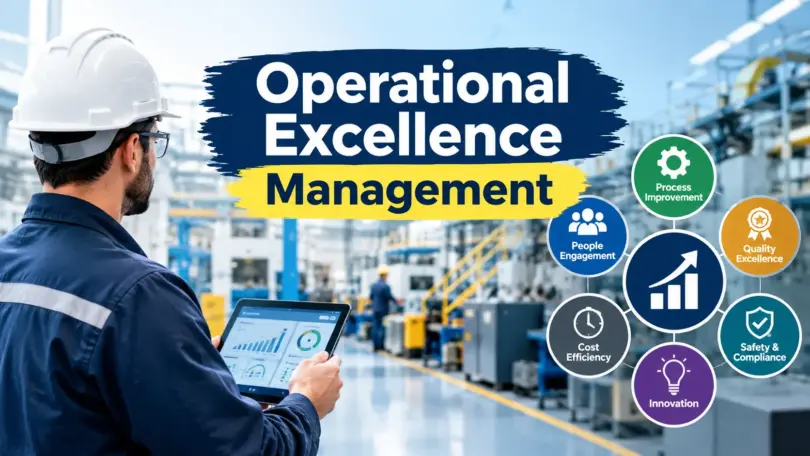

Most industrial organizations don’t fail at operational excellence because they picked the wrong methodology. They fail because they ran a project when they needed a system. A Lean event on the shop floor here, a Six Sigma course there, a few KPI dashboards nobody checks after month three. Operational excellence management is the discipline that turns those scattered efforts into something that actually holds together across plants, shifts, and years, not just one production line for one quarter.
Operational excellence management is a long-term business discipline focused on governing continuous improvement, standardizing processes, and measuring performance so that efficiency gains hold over time instead of fading after a single project.
Operational Excellence vs. Operational Excellence Management: The Distinction That Matters
Most articles on this topic use “operational excellence” and “operational excellence management” as if they’re interchangeable. They’re not, and the difference explains why so many initiatives fizzle out.
Operational excellence is the goal: a business that consistently delivers value to customers while reducing waste, error, and delay. Operational excellence management is the system, the actual scaffolding of roles, routines, and decision rights, that makes that goal achievable on an ongoing basis rather than during a six-month improvement sprint.
Without the management layer, you get isolated wins: a plant floor that runs a successful Kaizen event, a customer service team that shaves two minutes off average handle time, then six months later everyone’s back to old habits because nothing structural changed. The management system is what prevents backsliding.
The Five Components of a Working OEM System
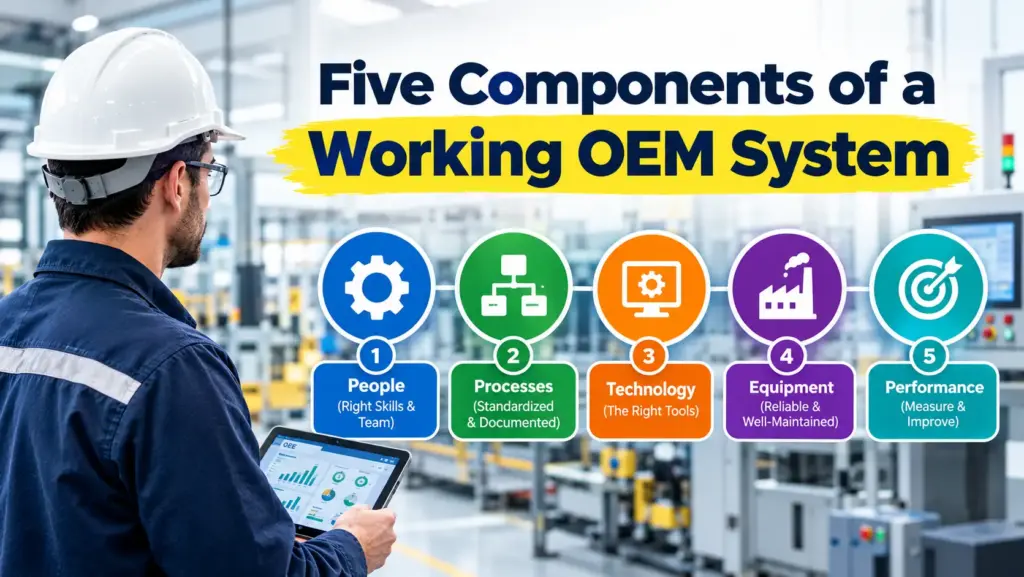
1. Leadership Governance, Not Just Leadership Buy-In
Every source on this topic says leaders need to “support” operational excellence. That’s true but vague enough to be useless. What actually works is a defined governance structure with real decision rights:
- An executive sponsor who ties operational excellence goals directly to business strategy and controls budget for it, not someone who shows up at kickoff meetings and then disappears.
- A steering committee that meets on a fixed cadence (monthly is typical) to review portfolio-level progress across all active improvement initiatives, not just the ones going well.
- Process owners at the department level who are accountable for the performance of specific processes, distinct from the people who happen to work within them.
- Improvement facilitators (often trained to Green Belt or Black Belt level in Lean Six Sigma terms) who run individual projects but report progress into the governance structure rather than operating as a separate island.
The mistake most companies make: they hire a Six Sigma Black Belt, give them a project list, and call that a management system. A Black Belt without governance behind them is a specialist working in isolation, not a system.
2. A Deliberate Methodology Choice, Not a Methodology Grab Bag
Nearly every competing resource on this topic lists Lean, Six Sigma, Kaizen, and TQM side by side without saying when to use which. That’s a real gap, because picking the wrong tool for the problem wastes months.
| Methodology | Best suited for | Weak fit for |
|---|---|---|
| Lean | Cutting waste, speeding up flow, removing non-value-added steps in a known process | Problems where the root cause is unclear or data is scarce |
| Six Sigma | Reducing defects and variation in processes with measurable, repeatable outputs | Fast-moving, low-volume, or highly judgment-based work |
| Kaizen | Incremental, team-driven improvements in a specific area over a short burst (days, not months) | Large structural or cross-functional redesigns |
| Total Quality Management (TQM) | Building an organization-wide quality culture over the long term | Organizations wanting quick, isolated wins |
In practice, most mature operational excellence management systems combine two or three of these rather than picking just one. A manufacturer might run Lean for shop-floor flow, Six Sigma for defect-heavy processes like quality inspection, and Kaizen events for smaller, team-level fixes that don’t need a full DMAIC project cycle.
3. Standardized Processes With Room to Improve Them
Standardization sounds like the opposite of continuous improvement, but it’s the precondition for it. You can’t reliably improve a process that’s done differently by every team, every shift, every location. Standard work documents what “good” currently looks like, which gives you a stable baseline to measure change against.
The trap here is treating standards as permanent. In a working OEM system, the people doing the work have a clear, low-friction way to propose changes to the standard itself, not just report problems and wait for someone else to fix them.
4. Performance Measurement That People Actually Use
Most competing content mentions “KPIs” without naming any. Concretely, an operational excellence management system typically tracks metrics in three categories:
- Operational metrics: cycle time, first-pass yield, on-time delivery rate, defect rate per unit
- Financial metrics: cost per unit, cost of poor quality, working capital tied up in inventory
- People metrics: employee-submitted improvement ideas per quarter, percentage of ideas implemented, retention in roles directly tied to process ownership
The detail that gets skipped elsewhere: metrics only work if they’re visible where the work happens and reviewed on a short cycle, weekly or daily, not buried in a quarterly slide deck nobody reads until the numbers are already stale.
5. A Maturity Path, Not a Finish Line
Operational excellence management systems tend to move through recognizable stages:
- Stage 1, Ad hoc: improvement happens through individual heroics, no shared method, no tracking
- Stage 2, Localized: a few departments run structured projects, but there’s no cross-functional coordination or shared metrics
- Stage 3, Standardized: common methodology, defined governance, consistent metrics across the organization
- Stage 4, Integrated: improvement is embedded in daily management routines, not treated as a separate initiative
- Stage 5, Adaptive: the organization can redesign its own improvement system in response to changing conditions, not just run the same playbook indefinitely
Most organizations that say they “do operational excellence” are actually stuck between Stage 2 and Stage 3. Recognizing which stage you’re actually in, rather than the stage you’d like to claim, is often the single most useful diagnostic step before investing further.
Why Operational Excellence Management Programs Actually Fail
Generic “lack of leadership support” explanations don’t help much. Here’s what specifically derails these systems in practice:
- Treating it as a certification exercise. Sending people through Green Belt or Black Belt training builds individual skill, but skill without a system to deploy it into just produces trained people with no projects to run and no authority to run them.
- Measuring activity instead of outcomes. Counting the number of Kaizen events held says nothing about whether they produced lasting change. Tracking sustained improvement six and twelve months after a project closes is where most programs stop looking, right when the real test begins.
- No mechanism for killing bad standards. If the only path to change a process is a formal, multi-week improvement project, most small but real problems never get fixed. A lightweight, fast-track process for minor standard updates keeps the system credible.
- Governance that only meets when things are going well. A steering committee that skips reviews when the numbers are bad is a governance structure in name only.
- No connection to business strategy. Improvement projects chosen because they’re easy to run, rather than because they move a metric the business actually cares about, burn goodwill fast once leadership notices the disconnect.
Building the System: A Practical Sequence
Rather than a generic list of “steps to implement,” here’s a sequence that reflects how this actually gets built in practice, in roughly the order that avoids rework:
- Assess your current maturity stage honestly, using the five-stage framework above, before choosing tools or training.
- Pick one or two methodologies that match your actual problem types, not every methodology available.
- Define governance roles and decision rights first, before running your first improvement project, so early wins have somewhere to plug into.
- Choose a small number of metrics per level (operational, financial, people) and make them visible at the point of work, not just in reports.
- Run a pilot in one function or site, with a defined review point at 90 days to check whether gains are holding, not just whether the project closed on time.
- Expand deliberately, using lessons from the pilot to adjust governance and training before scaling company-wide.
- Build the fast-track path for minor standard changes early, so the system doesn’t get a reputation as slow or bureaucratic.
Key Takeaways
- Operational excellence management is the governance and measurement system that sustains improvement, distinct from operational excellence itself, which is the outcome.
- A working system needs defined leadership roles with real decision rights, not just leadership “support.”
- Methodology choice should match the type of problem: Lean for flow and waste, Six Sigma for defect reduction, Kaizen for fast team-level fixes, TQM for long-term culture building.
- Most programs stall between Stage 2 (localized) and Stage 3 (standardized) maturity, often because governance only exists on paper.
- Programs commonly fail from treating improvement as a certification exercise, measuring activity instead of outcomes, or having no fast path to fix small process problems.
Frequently Asked Questions
What is the difference between operational excellence and operational excellence management?
Operational excellence is the outcome, a business that consistently delivers value while minimizing waste and error. Operational excellence management is the ongoing system of governance, methodology, and measurement that makes that outcome sustainable rather than a one-time achievement.
What is an Operational Excellence Management System (OEMS)?
An OEMS is the formal framework an organization uses to run operational excellence as an ongoing discipline: defined leadership roles, a chosen set of improvement methodologies, standardized processes, and performance metrics tracked on a regular cycle.
Which methodology should I start with: Lean, Six Sigma, or Kaizen?
It depends on the problem. Use Lean when the goal is speeding up flow and cutting waste in a process you already understand. Use Six Sigma when defects or inconsistent quality are the core issue and you have data to analyze. Use Kaizen for smaller, team-driven fixes you want resolved in days rather than months.
How long does it take to build a mature operational excellence management system?
Most organizations take two to four years to move from ad hoc improvement to a standardized, cross-functional system, and longer still to reach the point where improvement is fully integrated into daily management rather than run as a separate initiative.
Do small businesses need a full operational excellence management system?
Smaller organizations rarely need the full governance structure of a large enterprise, but the core principles, standard processes, a consistent improvement method, and metrics people actually look at, scale down well. A five-person process owner meeting can function the same way a formal steering committee does at scale.
What KPIs actually matter for operational excellence management?
There’s no universal list, but effective systems typically track a mix across three categories: operational (cycle time, first-pass yield, on-time delivery), financial (cost per unit, cost of poor quality), and people (improvement ideas submitted and implemented, retention in process-owner roles).
Why do so many operational excellence initiatives fail after the first year?
The most common reason is that the initiative was run as a project with an end date rather than embedded into an ongoing management system. Once the project team disbands and the initial energy fades, without governance and standard review cycles in place, performance tends to drift back toward baseline.
Is operational excellence management only relevant to manufacturing?
No. While it originated largely in manufacturing through frameworks like the Toyota Production System, the same governance and measurement principles apply in healthcare, financial services, IT, and logistics, anywhere processes are repeatable and performance can be measured.
You May Aslo Like It:
Custom Cable Assembly 101: How to Choose the Right Manufacturer for Your Project
Manufacturing Management Software: What It Actually Does and How to Choose the Right One
Industrial Management Definition: What It Actually Means (And Why Most Explanations Fall Short)