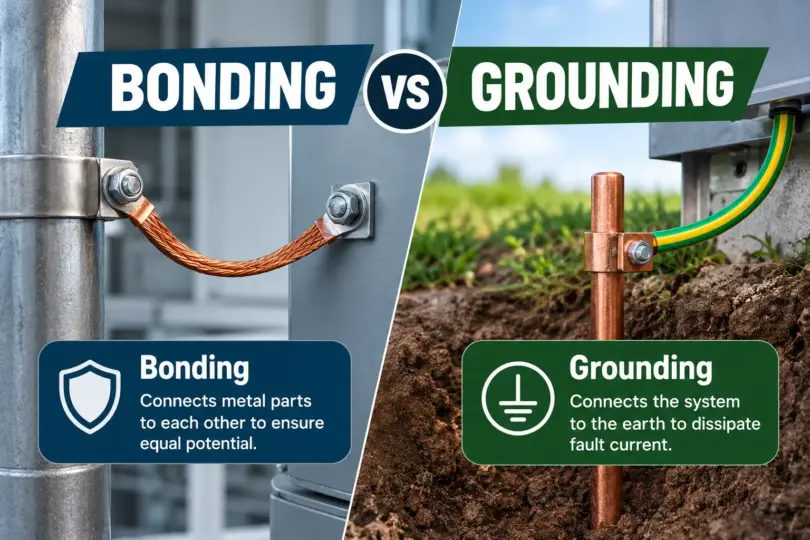

Grounding connects an electrical system to the earth to give voltage a stable reference point and a path for surges. Bonding connects metal parts to each other so they stay at the same electrical potential and can safely carry fault current back to the source. Both work together, but they serve different purposes.
Both bonding and grounding are core to electrical safety, but understanding bonding vs grounding is important because each serves a different purpose. Without proper grounding, a system can lose its stable voltage reference and may not have the intended path for lightning or surge energy. Without proper bonding, metal enclosures, conduit, and equipment can become energized during a fault, creating a serious shock hazard.
Understanding the difference between bonding and grounding isn’t just technical trivia it helps explain how electrical systems protect people and equipment. This guide breaks down exactly what bonding and grounding mean, how they work together, where they appear in real installations, and what the NEC requires.
What Is Electrical Grounding?
Electrical grounding is the intentional connection between an electrical system (or equipment) and the earth, made through a grounding electrode system, typically a metal rod, plate, or the building’s metal water pipe, buried in or in contact with the earth.
A grounding system does a few key jobs:
- Gives the electrical system a stable voltage reference point relative to the earth
- Helps limit voltage during lightning strikes, line surges, or accidental contact with higher-voltage lines
- Stabilizes system voltage during normal operation
There are generally two categories worth knowing:
- System grounding: grounding one conductor of the electrical system itself (like the neutral) to the earth.
- Equipment grounding: connecting the non-current-carrying metal parts of equipment (enclosures, frames, conduit) so they never become energized under normal conditions.
A quick but important clarification: the wire that connects the system to the grounding electrode, and the wire that connects equipment enclosures for fault protection, are technically two different conductors with two different names, the grounding electrode conductor (GEC) and the equipment grounding conductor (EGC). People often lump both together as “the ground wire,” but they do different jobs. We cover this distinction in detail in the EGC vs GEC section below. For now, the key point stands: grounding by itself is not an effective fault-current path back to the source. That job belongs to bonding, which we’ll get to next.
What Is Electrical Bonding?
Electrical bonding is the practice of connecting metal parts and equipment together with a bonding conductor so that they are electrically continuous and sit at the same potential. This matters because if two metal parts aren’t bonded, they could develop a voltage difference between them during a fault, and anyone touching both at once could become the path for that current.
Key terms here:
- Bonding conductor / bonding jumper: the wire or strap that electrically connects two metal parts.
- Main bonding jumper: the critical connection, made at the service equipment, that ties the grounded (neutral) conductor to the equipment grounding conductor and to the metal enclosure of the service equipment. This is what creates the return path for fault current.
- Equipment bonding: bonding together non-current-carrying metal parts of equipment (like panels, conduit, and enclosures) so that a ground fault has a low-impedance path back to the source, allowing the overcurrent device to trip quickly.
In short: bonding electrical equipment creates a safe, low-resistance path for fault current to flow back to the source, so a breaker or fuse can clear the fault fast, before it becomes a shock or fire hazard.
Bonding vs Grounding: Key Differences
| Aspect | Grounding | Bonding |
|---|---|---|
| Purpose | Connects the system to the earth for a stable voltage reference and surge protection | Connects metal parts together to keep them at the same potential and clear faults |
| Current path | Path for lightning/surge energy to dissipate into the earth (not an effective fault path) | Low-impedance path for fault current to return to the source |
| Connection | Conductor to earth (via grounding electrode) | Conductor between metal parts, equipment, or enclosures |
| Safety function | Stabilizes voltage; protects against surges and lightning | Enables fast overcurrent device operation during a ground fault |
| Common applications | Grounding electrode systems, driven ground rods, water pipe grounding | Panel bonding, conduit bonding, main bonding jumper, equipment bonding jumpers |
This table captures the core of bonding vs grounding (or grounding vs bonding, depending on how you search it), and it’s the single biggest point of confusion in the trade. The short version: grounding means earth reference, bonding means fault-current path.
How Bonding and Grounding Work Together
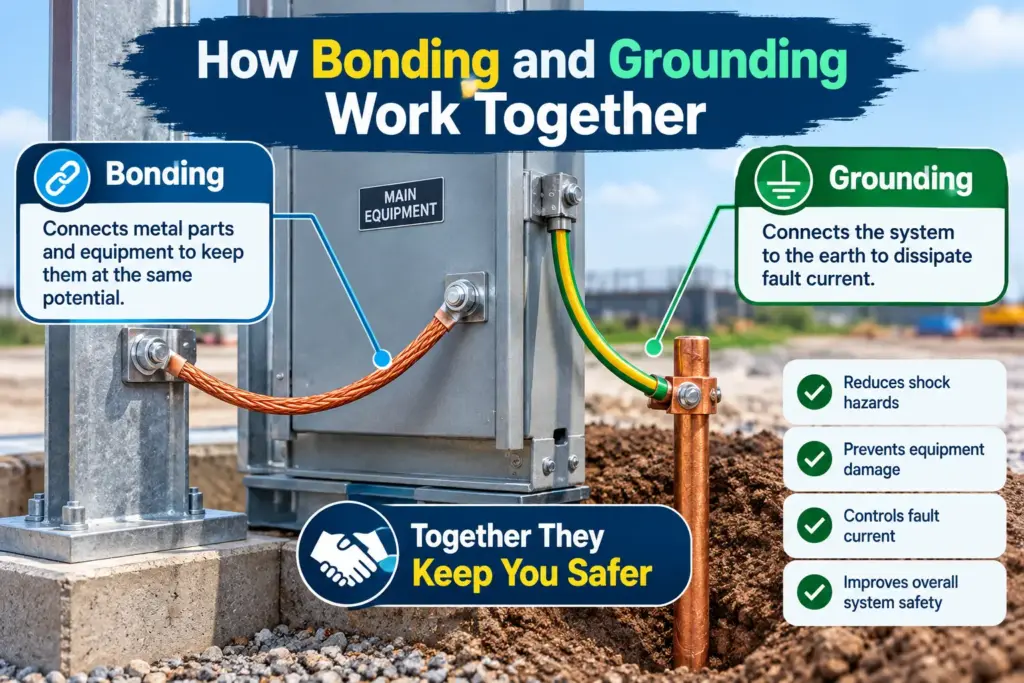
Neither system works in isolation. Electrical safety depends on grounding and bonding functioning as a team.
Here’s how it plays out during a ground fault:
- A hot conductor accidentally contacts a metal enclosure or equipment frame.
- Because that metal is bonded, the fault current doesn’t just sit there energizing the case, it flows through the bonding path back toward the source.
- This bonded connection provides a low impedance path, which allows enough current to flow to trip the breaker or blow the fuse almost instantly.
- Grounding, meanwhile, keeps the system referenced to earth and handles surges (like lightning), but it is the bonding path, not the earth connection, that actually clears a fault quickly.
Common misconception: driving a ground rod alone does not protect you from a ground fault. Earth itself has too much resistance to carry enough current to trip a breaker reliably. Proper electrical fault protection depends on solid, continuous bonding, not just a grounding electrode.
Practical Example: What Happens When a Hot Wire Touches a Metal Panel?
It helps to see the two paths side by side, as they would actually play out during a fault:
Fault-current path (bonding):
Hot wire touches metal enclosure, then flows through the bonded metal enclosure, then through the equipment grounding conductor (EGC), then back to the bonded neutral at the source, then enough current flows to trip the breaker, and the fault is cleared in a fraction of a second.
Earth path (grounding):
Grounding electrode conductor (GEC), then grounding electrode, then earth. This path exists mainly to stabilize system voltage and drain surge energy (like a lightning strike). It is not the path that clears a routine ground fault, because the earth itself has far too much resistance to carry enough current to trip a breaker.
This is exactly why both systems matter: bonding is what makes the breaker trip; grounding is what keeps the system’s voltage referenced to earth and protects it from surges.
What Is the Purpose of Bonding?
The purpose of electrical bonding is to eliminate dangerous voltage differences between metal parts and to ensure fast, safe clearing of ground faults.
Bonding for electrical safety accomplishes this through:
- Equipotential bonding: keeping all accessible metal parts at (roughly) the same potential, so touching two different metal surfaces at once doesn’t create a shock hazard.
- Bonding metal parts: conduit, enclosures, raceways, junction boxes, and equipment frames are all tied together electrically.
- Ensuring bonded electrical equipment has a continuous, low-impedance path so overcurrent protection devices operate as designed.
Without bonding, a fault could energize a metal panel or enclosure without tripping anything, leaving it “live” and dangerous to touch, potentially for a long time.
What Is the Purpose of Grounding?
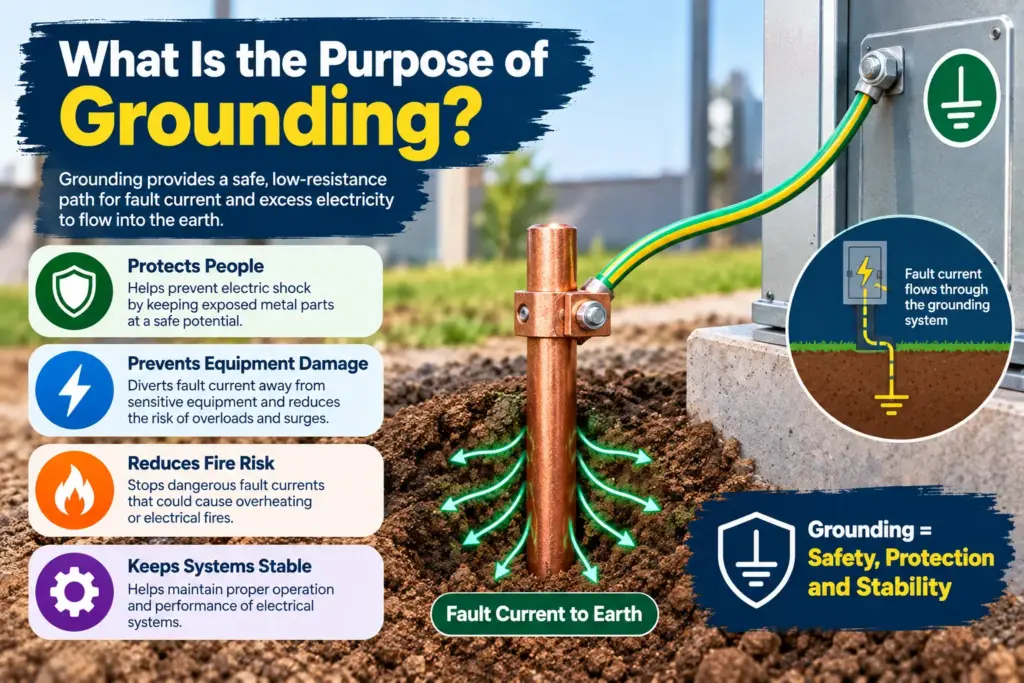
The purpose of electrical grounding centers on stability and surge protection rather than fault clearing.
Why electrical systems are grounded:
- To limit voltage caused by lightning strikes, line surges, or unintentional contact with higher-voltage lines
- To stabilize voltage during normal operation, giving the system a consistent reference point relative to the earth
- To support proper operation of certain protective and sensing devices
Grounding for safety applies at two levels:
- System grounding: grounding a system conductor (commonly the neutral) at the source.
- Equipment grounding: ensuring equipment enclosures are connected so they don’t become energized relative to earth under normal conditions.
Grounding is essential, but as covered above, it works with bonding, not instead of it.
Grounding vs Grounded vs Bonded
This is where a lot of people, even experienced techs, trip over terminology.
- Grounding conductor: the general term for a conductor used to connect equipment or a system toward earth (this covers both the GEC and the EGC, discussed below).
- Grounded conductor: different from a grounding conductor. It’s the conductor that is intentionally grounded, in a standard residential system, that’s the neutral conductor.
- Grounded vs grounding: “grounded” describes a conductor that is already connected to earth (like the neutral); “grounding” describes a conductor whose job is to make or maintain that connection.
- Bonded vs grounded: “bonded” means electrically connected to other metal parts to maintain equal potential and provide a fault path; “grounded” specifically means connected to earth. A part can be bonded without being directly grounded itself, it’s bonded to something that is grounded.
Rule of thumb: a grounded conductor is normally current-carrying (like a neutral); a grounding conductor’s job is to provide a safety connection toward earth or toward the fault-current path; a bonding conductor ties metal parts together.
EGC vs GEC: What’s the Difference?
This is one of the most important, and most commonly confused, distinctions in grounding and bonding terminology. Both are “grounding conductors,” but they connect different things and serve different purposes.
| Aspect | Equipment Grounding Conductor (EGC) | Grounding Electrode Conductor (GEC) |
|---|---|---|
| What it connects | Equipment enclosures, conduit, and metal parts back to the source (bonded neutral / service equipment) | The grounded system conductor (or system) to the grounding electrode system |
| Main purpose | Provides the low-impedance fault-current path so a breaker or fuse trips during a ground fault | Connects the system to the earth for voltage stabilization and surge/lightning protection |
| Is it an effective fault-current path? | Yes, this is its primary job | No, the earth path is not considered an effective ground-fault current path |
| Typical example | The bare or green wire running with circuit conductors back to the panel | The conductor running from the panel to a ground rod, water pipe, or other grounding electrode |
In plain terms, the EGC is about equipment safety and fault clearing, it’s part of the bonding path. The GEC is about earth connection, it’s part of the grounding path. Confusing the two is a common source of miswired panels and misunderstood inspection reports.
Neutral vs Ground: What’s the Difference?
This is one of the most searched questions in residential and commercial wiring, and it deserves its own explanation separate from the panel section above.
- Neutral wire vs ground wire: the neutral is a normally current-carrying conductor that completes the circuit back to the source under normal operation. The ground wire (equipment grounding conductor) normally carries no current at all, it only carries current during a fault.
- Neutral and ground difference: neutral is part of the working circuit; ground is a safety conductor that exists purely to protect people and equipment if something goes wrong.
- Can neutral and ground be connected? Yes, but only in one specific place: at the main service panel (or main disconnecting means), through the main bonding jumper. This is called the neutral-ground bond.
- Neutral ground bond: this single, intentional connection point is what allows a ground fault anywhere in the system to have a complete path back to the source through the grounded neutral.
The distinction is easiest to see by comparing the main panel to a subpanel:
| Location | Neutral and Ground Bonded? | Why |
|---|---|---|
| Main service panel (main disconnect) | Yes, bonded via the main bonding jumper | This is the single required bond point that creates the fault-current return path for the entire system |
| Subpanel (fed from the main panel) | No, neutral and ground bars must be kept separate | Bonding them again would create parallel neutral current paths, which can energize metal enclosures and interfere with proper fault clearing |
If you remember nothing else from this section: neutral and ground should be bonded together in exactly one place in a typical system, the main service disconnect, and kept separate everywhere downstream of it.
Grounding vs Earthing: Are They the Same?
If you’re reading international electrical resources, you’ll often see the term “earthing” used instead of “grounding.” Functionally, they refer to the same underlying concept: connecting an electrical system or equipment to the earth for safety and voltage stability.
The difference is mostly regional terminology:
- In the United States, “grounding” is the standard term, used throughout the NEC.
- In the UK, much of Europe, and many other countries, “earthing” is the standard term, used in codes like the IET Wiring Regulations (BS 7671).
While the core concept is similar, the exact technical requirements, conductor sizing, electrode types, bonding requirements, and terminology for related conductors, depend entirely on the electrical code that applies in that jurisdiction. So “grounding” and “earthing” can be treated as equivalent in everyday conversation, but always refer to the applicable local code (NEC, IET, IEC, or otherwise) for actual installation requirements.
Common Examples of Bonding and Grounding
Real-world grounding and bonding rarely exists in isolation, most electrical systems combine several elements:
- Electrical panel: the neutral bus is grounded to the system; the enclosure and equipment grounding conductors are bonded.
- Service equipment: the main bonding jumper ties everything together at the point of service.
- Metal conduit: functions as an equipment grounding conductor when properly bonded at both ends.
- Metal water pipe: often used as (or bonded to) a grounding electrode, and separately, interior metal piping is bonded for safety.
- Electrical enclosure: bonded to ensure it never becomes an unintentional shock hazard.
- Transformers: both grounded (system reference) and bonded (equipment safety) depending on configuration.
- Generators: require their own grounding and bonding consideration, especially for separately derived systems.
- Industrial equipment: large motors, switchgear, and machinery frames are bonded together and grounded per code.
Related terms: panel bonding, electrical panel grounding, grounding metal conduit, bonding metal conduit, equipment grounding conductor (EGC).
Bonding and Grounding in Electrical Panels
The electrical panel is where panel grounding and panel bonding most visibly come together, and it’s also where the most common mistakes happen.
- Main bonding jumper: in the main service panel, this jumper connects the neutral bus, the ground bus, and the panel enclosure together. This is what makes the main panel’s neutral-and-ground bond point the single point of system grounding.
- Neutral bonding: only occurs at the main panel (or main disconnect), as covered in the Neutral vs Ground section above.
- Ground bar vs neutral bar: the ground bar is always bonded to the metal enclosure; the neutral bar is bonded to the enclosure only at the service/main panel, never at subpanels (unless specifically permitted, such as for certain separately derived systems).
Getting this distinction wrong is one of the most common, and most dangerous, panel wiring mistakes.
Common Bonding and Grounding Mistakes
Even experienced installers run into these electrical safety mistakes:
- Bonding neutral and ground in a subpanel: creates parallel current paths and can energize metal enclosures. One of the most frequent grounding mistakes.
- Missing bonding jumpers at meter bases, service equipment, or conduit connections, which breaks the fault-current path.
- Relying on conduit alone without proper bonding bushings, especially at concentric or eccentric knockouts, which can leave a high-impedance connection.
- Using undersized grounding or bonding conductors relative to the overcurrent device, which reduces the ability to clear a fault quickly.
- Painted or corroded bonding points: paint and corrosion are insulators; bonding connections need clean, metal-to-metal contact.
- Treating a ground rod as sufficient fault protection: earth resistance is too high to trip breakers reliably; this kind of improper grounding assumption is a recurring improper bonding risk too.
- Confusing the EGC with the GEC: assuming the wire that connects equipment to the source is the same as the wire that connects the system to earth. They serve different functions and are sized differently.
- Forgetting to bond isolated metal parts, like a metal water heater or detached metal structure, that could otherwise become energized.
Bonding vs Grounding in NEC
The National Electrical Code (NEC), published by the NFPA as NFPA 70, dedicates Article 250, Grounding and Bonding, entirely to this topic, and it’s one of the most detailed articles in the entire code.
Key parts of Article 250 include (the overall structure has been broadly consistent across recent editions, including 2023 and 2026):
- Part I. General: overall scope and requirements, including the definition of an effective ground-fault current path
- Part II. System Grounding: requirements for grounding electrical systems
- Part III. Grounding Electrode System and Grounding Electrode Conductor (GEC): rules for grounding electrodes and the grounding electrode conductor
- Part IV. Enclosure, Raceway, and Service Cable Connections
- Part V. Bonding: core NEC bonding requirements
- Part VI. Equipment Grounding Conductors (EGC)
- Part VII. Methods of EGC Connections
One of the most important clarifications in Article 250 is that the earth is explicitly stated as not being an effective ground-fault current path. This reinforces everything discussed above about bonding (through the EGC) being the mechanism that actually clears faults, while grounding (through the GEC) provides the earth reference and surge protection.
Important: NEC editions are updated every three years, and the current published edition is NFPA 70, 2026. Section numbers and specific requirements can shift between editions, and local jurisdictions sometimes adopt an earlier edition or apply local amendments. Always verify exact section references and requirements against the specific NEC edition, and any local amendments, adopted in your jurisdiction before relying on them for installation or inspection.
Frequently Asked Questions
Is bonding the same as grounding?
No. Grounding connects a system or equipment to the earth for voltage reference and surge protection. Bonding connects metal parts together so faults have a safe, low-impedance path back to the source.
What is the difference between bonding and grounding?
Grounding is about earth reference; bonding is about connecting metal parts to each other so fault current can flow back to the source and trip protective devices.
Why is electrical bonding necessary?
Without bonding, metal parts could develop different voltage potentials during a fault, creating a shock hazard, and ground faults might not generate enough current to trip a breaker.
What happens if electrical equipment is not bonded?
A fault could energize the equipment’s metal enclosure without tripping the breaker, leaving it dangerously “live” to anyone who touches it.
Does bonding provide a path for fault current?
Yes, that’s its main safety function. Bonding creates the low-impedance path needed for a breaker or fuse to clear a fault quickly.
What is the difference between a bonding wire and a ground wire?
A bonding wire connects metal parts to each other to keep them at equal potential and provide a fault path. A ground wire is a general term that could mean either the equipment grounding conductor (fault path) or the grounding electrode conductor (earth connection); see the EGC vs GEC section above for the precise distinction.
What is the difference between EGC and GEC?
The equipment grounding conductor (EGC) connects equipment enclosures back to the source to provide a fault-current path. The grounding electrode conductor (GEC) connects the grounded system conductor to the grounding electrode system for earth reference and surge protection. They are not interchangeable.
Should neutral and ground be bonded?
Only at the main service panel (or main disconnect), via the main bonding jumper. In subpanels, neutral and ground must be kept separate.
Can neutral and ground be connected in a subpanel?
No. Bonding neutral and ground again at a subpanel creates parallel current paths through metal enclosures and conduit, which can be a shock hazard and interferes with proper fault clearing.
What is an equipment grounding conductor?
It’s the conductor that connects non-current-carrying metal parts of equipment back to the source, providing the fault-current return path that allows breakers to trip during a ground fault.
Why are metal electrical parts bonded?
To keep them at the same electrical potential and prevent shock hazards, and to ensure a continuous low-impedance path for fault current.
What is the purpose of a grounding electrode?
It provides the physical connection point between the electrical system and the earth, helping dissipate surge energy like lightning and stabilizing system voltage.
Is grounding the same as earthing?
They refer to the same underlying concept. “Grounding” is the term used in North America, while “earthing” is common in the UK and many other countries. The exact technical requirements depend on the electrical code that applies in that region.
Can a system be grounded without being properly bonded?
Yes, and that’s actually a common, dangerous scenario. A system can have a ground rod installed but still lack proper bonding between equipment, meaning faults won’t clear reliably even though the system is technically “grounded.”
Understanding bonding vs grounding comes down to remembering their separate jobs: grounding (through the grounding electrode conductor) gives a system its earth reference and surge protection, while bonding (through the equipment grounding conductor and bonding jumpers) ties metal parts together so faults can be cleared quickly and safely. Together, they form the backbone of electrical safety in every panel, enclosure, and piece of equipment you’ll work with.
You May Also Like It:
Industrial Robot Safety: The Complete 2026 Guide for Facilities, Engineers & Safety Managers
Safety Topics: Guide to OSHA Safety Topics, Toolbox Talks, and Meeting Ideas
Industrial Safety Signs: The Complete Guide to Types, Meanings, Colors, and Standards