

Introduction
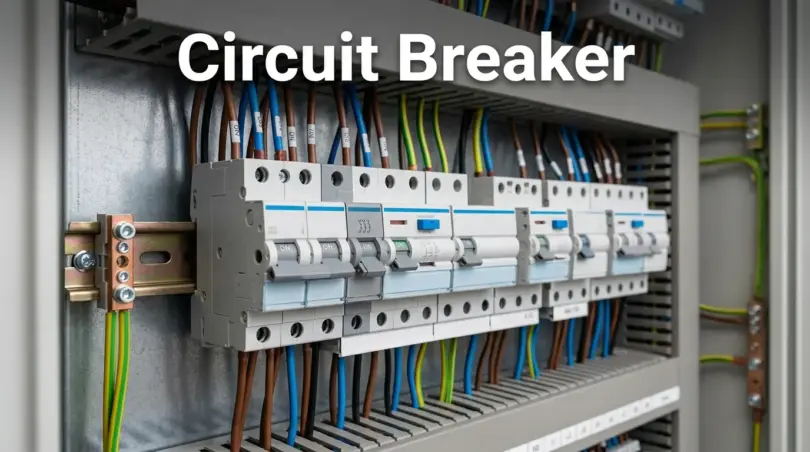
A circuit breaker is an automatic electrical safety device that protects a circuit from damage caused by overload or short circuit. It continuously monitors the flow of current, and the moment that current exceeds its rated limit, it interrupts (trips) the circuit, cutting off power before wires overheat, insulation degrades, or a fire starts. Unlike a fuse, which typically must be replaced after it blows, most circuit breakers can simply be reset and reused once the underlying fault is cleared.
Circuit breakers matter because they are the single most important line of defense between everyday electrical loads and catastrophic failure. Every home, office, factory, and power grid depends on them to prevent overheating, equipment damage, electrical fires, and electric shock. Whether you’re wiring a house, troubleshooting a tripped breaker, or choosing the right protection device for an industrial panel, understanding how circuit breakers work and which type fits your application is essential.
This guide covers everything: the working principle, why breakers trip, all major types (MCB, MCCB, RCCB, RCBO, ACB, VCB, SF6, oil), ratings, pole configurations, breaker vs. fuse, selection criteria, common problems, safe resetting, and maintenance, with FAQs at the end.
What Is a Circuit Breaker?
A circuit breaker is an electromechanical (or electronic) switching device, a type of protective switchgear, designed to protect an electrical circuit from damage caused by excess current. It combines two functions in one device: it acts as a normal on/off switch for the circuit, and it acts as an automatic protective device that opens the circuit when something goes wrong. Circuit breakers are installed inside a distribution board or electrical panel, where each breaker typically protects one dedicated circuit.
Electrical circuit breaker is the technical term for this device: it is installed between the power source and the load. Under normal conditions, it allows current to flow uninterrupted. Under abnormal conditions, its internal sensing mechanism detects the fault and physically separates the contacts to stop the flow of electricity.
Circuit protection is the core purpose of a breaker. It safeguards wiring, appliances, and connected equipment from the heat and stress generated by excessive current, which could otherwise damage insulation, melt conductors, or ignite fires.
Overcurrent protection is the technical category circuit breakers belong to.”Overcurrent” simply means more current flowing through a circuit than the wiring or equipment is rated to handle, whether from an overload or a short circuit, and the breaker’s entire job is to detect and stop it quickly.
How Does a Circuit Breaker Work?
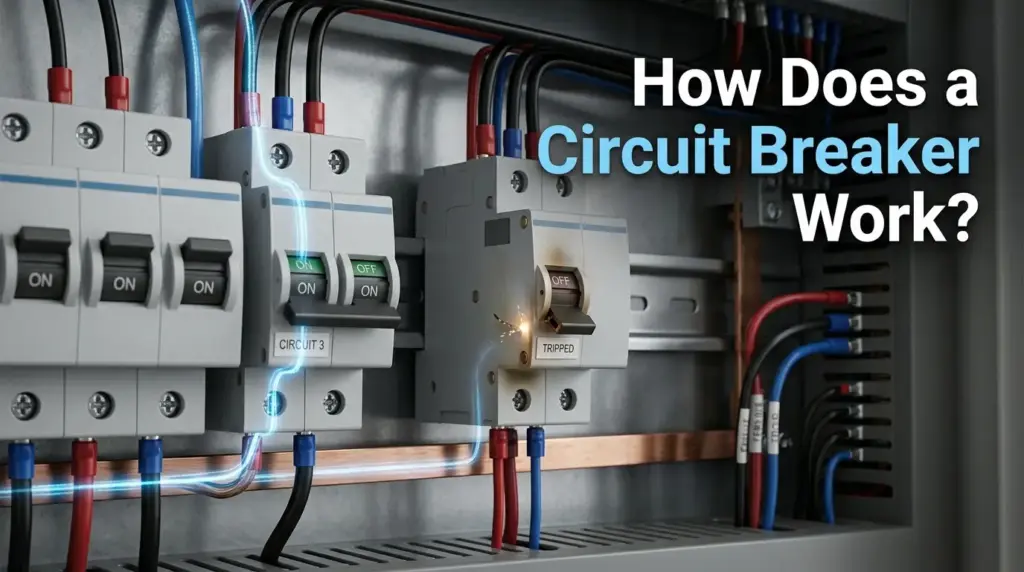
The circuit breaker working principle is based on constant current monitoring and automatic disconnection.
- Normal current: During normal operation, current flows through the breaker’s contacts, which remain closed, allowing electricity to reach the connected load without interruption.
- Overload: When a circuit draws more current than it’s designed for, often because too many devices are running at once, the breaker’s internal sensing element (usually a bimetallic strip) heats up and bends, eventually tripping the mechanism after a short delay.
- Short circuit: When a live wire directly contacts a neutral or ground wire, current spikes almost instantly to very high levels. This is detected by an electromagnetic coil, which trips the breaker within milliseconds, much faster than a typical overload response.
- Trip mechanism: Once a fault is detected, a spring-loaded mechanism releases and forcibly separates the contacts, breaking the circuit and stopping current flow immediately.
- Arc interruption: When contacts separate under load, an electric arc forms between them. The breaker is designed with arc chutes, gases (like SF6), or vacuum chambers to extinguish this arc quickly and safely, preventing damage to the contacts and surrounding components.
Why Do Circuit Breakers Trip?
A breaker trips because it has detected a condition that could be unsafe. The main causes are:
- Overload protection: Too many appliances drawing current on one circuit exceeds its rated capacity, causing a gradual heat buildup that trips the breaker.
- Short circuit protection: A direct, low-resistance connection between live and neutral wires causes a sudden current surge, which the breaker interrupts almost instantly.
- Ground fault: Current leaks from the circuit into a ground path (often through moisture, damaged insulation, or faulty equipment), which specialized breakers (RCCBs/RCBOs) detect and respond to.
- Electrical faults: Loose connections, damaged wiring, or failing appliances can create abnormal current paths that trigger a trip.
- Circuit breaker keeps tripping: If a breaker trips repeatedly, it usually signals a persistent problem such as an overloaded circuit, a wiring fault, a failing appliance, or in rare cases a worn-out breaker, and should be investigated rather than reset repeatedly.
Types of Circuit Breakers
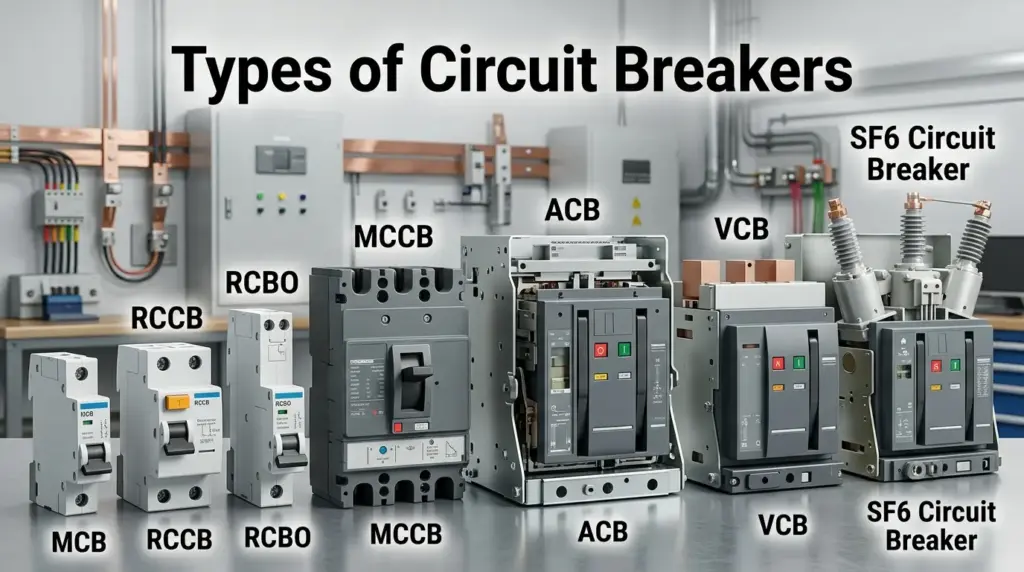
Miniature Circuit Breaker (MCB)
Purpose: Protects low-voltage circuits from overload and short circuit using a thermal-magnetic trip mechanism. Voltage/Application: Typically rated up to 125A, used on systems up to around 440V; the trip curve (Type B, C, or D) determines how sensitive it is to inrush current. Common in residential and light commercial wiring for lighting and socket circuits. Key Difference: Compact, with fixed trip settings and non-adjustable breaking capacity, and easy to reset manually. It’s the most widely used breaker in homes.
Molded Case Circuit Breaker (MCCB)
Purpose: Protects higher-current circuits, typically with adjustable thermal-magnetic or electronic trip settings. Voltage/Application: Ratings generally start around 16–125A and extend up to 2500A, used on systems up to about 1000V (or higher for some industrial models); common in commercial buildings, sub-distribution boards, and industrial panels. Key Difference: Higher breaking capacity and adjustable protection settings compared to MCBs, with some overlap in the lower current range, making MCCBs suitable for larger or more demanding loads.
RCCB and RCBO
Purpose: RCCB (Residual Current Circuit Breaker) detects earth leakage/ground faults; RCBO combines RCCB functionality with MCB-style overload and short-circuit protection in one device. Voltage/Application: Used in residential and commercial circuits, especially bathrooms, kitchens, and outdoor sockets where shock risk is higher. Key Difference: RCCB does NOT protect against overload/short circuit on its own; RCBO does both jobs (earth leakage plus overcurrent) in a single unit.
Air Circuit Breaker (ACB)
Purpose: Interrupts current using air at atmospheric pressure to extinguish the arc. Voltage/Application: Used for low-voltage applications (up to 1000V/1150V) with high current ratings, typically in main distribution boards of large buildings and industries. Key Difference: Handles very high currents (up to 6300A+) and is favored for its reliability at low voltage but high load levels.
Vacuum Circuit Breaker (VCB)
Purpose: Uses a vacuum as the arc-quenching medium, since a vacuum has extremely high dielectric strength. Voltage/Application: Widely used in medium-voltage systems (11kV–33kV) such as substations and industrial power distribution. Key Difference: Low maintenance, long contact life, and no risk of fire since there’s no oil or gas involved, making it ideal for medium-voltage switching.
SF6 Circuit Breaker
Purpose: Uses sulfur hexafluoride (SF6) gas, an excellent insulator and arc-quenching medium, to interrupt current. Voltage/Application: Used in high-voltage transmission systems (33kV and above, up to 800kV). Key Difference: Excellent for very high voltage and high fault currents, though SF6 gas is a potent greenhouse gas requiring careful handling.
Oil Circuit Breaker
Purpose: Uses insulating oil to quench the arc formed during contact separation. Voltage/Application: Historically used in high-voltage applications, now largely replaced by SF6 and vacuum breakers. Key Difference: Bulky, requires regular oil maintenance, and carries fire risk. Mostly found in older installations today.
Circuit Breaker Ratings Explained
Understanding ratings is essential for choosing and safely operating a breaker:
- Voltage rating: The maximum voltage the breaker is designed to safely handle (e.g., 240V, 415V, 11kV).
- Current rating: The maximum continuous current the breaker can carry without tripping under normal conditions (e.g., 16A, 32A, 100A).
- Breaking capacity: The maximum fault current the breaker can safely interrupt without sustaining internal damage, usually expressed in kA (kiloamps), sometimes listed separately as Icu (ultimate) and Ics (service) breaking capacity.
- Interrupting rating: Closely related to breaking capacity, this defines the highest short-circuit current the breaker can clear at rated voltage without failure.
- Trip curve/trip characteristic: For MCBs, curve types (commonly B, C, or D) define how quickly the breaker trips relative to normal inrush current: B for resistive loads, C for mixed loads, D for high-inrush loads like motors.
- Pole configuration: Refers to how many separate circuit conductors (phases/lines/neutral) the breaker switches simultaneously: single-pole, double-pole, or three-pole (sometimes four-pole when neutral is also switched).
Single-Pole vs Double-Pole vs Three-Pole Circuit Breakers
- Single-pole breaker: Switches one live/line conductor only; used for standard single-phase circuits (commonly 120V in North America or 230V in most other regions) such as lighting and general-purpose outlets.
- Double-pole breaker: Switches two conductors together, either two live wires on a split-phase 240V system (common in North America for water heaters, dryers, and AC units), or the live and neutral together on a single-phase 230V system for full isolation, which is required in many other regions.
- Three-pole breaker: Switches all three phases of a three-phase circuit simultaneously; used for industrial and commercial three-phase loads such as motors, pumps, and large machinery.
Choosing the right pole configuration depends on the voltage system, phase type, and local electrical code requirements. Using the wrong configuration can leave equipment under-protected, fail to provide full isolation, or prevent the load from operating correctly.
Circuit Breaker vs Fuse
| Aspect | Circuit Breaker | Fuse |
|---|---|---|
| Working Principle | Uses a thermal-magnetic or electronic trip mechanism to sense and open the circuit | Uses a metal element that melts (fuses) when current exceeds its rating |
| Reset/Replacement | Can typically be manually reset and reused after tripping, once the fault clears | Must be physically replaced after it blows |
| Response Speed | Fast for short circuits; slightly delayed for overloads to avoid nuisance trips | Very fast response, especially for high-current short circuits |
| Protection Precision | Often offers adjustable trip curves/settings on larger breakers | Fixed protection level with no adjustability |
| Typical Applications | Home panels, commercial/industrial distribution, motor protection | Small appliances, automotive circuits, low-cost protection needs |
How to Choose the Right Circuit Breaker
- Load/current requirement: Calculate the total current the circuit will carry. For continuous loads (running 3+ hours), standard practice is to size the breaker at around 125% of the continuous load current (i.e., keep the load at about 80% of the breaker’s rating) to avoid nuisance tripping and heat buildup. Always confirm exact values against local code tables rather than relying on a fixed rule of thumb.
- Voltage: Match the breaker’s voltage rating to the system voltage (single-phase or three-phase).
- Breaking capacity: Ensure the breaker can safely interrupt the maximum possible fault current at its installation point.
- Application: Consider whether the breaker is for lighting, general power, motor loads, or earth-leakage-sensitive areas like bathrooms.
- Number of poles: Match pole configuration to the circuit type, single-pole for 120/230V, double-pole for 240V, three-pole for three-phase.
- Installation environment: Factor in temperature, moisture, dust, and space constraints, which may call for enclosures or specific breaker types (e.g., RCBO for wet areas).
- Electrical code requirements: Always follow local/national electrical codes, which often mandate specific breaker types (like RCBOs) for certain rooms or applications.
Common Circuit Breaker Problems
- Breaker keeps tripping: Usually caused by an overloaded circuit, a short circuit, a ground fault, or a failing appliance drawing excess current.
- Breaker won’t reset: Often indicates an active fault is still present, a worn-out internal mechanism, or in rare cases a wiring issue preventing the switch from latching.
- Breaker feels hot: Can result from loose wiring connections, an overloaded circuit, or a breaker nearing the end of its service life. This should be checked promptly, as it’s a fire risk.
- Breaker won’t stay on: Suggests a persistent fault condition downstream, such as a short circuit or a failed appliance, that trips the breaker immediately after reset.
- Nuisance tripping: Occurs when a breaker trips without an actual fault, often due to age, sensitivity issues, or a poorly matched breaker rating for the circuit’s normal fluctuations.
How to Reset a Circuit Breaker Safely
- Turn off or unplug the devices on the affected circuit to remove the load.
- Locate the tripped breaker in the panel. It will usually sit in a middle position between “ON” and “OFF.”
- Push the breaker fully to the “OFF” position first, then switch it firmly back to “ON.”
- Gradually reconnect devices one at a time to check if the breaker holds.
Safety Warning: If a breaker trips again immediately or repeatedly, do not keep resetting it. This indicates an active fault, and continuing to force the breaker back on can cause fire, shock, or equipment damage. Turn off power to that circuit and contact a licensed electrician.
Circuit Breaker Maintenance and Safety
- Inspection: Periodically visually inspect breakers and panels for discoloration, burn marks, or corrosion, which can indicate underlying problems.
- Testing: Test breakers (especially RCCBs/RCBOs, which have a built-in test button) regularly to confirm they trip correctly when needed.
- Overheating: Watch for unusual warmth around the panel or breaker, as this often points to loose connections or an undersized breaker for the load.
- Loose connections: Have an electrician periodically check and tighten terminal connections, since loose wiring is a leading cause of arcing and overheating.
- Professional electrical inspection: Schedule a professional inspection every few years (or after any major electrical work) to catch aging components, code compliance issues, or hidden faults before they become dangerous.
Frequently Asked Questions
1. What is a circuit breaker?
A circuit breaker is an automatic switching device that protects electrical circuits from damage by interrupting current flow when it detects an overload, short circuit, or other fault.
2. How does a circuit breaker work?
It continuously monitors current flow using thermal and/or electromagnetic sensing; when current exceeds a safe threshold, an internal trip mechanism separates the contacts and stops the flow of electricity.
3. What causes a circuit breaker to trip?
The most common causes are overloaded circuits (too many devices drawing power at once), short circuits (direct contact between live and neutral wires), and ground faults (current leaking to earth).
4. What is the difference between an MCB and MCCB?
An MCB is a smaller, lower-current breaker with fixed trip settings used mainly in residential wiring, while an MCCB handles much higher currents, offers adjustable trip settings, and is used in commercial/industrial applications.
5. Is a circuit breaker better than a fuse?
In most modern applications, yes. Circuit breakers are reusable, offer adjustable protection, and don’t need replacement after tripping, whereas fuses must be physically replaced each time they blow.
6. How do I know what size circuit breaker I need?
Calculate the total current draw of the circuit’s load, then select a breaker rated appropriately above that (following local electrical code guidelines) to safely handle normal operation without nuisance tripping.
You May Also Like It:
Public Power Energy Supplier: What It Is and How It Works
Power vs Energy: What Is the Difference and Why Does It Matter?
Green Power Energy: The Complete Guide to Clean, Renewable Electricity
Consumers Energy Power Outage: How to Report, Track, and Stay Safe

[…] metal parts of equipment back to the source, providing the fault-current return path that allows breakers to trip during a ground […]