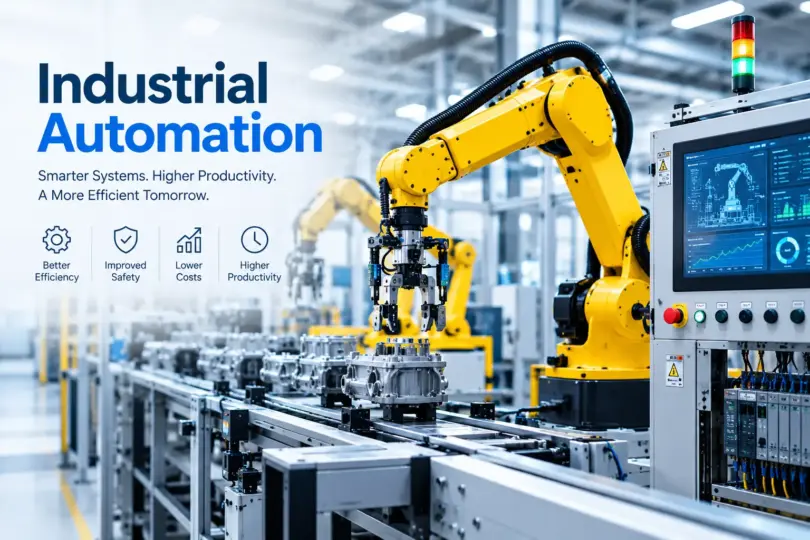

Industrial automation is the use of control systems, software, machines, sensors, and robotics to operate industrial processes with minimal human intervention. Common technologies include PLCs, SCADA, HMIs, industrial robots, sensors, actuators, and IIoT systems that work together to control, monitor, and optimize production.
What Is Industrial Automation?
Industrial automation refers to the application of control systems, such as computers, PLCs (Programmable Logic Controllers), and robotics, along with information technologies to handle industrial processes and machinery, reducing the need for constant human intervention. It is a core part of modern factory automation and automated manufacturing, where machines and software systems carry out repetitive, precise, or hazardous tasks that were traditionally performed manually.
An industrial automation system typically combines hardware (sensors, actuators, controllers) and software (control logic, monitoring dashboards, data systems) to manage everything from a single machine to an entire production plant.
The purpose of automation is not simply to replace human labor. Automation exists to deliver:
- Precision: consistent, repeatable actions that manual labor cannot match at scale
- Repeatability: identical output quality across thousands or millions of production cycles
- Continuous monitoring: real-time visibility into process conditions
- Safety: removing humans from hazardous, toxic, or physically demanding environments
- Process control: tighter control over variables like temperature, pressure, speed, and flow
Industrial control systems exist to make production faster, safer, more consistent, and more data-driven. Labor reduction is just one outcome among many.
How Does Industrial Automation Work?
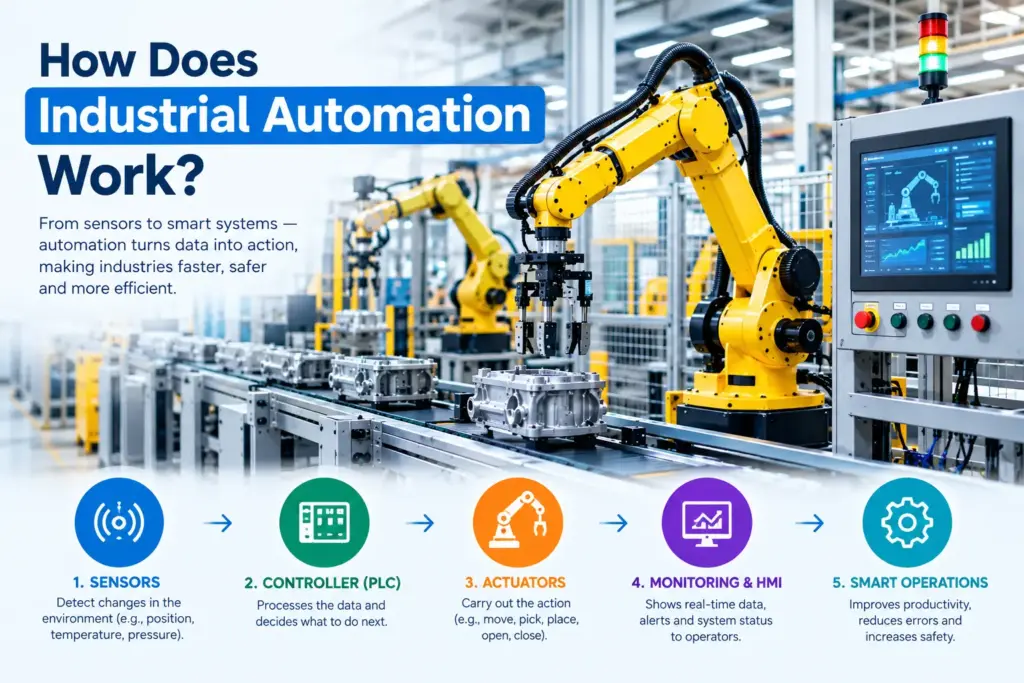
Most industrial automation systems follow a simple flow of information and action:
Sensors → PLC/Controller → Actuator/Motor → HMI/SCADA → Data/Monitoring
- Sensors collect data: Devices such as temperature, pressure, proximity, or level sensors continuously gather real-world data from the process or machine.
- PLC processes inputs: The Programmable Logic Controller receives sensor signals and evaluates them against pre-programmed logic and setpoints.
- Controller sends commands: Based on this logic, the controller issues instructions to the field devices.
- Actuators perform physical action: Motors, valves, pumps, and cylinders execute the physical response, such as opening a valve or starting a conveyor.
- HMI displays information: The Human-Machine Interface shows operators real-time status, alarms, and control options on a screen.
- SCADA provides supervisory monitoring: At a plant-wide or multi-site level, SCADA systems collect data from multiple PLCs, log historical trends, and allow centralized supervisory control.
This layered relationship, where PLCs handle real-time control, HMIs give local visibility, and SCADA provides supervisory oversight, is central to how nearly all modern industrial control systems are structured.
Types of Industrial Automation
Industrial automation is generally classified into four types, based on production volume, product variety, and flexibility requirements.
Fixed Automation
Also known as hard automation, fixed automation uses a set sequence of operations designed for one specific task. It is ideal for high-volume production of a single product, such as bottling lines or engine block machining. Fixed automated systems are highly efficient but expensive and difficult to reconfigure for a different product.
Programmable Automation
Programmable automation allows the sequence of operations to be changed through programming, making it suitable for batch production automation where different products are manufactured in medium to large batches. Changeover between batches requires reprogramming and physical setup changes, but the equipment itself remains reusable across product variants.
Flexible Automation
Flexible automation, often implemented through flexible manufacturing systems (FMS), allows different products to be manufactured with minimal changeover time and little to no manual intervention. FMS automation is well suited for mid-volume, mid-variety production where product designs change frequently.
Integrated Automation
Integrated automation connects multiple automated systems, machines, and processes into a single, unified control network. In integrated manufacturing systems, design, production, quality control, and logistics operate together under centralized data and control architecture, forming a key step toward smart factories.
Comparison of automation types:
| Type | Production Volume | Product Variety | Flexibility |
|---|---|---|---|
| Fixed Automation | Very High | Low (single product) | Very Low |
| Programmable Automation | Medium to High | Medium (batches) | Moderate |
| Flexible Automation | Medium | High | High |
| Integrated Automation | Varies (plant-wide) | High | Very High |
Key Components of Industrial Automation
The following components form the technical backbone of nearly every industrial automation system.
Programmable Logic Controllers (PLC)
A PLC (Programmable Logic Controller) is an industrial computer designed to control machinery and processes in real time. PLC automation uses ladder logic or similar programming to read sensor inputs and control outputs such as motors, valves, and relays. Industrial PLCs are rugged, reliable, and built to operate continuously in harsh factory environments, making the PLC control system the foundation of most automated processes.
SCADA Systems
SCADA (Supervisory Control and Data Acquisition) is a system architecture used to monitor and control industrial processes across large or geographically distributed sites. A SCADA system gathers real-time data from multiple PLCs and field devices, displays it to operators, logs historical trends, and allows supervisory-level control. SCADA automation is common in industries such as oil and gas, water treatment, and power distribution.
Human-Machine Interface (HMI)
An HMI (Human-Machine Interface) is the screen or panel through which operators interact with machines and control systems. Industrial HMIs display real-time process data, alarms, and control buttons, allowing operators to monitor and adjust operations without needing to interact directly with the PLC. HMI automation improves usability and reduces the risk of operator error.
Sensors and Actuators
Industrial sensors detect physical conditions and convert them into electrical signals the control system can interpret. Common types include:
- Temperature sensors
- Pressure sensors
- Proximity and position sensors
- Level and flow sensors
- Vision sensors
Actuators convert control signals into physical motion or action. Examples include motors, pneumatic cylinders, solenoid valves, and servo drives. Together, automation sensors and industrial actuators form the sensing and action layers of any automated system.
Industrial Robots and Cobots
Industrial robots perform tasks such as welding, painting, assembly, and material handling with high speed and precision. Collaborative robots (cobots) are a newer category designed to work safely alongside human workers without extensive safety barriers, making robotic manufacturing more flexible and accessible to small and mid-sized facilities.
Industrial Control Systems
An industrial control system (ICS) is the broader category that includes PLCs, SCADA, DCS (Distributed Control Systems), and related technologies used to manage industrial processes. ICS and process control systems are designed for reliability, real-time response, and safety, forming the operational core of automated plants.
Industrial Communication Networks
Industrial networking protocols allow devices, controllers, and software systems to exchange data reliably. Widely used industrial communication standards include:
- Modbus: one of the oldest and most widely supported industrial protocols
- PROFINET: a high-speed Ethernet-based standard common in European manufacturing
- EtherNet/IP: an Ethernet-based protocol widely used in North America
- OPC UA: a platform-independent standard for secure, interoperable data exchange across systems
These communication networks allow PLCs, HMIs, SCADA, sensors, and enterprise software to function as one connected automation architecture rather than isolated devices.
Industrial Automation Applications
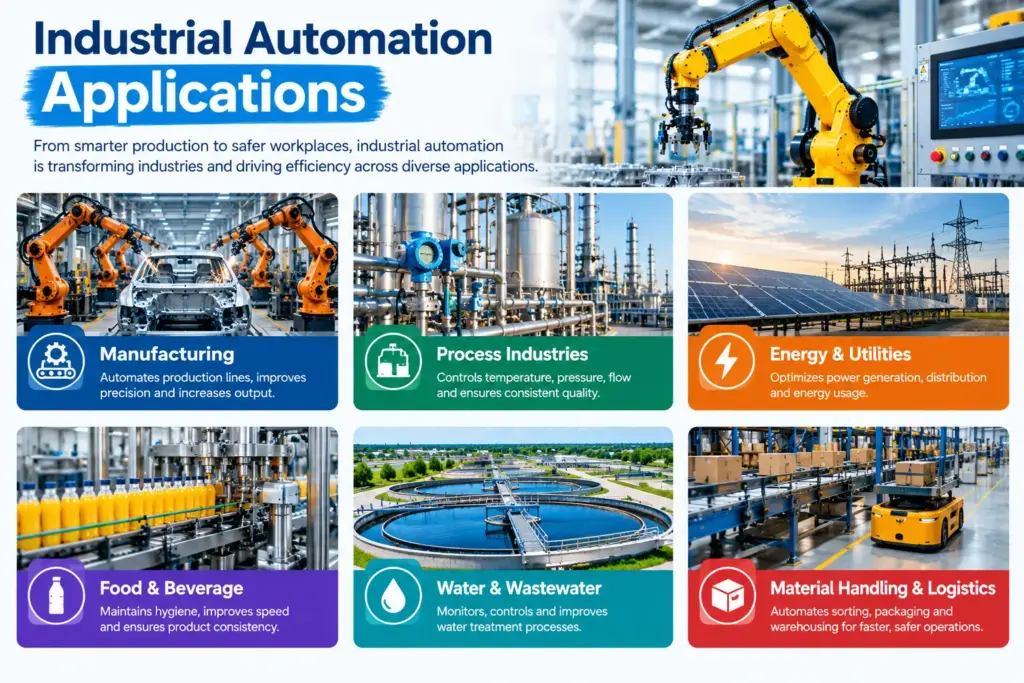
Industrial automation is used across nearly every major industry sector.
Industrial process automation
Refers specifically to the automated control of continuous or semi-continuous production processes, such as those found in oil and gas, chemical manufacturing, and pharmaceutical production. Unlike discrete manufacturing, where individual parts move through distinct assembly steps, process automation deals with the ongoing regulation of variables like flow rate, temperature, pressure, and chemical composition. This makes process control systems, SCADA, and DCS (Distributed Control Systems) especially critical, since even small deviations can affect product quality, safety, or yield. Industrial process automation is what keeps refineries, chemical plants, and pharmaceutical facilities running safely and consistently around the clock.
Manufacturing Automation
Automated assembly lines, CNC machining, and robotic welding are used to increase throughput and consistency in general manufacturing.
Automotive Automation
The automotive industry was one of the earliest adopters of automation, using robotic arms for welding, painting, and precision assembly on high-volume production lines.
Food and Beverage Automation
Automated systems handle mixing, filling, labeling, and packaging while maintaining strict hygiene and consistency standards required in food production.
Pharmaceutical Automation
Automation ensures precise dosing, sterile handling, and strict regulatory compliance in drug manufacturing and packaging environments.
Oil and Gas Automation
SCADA-based systems monitor and control pipelines, refineries, and drilling operations across remote and often hazardous locations.
Chemical Industry Automation
Automated control systems manage temperature, pressure, and chemical dosing with high precision to ensure safety and product consistency in chemical processing.
Warehouse and Material Handling
Automated guided vehicles (AGVs), conveyor systems, and robotic picking systems streamline material flow and order fulfillment in logistics and warehousing.
Packaging Automation
Automated packaging systems handle filling, sealing, labeling, and palletizing at speeds far beyond manual capability.
CNC and Machine Automation
Computer Numerical Control (CNC) machines automate precision cutting, drilling, and shaping of materials based on programmed instructions.
Benefits of Industrial Automation
- Increased productivity: Automated systems can run continuously with minimal downtime between cycles.
- Improved product quality: Consistent, programmed actions reduce variation between units.
- Reduced downtime: Predictive monitoring can flag issues before they cause a full stoppage.
- Better process control: Tighter control over variables like temperature, pressure, and speed.
- Improved workplace safety: Hazardous or repetitive tasks can be shifted away from human workers.
- Lower operational costs: Reduced waste, rework, and energy usage over time.
- Higher production accuracy: Machines repeat the same action with minimal deviation.
- Real-time monitoring: SCADA and HMI systems give continuous visibility into operations.
- Reduced human error: Automated logic removes variability caused by fatigue or manual oversight.
- Predictive maintenance: Sensor data can be used to anticipate equipment failures before they occur.
Industrial Automation vs Traditional Manufacturing
| Feature | Manual Manufacturing | Automated Manufacturing |
|---|---|---|
| Human intervention | High | Lower |
| Production speed | Variable | Consistent |
| Process monitoring | Manual | Real-time |
| Repeatability | Variable | High |
| Data collection | Limited | Extensive |
| Safety | More manual exposure to hazards | Hazardous tasks can be automated |
| Setup and changeover | Often faster for one-off jobs | May require reprogramming, but scales better |
| Initial investment | Lower | Higher upfront cost |
Industrial Automation and Industry 4.0
Industrial automation is not the same as Industry 4.0. Traditional automation focuses on controlling machines and processes locally through PLCs, SCADA, and HMIs. Industry 4.0, or smart manufacturing, extends this foundation by adding connectivity, data analytics, and intelligent decision-making across the entire enterprise.
Key elements of Industry 4.0 built on top of traditional automation include:
- Industrial Internet of Things (IIoT): connecting machines, sensors, and systems to the internet for centralized data collection
- Cloud manufacturing: storing and processing production data remotely for scalability and analysis
- Artificial intelligence in manufacturing: using AI models to detect patterns, optimize processes, and support decision-making
- Machine learning: algorithms that improve process predictions and quality control over time based on historical data
- Digital twin technology: virtual replicas of physical assets used to simulate and optimize performance before changes are made on the factory floor
- Predictive maintenance: using sensor and historical data to forecast equipment failures before they happen
Industrial automation is the control layer. Industry 4.0 is the intelligence and connectivity layer built on top of it.
Industrial Automation Challenges
- High initial investment: PLCs, robots, sensors, and integration work require substantial upfront capital.
- System integration: Connecting new automation equipment with existing legacy machinery can be technically complex.
- Maintenance requirements: Automated systems need regular preventive maintenance to avoid unplanned downtime.
- Skilled workforce: Operating and maintaining modern automation requires trained technicians and engineers, and this talent gap is a common bottleneck.
- Legacy equipment: Older machines may not support modern communication protocols, requiring retrofitting or replacement.
- Industrial cybersecurity: As control systems become more connected through IIoT and remote access, they become more exposed to cyber threats. Protecting PLCs, SCADA networks, and industrial communication channels is a critical design concern, not an afterthought.
- Network reliability: Industrial networks must maintain consistent, low-latency communication, since delays or dropouts can disrupt real-time control.
- Data management: Automated systems generate large volumes of data that must be stored, organized, and analyzed effectively to be useful.
How to Implement Industrial Automation
- Identify the process: Determine which task, line, or process is the best candidate for automation based on repetition, volume, or safety risk.
- Analyze production requirements: Study throughput needs, product variety, and tolerances to define system specifications.
- Choose automation technology: Decide between fixed, programmable, flexible, or integrated automation based on production goals.
- Select PLC, HMI, and SCADA: Choose controllers, interface panels, and supervisory systems suited to the scale of the operation.
- Install sensors and actuators: Deploy the field devices needed to sense conditions and execute physical actions.
- Integrate machines and networks: Connect all devices using appropriate industrial communication protocols (Modbus, PROFINET, EtherNet/IP, OPC UA).
- Test the system: Run controlled trials to validate logic, safety interlocks, and performance before full deployment.
- Train operators: Ensure staff understand how to use HMIs, respond to alarms, and follow safety procedures.
- Monitor performance: Use SCADA and data dashboards to track output, efficiency, and error rates after go-live.
- Maintain and optimize: Continuously review performance data to refine settings, plan preventive maintenance, and identify further automation opportunities.
Future of Industrial Automation
- AI-powered automation: Systems that adjust parameters automatically based on real-time analysis rather than fixed logic alone
- Industrial IoT: Expanding sensor networks that feed data into centralized platforms for deeper visibility
- Robotics: More capable, affordable robotic arms and mobile robots across small and mid-sized manufacturers
- Collaborative robots: Continued growth of cobots working safely alongside human teams
- Machine vision: Camera-based inspection systems for quality control and guidance that exceed human visual accuracy
- Predictive maintenance: Increasingly sophisticated models that forecast failures with greater accuracy
- Autonomous systems: Self-guided vehicles and robots that navigate and adapt without constant human direction
- Digital twins: Wider use of virtual simulation before physical changes are implemented
- Smart factories: Fully connected facilities where automation, data, and AI work together in real time
- Edge computing: Processing data closer to the machine itself for faster response times and reduced reliance on cloud connectivity
Frequently Asked Questions About Industrial Automation
What is industrial automation?
Industrial automation is the use of control systems, software, sensors, and machinery to operate industrial processes with minimal human involvement, improving precision, consistency, and safety.
What are the 4 types of industrial automation?
The four main types are fixed automation, programmable automation, flexible automation, and integrated automation, each suited to different production volumes and product variety needs.
What are the main components of industrial automation?
Key components include PLCs, SCADA systems, HMIs, sensors, actuators, industrial robots, and industrial communication networks that connect these devices together.
What is a PLC in industrial automation?
A PLC (Programmable Logic Controller) is an industrial computer that reads sensor input, applies programmed logic, and sends control signals to actuators and machines in real time.
What is SCADA in automation?
SCADA (Supervisory Control and Data Acquisition) is a system that monitors and controls industrial processes across multiple machines or sites, providing centralized data logging and supervisory control.
What is the difference between PLC and SCADA?
A PLC handles real-time, local control of a specific machine or process. SCADA provides supervisory monitoring and control across multiple PLCs or sites, often over a wider geographic area.
What are the benefits of industrial automation?
Benefits include increased productivity, improved quality, reduced downtime, better safety, lower operational costs, and real-time process monitoring.
Where is industrial automation used?
It is used across manufacturing, automotive, food and beverage, pharmaceuticals, oil and gas, chemicals, warehousing, and packaging industries.
What is the difference between automation and Industry 4.0?
Automation refers to the control layer that operates machines and processes. Industry 4.0 adds connectivity, data analytics, AI, and IIoT on top of that automation layer to enable smart, data-driven manufacturing.
Is industrial automation used in manufacturing?
Yes. Manufacturing is one of the largest and earliest adopters of industrial automation, using PLCs, robots, and control systems to run assembly lines, machining centers, and packaging operations.
Conclusion
Industrial automation brings together PLCs, SCADA, HMIs, sensors, actuators, and robotics to control industrial processes with greater precision, consistency, and safety than manual operation alone. From fixed automation on high-volume lines to flexible and integrated systems in modern smart factories, automation architecture is built on a clear flow: sensors gather data, PLCs process it, actuators act on it, and HMI/SCADA systems give operators visibility and control. As Industry 4.0 technologies like IIoT, AI, and digital twins extend this foundation, industrial automation continues to evolve from simple mechanical control into a fully connected, data-driven approach to modern manufacturing.
By Midwest Industries Automation Engineering Desk
Our editorial team works with control systems engineers and industry professionals to ensure technical accuracy across our automation guides.
You May Also Like It:
Industrial Robot Safety: The Complete 2026 Guide for Facilities, Engineers & Safety Managers
Safety Topics: Guide to OSHA Safety Topics, Toolbox Talks, and Meeting Ideas
Industrial Safety Signs: The Complete Guide to Types, Meanings, Colors, and Standards