

What Is the Difference Between a Soft Starter and a VFD?
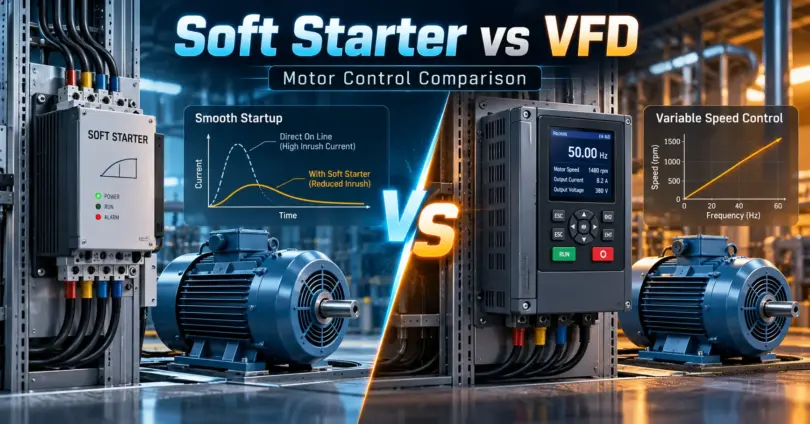
A soft starter reduces the voltage supplied to a motor during startup to limit inrush current and mechanical stress, then lets the motor run at fixed supply frequency. A variable frequency drive (VFD) controls both voltage and frequency, so it regulates motor speed and torque during the whole operation.
Choose a soft starter for fixed-speed motors that only need smooth starting and stopping. Choose a VFD when you need variable speed, precise process control, or energy savings on variable loads.
What Is a Soft Starter?
A soft starter is an electronic motor control device that gradually increases the voltage supplied to an AC motor during startup.
When a motor starts directly from the supply, it can draw several times its rated current. This sudden demand can cause voltage dips, mechanical shocks, and stress on connected equipment. A soft starter reduces these problems by controlling the voltage applied while the motor accelerates.
Once the motor reaches normal speed, it runs at the fixed frequency of the electrical supply.
Soft Starter Working Principle: How Does It Work?
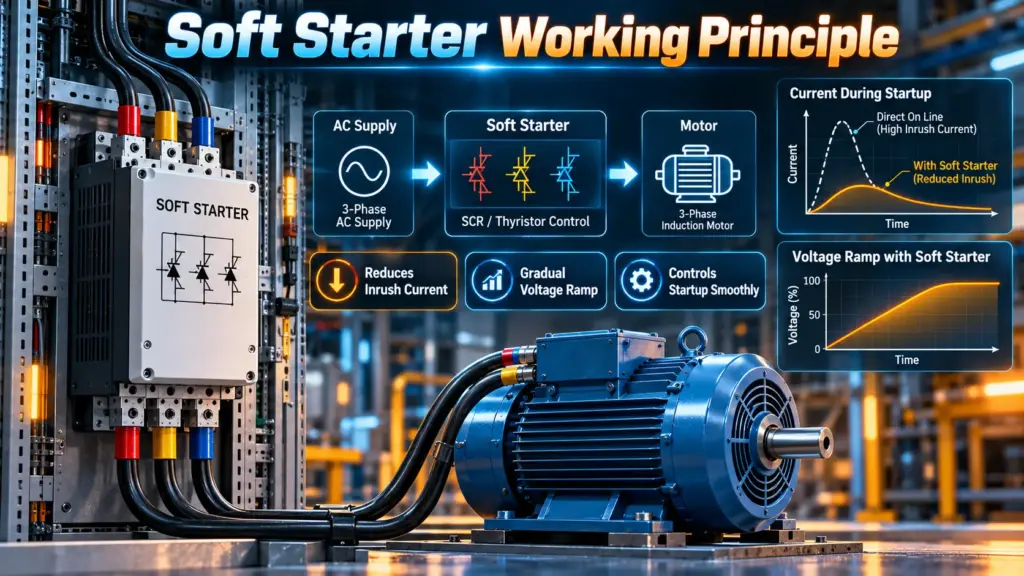
Most three-phase soft starters use silicon-controlled rectifiers (SCRs), also called thyristors. These components control how much of each AC waveform reaches the motor. Operation follows four steps:
- Motor startup: the soft starter first supplies reduced voltage.
- Voltage ramp: it raises the effective voltage by adjusting the thyristor firing angle.
- Acceleration: the motor develops torque and accelerates toward rated speed.
- Normal operation: the starter delivers full voltage, or hands over to an internal or external bypass contactor.
Many models also provide a controlled voltage ramp during shutdown, which reduces mechanical shock and, in pumps, hydraulic pressure surges.
Why Does Lower Voltage Reduce Starting Torque?
Induction motor torque is approximately proportional to the square of the applied voltage:
T ∝ V²
If a motor receives 70% of rated voltage, its torque becomes roughly (0.70)² = 0.49, or about 49% of the full-voltage value. This is a simplified illustration, but it shows why excessive voltage reduction can stop a heavily loaded motor from accelerating.
Advantages of a Soft Starter
- Reduces starting current compared with direct-on-line (DOL) starting.
- Limits mechanical stress on shafts, belts, couplings, and gearboxes.
- Offers adjustable acceleration and, on most models, soft stopping.
- Usually costs less than a comparable VFD.
- Needs less space and simpler setup.
- Has very low running losses when a bypass contactor is used.
Limitations of a Soft Starter
- No continuous speed control during normal operation.
- Starting torque falls as voltage is reduced, which can be unsuitable for high-inertia or heavily loaded starts.
- Built-in protection varies by model. Overload, short-circuit, and other required protection must be verified for the whole installation.
What Is a Variable Frequency Drive (VFD)?
A variable frequency drive is an electronic device that controls the speed of an AC motor by adjusting the frequency of the power supplied to it. It also controls voltage and uses a motor-control strategy (such as V/f or vector control) to produce the required torque.
Unlike a soft starter, a VFD stays in control of the motor throughout operation, which makes it ideal where speed must follow demand.
VFD Working Principle: How Does It Work?
A conventional low-voltage AC drive converts power in three stages:
- Rectification: the rectifier converts incoming AC into DC.
- DC link: capacitors, and in some designs inductors, smooth and store energy.
- Inversion: power semiconductors, usually insulated-gate bipolar transistors (IGBTs), switch rapidly to create a controlled AC output of variable frequency and voltage.
How Does Frequency Affect Motor Speed?
The synchronous speed of an AC induction motor depends on supply frequency and the number of poles:
Ns = 120 × f / P
Here Ns is synchronous speed in RPM, f is frequency in Hz, and P is the number of poles. For a four-pole motor:
| Frequency | Synchronous speed (4-pole) |
|---|---|
| 20 Hz | 600 RPM |
| 30 Hz | 900 RPM |
| 40 Hz | 1,200 RPM |
| 50 Hz | 1,500 RPM |
| 60 Hz | 1,800 RPM |
Actual shaft speed is slightly lower because of slip, and it varies with load.
Advantages of a VFD
- Continuous speed adjustment.
- Programmable acceleration and deceleration.
- Better process control when production requirements vary.
- Potential energy savings on variable-torque loads such as pumps and fans.
- Motor monitoring and diagnostics.
- Torque control and integration with PLCs, sensors, and automation systems.
Limitations of a VFD
VFDs cost more and need more careful installation and configuration. They also bring electrical considerations: input harmonics, electromagnetic interference (EMI), motor insulation stress, bearing currents, and extra heat from the power electronics. The severity depends on the drive, motor, cabling, and installation.
Soft Starter vs VFD: Complete Comparison Table
| Feature | Soft Starter | VFD |
|---|---|---|
| Primary purpose | Smooth starting and stopping | Speed and torque control |
| Voltage control | Mainly during start/stop | Throughout operation |
| Frequency control | No | Yes |
| Continuous speed adjustment | No | Yes |
| Starting current | Reduced versus DOL | Usually limited to about rated current or slightly above |
| Starting torque | Falls as voltage is reduced | Can be maintained, depending on drive and control mode |
| Acceleration control | Voltage, current, or torque ramp | Frequency-based speed ramp |
| Deceleration | Soft stop on supported models | Programmable, with braking options |
| Running speed | Fixed by supply frequency and load | Adjustable |
| Running efficiency | Very high with bypass | Includes continuous conversion losses |
| Energy-saving potential | Limited in steady operation | Significant on suitable variable-speed loads |
| Initial cost | Usually lower | Usually higher |
| Installation | Usually simpler | More configuration and EMC considerations |
| Harmonics | Mainly during SCR conduction | Depends on drive design |
| Typical applications | Fixed-speed pumps, fans, compressors, conveyors | Variable-speed pumps, fans, conveyors, process machinery |
One technology is not always better. Each is optimized for a different level of motor control.
Soft Starter vs VFD: Starting Current and Motor Torque
A standard three-phase induction motor started direct-on-line typically draws about five to eight times its rated current, depending on its design.
A soft starter lowers this current by reducing voltage, but the starting torque drops with it. A VFD works differently: it starts the motor at low frequency and raises frequency as the motor accelerates, coordinating voltage and current so the motor can produce high torque at low supply current.
A properly selected VFD can therefore often start a load with lower supply current and better torque control than a conventional soft starter. This matters when high starting torque, a weak supply, or precise acceleration is required.
Soft Starter vs DOL vs Star-Delta vs VFD
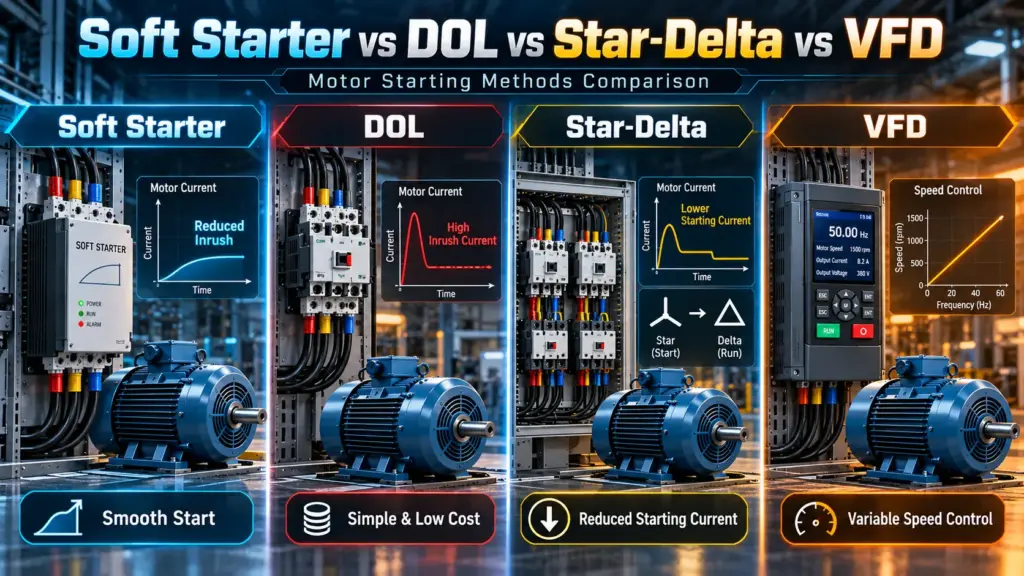
Many buyers also compare these two devices with older starting methods. This table shows how all four compare for a typical induction motor.
| Feature | DOL | Star-Delta | Soft Starter | VFD |
|---|---|---|---|---|
| Starting current | 5–8× rated | About 1/3 of DOL | Adjustable, commonly 2–4× rated | About 1–1.5× rated |
| Starting torque | Full | About 1/3 of DOL | Reduced, adjustable | Up to 150% or more of rated |
| Current/torque transitions | None | Sudden spike at changeover | Smooth | Smooth |
| Speed control | No | No | No | Yes |
| Soft stop | No | No | Yes | Yes |
| Motor leads required | 3 | 6 | 3 (or 6 for inside-delta) | 3 |
| Relative cost | Lowest | Low | Medium | Highest |
| Best for | Small motors, strong supply | Light-load starts, older plants | Fixed-speed machines needing smooth starts | Variable-speed or demanding processes |
Figures are typical values. Always confirm with the motor and equipment datasheets.
Soft Starter vs VFD Energy Consumption: Which Saves More Electricity?
A VFD can save significant energy where speed can be reduced to match demand. Consider a centrifugal pump that often runs below maximum flow. Without speed control, the motor stays near full speed while a throttling valve restricts flow, and energy is wasted across the valve. A VFD instead slows the motor.
For centrifugal pumps and fans, the affinity laws give an approximate relationship:
P2 / P1 = (N2 / N1)³
At 80% speed: (0.8)³ = 0.512. The ideal shaft power falls to about 51.2% of the original, a theoretical 48.8% reduction.
Worked Cost Example
Assume a pump absorbs 30 kW at full speed and runs 6,000 hours a year at 80% speed. Electricity costs $0.12 per kWh. These are illustrative numbers, so replace them with your own.
| Item | Value |
|---|---|
| Power at 100% speed | 30 kW |
| Ideal power at 80% speed (30 × 0.512) | 15.4 kW |
| Ideal power saved | 14.6 kW |
| Annual energy saved (14.6 × 6,000 h) | about 87,800 kWh |
| Ideal annual saving at $0.12/kWh | about $10,500 |
| Realistic expectation | Roughly 50–70% of the ideal figure, about $5,000–$7,500 |
The realistic range is lower because of static head, system friction, motor and VFD losses (a drive is typically 96–98% efficient), and varying operating points. For a motor that runs at a constant speed and load, a VFD may save little or nothing compared with an efficiently bypassed soft starter. A soft starter improves starting and stopping, not continuous energy use.
Soft Starter vs VFD Applications: Where Should Each Be Used?
1. Water Pumps
A soft starter reduces mechanical stress at startup, and pump-control models can ramp down gently to limit water hammer. A VFD is better when pump speed must change to regulate pressure or flow.
Best choice: soft starter for fixed-speed pumping with controlled starts; VFD for variable flow or pressure.
2. Industrial Fans and HVAC Systems
A soft starter suits a constant-speed fan that only needs smooth acceleration. A VFD lets fan speed follow ventilation demand, temperature, or pressure. Since fan power drops steeply at lower speeds, VFDs are especially valuable in HVAC.
Best choice: VFD when airflow requirements change often.
3. Conveyor Belt Systems
A soft starter reduces sudden shocks on a conveyor that runs at constant speed. A VFD helps where speed must change, acceleration must be tightly controlled, or stages must be synchronized. Heavily loaded conveyors need a starting-torque check in either case.
Best choice: soft starter for simple fixed-speed conveyors; VFD for adjustable speed or demanding acceleration.
4. Air Compressors
A soft starter can cut starting current on a fixed-speed compressor. A VFD can match output to varying air demand. Not every compressor tolerates variable speed, so lubrication, cooling, and manufacturer requirements must be checked.
Best choice: depends on compressor design and demand profile.
5. Industrial Mixers and Processing Equipment
Mixers and agitators often need different speeds for different materials or stages, which a VFD handles well. A mixer that runs at one speed with a manageable starting load can use a soft starter.
Best choice: VFD for variable mixing or production speeds.
Sizing Example: Selecting a Controller for a 37 kW Pump Motor
This example shows the logic of selection. Always use your own motor nameplate and the manufacturer’s selection tables.
| Parameter | Value |
|---|---|
| Motor | 37 kW, 400 V, 3-phase, 4-pole, 50 Hz |
| Rated current (FLC) from nameplate | about 68 A (typical) |
| Load | Centrifugal pump, light starting torque |
| Starts | 3 per hour, start time about 10 s |
- Check DOL starting current. At 6× FLC, the inrush is about 6 × 68 = 408 A, which may cause voltage dips on a weak supply.
- Soft starter option. With a current limit of 3× FLC, the start draws about 204 A. Because pump torque rises with speed squared, the motor accelerates comfortably at reduced voltage.
- Choose the rating. Pick a unit whose rated current for your duty class is at least 68 A. In practice, this often means the next standard size (for example 75 A or 90 A) for margin, depending on start time, starts per hour, and ambient temperature. Use the manufacturer’s tables.
- Add a bypass contactor (internal or external) to remove SCR losses during running.
- VFD option. Select a drive with a continuous output current rating of at least 68 A, normally a 37 kW or 45 kW unit depending on overload requirements. Start current stays near rated current.
- Decide. If the pump always runs at full speed, the soft starter is usually the more economical choice. If flow varies significantly, the VFD can pay back through energy savings, as in the cost example above.
Protection (overload, short-circuit, earth fault, isolation) must still be designed and coordinated for either option.
Bypass Contactors and Braking
Bypass Contactor
After the motor reaches full speed, a bypass contactor shorts across the SCRs so current flows through the contactor rather than the semiconductors. This removes SCR heat losses, reduces cooling needs, and extends the life of the starter. Many soft starters have a built-in bypass; others use an external contactor, which should be sized for the motor’s continuous duty (AC-1 or AC-3 as applicable).
Braking Options
- Soft stop: extends stopping time by ramping voltage down. It does not actively brake the motor.
- DC injection braking: available on some soft starters and VFDs; applies DC to the stator to stop the motor faster.
- VFD dynamic braking: a braking resistor absorbs regenerated energy as heat, useful for high-inertia loads.
- VFD regenerative braking: returns energy to the supply through a regenerative front end, which suits cranes, lifts, and frequent-braking applications.
Using a Soft Starter and a VFD in One System
The two devices are not always alternatives. In multi-motor pump stations, a common arrangement uses one VFD on a lead pump for flow control, while soft starters bring fixed-speed support pumps online as demand rises. This limits cost, because only one pump needs a VFD, while still avoiding hard starts on the others.
Another approach is a VFD with a bypass starter, allowing the motor to run direct from the supply if the drive fails. Such designs require proper interlocking so the motor is never connected to both sources at once, and each motor needs its own protection.
Soft Starter vs VFD Cost and Maintenance
| Cost factor | Soft Starter | VFD |
|---|---|---|
| Purchase price | Generally lower | Generally higher |
| Installation | Often simpler | Needs more planning (cabling, EMC, grounding) |
| Configuration | Fewer parameters | More parameters |
| Cooling | Low with bypass | Continuous drive heat losses |
| Maintenance | Connections, cooling, contactors | Fans, filters, electronics, connections, parameter backups |
| Electricity savings | Usually small in steady operation | Can be substantial on suitable loads |
| Long-term value | Strong for fixed-speed duty | Strong where speed control saves energy or improves output |
A VFD on a motor that always runs at one speed adds cost without meaningful benefit. A variable-demand pump running thousands of hours a year can easily justify one. The right comparison is total cost of ownership, not purchase price alone.
How to Choose Between a Soft Starter and a VFD
| If your application… | Preliminary choice |
|---|---|
| Needs adjustable speed during operation | VFD |
| Runs at fixed speed, needs smooth start/stop, light or moderate starting torque | Soft starter |
| Needs high starting torque with limited supply current | VFD |
| Is a centrifugal pump or fan with varying demand | VFD |
| Is a fixed-speed pump with water hammer concerns | Soft starter with pump-stop function |
| Is a heavily loaded or high-inertia conveyor | VFD, or an oversized soft starter after torque check |
| Has several motors, only one needing speed control | Combination of VFD and soft starters |
This is preliminary guidance. Final selection needs motor nameplate data, load details, protection design, and manufacturer specifications.
Technical Factors to Check Before Buying
- Motor rated current: select by current and derating requirements, not horsepower alone.
- Supply voltage and phases: confirm compatibility with your distribution system.
- Load torque: evaluate torque needed throughout acceleration.
- Starts per hour: frequent starts need thermal and duty checks.
- Ambient conditions: temperature, dust, moisture, ventilation, and enclosure rating.
- Protection: overload, short-circuit, grounding, and isolation arrangements.
- Control integration: PLC connectivity, communication protocols, and feedback.
- Motor suitability (VFD): insulation, low-speed cooling, and cable length.
- Standards: relevant product standards such as IEC 60947-4-2 (soft starters) and IEC 61800 (adjustable speed drives), plus local electrical codes.
When Not to Use a VFD
- The motor always runs at constant speed and full load, so there is nothing to save.
- The motor is old, with weak insulation, and the cable run between drive and motor is very long without filtering.
- The environment is very hot, dusty, or humid and cannot be controlled or protected.
- The budget or maintenance skills cannot support drive electronics and parameter management.
- The process has a high static head so slowing the pump gives little flow or saving.
- Simple starting is the only requirement and a soft starter meets it at lower cost.
Common Mistakes When Choosing a Soft Starter or VFD
- Choosing by price only: a cheaper soft starter may leave too little starting torque for the load.
- Assuming a VFD always cuts the bill: savings require operating conditions where lower speed or better control provides a measurable benefit.
- Ignoring the whole motor system: power quality, insulation, protection devices, heat dissipation, starting duty, and mechanics affect performance whichever controller you choose.
- Undersizing for duty: sizing by kW alone, without start time and starts per hour, leads to overheating and trips.
Frequently Asked Questions
1. What is the main difference between a soft starter and a VFD?
A soft starter mainly controls motor voltage during starting and stopping. A VFD controls frequency and voltage, allowing continuous speed adjustment during operation.
2. Does a soft starter change motor frequency?
No. A conventional soft starter controls the effective voltage applied to the motor while the supply frequency stays unchanged.
3. Which is better for a three-phase induction motor?
Both can be suitable. A soft starter is usually more economical for fixed-speed operation, while a VFD offers adjustable speed and more advanced control. The correct choice depends on starting torque, load behavior, duty, and process requirements.
4. Can a soft starter reduce electricity consumption?
It reduces peak starting current, but it does not substantially reduce running energy use. Once the motor is at full speed, consumption depends on the load and system efficiency.
5. Do VFDs require special motors?
Not always. Many standard induction motors work with a properly selected VFD, but insulation, cooling at low speed, bearing currents, and cable length must be evaluated. Some applications benefit from inverter-duty motors.
6. Can a soft starter be used for a water pump?
Yes. Soft starters are widely used on fixed-speed pumps, and many models offer a pump-stop function that reduces water hammer.
7. Can a VFD run a motor above its rated speed?
Some motor and drive combinations can, if the motor and driven machine are approved for it. Torque drops above base speed, and mechanical limits, cooling, and safety must be checked.
8. Which has lower maintenance requirements?
Soft starters usually have simpler configuration and fewer continuously operating power-conversion parts. VFDs need more attention to cooling, environment, electronic components, and parameter backups. Actual needs depend on equipment design and duty.
9. Is a VFD necessary for every industrial motor?
No. A VFD is worthwhile when adjustable speed, torque control, or process optimization gives a real advantage. Fixed-speed machines often run well with a soft starter or another starting method.
10. What happens if a soft starter is undersized?
It may overheat, trip during acceleration, or fail early. Selection must account for motor current, start time, starts per hour, overload duty, and ambient temperature.
11. Can a soft starter and a VFD be used together?
Yes. In multi-motor systems, one VFD can drive a lead motor while soft starters bring additional motors online. Each motor needs its own protection and a proper changeover design.
Key Takeaways
- A soft starter controls voltage for smooth starts and stops; a VFD controls frequency and voltage for speed and torque.
- Soft starters reduce starting torque along with current; VFDs can deliver high torque at low current.
- Energy savings come from running slower on pumps and fans, not from soft starting.
- For fixed-speed duty, a soft starter with bypass is usually the economical choice.
- Always size by motor current, start time, and starts per hour, and design protection for the full installation.
Final Thoughts
The choice depends on what the motor must do after it starts. If the application runs at constant speed and only needs controlled acceleration or deceleration, a soft starter is a practical and economical solution. If the process needs continuous speed adjustment, stronger torque control, or the ability to slow down with demand, a VFD offers more flexibility.
Before deciding, assess starting current, required torque, operating hours, load characteristics, the electrical installation, and total operating cost. This helps ensure reliable motor performance without unnecessary equipment expense.
You May Also Like It:
Circuit Breaker: Types, Working Principle, Uses, and Safety
Bonding vs Grounding: What’s the Difference?
Industrial Electrical System: A Complete Guide to Components, Installation, and Maintenance
Industrial Switchgear: Types, Design, and How to Choose the Right Syste




[…] Soft Starter vs VFD: Key Differences, Working Principles, and Applications […]