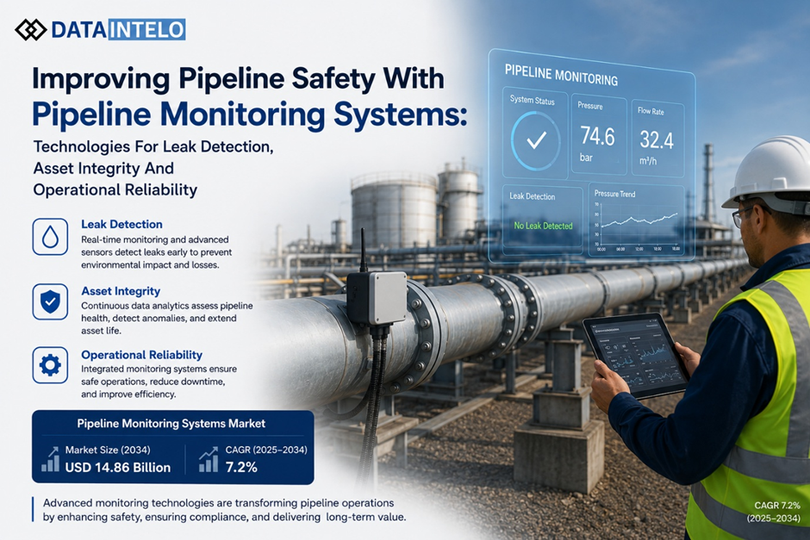

Pipeline networks play a significant role in industrial infrastructure as they transport many materials such as natural gas, crude oil, oil products and fluids over long distances. Their safety depends on numerous factors that go beyond stronger pipe materials or regular inspections. Continuous monitoring allows discovering pressure issues, abnormal flow rates, corrosion issues and other indicators ahead in time before minor problems become serious incidents. DataIntelo research indicates that, the global market of the pipeline monitoring systems is estimated at $7.86 billion in 2025 and will grow up to $14.86 billion by 2034, which results in 7.2% CAGR.
Pipeline monitoring can be seen as a multi-layer system. Sensors measure the data in the field, the communication systems transfer the readings to the software, which compares the current information with the information about the expected behavior, and the personnel reacts to the alarm. For instance, a monitoring system with 500 measurement points that sends one reading each five seconds will provide slightly over 8.64 million readings every day.
Why Continuous Pipeline Monitoring Matters
A pipeline can be subjected to various threats such as corrosion, mechanical damage, movement of ground, equipment failing, unlawful activity and changing operational conditions. PHMSA tracks incidents related to pipelines and keeps records on all types of systems, providing 20-year datasets with the data on incidents, their causes, victims and their injuries and costs.
Regular observation makes timely action possible. So, when the level of steady pressure drops, it will indicate leakage of the medium or, as in this instance, be a result of movement of a valve. For example, a corpse pipeline with the throughput of 500 thousand barrels a day may get reports of imaginary flow imbalance with a value of 0.1%, which stands for a loss of 500 barrels.
Core Technologies Used In Pipeline Monitoring
Pressure and flow sensors constitute the basis of various monitoring architectures. Operators are able to compare readings at different pipeline points in order to locate differences identified. Temperature sensors aid in the interpretation since fluid densities and viscosity depend on the modes of operation. For example, if measurements are taken every 10 seconds, one measurement point will generate 8640 readings in one day.
Computational Pipeline Monitoring (CPM) incorporates a number of hydraulic models and shall use necessary algorithms to analyze pressure, flow, temperature, and inventories. Taking a theoretical pipeline that has a throughput of 500,000 barrels per day, an unsolved difference of one percent would equal around 5,000 barrels that need to be looked at. Fiber-optic sensing can add another layer by detecting distributed acoustic, temperature or strain changes along long infrastructure sections. Unlike conventional point sensors, distributed fibre-optic technologies can provide measurements across extended pipeline sections.
In remote monitoring, SCADA systems help improve the data acquisition by producing reports that are accessible in the control room. Today’s systems are able to merge data from sensors with past data, alarms and maps. A system that collects 1,000 data points once a minute will appropriate 1.44 million data points per day.
Leak Detection Performance
A practical leak detection program should consider sensitivity, detection time, location accuracy, false alarms and response procedures. Reducing the time between abnormal behavior and operator awareness can improve response opportunities. For example, reducing detection time from 30 minutes to 5 minutes cuts the monitoring delay by approximately 83%.
A sensor may identify an abnormal pressure signal in 2 minutes, while verification and isolation could require an additional 10–20 minutes. This illustrates why effective leak detection depends not only on sensing technology but also on alarm validation, operator decision-making and response procedures.
| Monitoring technology | Primary signal | Safety contribution |
| Pressure/flow sensors | Hydraulic change | Rapid anomaly identification |
| CPM software | Model deviation | Leak recognition and localization |
| Fiber optics | Acoustic/strain/temperature | Distributed condition monitoring |
| SCADA | Multi-sensor data | Centralized operational response |
Asset Integrity Through Condition Data
To maintain pipeline integrity management, it is important to understand where degradation is taking place and the speed at which it is happening. With the help of monitoring technologies, it is possible to correlate what happens at the operating conditions and the results of the inspection, making practical comparisons. Let’s take, for instance, the findings of a corrosion monitoring where corrosion rate is 0.05 mm per year; engineers will have the possibility to compare this rate with the information received through the measurements of the wall thickness, making it possible to decide whether it is necessary to speed up the inspections or maintenance activities.
Inline inspection tools, commonly called smart pigs, provide another source of integrity information. Depending on the technology, they can identify metal loss, deformation, cracks and other anomalies. A 100-mile pipeline inspection can generate substantial anomaly records when multiple defect categories are evaluated.
The use of digital analytics allows one to assess situations and rank anomalies based on historical baselines. As an instance, the operator will look into the pressure reading which has changed by 3 standard deviations from the average, or into the places where the abnormal transient events happen 10 times more frequently when compared to the historical average.
Operational Reliability And Response
Safety technology delivers value only when operators respond in an efficient manner. The alarm limits have to be appropriate to the production conditions or equipment performance. When an alarm-processing is done for 8 hours, i.e. there are 1,000 alarms processed by the control room, the operators are getting 2.1 alarms each hour.
A good response system implies that the alarms are verified, there are clear escalation procedures and alternative communication lines. In calculating the detection-isolation process, the total time needed if estimation for detection is used is as follows: 3 minutes is for detection, 5 minutes is for confirmation, and 10 minutes for isolation.
Pipeline Safety Performance is measured by PHMSA through various indicators such as incidents, leakages, repairs, and pipeline mileage. Its national performance framework covers gas distribution and transmission measures and includes indicators such as serious incidents, significant incidents, leaks, excavation damage and higher-risk materials.
The business case is also operational. Earlier detection can reduce product loss, environmental damage, unplanned shutdowns and secondary equipment damage. In January 2025, PHMSA stated that updated natural-gas leak detection and repair requirements were expected to provide up to $1.5 billion in annual net public benefits and address approximately 2.8 million miles of U.S. gas transmission, distribution and gathering pipeline facilities.
Building A Layered Monitoring Strategy
No one technology covers all failure modes. A strong architecture combines field sensors, SCADA, CPM, inspection programs, fiber optic or acoustic technology, cybersecurity control, and trained personnel. For example, for a hypothetical 250-mile pipeline, operators can use continuous pressure and flow measurements together with SCADA visibility and periodic inline inspection and distributed sensing in high consequence areas.
Data quality is just as important. Sensors have to be calibrated, communication channels must have redundancies, and time stamping has to be properly synchronized. If two instruments are in different locations and their clocks differ by 10 seconds, transient event analysis can falsely link two measurements that were not taken at the same time.
Before putting too much faith in anomaly detection, engineers need to set up their normal operating baselines. If a system usually operates in a specific pressure range and produces an unusual reading that deviates 5%, it should not be interpreted as a burst but should be analysed in the context of the operational scenario.
Turning Monitoring Data Into Safety Performance
A safer pipeline is not simply a pipeline with more sensors. It is an asset supported by reliable measurements, appropriate analytical methods, disciplined inspection and maintenance, and people who understand what the data means. PHMSA’s publicly available datasets include incident times, locations, operating information, causes, injuries, fatalities and commodity releases, allowing safety performance to be evaluated using measurable evidence rather than assumptions.
This approach, enhanced by technological progress and economic impact of the sector, is confirmed by the current condition in the global pipeline monitoring systems market, which is projected to rise upwards of $14.86 billion by 2034 on its way from $7.86 billion by 2025, with cumulative growth rates estimated at 7.2 per cent, thus contributing to the investment flow towards the technologies related to the integration of detection, integrity checks, and operation-making decisions.
As a final point, the significance of effective pipeline monitoring lies in comprising all processes from measurement and detection to decision-making and execution. The most meaningful profit from the processing of data obtained by pressure, flow, acoustic, fiber-optic, inspection, and SCADA systems may be achieved if they are properly combined in the system, which gives operators access to comprehensive understanding of conduct of pipelines.
You May Also Like It:
Industrial Robot Safety: The Complete 2026 Guide for Facilities, Engineers & Safety Managers
Safety Topics: Guide to OSHA Safety Topics, Toolbox Talks, and Meeting Ideas
Industrial Safety Signs: The Complete Guide to Types, Meanings, Colors, and Standards
Safety Equipment Supplier: The Complete Buyer’s Guide for US Businesses
Athor Bio: Ashish Kolte is a Marketing Manager at DataIntelo specializing in marketing, market intelligence, and business strategy. He focuses on industry research, emerging technologies, AI, healthcare, and global market trends, helping organizations identify growth opportunities and make data-driven decisions.