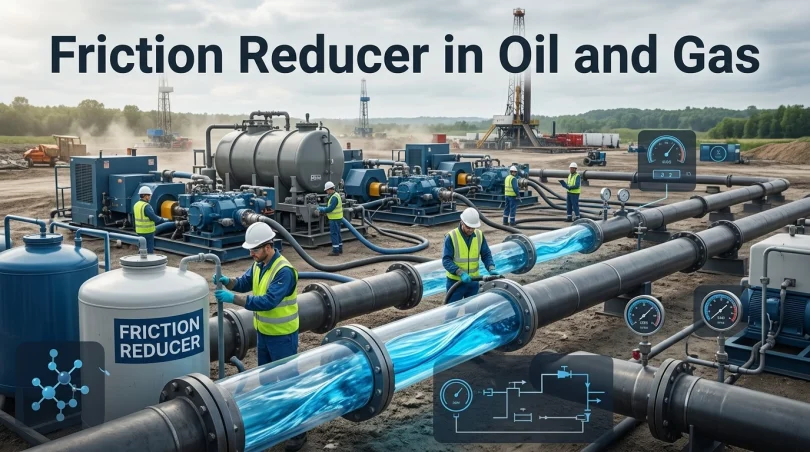

Friction reducer is a water-soluble polymer additive used in the oil and gas industry most commonly built on a polyacrylamide (PAM) base that gets blended into hydraulic fracturing fluids to cut friction-related pressure losses by 60% to 80% during high-rate pumping. This lets operators hit higher flow rates at lower surface treating pressures, which protects equipment and trims horsepower costs on location.
How It Works
Keeping the Job Smooth: Once the polymer is fully hydrated, treating pressure stays stable avoiding slowdowns or added costs during the job.
Cutting Friction: Shifts fluid flow inside pipes and wellbores from turbulent to laminar, reducing pressure loss during high-speed injection.
Saving on Power: Lowers the pump pressure needed for a given flow rate, bringing down horsepower expenses at the site.
Carrying Proppant: Keeps sand or ceramic proppant suspended in the fluid so it reaches evenly deep into rock fractures.
Protecting Equipment: Reduces wear on surface pumps and iron piping, extending their working life.
How a Friction Reducer Actually Cuts Drag
When water alone is pumped at the rates used in modern slickwater fracs, the flow inside the pipe turns turbulent. Turbulent flow eats horsepower because the fluid is constantly swirling against itself and against the pipe wall instead of moving in a straight line.
A friction reducer changes that. The long-chain polymer molecules stretch out in the flow and interrupt the small eddies that cause turbulence, nudging the flow regime closer to laminar. That interruption is what drives the drag reduction numbers mentioned earlier.
The catch is that “fully hydrated” part. A friction reducer that has not had time or shear to unwind and hydrate will not perform, no matter how good the chemistry is on paper. I have seen crews chase a “bad batch” of FR for hours when the real issue was inadequate mixing time at the blender.
Applications of Friction Reducers in Oil and Gas
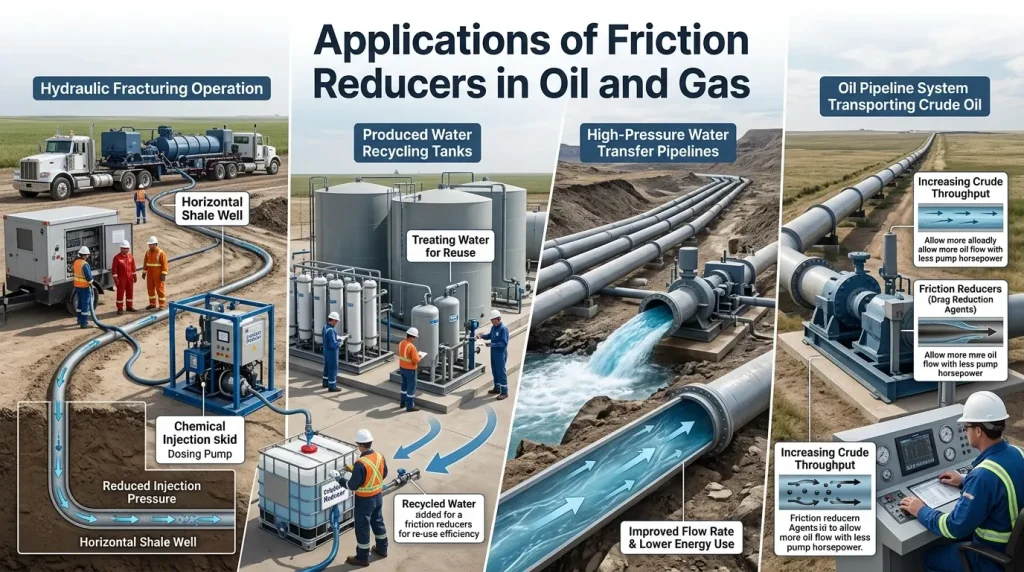
Friction reducers show up anywhere fluid needs to move fast through a wellbore without chewing up pump horsepower. The main applications include:
- Slickwater hydraulic fracturing: The single biggest use case, where FR is dosed into fresh, produced, or blended water to enable high-rate pumping through the frac string.
- Shale gas operations: Basins like the Marcellus, Haynesville, and Permian rely on friction reducers to make long-lateral, high-rate slickwater jobs economically viable.
- Horizontal wells: Longer laterals mean fluid travels further through casing and tubing, so friction management matters more than it does on shorter vertical completions.
- Unconventional reservoirs: Tight oil and shale plays with low permeability need high pump rates to create effective fracture networks, which is exactly the condition FR is built for.
- High-rate pumping and pipeline operations: Beyond fracturing, drag-reducing polymers are also used in crude oil pipelines and water transfer lines wherever turbulent flow is driving up pressure loss.
What Are Friction Reducers Made Of?
Most commercial friction reducers are built around a few core chemical components, and understanding them helps explain why performance varies between products.
- Polyacrylamide (PAM): The base polymer in the large majority of friction reducers, valued for its high molecular weight and strong water solubility.
- Anionic polymers: Many formulations use anionic or partially hydrolyzed polyacrylamide (HPAM) because the charge helps the polymer stretch out and interrupt turbulence more effectively.
- Hydrocarbon carrier fluids: Used in liquid inverse emulsion FR to suspend the polymer until it inverts and hydrates in water. Dry FR formulations skip this component entirely.
- Surfactants: Included to help the polymer disperse and invert quickly once it contacts water, reducing clumping or fish-eyeing.
- Crosslinking agents: Found in some high viscosity friction reducer (HVFR) systems, where a light crosslink structure adds viscosity for proppant transport without needing a separate gel package.
Types of Friction Reducers Used on Location
Not every friction reducer is built the same, and picking the wrong format for your water source or logistics setup is a common, avoidable mistake.
- Liquid inverse emulsion FR: The traditional workhorse. Polyacrylamide polymer suspended in a hydrocarbon carrier with a surfactant package. Inverts and hydrates quickly once it hits water, but the carrier oil adds cost, freight weight, and a spill risk that operators increasingly want to avoid.
- Dry (powder) FR: Solid polyacrylamide that eliminates the hydrocarbon carrier entirely. It cuts logistics weight and environmental footprint but needs proper hydration units on location since dry polymer can “fish-eye” (clump on the outside while staying dry inside) if it is dumped into water too fast.
- High viscosity friction reducers (HVFR): These do double duty, reducing friction while also adding enough viscosity to help carry proppant, which can reduce or eliminate the need for a separate gel system. They have gained ground fast in unconventional plays over the last several years because they simplify the fluid system on multi-well pads.
- Salt-tolerant and produced-water-compatible FR: Formulated to hold up in high-TDS water, which matters a lot if your operation is reusing produced or flowback water instead of sourcing fresh water for every stage.
Dry vs Liquid Friction Reducer: Quick Comparison
| Factor | Liquid Emulsion FR | Dry Powder FR |
|---|---|---|
| Hydration speed | Fast, minimal equipment needed | Slower, needs dedicated hydration unit |
| Logistics weight | Heavier (carries hydrocarbon oil) | Lighter, smaller footprint |
| Spill/environmental risk | Higher, petroleum distillate present | Lower, no oil carrier |
| Cold weather handling | Can gel or separate in freezing temps | Generally more stable in storage |
| Typical dosing | Slightly higher polymer active needed | Lower polymer loading for same result |
Friction Reducer Types: Which One Fits Your Job
| Type | Best For | Advantage | Limitation |
|---|---|---|---|
| Liquid FR | Fast-turnaround, single-well jobs | Quick hydration, minimal equipment | Higher transport cost and spill risk |
| Dry FR | Large, multi-well pad operations | Lower footprint, lighter freight | Needs a dedicated hydration unit |
| HVFR | Jobs needing proppant transport | Added viscosity, fewer chemical systems | Higher cost per treated barrel |
What Actually Drives Friction Reducer Selection on a Job
Engineers don’t pick a friction reducer off a spec sheet alone. A few things drive the real decision in the field.
Water chemistry comes first. High-salinity or produced water will knock down performance on a standard freshwater FR fast, which is why salt-tolerant chemistries exist. Run a bench test on your actual source water, not a generic freshwater sample, before you commit to a chemistry for a multi-well pad.
Temperature matters more than most people expect. Bottom hole temperature affects how long the polymer holds its drag-reducing shape before shear degradation sets in, especially on longer laterals where fluid spends more time in the wellbore.
Proppant carrying needs push some operators toward HVFR instead of running a separate linear or crosslinked gel system. It is one less chemical to truck in, store, and meter.
Regulatory and disclosure requirements in your basin can also narrow the field, since some operators are actively moving away from petroleum-distillate carriers for environmental and FracFocus disclosure reasons.
Common Field Problems and What Causes Them

Most friction reducer complaints trace back to a handful of root causes, not bad chemistry.
- Incomplete hydration: Not enough residence time or shear at the blender tub. Shows up as inconsistent pressure readings during the stage.
- Fish-eyeing of dry FR: Powder dumped too fast into the mix stream, forming clumped balls with dry cores. A properly calibrated dry hydration unit fixes this almost every time.
- Salt or produced water incompatibility: Performance drops off a cliff mid-stage as water source or blend ratio shifts. Confirm compatibility before the pad, not during it.
- Shear degradation: Excessive shear through pumps, chokes, or perforations can break the polymer chain and reduce effectiveness downhole, even if it worked fine at surface.
- Foaming: More common with certain surfactant packages in dry FR blends, usually solved with a small anti-foam addition or a surfactant reformulation from the supplier.
Environmental and Handling Notes Worth Knowing
Operators are under more pressure than they used to be to disclose chemical additives and reduce the footprint of frac fluid systems. That is a big part of why dry and produced-water-compatible friction reducers have gained market share: they cut hydrocarbon carrier volume, reduce freight trips, and lower spill exposure on a busy multi-well pad. If sustainability reporting or FracFocus disclosure is part of your operation’s requirements, ask your supplier for the full breakdown of carrier fluid and surfactant components up front rather than after the job is scheduled.
What to Look for in a Friction Reducer Supplier
A few practical questions separate a supplier who understands field operations from one who is just selling drums.
- Do they run bench compatibility testing on your actual source water before recommending a product?
- Can they support both dry and liquid formats depending on your logistics setup?
- Do they have field technical support available during the job, not just a data sheet?
- Can they document salt tolerance, temperature stability, and shear resistance with real test data, not marketing claims?
- Is their pricing based on active polymer content, so you are comparing apples to apples against competitors?
That last point trips up a lot of buyers. A cheaper drum price per gallon can still be more expensive per treated barrel if the active polymer concentration is lower.
Final Thoughts From the Field
Friction reducers look simple on a chemical data sheet, but the difference between a smooth stage and a frustrating one usually comes down to hydration, water compatibility, and matching the format to your actual logistics, not chasing the lowest price per drum. Test on your own water, ask suppliers for real performance data, and treat FR selection as an engineering decision, not a commodity purchase.
Frequently Asked Questions
What is a friction reducer used for in oil and gas?
It is added to fracturing fluid, mainly slickwater, to lower the pressure drop caused by high-velocity pumping, which protects equipment and allows higher pump rates.
How much friction reducer is typically used per barrel?
Dosing usually runs in the range of a few gallons per thousand gallons of fluid for liquid FR, though exact loading depends on water chemistry, temperature, and the specific polymer’s active concentration.
Is dry friction reducer better than liquid friction reducer?
Neither is universally better. Dry FR cuts logistics weight and environmental risk but needs proper hydration equipment on location, while liquid FR hydrates faster with simpler equipment but carries more freight weight and spill exposure.
Can friction reducers work in high-salinity or produced water?
Standard freshwater friction reducers often lose performance in high-TDS water. Salt-tolerant formulations are specifically designed to hold up in produced or flowback water reuse operations.
Do friction reducers affect proppant transport?
Standard low-viscosity FR does little for proppant transport on its own, which is why high viscosity friction reducers (HVFR) exist, since they combine drag reduction with enough viscosity to help carry sand.
What causes friction reducer to underperform on location?
The most common causes are incomplete hydration, shear degradation through pumps and perforations, water chemistry incompatibility, and improper mixing equipment calibration.
Are friction reducers hazardous or environmentally risky?
Liquid emulsion friction reducers typically contain a hydrocarbon carrier fluid, which carries some spill and disclosure considerations. Dry friction reducers eliminate that carrier and are generally viewed as a lower-footprint option.
How do I know if my water source is compatible with a specific friction reducer?
Run a bench-scale compatibility and drag reduction test using your actual source water before committing to a product for a multi-well pad, rather than relying on generic freshwater performance data.
You May Also Like It:
ZNOG Stock: Complete Investor Guide to Zion Oil & Gas (OTCMKTS: ZNOG)
Oil Smells Like Gas? 7 Causes, Warning Signs, and Fixes
Oil Well Packer: Complete Guide to Types, Functions, and Selection