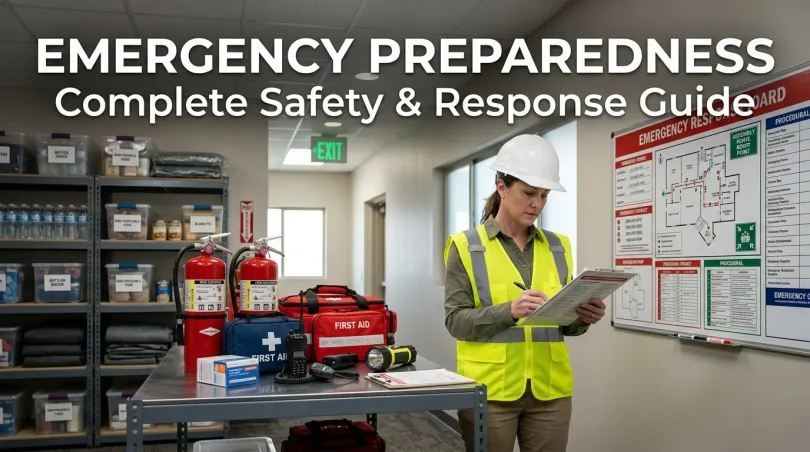

Emergency preparedness means having a tested plan, trained people, and the right supplies ready in advance, so that a home, workplace, or community can act fast and stay safe the moment a crisis begins.
How to Get Prepared: The Core Steps
- Know your risks first. Look at your location, building, and past incidents to figure out what you’re actually likely to face — a fire, a storm, a spill, a medical crisis — and plan around those, not generic worst cases.
- Put someone in charge. Decide ahead of time who leads during a crisis, who handles evacuation, who manages first aid, and who talks to outside responders. Confusion over authority wastes precious minutes.
- Build a notification system with backup. People need to find out something’s wrong immediately, through more than one channel — an alarm plus a phone alert plus a verbal chain, for example — in case one method fails.
- Mark the way out and the meeting spot. Everyone should know their exit route and where to gather afterward without needing to think about it, and there should be a clear rule for when to leave versus when to stay put.
- Keep the right gear on hand and know how to power down safely. Extinguishers, first-aid supplies, and safety devices only help if they’re stocked, working, and paired with a clear shutdown procedure for anything hazardous.
- Practice it before you need it. Real drills, not just paperwork, are what turn a plan into a reflex when an actual emergency hits.
Most people only think about emergency preparedness after something has already gone wrong — a fire alarm that no one took seriously, a flood that caught a warehouse off guard, or a medical emergency where nobody remembered where the first aid kit was kept. By then, it’s too late to plan. The entire point of preparedness is to do the thinking, training, and organizing before the emergency, so that when the actual event happens, your response is automatic rather than improvised.
This guide walks through what emergency preparedness and disaster preparedness really mean, why they matter for both individuals and organizations, how to build an emergency preparedness plan that actually works under pressure, what disaster relief safety measures look like in practice, and how to handle emergency situations step by step. It also covers emergency response procedures, practical emergency preparedness tips, and the basics of emergency management and crisis management — written to be usable whether you’re a homeowner, a safety officer, or a small business owner trying to get compliant.
What Is Emergency Preparedness?
Emergency preparedness is the set of actions, plans, and resources an individual, family, business, or community puts in place ahead of time so they can respond effectively when an unexpected, high-risk event occurs. It is not a single document sitting in a drawer — it’s a living system made up of risk assessments, written procedures, trained people, communication channels, and equipment that all work together the moment something goes wrong.
An emergency, in this context, is any situation that threatens the safety of people, damages property, or disrupts normal operations. That’s a broad definition on purpose, because the range of events that qualify is wide:
- Fires and explosions
- Floods, hurricanes, earthquakes, and severe weather
- Medical emergencies and workplace injuries
- Hazardous material spills or chemical releases
- Power outages and utility failures
- Structural collapses or equipment failures
- Workplace violence
- Public health emergencies, such as disease outbreaks
- Cyberattacks that disrupt critical systems
A workplace near a coastline plans differently than a warehouse in an earthquake zone or an office in a landlocked city with occasional winter storms. Preparedness only works when it’s built around the specific risks a person, site, or community is actually likely to face — a generic, copy-pasted plan rarely holds up when it’s tested for real.
Why Emergency Preparedness Matters
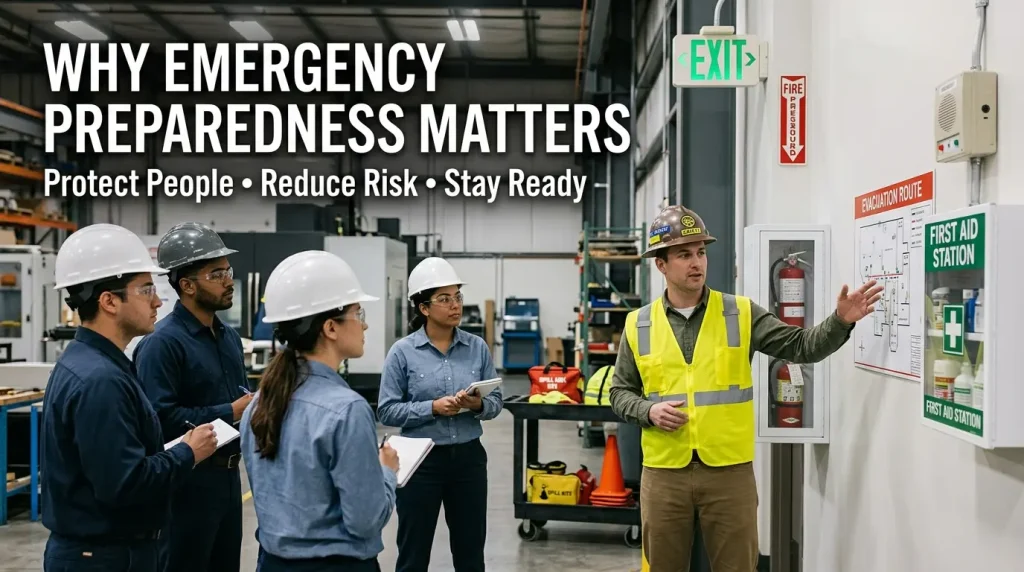
It’s tempting to treat preparedness as a compliance checkbox — something you do because a regulator requires it. But the real value shows up in the moments when things go wrong.
It saves lives. The single biggest factor in survival during a fire, chemical release, or medical emergency is how quickly the right action is taken. Preparedness turns that reaction time from minutes of confusion into seconds of trained response.
It limits damage and financial loss. Organizations that respond quickly to spills, fires, or structural issues contain the damage before it spreads. Delayed reactions almost always cost more — in repairs, downtime, and liability.
It keeps operations running. A disaster recovery plan tied to emergency preparedness means a company can shift to a backup location, restore systems, or resume partial operations instead of shutting down completely after a disruption. This is really where emergency management earns its keep — coordinating people, resources, and decisions so the business doesn’t stall.
It satisfies legal and regulatory obligations. In the United States, the Occupational Safety and Health Administration (OSHA) requires many employers to maintain a written emergency action plan, and similar workplace safety obligations exist under provincial and international frameworks such as ISO 45001. Falling short isn’t just a paperwork problem — it becomes a legal and financial liability.
It builds trust and confidence. Employees, families, and communities who know there’s a real plan in place tend to stay calmer during an actual emergency, which itself reduces panic-driven mistakes.
The Core Stages of Emergency Preparedness Planning
There’s more than one way to structure a plan, but a useful way to approach emergency preparedness planning is across four connected stages: prevent, prepare, respond, and recover. Different agencies, industries, and standards word this differently, and no single regulator owns this exact framing — but the underlying logic holds regardless of which terminology a particular standard uses. Skipping any one of these stages weakens the whole system.
1. Prevention
Prevention is about reducing the likelihood that an emergency happens in the first place. This includes following building codes, maintaining equipment, installing fire suppression systems, managing hazardous materials properly, and using monitoring or surveillance systems to catch problems early. Prevention doesn’t eliminate risk completely, but it shrinks the range of things you actually need to prepare for.
2. Preparation
Preparation is where the real planning work happens. It means identifying hazards, writing response procedures, training staff or family members, stocking emergency supplies, and forming relationships with local responders — fire departments, EMS, or emergency management agencies — before you ever need them. A plan that exists only on paper and has never been practiced is not real preparation.
3. Response
Response is what happens during the emergency itself: evacuating a building, administering first aid, containing a spill, shutting down equipment, or contacting emergency services. This stage is where preparation either pays off or falls apart. Speed and clarity matter more here than almost anywhere else — confusion about who’s in charge or what to do first can turn a manageable incident into a serious one.
4. Recovery
Recovery is the return to normal operations after the immediate danger has passed. It includes damage assessment, restoring systems, supporting affected employees or family members, and reviewing what happened so the plan can be improved. Recovery is often overlooked in planning, but it’s just as important as the response itself — it determines how quickly life or business gets back to normal.
How to Build an Emergency Preparedness Plan
Whether you’re planning for a household or an entire facility, the process follows a similar structure.
Step 1: Conduct a Risk Assessment
Start by identifying what could realistically go wrong. Look at your location, industry, building type, and history of past incidents. A coastal facility needs a hurricane plan; a manufacturing site needs a chemical spill and equipment failure plan; a family in an older home needs a fire and carbon monoxide plan. Rank each risk by likelihood and severity so you know where to focus first.
Step 2: Define Roles and a Command Structure
During an emergency, someone has to be in charge. Most organizational failures during real incidents aren’t technical — they’re about confusion over who makes decisions. Assign an incident commander, designate people responsible for evacuation, first aid, communication, and shutdown procedures, and make sure everyone knows the chain of command before an emergency, not during one.
Step 3: Write a Clear Emergency Evacuation Plan and Site-Specific Procedures
Generic instructions don’t hold up under stress. Your emergency evacuation plan and other emergency safety procedures should spell out, scenario by scenario, how to evacuate, where to muster, how to shut down machinery, how to contain a spill, and how to perform CPR or use an AED. These procedures need to be simple enough that someone can follow them while their hands are shaking.
Step 4: Build an Emergency Communication Plan
Decide in advance how people will be notified of an emergency and how you’ll communicate with outside responders like fire departments, EMS, or regulators. A solid emergency communication plan builds in redundancy — radios, phone trees, mass notification apps, or public address systems — because the first system you try often fails when you need it most.
Step 5: Stock the Right Equipment
Match your equipment to your actual risks: fire extinguishers, first aid kits, gas monitors, emergency lighting, evacuation chairs, water and food supplies, flashlights, and battery backups. Equipment without trained people to use it is nearly as useless as having no equipment at all.
Step 6: Train and Drill Regularly
A plan is only as good as the people executing it. Regular drills build muscle memory so that during a real event, people react instinctively instead of freezing or improvising. After every drill — or every real incident — debrief honestly and update the plan based on what actually happened.
Step 7: Review and Improve Continuously
Emergency plans go stale fast. New employees join, building layouts change, equipment gets replaced, and regulations evolve. Review the plan at least once a year, and always after a drill, a near-miss, or an actual emergency.
Emergency Preparedness Checklist
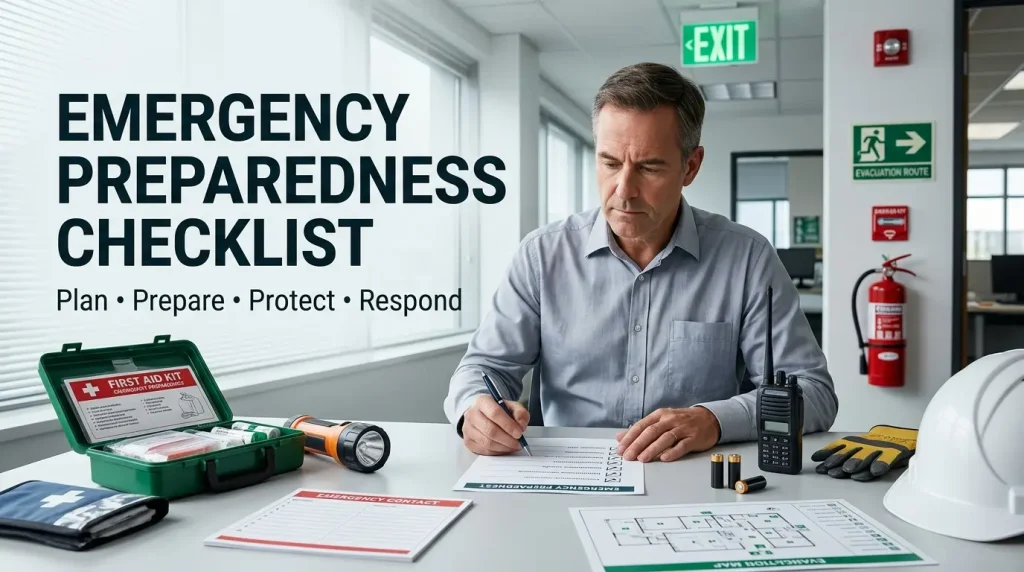
A written plan is only useful if you can tell, at a glance, what’s actually done and what’s still missing. Use this emergency preparedness checklist to track the essentials — for a workplace, a family, or a small business:
- [ ] Risk assessment completed and documented
- [ ] Emergency contacts (internal team and external services) recorded and shared
- [ ] Emergency evacuation routes mapped and clearly marked
- [ ] Emergency exits kept clear and accessible at all times
- [ ] First aid kit stocked, accessible, and checked regularly
- [ ] Fire extinguishers inspected and within their service date
- [ ] Emergency supplies stocked and rotated (water, food, batteries, etc.)
- [ ] Emergency communication plan tested — alarms, alerts, and phone trees
- [ ] Employees or family members trained on the plan
- [ ] Emergency drills completed and debriefed
- [ ] Emergency action plan reviewed and updated within the last 12 months
- [ ] Recovery procedures documented and assigned to specific people
Running through this list once a quarter — not just once a year — is what keeps an emergency preparedness plan from quietly going out of date.
Emergency Preparedness Kit: What Should You Include?
Every household, office, and vehicle should have some version of an emergency preparedness kit — a self-contained set of supplies that gets you through the first 72 hours without outside help. At minimum, an emergency supplies checklist should cover:
- Water — at least one gallon per person, per day, for three days minimum
- Non-perishable food — enough for three days, plus a manual can opener
- First aid supplies — bandages, antiseptic, gloves, and any personal medications
- Flashlights — one per person, never candles or open flames indoors
- Batteries — sized correctly for your flashlights and radio
- A battery-powered or hand-crank radio — for updates when the power and internet are both down
- Prescription medications — at least a week’s supply, rotated regularly
- Important documents — IDs, insurance papers, and medical information in a waterproof pouch
- Phone chargers or a power bank — fully charged and checked periodically
- A written list of emergency contacts — including an out-of-area contact
- Basic hygiene supplies — hand sanitizer, wipes, and any specific needs for infants, elderly family members, or pets
Keep the kit somewhere easy to grab on the way out, and check it every six months — food expires, batteries drain, and documents go out of date.
Disaster Relief Safety Measures
When a large-scale disaster hits — a hurricane, earthquake, flood, or wildfire — natural disaster preparedness and a well-rehearsed disaster response plan shift from paperwork into the thing that actually keeps people alive. These are the core disaster relief safety measures that matter most:
- Secure shelter first. Move to a safe, structurally sound location before addressing anything else. In floods and hurricanes, that often means higher ground; in earthquakes, it means clear, open space away from falling debris.
- Account for everyone. Take a headcount of family members, coworkers, or residents as soon as it’s safe to do so. Missing-person confusion wastes critical time during rescue operations.
- Avoid downed power lines and standing water. Both are common causes of secondary injuries and deaths after storms and floods.
- Use emergency supplies wisely. A basic disaster kit should include water (at least one gallon per person per day for several days), non-perishable food, a first aid kit, flashlights, batteries, a battery-powered or hand-crank radio, medications, and copies of important documents.
- Follow official evacuation and shelter-in-place orders. Local emergency management agencies issue these based on real-time hazard data — ignoring them is one of the leading causes of preventable injury during disasters.
- Watch for gas leaks and structural damage. After earthquakes or explosions, check for the smell of gas, visible cracks, or leaning structures before re-entering a building.
- Coordinate with relief organizations. Groups such as the Red Cross and local emergency management offices provide shelter, medical aid, and supplies — knowing where these resources are located ahead of time saves precious hours.
- Protect mental health, too. Disaster relief isn’t only physical. Psychological first aid — checking in on people, watching for signs of shock or trauma, and connecting people with support resources — is now a recognized part of comprehensive disaster response.
How to Handle Emergency Situations: A Step-by-Step Approach
When an emergency actually happens, most people default to one of two extremes — freezing up or acting impulsively without a plan. Neither works well. Here’s a practical sequence for handling almost any emergency situation:
- Stay calm and assess the situation. Panic slows down decision-making. Take a few seconds to understand what’s actually happening before reacting.
- Ensure your own safety first. You can’t help others if you become a second casualty. Move away from immediate danger before assisting anyone else.
- Alert others. Sound an alarm, shout a warning, or use whatever notification system is available so people nearby know something is wrong.
- Call for professional help. Contact emergency services immediately — don’t assume someone else already has.
- Follow the established plan. If a workplace or building has an emergency action plan, follow it. Head to designated exits, muster points, or shelter locations.
- Provide first aid if trained and safe to do so. Basic first aid — controlling bleeding, performing CPR, treating shock — can be the difference between life and death before professional help arrives.
- Avoid re-entering danger zones. Once you’re safe, stay safe. Going back into a burning building or flooded area to retrieve belongings is one of the most common causes of preventable deaths during emergencies.
- Wait for an official all-clear. Don’t return to a building or area until authorities or designated personnel confirm it’s safe.
- Debrief afterward. Once the immediate danger has passed, review what happened, what worked, and what didn’t — this feeds directly back into improving the plan for next time.
Emergency Response and Emergency Response Procedures
Emergency response refers to the immediate actions taken during an incident to protect people, limit damage, and stabilize the situation. Emergency response procedures are the specific, written instructions that guide that response for each type of scenario. Together, they form the operational core of any preparedness plan.
A well-built set of emergency response procedures typically includes:
- Emergency evacuation procedures — clearly marked exit routes, designated assembly points, and a process for accounting for everyone once outside.
- Shelter-in-place procedures — used when leaving the building is more dangerous than staying, such as during certain chemical releases or severe weather.
- Medical response procedures — who administers first aid, where supplies are kept, and how to escalate to professional medical care.
- Fire response procedures — how to use extinguishers, when to evacuate versus fight a small fire, and how to notify the fire department.
- Hazardous materials procedures — containment steps, protective equipment requirements, and notification protocols for spills or leaks.
- Communication procedures — internal notification chains and external contact with emergency services, regulators, or media if needed.
- Shutdown procedures — how to safely power down machinery, equipment, or systems during an evacuation.
The difference between a plan that works and one that fails almost always comes down to specificity. “Evacuate the building” is not a procedure — it’s a goal. A real procedure names the exit routes, the assembly point, who checks the restrooms and back offices, and who has the authority to call an official all-clear.
Emergency Preparedness by Setting
For Workplaces and Businesses
Employers carry legal responsibility for worker safety during emergencies. This means having a written emergency action plan, training every employee (not just safety officers), keeping equipment accessible and functional, and coordinating with local fire and emergency services. Regulatory bodies like OSHA expect documented procedures, accessible plans at the worksite, and evidence of regular training — not just a binder that nobody has read.
For Families and Households
Household preparedness is often underestimated. Every family should have a basic emergency kit, an evacuation plan for fire or natural disaster, a designated meeting point outside the home, an out-of-area contact person in case local phone lines are overwhelmed, and a clear understanding of how to shut off gas, water, and electricity if needed.
For Communities
Community-level preparedness relies on coordination between local government, emergency services, hospitals, schools, and residents. Early warning systems, public shelters, mutual aid agreements between neighboring jurisdictions, and clear public communication channels are what allow a community to respond as a unit rather than as scattered individuals.
Common Mistakes That Undermine Emergency Preparedness
Even organizations that invest heavily in planning often fall short in practice. The most frequent failure points include:
- Using generic, templated plans instead of ones built around actual site-specific risks.
- Unclear roles during escalation, leaving people unsure who has decision-making authority.
- Communication breakdowns, especially reliance on a single channel that fails under stress.
- Equipment without trained personnel, which is functionally the same as having no equipment at all.
- Plans that are never drilled, so the first real test of the plan happens during an actual emergency.
- No post-incident review, meaning the same mistakes repeat because nobody learned from the last one.
The gap between having a plan and having a plan that works almost always comes down to practice, clarity, and honest review — not the amount of paperwork involved.
Frequently Asked Questions
What are disaster relief safety measures?
Disaster relief safety measures are the practical actions taken to protect life and reduce harm during and after a large-scale disaster — securing shelter, accounting for people, avoiding hazards like downed power lines or floodwater, using emergency supplies responsibly, following official evacuation orders, and coordinating with relief organizations for medical aid and resources.
How do you handle emergency situations effectively?
Stay calm, ensure your own safety first, alert others, call for professional help, follow the established emergency plan, provide first aid if trained, avoid re-entering danger zones, and wait for an official all-clear before resuming normal activity.
What’s the difference between emergency response and emergency preparedness?
Emergency preparedness is everything done before an incident — planning, training, stocking supplies. Emergency response is what happens during the incident itself, guided by the procedures built during preparedness.
How often should an emergency preparedness plan be updated?
At minimum, once a year, and always after a drill, a near-miss, a real incident, or any significant change to a building, staff, or operations.
Final Thoughts
Emergency preparedness isn’t about predicting exactly what will go wrong — it’s about building a system flexible and well-practiced enough to handle whatever does. The organizations and families that come through emergencies with the least damage aren’t the ones who got lucky. They’re the ones who took the time, before anything happened, to identify their risks, write real procedures, train their people, and test the plan until it became second nature.
The first five to ten minutes of any emergency almost always determine the outcome — how much is lost, how many people are hurt, and how quickly things return to normal. Emergency preparedness is simply the work of making sure that when those minutes arrive, you’re not figuring things out for the first time.
You May Also Like It:
Industrial Robot Safety: The Complete 2026 Guide for Facilities, Engineers & Safety Managers
Safety Topics: Guide to OSHA Safety Topics, Toolbox Talks, and Meeting Ideas
Industrial Safety Signs: The Complete Guide to Types, Meanings, Colors, and Standards
Safety Equipment Supplier: The Complete Buyer’s Guide for US Businesses