

Introduction
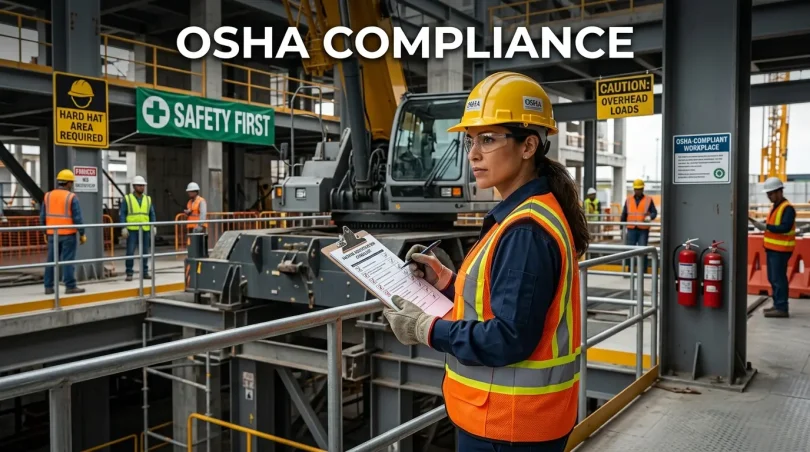
OSHA compliance means meeting the workplace safety and health standards set by the Occupational Safety and Health Administration, a U.S. federal agency created in 1970 to protect employees from job-related injuries, illnesses, and deaths. It requires employers to identify hazards, provide proper training and protective equipment, keep accurate safety records, and maintain a work environment free of recognized dangers.
If you run a business where people work — an office, a factory floor, or a construction site — workplace safety isn’t optional. This guide breaks down what OSHA compliance actually involves, a practical compliance checklist, current penalty amounts, and how businesses can stay inspection-ready.
What Is OSHA Compliance?
OSHA compliance means meeting the safety and health standards set by the Occupational Safety and Health Administration to protect workers from job-related injuries, illnesses, and fatalities. These standards cover hazardous materials handling, machine guarding, electrical safety, ergonomics, fire prevention, and emergency preparedness.
Compliance isn’t a one-time checklist item — it’s an ongoing responsibility built around OSHA’s General Duty Clause, which requires every employer to provide a workplace “free from recognized hazards that are causing or are likely to cause death or serious physical harm.” Beyond this general clause, OSHA maintains detailed standards under 29 CFR 1910 (general industry) and 29 CFR 1926 (construction).
It’s also worth knowing that OSHA compliance isn’t always purely federal. States such as California, Michigan, Washington, and 20+ others run their own OSHA-approved State Plans. These state programs must be at least as effective as federal OSHA, but they can include different or more stringent requirements and penalty policies. Businesses operating in these states need to check both federal and state-level rules.
Why OSHA Compliance Is Important
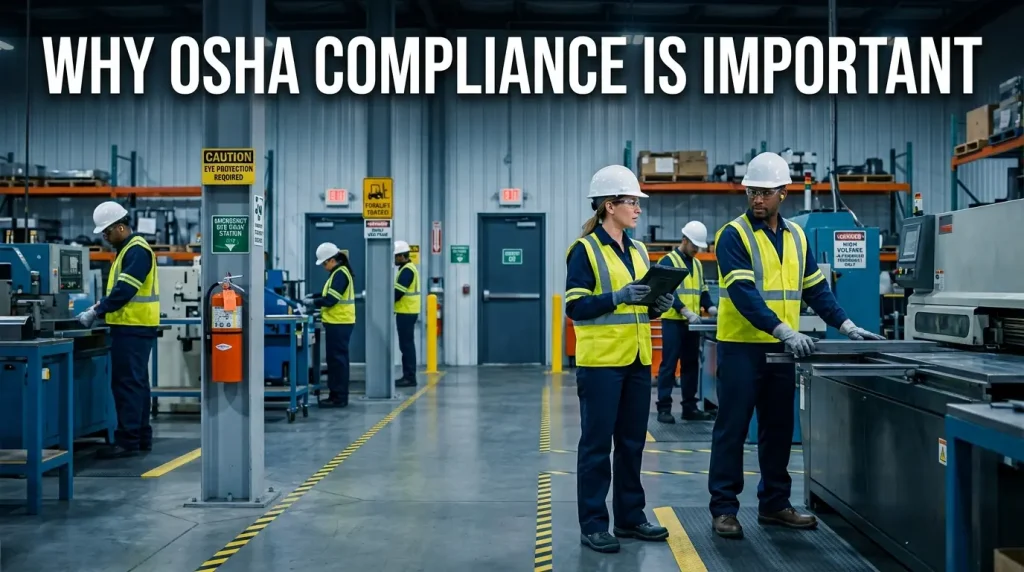
- Protecting human lives — the most fundamental reason for every rule OSHA enforces.
- Avoiding legal and financial penalties — non-compliance can mean steep fines and legal liability.
- Reducing costs — accidents drive up medical expenses, workers’ comp claims, lost productivity, and insurance premiums.
- Improving employee morale and retention — workers stay engaged when they feel genuinely safe.
- Protecting business reputation — a poor safety record damages client trust and can cost future contracts.
Key OSHA Requirements
Most businesses, regardless of industry, need to address these core compliance areas:
- General Duty Clause — a baseline obligation to eliminate recognized hazards.
- Hazard Communication Standard (HazCom) — proper labeling, Safety Data Sheets (SDS), and employee training for hazardous chemicals.
- OSHA Recordkeeping (Forms 300, 300A, and 301) — many employers with 10 or more employees must maintain records of qualifying work-related injuries and illnesses, subject to certain exemptions. Certain establishments must also electronically submit injury and illness data to OSHA based on employee count and industry classification.
- Emergency Action Plans, where required — procedures for reporting emergencies, evacuation, employee accountability, and other applicable emergency-response measures.
- Industry-specific standards — additional rules for construction, manufacturing, healthcare, agriculture, and other higher-risk sectors.
Workplace Hazard Identification
Identifying hazards before they cause harm is at the core of OSHA compliance. Common hazard categories include:
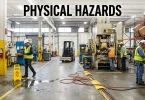
- Physical hazards — noise, temperature extremes, radiation, unguarded machinery
- Chemical hazards — toxic substance exposure, fumes, flammable materials
- Biological hazards — bacteria, viruses, mold, bloodborne pathogens
- Ergonomic hazards — repetitive strain, poor workstation design, improper lifting
- Safety hazards — slips, trips, falls, electrical hazards, fire risks
Regular workplace inspections, Job Hazard Analyses (JHAs), and open employee feedback channels help catch hazards early — before OSHA does.
Personal Protective Equipment (PPE)
When hazards can’t be eliminated through engineering or administrative controls, PPE becomes the last line of defense. OSHA requires employers to:
- Conduct a hazard assessment to determine what PPE is necessary
- Provide most required PPE at no cost to employees
- Train workers on proper use, maintenance, and limitations of PPE
- Ensure PPE fits correctly and is inspected regularly for wear or damage
Common PPE includes hard hats, safety goggles, gloves, hearing protection, respirators, and high-visibility clothing — exact requirements depend on the hazards present at each site. Employers should also ensure that PPE is appropriate for the identified hazard, properly fitted, well maintained, and used by employees who have been trained on it.
Employee Safety Training
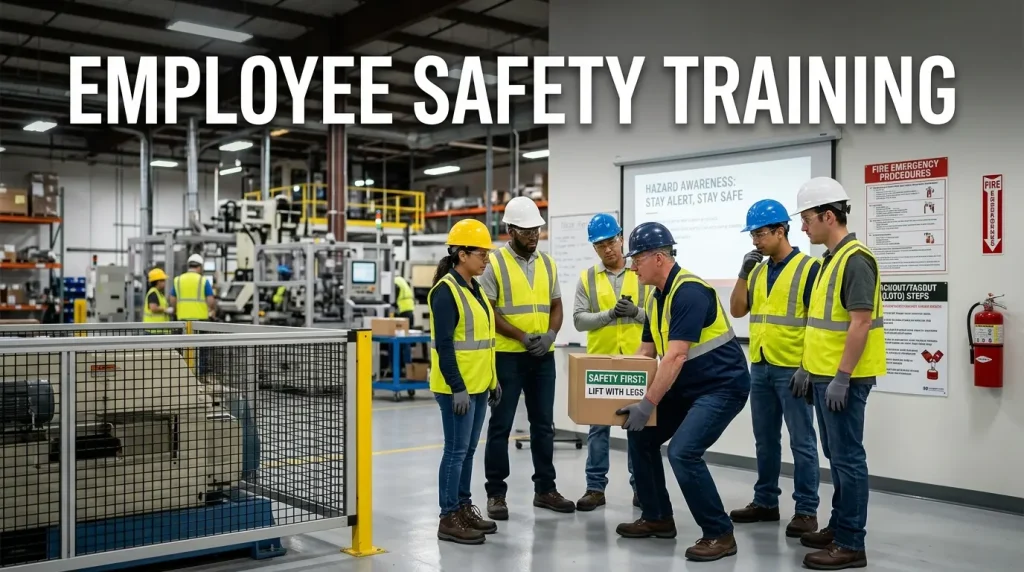
Employee training is a critical part of OSHA compliance, particularly when OSHA standards require workers to be trained on specific hazards, equipment, procedures, or protective measures. Key components include:
- Onboarding safety orientation for every new hire
- Job-specific training tailored to equipment, chemicals, or tasks involved
- OSHA-required training and, where applicable, OSHA 10-Hour or 30-Hour Outreach courses for general industry and construction workers
- Refresher training on a regular schedule or after any incident/near-miss
- Documentation of all sessions, attendees, and content covered
It’s worth noting that OSHA 10-Hour and 30-Hour Outreach courses are generally voluntary and shouldn’t be confused with training that’s specifically mandated by OSHA standards. That said, some states, employers, unions, or other organizations may require them as a condition of employment.
Well-trained employees are far less likely to be involved in accidents — and thorough documentation protects the business during an OSHA inspection.
OSHA Inspections & Penalties (Updated 2025–2026 Figures)
OSHA generally prioritizes inspections involving imminent danger, severe injuries and illnesses, worker complaints and referrals, and targeted high-hazard workplaces and programs.
OSHA’s civil penalty amounts are adjusted annually for inflation. As of the most recent federal adjustment (effective January 2025):
| Violation Type | Maximum Penalty |
|---|---|
| Serious / Other-Than-Serious / Posting Requirements | $16,550 per violation |
| Failure to Abate | $16,550 per day beyond the abatement date |
| Willful or Repeated | $165,514 per violation |
State Plan states may have different or more stringent safety and health requirements and may use different penalty policies; their programs must be at least as effective as the federal OSHA program — so always verify local numbers if you operate in a State Plan jurisdiction.
Violation categories:
- Other-than-serious — minor infractions with limited penalty
- Serious — a hazard that could realistically cause death or serious harm
- Willful — intentional or reckless disregard for safety standards, carrying the steepest fines
- Repeat — substantially higher penalties for recurring violations
Beyond fines, non-compliance can trigger shutdowns, lawsuits, and lasting reputational damage.
How Businesses Can Maintain OSHA Compliance (Checklist)
- Appoint a safety officer or compliance team to own OSHA compliance ongoing
- Conduct regular self-audits using OSHA’s self-inspection checklists to catch issues before an inspector does
- Keep detailed records — training logs, incident reports, OSHA 300/300A/301 forms
- Stay current on standard updates relevant to your industry and state
- Build a genuine safety culture where employees can report hazards without fear of retaliation
- Use OSHA’s free On-Site Consultation Program — available to small businesses at no cost and separate from enforcement
- Partner with safety consultants for high-risk or complex operations
Frequently Asked Questions
Q: Does OSHA apply to small businesses?
Yes. Most private-sector employers are covered, though some recordkeeping requirements only apply once a business reaches 10 or more employees. OSHA also offers a free, confidential On-Site Consultation Program specifically for small businesses.
Q: How often does OSHA update its penalty amounts?
Penalties are adjusted annually for inflation, typically effective in mid-January, under the Federal Civil Penalties Inflation Adjustment Act.
Q: What’s the difference between federal OSHA and a State Plan?
State Plans are OSHA-approved programs run by individual states (e.g., California, Michigan, Washington) that must be at least as effective as federal OSHA, though they can include additional requirements specific to that state.
Q: What triggers an OSHA inspection?
Imminent danger situations, reports of severe injuries or fatalities, employee complaints, referrals from other agencies, and targeted programs for high-hazard industries.
Conclusion
OSHA compliance is much more than avoiding fines — it’s about creating a workplace where employees can do their jobs without fear of injury or illness. By understanding key requirements, identifying hazards early, investing in proper PPE and training, and building a genuine culture of safety, businesses can protect their people, their reputation, and their bottom line. Compliance isn’t a destination — it’s a continuous commitment to doing right by the people who show up to work every day.
You May Also Like It:
Industrial Robot Safety: The Complete 2026 Guide for Facilities, Engineers & Safety Managers
Safety Topics: Guide to OSHA Safety Topics, Toolbox Talks, and Meeting Ideas
Industrial Safety Signs: The Complete Guide to Types, Meanings, Colors, and Standards
Safety Equipment Supplier: The Complete Buyer’s Guide for US Businesses

[…] minimum guidance (HSE or OSHA […]
[…] or hospital in near proximity; construction has its own related provisions under 29 CFR 1926. OSHA generally doesn’t prescribe exact kit contents, so most US employers reference the ANSI/ISEA […]