
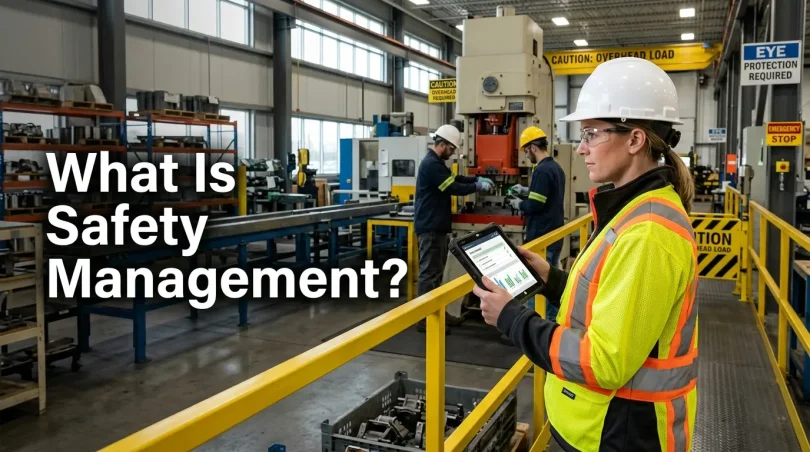

Safety management is the process organizations use to identify hazards, assess risks, and implement controls to prevent workplace injuries and incidents. It’s typically run through a Safety Management System (SMS) a structured framework combining policies, procedures, training, and monitoring, guided by standards like OSHA (US) and ISO 45001 (international).
Key elements of a Safety Management System:
- Hazard identification – spotting risks before they cause harm
- Risk assessment – evaluating likelihood and severity
- Controls – engineering, administrative, or PPE-based measures
- Training – ensuring workers understand procedures
- Monitoring & review – tracking performance and incidents
- Continuous improvement – plan → act → check → improve (PDCA cycle)
Safety management isn’t a one-time checklist it’s an ongoing cycle that keeps improving as new hazards emerge.
Understanding Safety Management
Safety management is the organized approach a company takes to protect its workers from harm while they carry out their jobs. It goes beyond posting a few warning signs or handing out protective gear. At its core, safety management is a system, a set of connected processes that work together to spot hazards before they cause harm, reduce the risk when a hazard cannot be eliminated, and respond effectively when something does go wrong.
A safety management system typically includes:
- A written safety policy that states the organization’s commitment
- Hazard identification and risk assessment processes
- Documented safety procedures for specific tasks
- Training programs for employees and supervisors
- Incident reporting and investigation processes
- Regular audits and performance reviews
- A structure for continuous improvement
The goal is simple even if the execution is not: reduce the likelihood of injury, illness, or death connected to work, while also protecting equipment, property, and business continuity.
What Is Workplace Safety?
Workplace safety refers to the actual conditions, behaviors, and outcomes that safety management is designed to produce. In other words, safety management is the system, and workplace safety is the result that system is trying to achieve.
Workplace safety covers everything from the physical environment, such as machinery guards and proper lighting, to the behavioral side, such as whether workers follow safe procedures and speak up about hazards. It applies to every kind of work environment, including offices, factories, construction sites, hospitals, warehouses, and remote job sites.
A genuinely safe workplace is one where:
- Hazards are identified before they cause harm
- Workers are trained on how to do their jobs safely
- The right equipment and controls are available and used correctly
- Incidents and near misses are reported and investigated, not ignored
- Safety is treated as a shared responsibility, not just a rule imposed from above
What Is Safety in the Workplace?
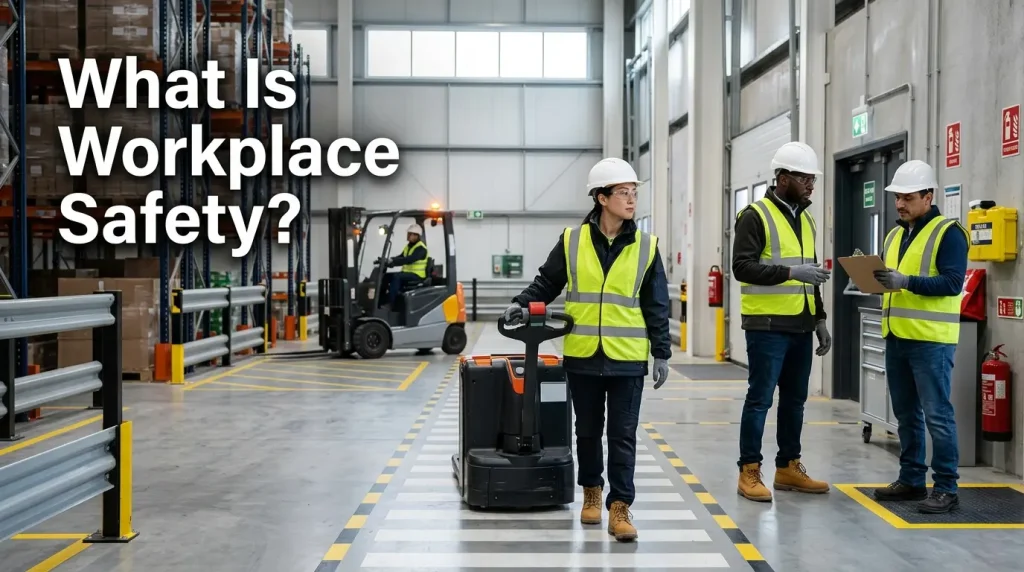
This question is closely related to workplace safety, but it is worth answering directly since people search for it in slightly different ways. Safety in the workplace means the day-to-day state of being protected from the specific hazards present in a particular job or environment.
For a construction worker, safety in the workplace might mean wearing fall protection at height and following lockout procedures around machinery. For an office employee, it might mean proper ergonomic setup and clear emergency evacuation routes. For a healthcare worker, it could mean following infection control protocols and using PPE correctly.
The hazards look different across industries, but the underlying idea is the same. Safety in the workplace is achieved when the risks specific to a job have been identified and reduced to an acceptable level through a combination of controls, training, and consistent practice.
Why Safety Management Matters
Safety management is not just a compliance requirement. It has a direct effect on people, operations, and the long-term health of an organization.
- It prevents injuries and saves lives. Every year, millions of workers are injured on the job, and a well-run safety management system directly reduces that number.
- It reduces financial and legal risk. Workplace incidents lead to medical costs, lost productivity, regulatory fines, and sometimes litigation. Preventing incidents is almost always cheaper than dealing with the aftermath.
- It improves operational efficiency. Fewer injuries mean fewer disruptions, less downtime, and more consistent output.
- It builds trust and morale. Employees who see safety taken seriously tend to be more engaged, more loyal, and more willing to speak up about problems before they become incidents.
- It protects an organization’s reputation. A poor safety record can damage relationships with clients, partners, and the public, while a strong one can become a genuine competitive advantage.
Key Elements of a Safety Management System
Different frameworks describe the components of a safety management system slightly differently, but most cover the same core areas.
| Element | What It Involves |
|---|---|
| Policy and leadership commitment | A documented commitment from management that safety is a genuine priority, not just paperwork |
| Hazard identification and risk assessment | Systematically identifying what could cause harm and evaluating how serious the risk is |
| Safety procedures | Step-by-step instructions for carrying out specific tasks safely |
| Training and competency | Ensuring workers understand hazards and know how to work safely before they begin a task |
| Incident reporting and investigation | Capturing what happened after an incident or near miss, and identifying the root cause |
| Emergency preparedness | Plans and drills for fires, chemical spills, medical emergencies, and other urgent situations |
| Monitoring and auditing | Regular checks to confirm that controls are working as intended |
| Continuous improvement | Using data from audits, incidents, and worker feedback to keep improving the system over time |
Safety Management vs Workplace Safety vs Safety Culture
These three terms are often used interchangeably, but they describe different layers of the same overall effort.
- Safety management is the system: the policies, procedures, and processes an organization puts in place.
- Workplace safety is the outcome: the actual level of protection workers experience day to day.
- Safety culture is the mindset: the shared attitudes, values, and behaviors around safety that exist within a team, whether or not anyone is watching.
A useful way to see the difference is through a simple example. A company can have a well-documented safety management system on paper, but if workers regularly skip steps because supervisors do not enforce them, workplace safety suffers and the safety culture is weak. The strongest organizations align all three: a solid system, consistent real-world safety, and a culture where people genuinely care about looking out for one another.
How Does a Safety Management System Work?
A safety management system works by following a repeating cycle rather than a single fixed process. Most frameworks, including ISO 45001, are built around the Plan-Do-Check-Act model.
- Plan. Identify hazards, assess risks, and set clear safety objectives.
- Do. Implement controls, train workers, and put safety procedures into practice.
- Check. Monitor performance through inspections, audits, and incident data.
- Act. Use what is learned to correct problems and improve the system going forward.
This cycle never really stops. New equipment gets introduced, processes change, and new hazards appear over time, so the system has to keep adapting rather than being treated as something that is finished once and left alone.
Safety Procedures: What They Are and Why They Matter
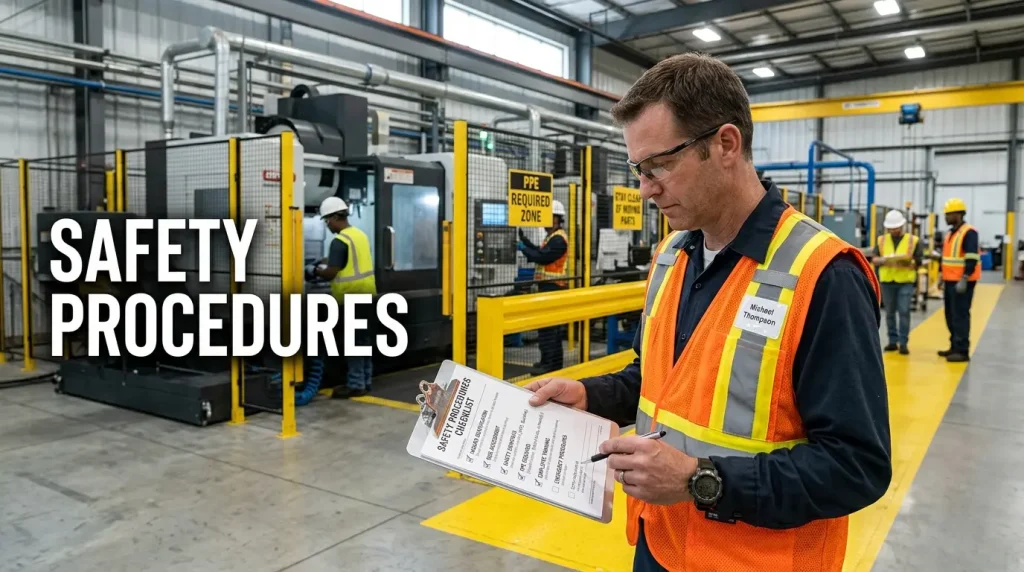
Safety procedures are the step-by-step instructions that tell workers exactly how to complete a specific task safely. If safety management is the overall system, safety procedures are one of its most practical, hands-on components, since they are what a worker actually reads or follows before starting a hazardous task.
A good safety procedure typically includes:
- The name of the task and who it applies to
- The hazards associated with that specific task
- The PPE or equipment required
- A clear, numbered sequence of steps
- What to do if something goes wrong during the task
Example of a Basic Safety Procedure Structure
| Step | What Happens |
|---|---|
| 1. Identify the task | Define exactly what job the procedure covers, such as “changing a machine blade” |
| 2. List the hazards | Identify what could cause harm during this task, such as pinch points or electrical risk |
| 3. Define the controls | State what must be done to reduce the risk, such as lockout/tagout before starting |
| 4. Write the steps | Break the task into short, ordered steps using simple, direct language |
| 5. Review and train | Have an experienced worker or supervisor test the procedure, then train the team on it |
Not every task in a workplace needs a written procedure. Low-risk, routine activities may only need verbal instruction during training. But any task where a mistake could lead to serious injury, such as working at height, handling hazardous chemicals, or operating heavy machinery, should have a clear, written safety procedure that workers can refer back to.
Steps to Build an Effective Safety Management System
- Get leadership commitment first. A safety management system will not work if management treats it as a formality rather than a genuine priority.
- Conduct a hazard and risk assessment. Understand what could go wrong before writing a single policy or procedure.
- Write clear policies and procedures. Keep the language simple and specific to actual tasks, not vague generalities.
- Train every worker properly. Training should be hands-on wherever possible, not just a slide deck or a signature on a form.
- Set up incident reporting. Make it easy and non-punitive for workers to report hazards, near misses, and incidents.
- Monitor performance regularly. Use inspections, audits, and safety metrics to see whether the system is actually working.
- Review and improve continuously. Update procedures and controls whenever hazards, equipment, or regulations change.
Safety Management Standards and Regulations
In the United States, workplace safety is primarily regulated by OSHA, the Occupational Safety and Health Administration, under Title 29 of the Code of Federal Regulations. OSHA sets legally enforceable requirements for hazard communication, PPE, recordkeeping, and specific industry standards, and it also publishes voluntary Recommended Practices for building a safety and health program, structured around core elements such as management leadership, worker participation, hazard identification, and program evaluation.
Internationally, the most widely recognized framework is ISO 45001, a standard for occupational health and safety management systems. It is built around the Plan-Do-Check-Act cycle and emphasizes leadership commitment, worker participation, and continual improvement. Unlike OSHA regulations, ISO 45001 is a voluntary, certifiable standard that organizations can adopt anywhere in the world, and many companies use it alongside local regulatory requirements rather than as a replacement for them.
Other relevant frameworks include ANSI/ASSP Z10, an American standard for occupational health and safety management systems, and OSHA’s Voluntary Protection Programs, which recognize employers with strong, well-documented safety performance. These frameworks are not interchangeable with one another, but they often overlap and can be used together to strengthen an organization’s overall approach.
Common Workplace Hazard Categories
Effective safety management starts with understanding the types of hazards a workplace might face. These are generally grouped into five categories:
- Physical hazards – noise, extreme temperatures, radiation, or moving machinery
- Chemical hazards – exposure to toxic, flammable, or corrosive substances
- Biological hazards – exposure to bacteria, viruses, or other infectious agents
- Ergonomic hazards – repetitive motion, poor posture, or improper lifting
- Psychosocial hazards – workplace stress, harassment, fatigue, or excessive workload
A thorough safety management system addresses all five, not just the physical and chemical hazards that tend to get the most attention.
Safety Management Best Practices
- Involve workers directly in hazard identification, since they often notice risks that management does not see.
- Keep safety procedures written in plain, direct language rather than dense technical jargon.
- Investigate near misses with the same seriousness as actual incidents, since they reveal the same underlying risks before someone gets hurt.
- Review and update procedures whenever new equipment, processes, or regulations are introduced.
- Track leading indicators, such as completed inspections and training rates, not just lagging indicators like injury counts.
- Make reporting hazards or near misses simple and free of blame, so problems surface early.
Challenges and Limitations of Safety Management
Even a well-designed safety management system has limits, and understanding them helps set realistic expectations.
- A system on paper does not guarantee real-world safety. Written policies only work if they are actually followed on the floor.
- Culture is harder to build than documentation. A strong safety culture takes consistent leadership and time, and it can erode quickly if safety is deprioritized under pressure.
- New hazards can outpace old procedures. New equipment, materials, or processes can introduce risks that existing procedures do not yet address.
- Over-reliance on PPE instead of stronger controls. Some organizations lean too heavily on personal protective equipment instead of eliminating or engineering out the hazard first.
- Reporting gaps hide real risk. If workers fear blame for reporting incidents or near misses, the data used to improve the system becomes incomplete.
Frequently Asked Questions
What is the main goal of safety management?
The main goal is to prevent workplace injuries, illnesses, and incidents by identifying hazards and putting effective controls in place before harm occurs.
What is the difference between safety management and workplace safety?
Safety management refers to the system of policies, procedures, and processes an organization builds. Workplace safety refers to the actual outcome, the real level of protection workers experience because of that system.
What is a safety management system?
A safety management system, often shortened to SMS, is the structured combination of policies, hazard assessments, procedures, training, and monitoring processes an organization uses to manage workplace risk.
Who is responsible for safety management in a company?
Ultimate responsibility usually sits with senior leadership and management, since they set policy and allocate resources, but effective safety management depends on participation from supervisors and every individual worker.
What are safety procedures?
Safety procedures are step-by-step written instructions that explain how to perform a specific task safely, including the hazards involved and the controls required.
Do all workplace tasks need a written safety procedure?
No. Low-risk, routine tasks may only need verbal training. Tasks with a real potential for serious injury, such as working at height or handling hazardous chemicals, should always have a written procedure.
What is the difference between a safety policy and a safety procedure?
A safety policy is a high-level statement of an organization’s commitment and expectations around safety. A safety procedure is the specific, step-by-step guidance for carrying out an individual task safely.
What is ISO 45001?
ISO 45001 is an international standard for occupational health and safety management systems. It provides a voluntary framework organizations can use, or become certified against, to manage workplace safety risks systematically.
How often should a safety management system be reviewed?
Most organizations review their safety management system at least once a year, and additionally whenever there is a significant incident, a change in regulations, or the introduction of new equipment or processes.
What is workplace safety culture?
Workplace safety culture refers to the shared attitudes, values, and everyday behaviors around safety within a team or organization, reflecting how seriously people actually treat safety when no one is specifically enforcing it.
Final Thoughts
Safety management brings structure to what could otherwise be a patchwork of good intentions. It connects policy, hazard assessment, safety procedures, training, and ongoing review into a single system built to protect people, not just satisfy a checklist. Understanding what safety management is, what workplace safety actually looks like day to day, and how safety procedures translate policy into practice gives any organization a stronger foundation for keeping its people genuinely safe.
You May Also Like It:
Industrial Robot Safety: The Complete 2026 Guide for Facilities, Engineers & Safety Managers
Safety Topics: Guide to OSHA Safety Topics, Toolbox Talks, and Meeting Ideas
Industrial Safety Signs: The Complete Guide to Types, Meanings, Colors, and Standards
Safety Equipment Supplier: The Complete Buyer’s Guide for US Businesses






[…] and process industries layer process safety management on top of general standards. A single missed valve inspection carries catastrophic-event risk, not […]