
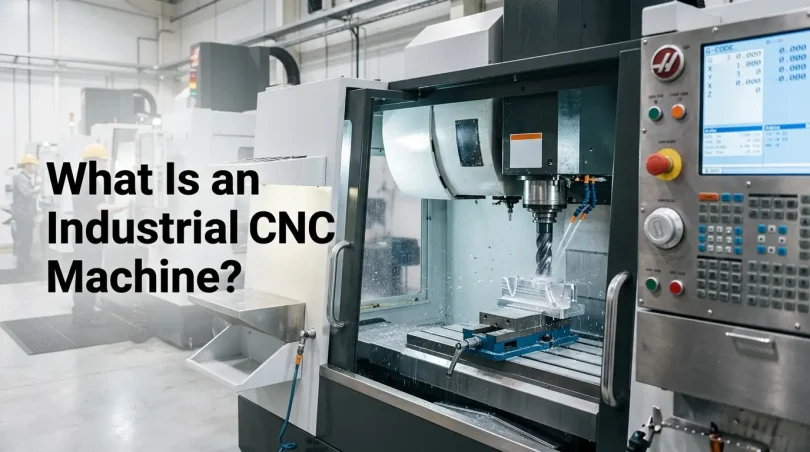

An industrial CNC machine is a computer-controlled machine tool built for heavy-duty, high-volume manufacturing. CNC stands for Computer Numerical Control, meaning a computer directs the exact movement of cutting tools using pre-programmed digital instructions instead of a human operator moving them by hand. Industrial CNC machines, including routers, mills, and lathes, are used to cut, shape, drill, engrave, or carve materials such as wood, metal, plastic, and composites with high precision and repeatability. They are the backbone of modern manufacturing across industries like furniture, signage, aerospace, and metal fabrication.
Understand About Industrial CNC Machine
An industrial CNC machine is a heavy-duty version of a computer numerical control machine, built specifically for continuous, high-volume production rather than occasional or hobbyist use. While a desktop CNC machine might be used by a hobbyist to carve small wooden signs on weekends, an industrial CNC machine is designed to run for long shifts, handle tougher materials, and hold tighter tolerances over thousands of repeated cuts.
At its core, a CNC machine works by following digital instructions, usually generated from a CAD design and converted into G-code, which tells the machine exactly where to move, how fast, and what tool to use at each step. Industrial versions of these machines are built with heavier frames, more powerful motors, and more rigid components so they can maintain accuracy even under constant, demanding use.
Industrial CNC machines generally fall into a few main categories:
- CNC routers – used mainly for cutting, engraving, and shaping flat or 3D materials like wood, acrylic, and composites
- CNC mills – used for precision milling of metal and other rigid materials, often for parts with tight tolerances
- CNC lathes – used to shape cylindrical parts by rotating the material against a cutting tool
- CNC plasma and laser cutters – used for cutting metal sheets using a plasma torch or laser beam instead of a physical bit
Each type serves a different purpose, but they all share the same underlying principle: a computer, not a human hand, controls the precise movement of the cutting tool.
Industrial CNC Machining: How the Process Works
Industrial CNC machining is the manufacturing process carried out by these machines. It is important to separate the two terms. A CNC machine is the physical equipment, while CNC machining is the process that equipment performs. Industrial CNC machining refers specifically to this process at a production scale, used to manufacture parts and products in real volume rather than one-off prototypes.
The typical industrial CNC machining workflow looks like this:
- Design. An engineer or designer creates a digital model of the part using CAD software.
- Programming. The design is converted into machine-readable instructions, typically G-code, using CAM software.
- Setup. The material, known as the workpiece, is secured to the machine bed, and the correct cutting tool is loaded.
- Machining. The machine executes the program, removing material through cutting, drilling, milling, or routing to create the final shape.
- Quality check. The finished part is inspected against the original design specifications for accuracy.
This is generally a subtractive manufacturing process, meaning material is removed from a solid block or sheet to reveal the final part, rather than built up layer by layer as with 3D printing. Industrial CNC machining is valued for its precision, consistency across large production runs, and ability to work with a wide range of materials, from hardwoods and aluminum to steel and engineering plastics.
Industrial CNC Routers: A Closer Look
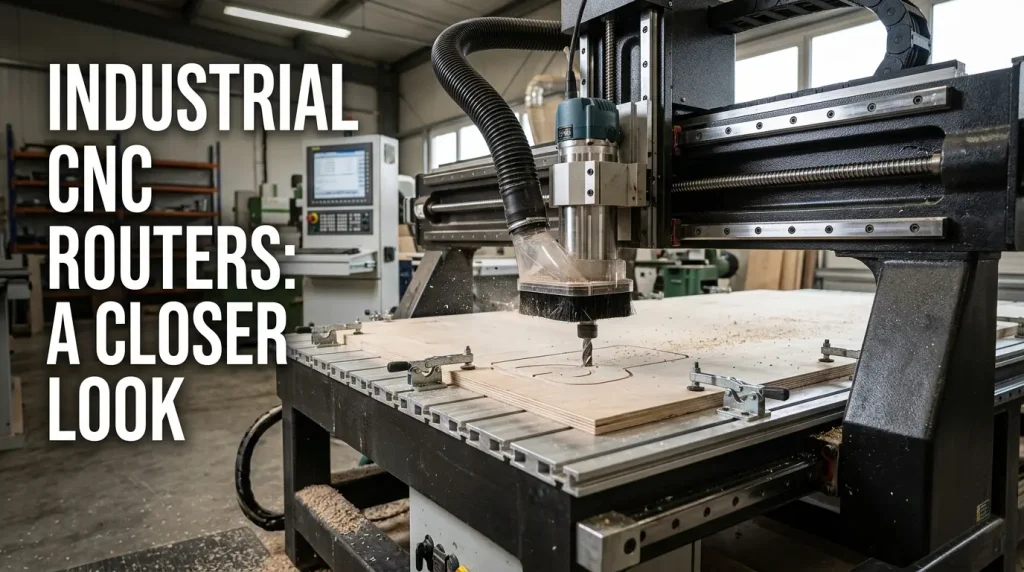
Industrial CNC routers are among the most widely used CNC machines in manufacturing, especially for flat and sheet materials. They function similarly to a handheld router, but the cutting head is guided automatically by a computer along the X, Y, and sometimes Z axis, rather than being moved manually.
Industrial CNC routers are commonly used in:
- Furniture and cabinetry production
- Sign making and engraving
- Aerospace component fabrication
- Boat building
- Musical instrument manufacturing
- Foam, plastic, and composite panel cutting
Compared to entry-level or hobbyist CNC routers, industrial CNC routers are built with heavier steel frames, more powerful spindles, and stronger drive systems, which allow them to run continuously in a production environment without losing accuracy. Many industrial routers also support automatic tool changers, dust collection systems, and vacuum hold-down tables to keep production efficient and consistent.
Industrial CNC Router Table: Key Components
The industrial CNC router table is the physical platform and structure that makes up the machine. Understanding its main components helps explain why industrial-grade tables perform so differently from smaller, hobbyist versions.
| Component | Function |
|---|---|
| Spindle | Holds and spins the cutting tool at high speed to perform the actual cutting or carving |
| Gantry | The bridge-like structure that carries the spindle across the X and Y axes |
| Work table or bed | The surface where material is secured, often using a vacuum system or T-slot fixtures |
| Drive system | Motors, ball screws, and linear guides that move the gantry and spindle with precision |
| Control system | The computer and software that interprets G-code and directs machine movement |
| Z-axis assembly | Controls the vertical movement of the spindle for depth of cut |
| Dust collection system | Removes debris and dust during cutting to maintain accuracy and a clean work area |
Industrial CNC router tables generally come in a few common configurations:
- T-slot tables – economical and flexible, well suited for 3D carving, embossing, and irregularly shaped workpieces
- Vacuum tables – hold flat sheet material firmly in place using suction, ideal for high-efficiency cutting of large panels
- Combination tables – blend T-slot and vacuum zones for flexibility across different job types
Table size also matters for industrial use. Common industrial sizes include 4×8 feet and 5×10 feet, chosen to match standard sheet material dimensions like plywood, MDF, or aluminum composite panels, which reduces waste and simplifies material handling.
CNC Router News: Latest Trends and Developments
The industrial CNC router space continues to evolve quickly, driven by automation, smarter software, and rising demand for precision manufacturing. A few developments shaping the industry right now include:
- AI-assisted motion and monitoring. Manufacturers are increasingly building AI-driven gantry motion systems and intelligent machine monitoring into industrial routers, helping reduce errors and downtime.
- Cloud-connected operations. Industrial IoT-enabled machines now allow operators to monitor performance, schedule maintenance, and track production remotely.
- Energy-efficient machine design. Newer industrial CNC routers are being built with power-saving components, with some manufacturers reporting meaningful reductions in energy consumption.
- Automated material handling. Robotics integration for loading and unloading materials is becoming more common on production floors, reducing manual labor and speeding up cycle times.
- Growing global demand. Market research consistently points to steady growth in CNC router adoption, driven by automation across woodworking, metal fabrication, plastics, and signage industries.
Anyone researching a new industrial CNC router purchase or upgrade should keep an eye on these developments, since features like remote monitoring and automated material handling are quickly becoming standard rather than optional on higher-end industrial machines.
Why Industries Rely on Industrial CNC Machines
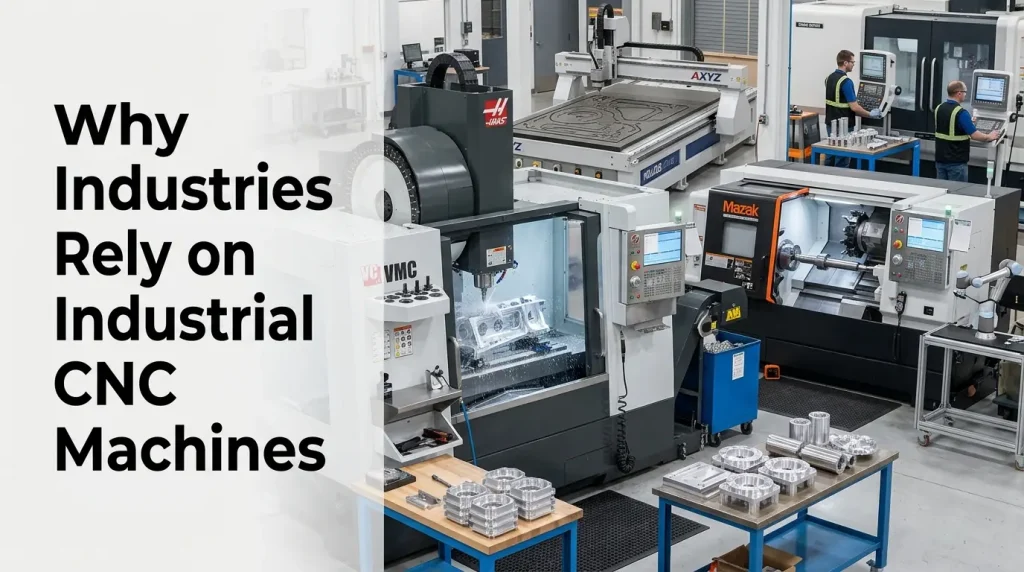
- Precision and repeatability. Industrial CNC machines can hold tolerances far tighter than manual methods, and every part produced matches the original design exactly.
- Higher production speed. Once programmed, these machines can run continuously, dramatically increasing output compared to manual machining.
- Reduced material waste. Precise cutting paths and nesting software help manufacturers get more usable parts out of the same amount of raw material.
- Lower long-term labor dependency. A single skilled operator can oversee multiple machines running simultaneously, rather than manually shaping each part.
- Consistency across large production runs. Every unit produced is virtually identical, which matters enormously for industries with strict quality requirements, such as aerospace or automotive manufacturing.
Choosing the Right Industrial CNC Machine
Selecting the right machine depends heavily on the materials and production volume involved. A few factors to weigh:
- Material compatibility. Wood and plastics generally require different spindle power and tooling than aluminum or steel.
- Table size and work area. The machine’s bed size should match the typical dimensions of the parts or sheet materials being produced.
- Spindle power. Industrial setups often range from 2.2 kW for professional woodworking up to 7.5 kW or more for heavier industrial applications.
- Precision requirements. Industrial-grade machines can typically achieve accuracy below ±0.01mm, which matters for aerospace, medical, or precision engineering parts.
- Software compatibility. The control system should support the CAD/CAM software already used by the design and production team.
- Automation features. Automatic tool changers, vacuum hold-down systems, and robotic material handling all affect long-term productivity, even though they raise upfront cost.
Industrial CNC Machine Maintenance and Safety Basics
Keeping an industrial CNC machine running accurately and safely requires consistent upkeep, not just occasional attention.
- Clean dust and debris from the work area and rails after every shift to prevent buildup that affects precision.
- Check and lubricate moving components, such as linear guides and ball screws, on a regular schedule.
- Inspect cutting tools for wear or damage before starting a new job, since a dull or damaged bit affects both quality and safety.
- Verify that dust collection and ventilation systems are functioning properly, especially when cutting materials that produce fine particulates.
- Train operators thoroughly on emergency stop procedures and safe material loading before they run the machine unsupervised.
- Schedule periodic calibration checks to confirm the machine is holding its stated precision over time.
Frequently Asked Questions
What is the difference between a CNC machine and an industrial CNC machine?
A CNC machine is any computer-controlled machine tool, including small desktop or hobbyist versions. An industrial CNC machine is built specifically for heavy, continuous production use, with a sturdier frame, more powerful components, and tighter precision.
What materials can an industrial CNC router cut?
Industrial CNC routers can cut a wide range of materials, including hardwoods, softwoods, MDF, acrylic, PVC, aluminum, and various composite panels, depending on the spindle and tooling used.
What is the difference between a CNC router and a CNC mill?
CNC routers are generally used for flat or 3D cutting, engraving, and shaping of softer materials like wood, plastic, and composites. CNC mills are built for precision milling of harder materials, especially metals, with tighter tolerances.
How much does an industrial CNC router table cost?
Costs vary widely based on size, power, and features, but industrial-grade setups typically start well above mid-range professional machines and can run into the tens of thousands of dollars depending on specifications.
What industries use industrial CNC machining the most?
Industrial CNC machining is heavily used in furniture and cabinetry, signage, aerospace, automotive, metal fabrication, boat building, and packaging, among many other manufacturing sectors.
Is CNC machining considered subtractive manufacturing?
Yes. Most CNC machining processes are subtractive, meaning material is removed from a solid block or sheet to create the final part, as opposed to additive processes like 3D printing.
What is the standard size for an industrial CNC router table?
Common industrial sizes include 4×8 feet and 5×10 feet, chosen to match standard sheet material dimensions like plywood or aluminum composite panels and minimize material waste.
Do industrial CNC machines require a skilled operator?
Yes, though the skill set differs from manual machining. Operators need to understand CAD/CAM software, machine setup, tool selection, and safety procedures, even though the actual cutting is automated.
What is the latest trend in the CNC router industry?
Recent CNC router news points to growing adoption of AI-assisted motion systems, cloud-connected monitoring, energy-efficient machine designs, and automated material handling as manufacturers push for greater efficiency and precision.
Final Thoughts
An industrial CNC machine turns a digital design into a precise physical part, again and again, with a level of consistency manual methods simply cannot match. Whether it takes the form of a router, mill, or lathe, the underlying value is the same: computer-controlled precision at production scale. Understanding what an industrial CNC machine is, how industrial CNC machining actually works, and what to look for in an industrial CNC router or router table gives any manufacturer a solid foundation for choosing the right equipment for their operation.
You May Also Like It:
CNC Machining Tolerances: The Complete Expert Guide
Prototype CNC Machining: The Complete Expert Guide
Precision Machining Services: The Complete Expert Guide to CNC Manufacturing



[…] What Is an Industrial CNC Machine? […]