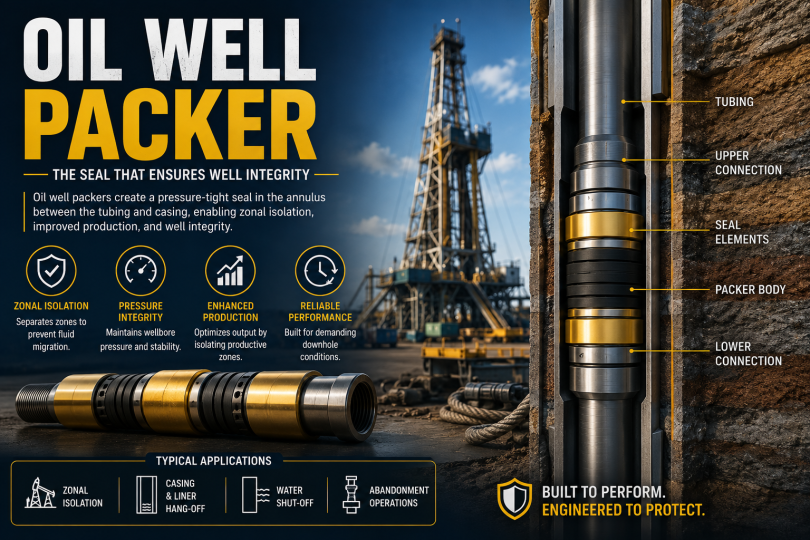

An oilfield packer is a mechanical device placed inside an oil or gas well to seal the space between the production tubing and casing. It prevents fluids and gases from moving through this gap and directs production through the tubing.
That’s the one-line version. Everything below covers the types you’ll actually encounter in the field, how each one is set and released, and how a completions engineer picks between them plus where people usually get confused.
Why Wells Need a Packer at All
Picture the tubing running down the middle of the casing like a straw inside a slightly bigger straw. Without anything blocking that gap, reservoir fluid under pressure would have two paths to the surface: up the tubing (the one you want) and up the annulus (the one you don’t). An unsealed annulus means the casing is exposed to full reservoir pressure and corrosive fluid for years, and there’s no way to isolate one producing zone from another if the well has more than one.
A packer closes that second path. It’s a simple idea with a lot of engineering behind it, because the seal has to hold at pressures up to 20,000 psi and temperatures past 450°F, in a hole that might be five miles deep and curving sideways.
What a Packer Actually Does Downhole
Well integrity reduces the chance of a casing failure or uncontrolled flow between zones
Zonal isolation keeps fluid from one producing interval out of another
Casing protection routes corrosive, high-pressure fluid through the tubing instead of past the casing wall
Pressure control holds a pressure differential across the isolated section, which matters during production and during frac/acid jobs
Selective production lets an operator produce or shut in specific zones independently
Anchoring carries the tubing string’s weight and resists the pressure forces trying to push it up or down
The Parts Inside a Packer
| Component | What it does |
|---|---|
| Seal assembly (packing element) | Rubber or elastomer element compressed outward against casing/open hole to make the seal |
| Slips | Hardened metal wedges that bite into the casing and hold the packer in place |
| Cone | Pushes the slips outward as the packer is set |
| Flow mandrel | The central tube fluid actually flows through; sets the pressure rating of the whole assembly |
| Setting mechanism | Whatever activates the packer — mechanical, hydraulic, wireline, or hydrostatic |
Core Functions of a Production Packer in Oil and Gas
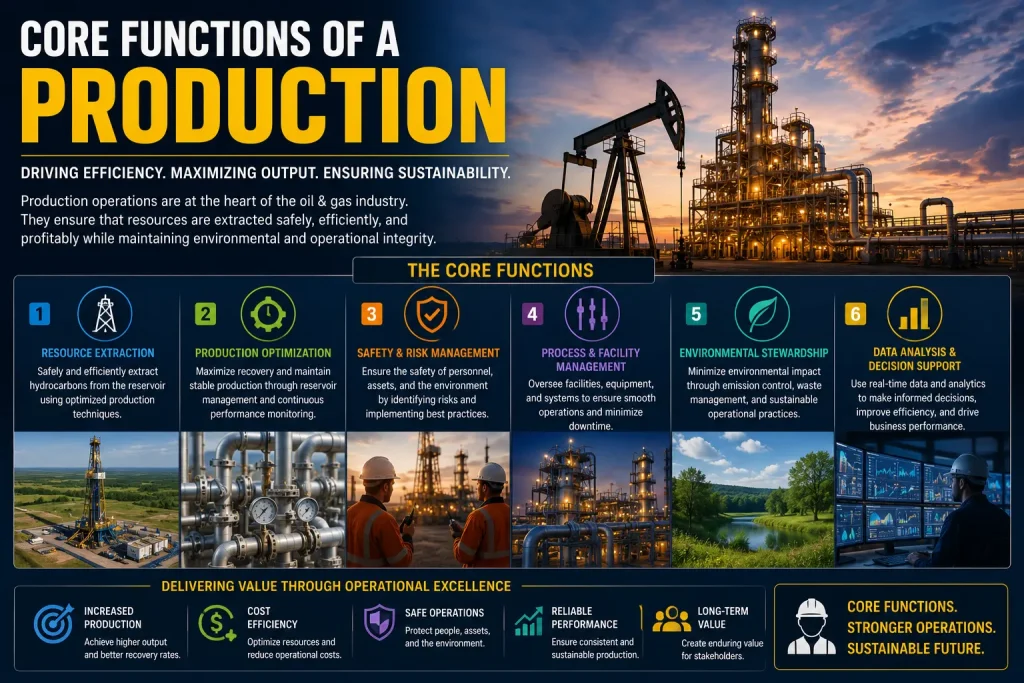
Understanding what a packer does is best approached by examining its core functions. A well packer in oil and gas performs the following primary roles.
Zonal Isolation
The most fundamental function of any oil well packer is zonal isolation preventing fluid movement between distinct geological zones within the wellbore. In many reservoirs, multiple producing intervals exist at different depths. Without isolation, fluids from one zone can migrate to another, contaminating production and making it impossible to manage each zone independently. A packer set between two zones creates a physical barrier that forces each zone to communicate only through its designated flow path.
Casing Protection
A production packer protects the wellbore casing from the full force of reservoir pressure and the corrosive effects of produced fluids. By sealing the annulus, the packer ensures that high-pressure hydrocarbons and corrosive gases travel only through the production tubing not through the annular space where they would be in direct contact with the casing. This protection significantly extends casing life and reduces the risk of costly casing failures.
Pressure Containment and Control
Packers maintain differential pressure across isolated sections of the wellbore. This is critical during production operations where reservoir pressure must be controlled to avoid blowouts and during stimulation operations like hydraulic fracturing or acidizing, where treatment fluids must be directed precisely into the target zone at high pressure.
Flow Control and Selective Production
In wells with multiple producing zones, packers enable selective production allowing the operator to produce from one zone while shutting off another, or to inject fluids into a specific interval without affecting adjacent formations. This selective control maximizes reservoir recovery and allows operators to respond dynamically to changing reservoir conditions.
Mechanical Anchoring
A packer provides a fixed mechanical anchor point in the wellbore. This anchor supports the weight of the tubing string below it, resists upward and downward forces generated by pressure differentials, and provides a stable platform for running and retrieving downhole tools.
Well Integrity and Safety
By preventing uncontrolled fluid migration and pressure communication between zones, oil well packers are a primary component of wellbore integrity management. They reduce the risk of casing collapse, blowouts, and environmental contamination making them essential for safe well operations over the full producing life of a well.
Main Components of an Oil Well Packer
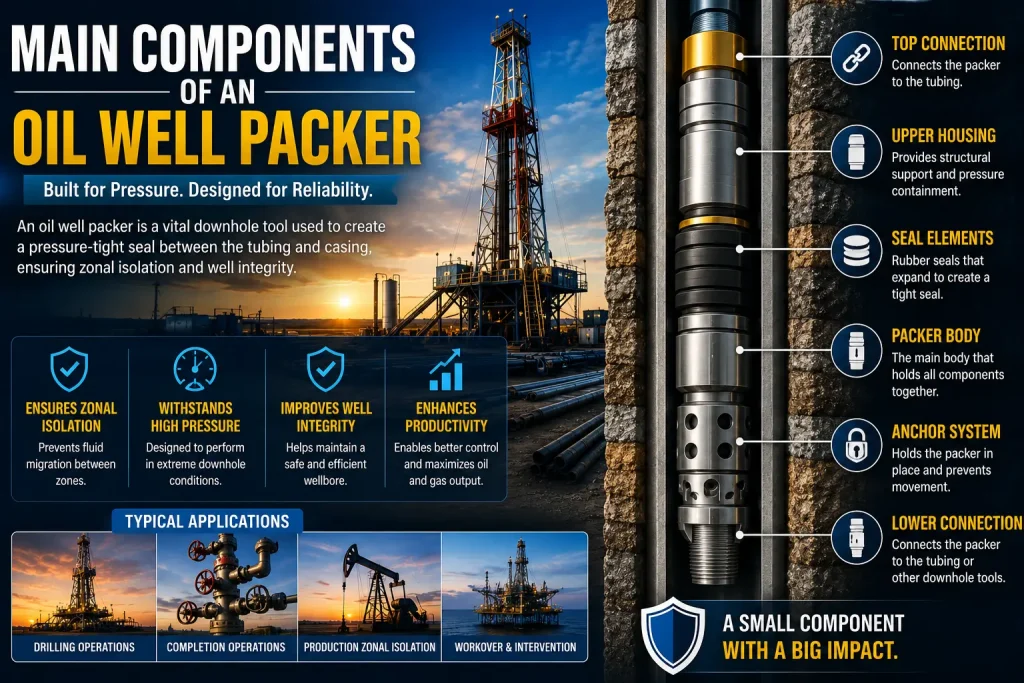
Regardless of the specific type, almost all oil well packers share the same fundamental internal components. Understanding these components helps in evaluating packer specifications and performance ratings.
Seal Assembly (Packing Element)
The seal assembly is the heart of the packer. It consists of one or more elastomeric elements typically rubber that are compressed outward against the casing wall or open hole formation to create the pressure-tight seal. In a three-element packer design, the center element is softer to seal against minor casing imperfections, while the upper and lower elements are harder to resist extrusion under high pressure and temperature. Back-up rings metallic inserts placed adjacent to the elastomeric elements reduce extrusion and improve sealing reliability under extreme conditions.
Slip Assembly
The slips are hardened metal wedges that grip the inside of the casing wall when the packer is set. The slips prevent the packer from moving either upward or downward under the forces generated by pressure differentials and tubing weight. Some packers use unidirectional slips that resist movement in only one direction. Others use bidirectional slips that hold in both directions. The choice depends on the expected downhole loading conditions.
Cone Assembly
The cone also called the expander or wedge is the component that forces the slips outward when the packer is being set. As the packer setting mechanism is activated, the cone moves relative to the slips and drives them radially outward into the casing wall. The cone is sometimes referred to as the expander cone.
Flow Mandrel
The flow mandrel is the central tubular body of the packer through which produced fluids pass on their way to the surface. It is the structural backbone of the packer and its strength largely determines the pressure differential rating of the entire assembly. The alloy used for the flow mandrel is selected based on the corrosivity and temperature of the wellbore fluids.
Setting Mechanism
The setting mechanism is the component or system that activates the packer compressing the seal element and engaging the slips. The nature of the setting mechanism defines the packer type: mechanical, hydraulic, electric wireline, or hydrostatic.
The Main Types of Oil Well Packers
1. Permanent Packers
Stay in the well for the life of the completion. Removed only by milling or drilling out, so they’re chosen when the operator doesn’t expect to need a workover. Rated up to roughly 20,000 psi / 475°F. Usually set on electric wireline or tubing.
2. Retrievable Packers
Can be unset and pulled to surface without milling — released by picking up on the tubing, rotating it, or shearing a release ring. Common in injection wells and anywhere the completion might be reconfigured. Ratings run a bit lower than permanent packers, typically up to 15,000 psi / 400°F, because the mechanism is more complex and more exposed to well fluid.
3. Mechanically Set Packers
Set by moving the tubing string itself:
- Compression-set — slack off weight onto the packer. Best in shallow, straight, low-pressure wells.
- Tension-set — pull up on the tubing. Easy to release, good for temporary jobs.
- Rotation-set — set with a left-hand turn, released with a right-hand turn.
4. Hydraulic Set Packers
Set by pumping fluid pressure down the tubing (or a dedicated line) to drive the cone behind the slips — no tubing movement needed. This makes them the default choice in deviated and horizontal wells, where rotation-set tools aren’t reliable.
5. Wireline (Electric Line) Set Packers
Run in on wireline and set by an electrically fired explosive charge. Most precise depth placement of any method, and the standard way permanent packers get installed.
6. Inflatable Packers
A rubber bladder that’s pumped up with fluid to expand against an open-hole wall. Used where the hole is irregular or where the tool needs to pass a restriction before expanding — open-hole testing, temporary zone isolation, cement evaluation.
7. Swellable Packers
No mechanical or hydraulic setting at all — the elastomer element swells on contact with oil, water, or both, sealing passively over time. Common in horizontal open-hole completions with multiple zones.
8. Thermal Packers
Built for sustained heat — SAGD, cyclic steam, geothermal wells. Standard rubber breaks down above ~300°F, so these use FKM or FFKM elastomers rated to 400–450°F+.
How to Pick the Right One
Run through these in order depth and geometry usually narrow the field before pressure rating does:
Fluid compatibility CO2, H2S, and stimulation chemicals all attack elastomers differently; sour service needs its own material grade.
Depth beyond ~12,000 ft, tubing rotation gets unreliable, so hydraulic-set or wireline-set permanent packers take over from mechanical types.
Wellbore path straight vertical wells can use almost any setting method; deviated or horizontal wells push you toward hydraulic-set, hydrostatic-set, or swellable packers.
Pressure/temperature the packer’s rating has to clear the worst condition it’ll see, including a frac job’s surface injection pressure, not just normal production pressure.
Casing size has to match the ID range the packer’s slips and seals are built for.
Will it need to come out? if a workover is even plausible, go retrievable. If the completion is truly final, permanent packers seal and grip better.
Where Packers Get Used
- Production completions isolating the perforated zone from the rest of the wellbore
- Injection wells keeping injected water or gas in the target zone during waterflood/EOR
- Frac and acid jobs directing full treatment pressure into one interval at a time
- Well testing (DST) temporary isolation to measure pressure and deliverability
- Workovers isolating corroded casing or a water-producing zone for a squeeze job
- Plug and abandonment cement packers and bridge plugs forming permanent barriers
Oil Well Packer Applications in Well Operations in Detail
Oil well packers are used across the full lifecycle of a well from initial completion through enhanced recovery and eventual abandonment.
Production Completions
In a standard production completion, a packer is set near the top of the producing interval to isolate the perforated production zone from the rest of the wellbore. This directs all reservoir fluids into the production tubing and protects the casing from produced fluids and pressure.
Injection Wells
In water flooding and enhanced oil recovery programs, packers are used in injection wells to isolate the injection interval ensuring that the injected water or gas enters the target reservoir zone rather than migrating to shallower or deeper formations.
Hydraulic Fracturing and Acidizing
During stimulation operations, packers are used to isolate specific intervals so that the full energy and volume of the treatment fluid whether fracturing fluid or acid acts on the intended zone. Multiple packers, sometimes in combination with bridge plugs, enable operators to stimulate individual zones sequentially in a multi-stage fracturing program.
Well Testing
During drillstem testing (DST) and production well testing, inflatable and retrievable packers provide temporary isolation of specific reservoir intervals. This allows engineers to measure reservoir pressure, permeability, and deliverability without committing to a permanent completion design.
Well Remediation and Workover
During well workovers, packers are used to isolate zones of corroded casing, shut off water-producing intervals, isolate leaks, and enable squeeze cementing operations. Retrievable packers are most commonly used in these applications because they can be set and retrieved multiple times.
Plug and Abandonment
During permanent well abandonment, cement packers and bridge plugs are used in conjunction with cement to create multiple barriers that isolate the producing formation from the surface permanently in compliance with regulatory requirements.
Production Packer vs. Service Packer
All oil well packers fall into one of two broad categories based on their primary application.
Production Packers
A production packer is designed to remain in the well throughout the production life of the completion. It provides a long-term seal that supports continuous fluid production. Production packers must withstand the sustained thermal and mechanical loading of the producing well for years or decades. They are subject to the full API 11D1 validation testing requirements.
Service Packers
A service packer also called a workover packer or test packer is used temporarily during well service operations such as cement squeeze jobs, acidizing, hydraulic fracturing, and well testing. Service packers are retrieved after the operation is complete. They are not designed for long-term deployment but must withstand the high differential pressures and fluid volumes associated with stimulation operations.
Oil Well Packer Standards: API 11D1 and ISO 14310
Production packers used in oil and gas wells are designed, tested, and validated according to two primary international standards: API 11D1 (the American Petroleum Institute standard) and ISO 14310 (the International Organization for Standardization standard). Both standards are technically equivalent and cover the same validation testing requirements.
These standards define six validation grades from V6 (the least stringent) to V0 (the most stringent) based on the pressure differentials, temperature ranges, and mechanical loading conditions under which the packer is tested. They also define three quality control grades Q1 through Q3 governing the manufacturing quality assurance process.
When evaluating packer specifications for a high-pressure or high-temperature application, operators should confirm both the validation grade and the quality control grade to ensure the packer meets the actual well conditions.
Major Oil Well Packer Manufacturers
Several major oilfield service companies manufacture and supply oil well packers globally. The following are among the largest and most widely used in the industry.
Halliburton
Halliburton has manufactured production packers for over 75 years and offers one of the broadest packer portfolios in the industry. Halliburton’s permanent packers are rated up to 20,000 psi at 475°F and their retrievable packers up to 15,000 psi at 400°F. They supply packers for multilateral wells, horizontal wells, deepwater completions, intelligent completions, and sand control applications. All Halliburton packers are validated to ISO 14310 and API 11D1 standards.
Baker Hughes
Baker Hughes introduced the first completion packer over 80 years ago and continues to be a leading manufacturer. Baker Hughes offers both production packers and temporary packers for workovers, well tests, and interventions, with mechanical, hydraulic, and electrically-set options across its portfolio. Its packers are deployed globally through a worldwide network of application engineers and field personnel.
SLB (Schlumberger)
SLB is one of the largest oilfield service companies in the world and manufactures a complete range of downhole packers for all completion types. SLB’s packer portfolio covers mechanical, hydraulic, and inflatable designs for cased-hole and open-hole applications across all well geometries and pressure-temperature envelopes.
Superior Energy Services
Superior Completion Services, part of Superior Energy Services, offers a range of field-proven packer solutions for conventional completions and more challenging well conditions. Their portfolio includes both standard designs and specialized tools for high-pressure, high-temperature, and highly deviated wells.
Frequently Asked Questions About Oil Well Packers
What is the difference between a permanent packer and a retrievable packer?
A permanent packer is designed to stay in the well for the life of the completion and can only be removed by drilling or milling it out. A retrievable packer can be mechanically unset and pulled back to the surface without damaging the wellbore, providing operational flexibility for future workovers.
What is a downhole packer?
A downhole packer is simply another term for an oil well packer any packer-type device run into the wellbore to create a seal at depth. The term “downhole” distinguishes these tools from surface equipment.
What does a packer do in an oil well?
A packer in an oil well creates a seal between the production tubing and the casing or open hole, isolating the producing zone from the rest of the wellbore. It protects the casing, controls pressure, enables selective production from multiple zones, and provides the mechanical anchor point for the completion string.
What is a hydraulic set packer?
A hydraulic set packer is a packer activated by fluid pressure rather than mechanical tubing movement. Fluid pressure drives the cone behind the slips and compresses the seal element. Hydraulic set packers are preferred in deviated and horizontal wells where tubing rotation is impractical.
What is an inflatable packer used for?
Inflatable packers are used primarily in open-hole sections where the wellbore is irregular or where the packer must pass through a restriction before setting at a larger diameter. Common applications include exploration well testing, cement assurance, and temporary zone isolation.
What is a swellable packer?
A swellable packer uses a special elastomeric element that expands when it contacts water, oil, or a combination of wellbore fluids. No mechanical or hydraulic activation is required the packer sets passively over time. Swellable packers are widely used in open-hole horizontal completions.
What standards govern oil well packer design and testing?
The primary standards are API 11D1 and ISO 14310, which are technically equivalent. They define validation grades (V6 through V0) based on pressure and temperature testing conditions, and quality control grades (Q1 through Q3) governing manufacturing quality assurance.
Can a packer be used in a horizontal well?
Yes, but the setting mechanism must be appropriate for the well geometry. In horizontal wells, mechanical rotation-set packers are generally impractical. Hydraulic-set, hydrostatic-set, or swellable packers are the preferred options for horizontal completions.
Conclusion
The oil well packer is one of the most indispensable tools in oil and gas production. From the basic function of sealing the annulus in a shallow vertical production well, to the sophisticated task of isolating multiple zones in a deep horizontal HP/HT completion, packers are at the core of how operators control, protect, and optimize their wells.
Understanding the difference between permanent and retrievable packers, between mechanical and hydraulic setting mechanisms, and between standard and specialized designs along with the factors that govern selection is essential knowledge for anyone working in well completions, production engineering, or petroleum operations.
Whether you are evaluating a production packer for a new completion, selecting a service packer for a workover program, or simply building your foundational knowledge of downhole completion tools, the oil well packer deserves careful study. It is a small device in the grand scale of an oil field but it is one on which the safety, efficiency, and profitability of the entire well depends.
You May Also Like It:
Prototype CNC Machining: The Complete Expert Guide
Steel Grade: The Complete Guide to Understanding Every Type of Steel
Industrial Safety Products: The Complete Guide to Protecting Your Workforce