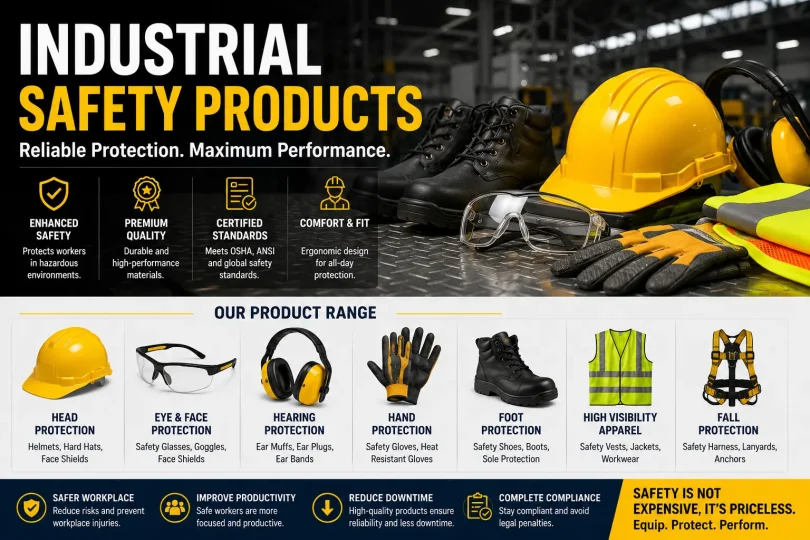

Every year, hundreds of thousands of workers get injured on the job. Most of those injuries were preventable. The right industrial safety products, chosen correctly and used consistently, are what stand between a normal workday and a life-changing accident.
But here is what most guides do not tell you: buying safety products is only half the job. Knowing which product to buy for which hazard, maintaining it properly, and making sure your workers actually use it the right way, that is where real protection begins.
This guide covers every major category of industrial safety products in plain language, with practical advice that goes beyond what most competitors cover.
What Are Industrial Safety Products?
Industrial safety products are tools, equipment, and systems designed to protect workers from physical, chemical, biological, and environmental hazards in the workplace. They range from something as simple as a pair of gloves to complex systems like AI-powered gas monitoring networks.
The global industrial safety products market currently sits at USD 18.6 billion and is projected to reach USD 36.9 billion by 2036. That growth reflects a major shift in how businesses think about safety: not as a legal obligation to tick off, but as a core part of running a smart, productive operation.
The industries with the highest fatality rates tell you exactly where the stakes are highest. Logging leads at 97.6 deaths per 100,000 workers, followed by fishing at 77.4, roofing at 51.5, and waste collection at 44.3. Construction, manufacturing, and oil and gas consistently rank among the most hazardous sectors globally. In each of these environments, the right safety products save lives every single day.
What Changed in 2026: The Shift from Reactive to Predictive Safety
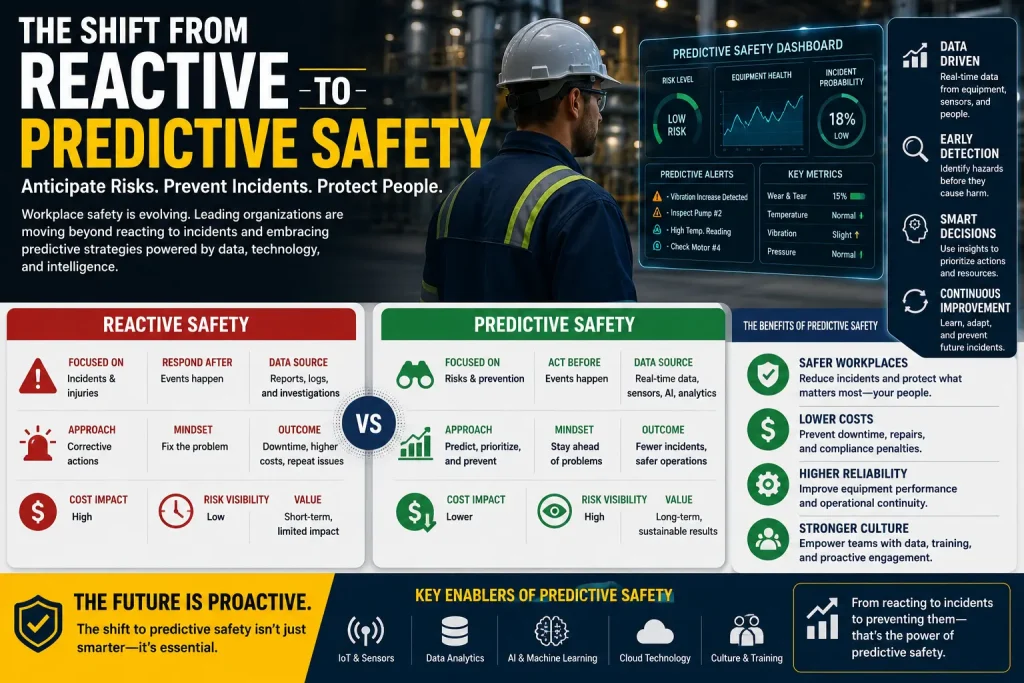
Before diving into individual products, it helps to understand the biggest shift happening across the industry right now.
Traditional safety products were reactive. A hard hat absorbed an object after it fell. A gas alarm triggered after levels became dangerous. A harness stopped a fall after it had already started.
The new standard is predictive. Smart helmets now warn supervisors before a worker shows signs of heat exhaustion. AI-powered cameras detect fatigue in a worker’s gait and cut power to nearby machinery before an incident happens. Connected gas monitors send alerts to a safety dashboard the moment readings begin trending upward, not just when they hit a dangerous threshold.
This shift does not mean traditional PPE is obsolete. It means the baseline has been raised, and the best workplaces are combining reliable core equipment with smarter systems on top.
There are also concrete regulatory changes that took effect in 2026. Chemical labels and Safety Data Sheets now must meet GHS Revision 7 standards. All SCBA equipment must comply with the new consolidated NFPA 1970 standard, replacing the old NFPA 1981. Arc-flash labels now must include nominal voltage and the date of the last assessment. And OSHA’s “PPE Must Fit” rule is now actively enforced, meaning a single-size-fits-all approach to equipment is no longer compliant.
These updates matter when you are making purchasing and training decisions. The rest of this guide covers each product category in full detail.
1. Personal Protective Equipment (PPE)
PPE is the foundation of any industrial safety program. It is what protects an individual worker when all other controls have been applied and a residual risk still exists.
Head Protection
Hard hats do one job: protect the brain. But not every hard hat protects the same way.
Type I hard hats protect only the top of the head. Type II hard hats protect the top and sides. For most industrial environments, Type II is the right choice. Beyond the type, the electrical class matters too. Class G (General) handles everyday construction and manufacturing. Class E (Electrical) is built for workers near live circuits. Class C (Conductive) offers no electrical protection and is used only where that hazard does not exist.
One detail that most guides skip: hard hats have an expiration date. Most manufacturers recommend replacing the shell every five years, even if it looks perfectly fine. UV exposure, chemical contact, and repeated minor impacts degrade the material invisibly over time. And if a hard hat takes a serious impact, it must be retired immediately regardless of how it looks. The protective liner inside absorbs energy during an impact and loses its ability to do so again.
Smart hard hats have moved from being optional on large sites to being standard practice on high-risk ones. They now include built-in sensors for heart rate and body temperature, real-time location tracking, zone-entry alerts, gas detection in the shell, and NFC chips that log inspection and compliance data automatically. The difference between a standard hard hat and a smart one is the difference between passive protection and active awareness.
Eye and Face Protection
Nearly 2,000 workplace eye injuries require medical attention every single day in the United States. The vast majority are caused by particles, splashes, and flying debris that a proper pair of safety glasses would have stopped.
The right protection depends on the hazard:
- Safety glasses for flying debris, dust, and light splash in general work environments
- Safety goggles for chemical splash, fine airborne particles, or environments where glasses can be knocked off
- Face shields for grinding, heavy chemical handling, and welding (always paired with glasses or goggles underneath, never used alone)
- Welding helmets with auto-darkening lenses for arc welding, which now come standard with this feature rather than as a premium upgrade
Look for ANSI Z87.1 certification on any safety eyewear. This confirms the product has been tested for impact resistance, optical clarity, and UV protection. Under current OSHA enforcement, equipment must also genuinely fit the worker wearing it. Women on industrial job sites have long been issued eyewear designed for average male facial dimensions. That is now both a compliance issue and a practical safety problem.
Hand Protection
Hand injuries send over one million workers to the emergency room in the United States every year. Cuts, crush injuries, chemical burns, and heat exposure are the most common causes, and each requires a different type of protection.
The ANSI/ISEA 105 cut resistance scale runs from A1 to A9. Most industrial cutting and fabrication environments now call for A4 to A6 rated gloves as a baseline. Earlier standards at A2 and A3 have proven insufficient for many metal fabrication, packaging, and glass handling tasks.
| Hazard | Recommended Glove Type |
|---|---|
| Cut and puncture | A4-A6 cut-resistant (HPPE fiber with glass or steel blend) |
| Chemical exposure | Nitrile, neoprene, or butyl rubber depending on chemical |
| Heat and flame | Leather or aluminized gloves |
| Electrical hazards | Rubber insulating gloves with leather protectors |
| Vibrating tools | Anti-vibration gloves with dampening material |
| General handling | Coated synthetic or leather work gloves |
A critical but commonly overlooked point: gloves must be inspected before every use. A pinhole in a chemical-resistant glove can allow a corrosive substance to reach the skin within seconds. That inspection takes five seconds and is skipped constantly.
Foot Protection
Feet face falling objects, rolling loads, sharp materials on the ground, slippery surfaces, and electrical hazards. Safety footwear must be matched to the specific combination of risks in each environment.
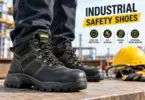
Steel toe boots protect against impact and compression and remain the most widely used option in construction and manufacturing. Composite toe boots offer comparable protection without conducting electricity or extreme cold, making them better suited for electrical work or outdoor use in winter. Aluminum toe boots split the difference, lighter than steel but slightly heavier than composite.
For ATEX and hazardous area environments, anti-static footwear prevents static discharge that could ignite flammable atmospheres. For EV battery production environments, which are growing rapidly, chemical-resistant and anti-static footwear is now a specific requirement.
ASTM F2413 certification is the standard to look for on any industrial safety footwear purchase.
Respiratory Protection
Respiratory hazards are among the most dangerous in industrial settings because they are often invisible. Dust, fumes, vapors, biological agents, and oxygen-deficient atmospheres can cause permanent lung damage or death with no immediate warning.
Choosing the right respirator starts with identifying the contaminant:
- Disposable filtering facepieces (N95, N99, N100): For particulates like dust, mist, and fumes. NIOSH approval is non-negotiable here.
- Half-face and full-face elastomeric respirators: For use with replaceable cartridges matched to specific chemical hazards (organic vapor, acid gas, combination cartridges).
- Powered Air-Purifying Respirators (PAPRs): Provide a continuous flow of filtered air and reduce breathing effort significantly. The latest models include built-in gas sensors that monitor filter saturation in real time, automatically increasing airflow when levels rise and displaying a warning on a small heads-up display when the filter needs changing.
- Self-Contained Breathing Apparatus (SCBA): For immediately dangerous to life and health (IDLH) atmospheres. Required to meet the new NFPA 1970 standard.
Respirator cartridges do not last forever. Their service life depends on the concentration of the contaminant and the temperature and humidity of the environment. Using time-based replacement schedules without factoring in exposure levels is a common mistake.
2. Fall Protection Equipment
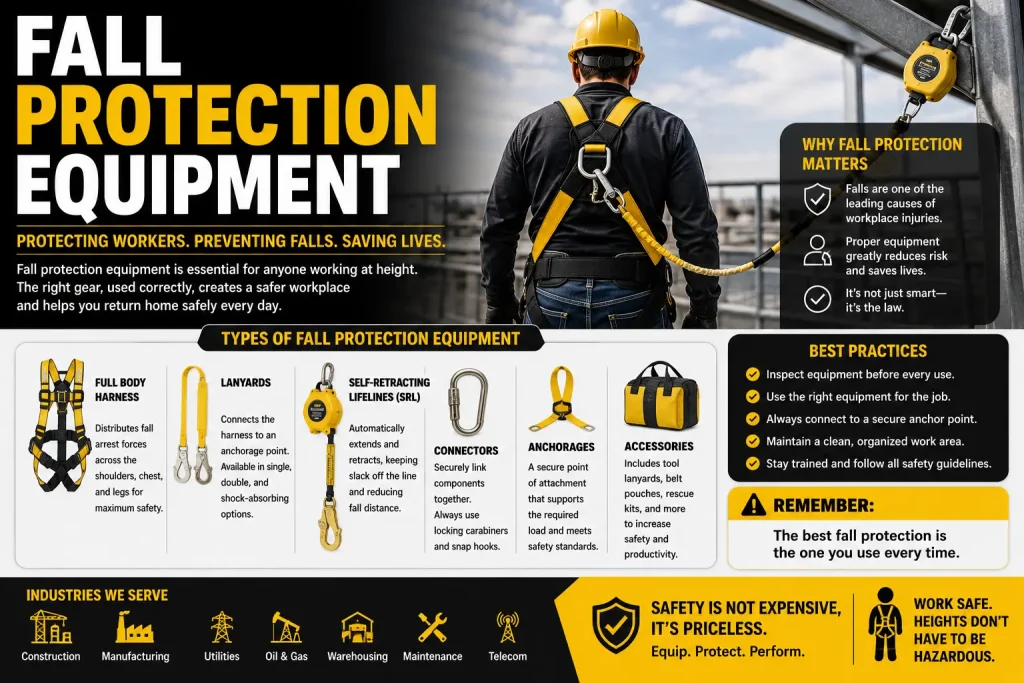
Falls are the leading cause of death in construction. OSHA recorded 421 worker fatalities from falls in 2023 alone, and thousands more resulted in serious injuries. Fall protection is not optional in any environment where workers are at height.
The Hierarchy of Fall Protection
Before reaching for a harness, there is an ordered approach that the best safety programs follow:
- Elimination: Can the task be redesigned so no one needs to work at height?
- Passive systems: Guardrails, safety nets, and hole covers that protect workers without requiring them to do anything.
- Fall restraint: Systems that prevent workers from reaching the fall edge in the first place.
- Fall arrest: Systems that stop a fall that has already started.
Most workplaces jump straight to fall arrest without considering whether passive protection is possible. Guardrails are more reliable than harnesses because they do not depend on worker behavior.
Core Fall Protection Products
Full-body harnesses must fit properly and be inspected before every use. Check webbing for fraying, cuts, and UV damage. Check buckles and D-rings for corrosion or deformation. Any harness that has arrested a fall must be retired immediately, regardless of how it looks. The forces involved in stopping a falling body compromise the harness permanently.
Self-retracting lifelines (SRLs) allow greater freedom of movement than standard lanyards and lock faster during a fall. They are preferred on jobs where workers move across a large area and a long lanyard would create swing-fall risk.
Anchor points are where the entire system is only as strong as what it connects to. OSHA requires anchor points to support a minimum of 5,000 pounds per attached worker. Connecting a harness to an unrated pipe or a structural element that has not been assessed is one of the most common fall protection failures.
The swing fall hazard: One thing most safety guides do not explain clearly is what happens when an anchor point is not directly above the work area. If a worker falls while connected to an offset anchor, they swing like a pendulum and can slam into a wall, column, or machinery at significant speed. This is called a swing fall, and it causes serious injury even when the harness functions perfectly. Anchor placement is as important as the equipment itself.
3. Gas Detection Equipment
In many industrial environments, the most dangerous hazard cannot be seen or smelled. Toxic gases, combustible atmospheres, and oxygen-deficient spaces kill workers every year, often with very little warning.
Types of Gas Detectors
Single-gas detectors monitor one specific gas and are used when only one known hazard exists in a consistent environment. They are small, simple to operate, and cost-effective for targeted applications.
Multi-gas detectors are the standard for most industrial and confined space work. The most common configuration monitors four gases simultaneously: oxygen (O2), carbon monoxide (CO), hydrogen sulfide (H2S), and combustible gases measured as a percentage of the lower explosive limit (LEL).
Fixed detection systems are permanently installed sensors that monitor an entire facility continuously. They trigger alarms and can automatically activate ventilation or shutdown systems when readings exceed safe thresholds.
Wearable personal monitors have advanced significantly. Modern units clip to a collar or wristband, transmit data wirelessly to a central safety platform, and give supervisors a real-time view of every worker’s exposure levels throughout a shift. Instead of finding out about a gas event after the fact, safety managers can see exposure trends building and evacuate the area before a crisis develops.
Confined Space Entry
Any space large enough for a worker to enter, with limited access and not designed for continuous occupancy, meets the definition of a confined space. When that space also contains a serious atmospheric, engulfment, or configuration hazard, it becomes a permit-required confined space.
Before any entry, the atmosphere must be tested and documented:
- Oxygen content must be between 19.5% and 23.5%
- Combustible gas concentration must be below 10% LEL
- Toxic contaminants must be below their permissible exposure limits
Testing must happen in layers from top to bottom, since different gases settle at different heights. Heavier gases like hydrogen sulfide and propane pool at the bottom. Lighter gases like methane rise to the top.
The most important maintenance rule for gas detectors: bump testing before each use and full calibration every six months. A gas detector that has never been calibrated provides a false sense of security. The sensor degrades over time, and without calibration, no one knows whether it still responds accurately.
4. Lockout/Tagout (LOTO) Products
Lockout/Tagout is one of OSHA’s most frequently cited standards, and the reason is consistent: failure to control hazardous energy during maintenance causes serious injuries and deaths that are entirely preventable.
The principle is simple. Before any worker performs maintenance on a machine, all sources of hazardous energy, electrical, pneumatic, hydraulic, mechanical, thermal, and gravitational, must be isolated and locked in the off position so the machine cannot be energized accidentally.
Core LOTO Equipment
Lockout hasps allow multiple padlocks to be applied to a single isolation point. When a team is working on a machine, each worker applies their own personal padlock. The machine cannot be restarted until every single worker removes their lock. This prevents the scenario where one worker finishes and restarts the machine while others are still inside.
Energy-specific lockout devices are designed for particular isolation points: circuit breaker lockouts, valve lockouts, plug lockouts, and cable lockouts. Each is matched to the type of energy source being isolated.
LOTO stations centralize all supplies in one visible, accessible location. Workers should never have to search for a padlock before starting maintenance.
Smart digital LOTO systems have emerged as a significant advancement. Every smart lock connects to the facility’s cloud system. A machine can only be cleared for restart after every assigned worker has confirmed they are clear on their app and uploaded photographic evidence from the work area. The system generates a complete digital audit trail automatically. The single most common LOTO failure, a machine restarting due to miscommunication, is eliminated by this approach.
A LOTO program fails not because the products are wrong but because training is inadequate and enforcement is inconsistent. Audits should include direct observation of workers performing actual LOTO procedures, not just checking whether the written program exists.
5. Fire Safety Products
A complete fire safety program covers detection, suppression, emergency egress, and response. Extinguishers alone are not enough.
Choosing the Right Fire Extinguisher
The extinguisher class must match the type of fire it will be used on:
| Fire Class | What Burns | Extinguisher Agent |
|---|---|---|
| Class A | Wood, paper, cloth, ordinary combustibles | Water, foam, dry chemical |
| Class B | Flammable liquids and gases | CO2, dry chemical, foam |
| Class C | Energized electrical equipment | CO2, dry chemical (non-conductive) |
| Class D | Combustible metals (magnesium, titanium) | Dry powder specific to the metal |
| Class K | Cooking oils and fats in commercial kitchens | Wet chemical |
ABC extinguishers cover the three most common fire classes and are appropriate for most general industrial areas. In electrical rooms, CO2 extinguishers are preferred because they leave no residue that could damage sensitive equipment.
Flammable Liquid Storage
Flammable safety cabinets store hazardous liquids and must meet NFPA and OSHA requirements. Safety cans are used for transferring flammable liquids safely. These are not optional upgrades: they are required equipment wherever flammable materials are stored or handled. Self-closing lids, flame arresters, and pressure-relief vents are critical safety features, not accessories.
Emergency Eyewash Stations and Safety Showers
ANSI Z358.1 sets clear requirements for emergency decontamination equipment:
- Within 10 seconds of travel time, roughly 55 feet, from any potential chemical exposure area
- Delivering tepid water between 60 and 100 degrees Fahrenheit
- Sustaining flow for a minimum of 15 minutes
- Tested weekly for plumbed units to ensure flow and function
Cold water causes shock and causes workers to pull away from the stream before adequate flushing has occurred. Tepid water allows 15 minutes of continuous flushing, which is what chemical decontamination actually requires.
6. High-Visibility Clothing and Traffic Safety
In any environment where workers share space with vehicles or heavy equipment, visibility is a life-safety requirement. High-visibility clothing is classified by ANSI/ISEA 107 based on the risk level.
Class 1 is for low-risk environments where workers are separated from traffic moving at low speeds, such as parking lot work or warehouse aisles with slow-moving equipment.
Class 2 is for moderate-risk environments, including roadside construction where traffic exceeds 25 mph.
Class 3 provides the highest visibility and is required wherever workers are exposed to high-speed traffic or work in low-light or nighttime conditions.
Modern high-visibility garments use lighter, more breathable fabrics than earlier versions, which means workers actually wear them rather than removing them when it gets warm. Some now incorporate LED panels and sensors that automatically increase brightness in low light. A reflective vest that a worker has rolled up and stuffed in their pocket provides zero protection.
7. Hazard Communication: Chemical Labels and Safety Data Sheets
Workers cannot protect themselves from a hazard they cannot identify. Hazard communication systems make sure every chemical in a facility is clearly labeled and every worker knows what risks it presents.
The Globally Harmonized System (GHS) provides the framework for chemical classification and labeling. As of January 2026, all manufacturers and importers are required to comply with GHS Revision 7, which brought updated classifications and labeling requirements across a wide range of substances.
Every chemical container must carry a GHS-compliant label with:
- A product identifier
- Signal word (Danger or Warning based on severity)
- Hazard statements describing the specific risks
- Standardized pictograms
- Precautionary statements for handling, storage, and first aid
- Supplier contact information
Safety Data Sheets (SDS) must be accessible to every worker who handles or works near hazardous chemicals. Whether kept in paper binders at each work station or on a digital system accessible by mobile device, they must be findable quickly, not locked in a manager’s office.
8. Ergonomic Safety Products
Musculoskeletal disorders (MSDs), strains, sprains, repetitive motion injuries, and back problems are the single most expensive category of workplace injury. They develop slowly, they are often dismissed until they become serious, and they are almost always preventable.
Anti-fatigue mats reduce the physical toll of standing on hard concrete or tile for extended periods. Workers who stand all day without support develop foot, knee, and lower back problems over time.
Lifting aids and mechanical assists reduce the physical load on workers during heavy or repetitive lifting tasks. Drum lifters, tilters, and vacuum lift assists take the strain off the lower back, where the majority of lifting injuries originate.
Knee pads protect workers in trades that require sustained kneeling. Without them, workers develop chronic knee problems that end careers.
Industrial exoskeletons have moved from niche pilot programs to mainstream adoption. Soft exoskeletons, worn like a vest and shorts, use artificial muscle fibers to support the lower back and reduce bending strain by up to 40%. Rigid exoskeletons, used for heavy assembly and overhead work, can make a 50-kilogram load feel like carrying a bottle of water. They are in active use across automotive, logistics, and construction sectors and are proving particularly valuable for workers over 50 who have the experience but face physical limitations.
The important point about ergonomic products: they work best when the task has been analyzed first. The best anti-fatigue mat cannot compensate for a poorly designed workstation. Always assess the task, then select the product.
9. Smart Safety Technology and Wearables
This is the area where industrial safety is changing fastest, and it is where most traditional safety guides fall significantly short.
Wearable proximity sensors protect workers in environments with automated guided vehicles (AGVs), forklifts, and heavy equipment. When a moving object enters within a set radius, the worker’s wristband delivers a specific vibration pattern indicating direction and urgency, without requiring the worker to look up from their task.
AI-powered safety cameras scan production floors continuously. They detect workers entering restricted zones, identify workers without required PPE, and analyze gait and movement patterns to identify fatigue before it causes an incident. When a risk is detected, the system can lock out nearby machinery within fractions of a second.
Predictive safety platforms connect data from wearables, fixed sensors, inspection records, and incident reports into a single system. AI analyzes patterns across all of this data to identify areas with elevated risk before anything happens. A safety manager receives an alert that a specific zone or process is showing elevated risk indicators, based on trends, not just on a current reading.
VR safety training has proven transformative. Studies show it achieves an 85% knowledge retention rate, compared to roughly 10% for traditional classroom instruction. Workers who have simulated a scaffold collapse, a chemical leak, or a confined space emergency respond more effectively in real situations because their brain has already processed the scenario. It is now widely used for induction training, emergency response drills, and high-risk task preparation.
Smart safety vests function as a central hub for multiple safety functions: active LED lighting for visibility in darkness, built-in cooling fans for heat management, fall detection that triggers an alert when an abnormal gravity shift is detected, and a man-down alarm if a worker remains motionless for more than 60 seconds, critical for detecting sudden cardiac events or loss of consciousness.
10. Spill Containment and Environmental Safety
Hazardous material spills create three simultaneous problems: worker exposure, environmental contamination, and regulatory liability. Proactive containment prevents all three.
Spill kits should be positioned at every chemical storage and handling location. There are three main types:
- Universal spill kits: Absorb most liquids including water-based and oil-based chemicals
- Oil-only spill kits: Repel water and absorb only hydrocarbons, ideal for outdoor use near water
- Chemical spill kits (hazmat kits): Designed for aggressive chemicals and include chemical-resistant PPE for the responder
Secondary containment pallets and sumps hold the contents of containers stored on them in case of a leak or rupture. For many chemical storage situations, EPA regulations require secondary containment capable of holding 110% of the largest container or 10% of the total stored volume.
Absorbent pads, socks, and pillows provide immediate containment and are the first thing a worker reaches for when a spill occurs. Pads are for large surface area coverage. Socks are for surrounding a spill to stop it from spreading. Pillows are for absorbing pooled liquid from sumps and low points.
How to Choose the Right Industrial Safety Products
With hundreds of products across every category, knowing where to start is the most common challenge for safety managers and procurement teams. This framework cuts through the noise.
Start with the hazard, not the product. A Job Hazard Analysis (JHA) for every task tells you exactly what you are protecting against. Buying products first and then trying to fit them to the hazard results in mismatched protection and wasted budget.
Apply the hierarchy of controls. PPE is always the last line of defense, not the first. Before purchasing any PPE, ask whether the hazard can be eliminated, substituted with something less dangerous, engineered out with guarding or ventilation, or controlled administratively with procedures and rotation. PPE is what you use when those options have been exhausted.
Verify the certification. Every safety product in a regulated category must meet the relevant standard. NIOSH for respirators. ANSI Z87.1 for eye protection. ANSI Z89.1 for head protection. ASTM F2413 for footwear. ANSI/ISEA 107 for high-visibility clothing. Uncertified products provide no legal coverage and may provide no actual protection.
Factor in fit and comfort. A product that workers refuse to wear because it is uncomfortable provides zero protection. Where possible, involve workers in product trials before making bulk purchases. The “PPE Must Fit” enforcement standard now requires that equipment genuinely fits each individual worker, not just meets a generic size specification.
Plan for replacement from the start. Every safety product has a defined service life. Build inspection schedules and replacement budgets into your safety program from day one. A gas detector with a degraded sensor, a harness past its expiration, or a hard hat from several years ago are not safety equipment. They are liability.
Compliance Checklist for 2026
For safety managers reviewing their programs, here are the active regulatory requirements to confirm.
- GHS Revision 7 chemical labels and SDS updates completed
- SCBA equipment assessed and compliant with NFPA 1970 (deadline: March 28, 2026)
- Arc-flash labels updated to include nominal voltage and assessment date
- 2025 injury and illness data submitted electronically via OSHA’s Injury Tracking Application
- Methylene chloride exposure monitoring initiated for applicable facilities (deadline: November 9, 2026)
- Heat illness prevention plans in place (mandatory in CA, CO, MD, MN, NV, OR, WA; strongly recommended everywhere else)
- PPE fit documentation in place for each worker by equipment category
Frequently Asked Questions
What are the most important industrial safety products for a new facility?
Start with a hazard assessment, then build around the fundamentals: head protection, eye and face protection, hand protection, foot protection, and respiratory protection. Add fall protection, fire safety, LOTO equipment, and gas detection based on what your specific hazards require.
How often should safety equipment be replaced?
It depends on the product. Hard hats typically last five years from the date of manufacture, but must be replaced immediately after any significant impact. Harnesses that have arrested a fall are retired on the spot. Respirator cartridges may last from hours to months depending on exposure levels. Gas detector sensors typically need replacement every one to two years. Always follow manufacturer guidance and inspect before every use.
Does more expensive PPE mean better protection?
Not automatically. The protection level is defined by the certification standard, not the price. A properly certified mid-range harness that fits correctly is safer than an expensive one that fits poorly or is past its service life. Focus on certification first, then comfort, then cost.
What is the difference between Type I and Type II hard hats?
Type I protects only the top of the head. Type II protects the top and sides. Type II is the better choice for most industrial environments where impacts can come from the side, from falls, or from contact with structures.
Are smart safety products worth the cost for smaller operations?
For high-risk environments, yes. A single serious injury costs far more than the technology that could have prevented it, in workers compensation, lost productivity, legal exposure, and human cost. Connected gas monitors, smart LOTO, and wearable proximity sensors have clear ROI in environments with confined space work, heavy vehicle traffic, or complex energy isolation requirements.
Final Words: Safety Is a System, Not a Product
No single product makes a workplace safe. A hard hat worn tilted back protects nothing. A gas detector never calibrated gives false confidence. A fire extinguisher on the wrong class of fire makes things worse.
Real industrial safety is a system: the right products, chosen for specific hazards, used correctly by trained workers, maintained on schedule, and continuously evaluated against real incident data.
The businesses that take that approach spend less on injuries, spend less on insurance, keep their people longer, and build operations that can actually scale. That is what safety products, used properly, actually deliver.
You May Also Like It:
CNC Machining Tolerances: The Complete Expert Guide
Prototype CNC Machining: The Complete Expert Guide
Steel Grade: The Complete Guide to Understanding Every Type of Steel