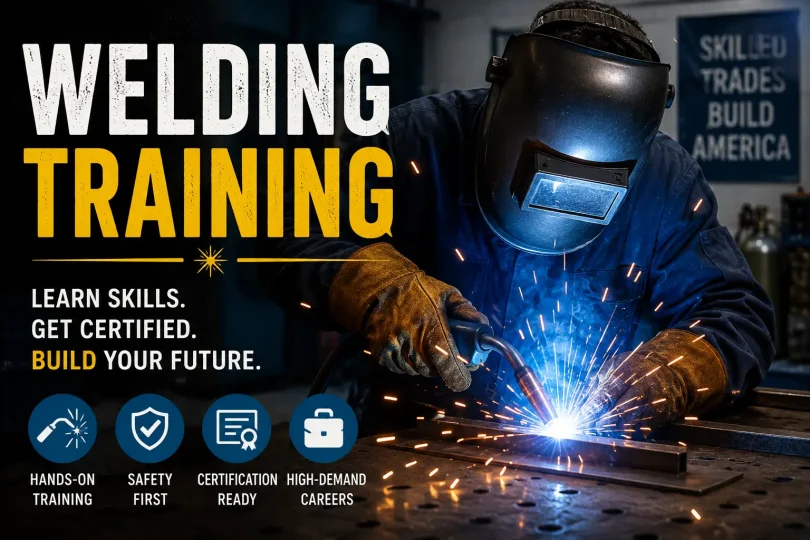

Welding training is the hands-on and classroom instruction that teaches someone to fuse metal safely and to code, usually through a trade school, community college, union apprenticeship, or employer-sponsored program. Most paths take 6 months to 2 years and combine shop hours with process-specific instruction in MIG, TIG, or stick welding. The right choice depends less on which school has the nicest brochure and more on what you’re actually trying to weld for a living.
I’ve spent time around fabrication shops and trade programs, and here’s the thing nobody tells you upfront: the school matters less than the machine time you log. A 6-month program with 80% shop hours will beat a 2-year program that’s mostly lecture, every time. Let’s get into what actually separates a good program from a waste of your tuition.
Welding training runs 4 months to 4 years depending on the path (trade school, community college, or apprenticeship), costs anywhere from near-zero (paid apprenticeship) to $22,000 (private accelerated program), and leads to a median welder salary around $51,000 a year, according to the U.S. Bureau of Labor Statistics. The trade currently has more open jobs than trained workers to fill them.
Welding Training at a Glance
| Metric | Figure |
|---|---|
| Typical program length | 4 months to 2 years (school), 3 to 5 years (apprenticeship) |
| Median annual wage (welders, cutters, solderers, brazers) | $51,000, or about $24.52/hour (BLS, May 2024) |
| Entry-level wage (10th percentile) | Around $38,130/year |
| Experienced/specialty wage (90th percentile) | Around $75,850/year |
| Projected job growth (2024-2034) | 2%, with about 45,600 openings a year |
| New welding professionals needed by 2028 | Roughly 330,000 (AWS workforce data) |
| Minimum education requirement | High school diploma or equivalent |
| Common entry credential | AWS-recognized weld test or certificate of completion |
What Competitor Guides Get Wrong (And What You Actually Need to Know)
Most welding training pages read like brochures. They list processes and hours and call it a day, without addressing what it actually takes to become a certified welder or land a stable welding technician role in one of the skilled trades. Here’s what they skip:
- The gap between “certified” and “employable.” A school certificate and an AWS-recognized weld test are not the same thing. Employers care about the second one.
- Hidden costs beyond tuition. Hood, gloves, jacket, boots, and testing fees can add $800 to $1,500 on top of whatever the program quotes you.
- What happens if you fail a qualification test. Almost every site avoids this. It happens more than you’d think, and it’s not the end of the road.
- Real regional demand differences. Pipeline welders in Texas and structural welders in the Midwest are not competing for the same jobs, and training that ignores this sets students up for a rough job search.
I’ll cover all four below, along with the stuff that actually moves the needle on your first job offer.
Welding Courses: How to Judge One Before You Pay a Dime
A welding courses listing tells you the process names. It rarely tells you how to tell a strong one from a weak one. Here’s my checklist, built from watching students succeed and struggle.
Ask these questions before enrolling:
- How many actual welding hours (not lecture hours) are in the curriculum?
- Do students weld in flat position only, or do they progress to vertical and overhead?
- Is the testing done to an actual AWS D1.1 or ASME Section IX procedure, or an in-house standard nobody outside the school recognizes?
- Can the school show you recent job placement numbers, not just claim a percentage?
- What’s the student-to-welding-booth ratio? If it’s more than 4:1, expect long waits for machine time.
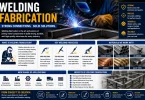
A field-tested rule of thumb: if a course can’t tell you exactly how many hours you’ll spend with a torch or gun in your hand versus sitting at a desk, that’s a red flag. The best programs I’ve seen run close to 70-80% hands-on time, similar to what you’d find in dedicated fabrication tracks that emphasize project-based learning over pure theory.
Process Selection Actually Matters More Than School Prestige
Here’s something almost every competitor buries or skips entirely: which process you train on determines which jobs you can even apply for.
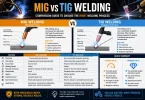
| Process | Best For | Typical Learning Curve | Common Industries |
|---|---|---|---|
| MIG (GMAW) | Fast production welding, thinner materials | Fastest to learn basics | Automotive, manufacturing, general fab |
| Stick (SMAW) | Outdoor and dirty conditions, thick steel | Moderate, harder to master aesthetics | Construction, pipeline, farm/ag repair |
| TIG (GTAW) | Precision welds, aluminum, stainless | Slowest, most technique-dependent | Aerospace, motorsports, food-grade, artistic fab |
| Flux-Cored (FCAW) | Heavy structural work, outdoor jobs | Similar to MIG, more forgiving in wind | Shipbuilding, structural steel, heavy equipment |
If your training program only teaches one process well, you’re narrowing your own job market before you even graduate. Look for programs that give you real stick time in at least two processes, not just a two-week overview of the ones they don’t emphasize.
Welding Training Program: The Timeline Nobody Gives You Straight
A welding training program length on paper rarely matches how long it takes to actually become job-ready. I’ve seen the gap firsthand.
Here’s a more honest breakdown:
- Basic entry-level competency: 4 to 7 months of consistent shop time. This gets you flat and horizontal position welds that pass a basic visual and bend test.
- Multi-position, multi-process competency: 9 to 18 months. This is what most manufacturing and structural employers actually want.
- Code-welder level (pipe, pressure vessel, aerospace): 18 months to 3 years, often including apprenticeship time after school.
A nuance most schools leave out: clock hours and skill hours aren’t the same. A student who shows up and grinds extra practice time on weekends will often out-test a classmate who did the bare minimum in the same program length. Ask any shop foreman and they’ll tell you they can spot the difference in an interview weld test within minutes.
What Happens If You Fail Your First Weld Test
This gets asked constantly and almost never answered publicly. Failing a 3G or 6G qualification test on your first attempt is common, not a sign you should quit. Programs with in-house retest options let you fix the specific defect (usually porosity, lack of fusion, or undercut) and retest within days. Programs without that built-in retest structure often leave students paying separately for a second exam slot, so ask about retest policy before you enroll, not after you fail.
Welding Trade School vs. Apprenticeship vs. Community College
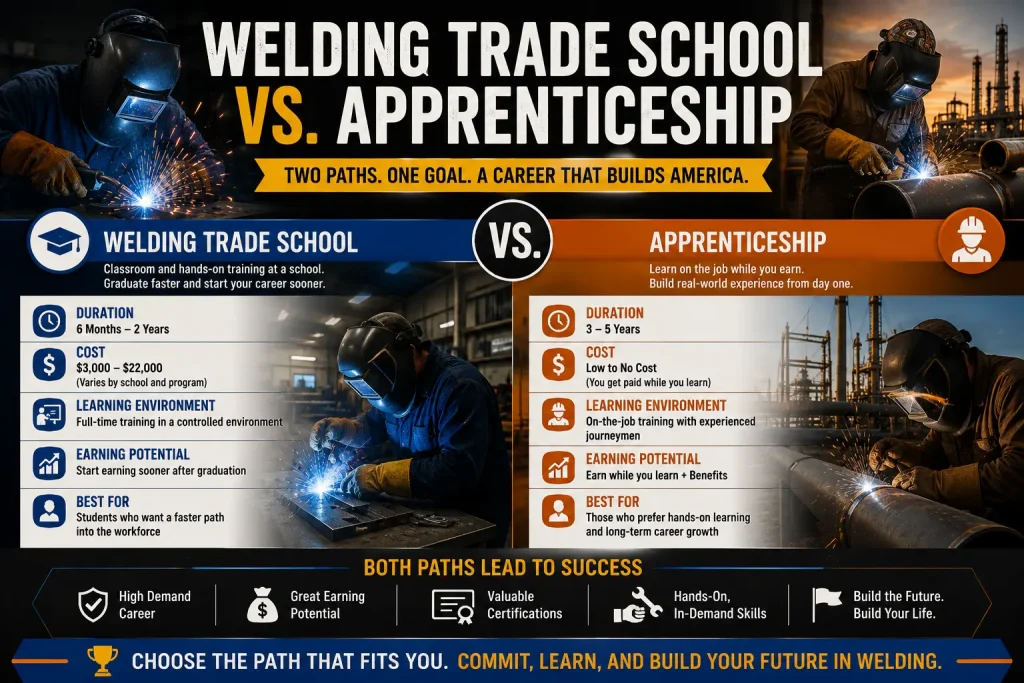
Every competitor article treats these as interchangeable. They’re not, and the differences change your first five years of income.
Welding trade school (private, accelerated):
- Fastest path to job-ready, often 6 to 12 months
- Higher upfront tuition, but concentrated shop time
- Best for career-changers who need speed and don’t want to commute to a campus for two years
A welding trade school works well if your priority is getting into the workforce fast and you can commit to full-time attendance.
Community college programs:
- Lower tuition, often eligible for broader financial aid and transfer credit
- Slower pace, usually 1 to 2 years, includes general education requirements
- Good if you want an associate degree that could later support a move into inspection, engineering technology, or supervision
Union or employer apprenticeships:
- You earn while you learn, often starting around 50% of journeyman wage and stepping up yearly
- 3 to 5 year commitment, but zero or near-zero out-of-pocket training cost
- Strongest path for pipeline, structural iron, and shipbuilding work where union locals control a lot of the hiring
None of these is objectively “best.” A single parent who can’t take a pay cut for a year is often better served by an apprenticeship. A 19-year-old who wants to be earning full wages fast might do better with an accelerated private program. Match the path to your actual financial situation, not to whichever school runs the most ads in your area.
The Physical and Health Side Nobody Mentions
Welding training pushes your body in ways that catch people off guard. Overhead welding for extended periods strains your neck and shoulders long before your technique fails. Fume exposure, even with proper ventilation, is a real long-term consideration, which is why OSHA-compliant fume extraction training should be part of any program you’re evaluating, not an afterthought mentioned once in orientation.
Practical things to check with a program:
- Do they provide respiratory protection training beyond “wear your hood”?
- Is there a dedicated ventilation system at each booth, or shared shop air?
- Do instructors correct posture and positioning, or just weld technique?
A program that treats safety as a full module, not a single afternoon, tends to produce welders who last decades in the trade instead of burning out their joints by year eight.
Virtual Reality Welding Simulators: Worth It or a Gimmick?
A growing number of programs now use VR welding simulators before students touch a live arc. This is genuinely useful for one specific reason: it lets students fail safely and repeatedly on arm angle, travel speed, and stick-out distance without burning through rod or wire. It should never replace live welding hours, though. If a school leans heavily on simulator time to pad its “training hours” total, ask directly how many hours are simulated versus live arc. The simulator builds muscle memory for motion. It cannot replicate heat, puddle behavior, or the smell that tells an experienced welder something’s wrong before they even see it.
Financial Aid and Real Cost Ranges
Tuition-only comparisons are misleading because they ignore total cost of attendance. Here’s a more complete picture:
- Private trade school programs: $12,000 to $22,000 total, often including gear and testing fees, though this varies widely by region and program length.
- Community college programs: $3,000 to $9,000 for a full certificate or associate track, plus separate costs for gear and certification exams.
- Apprenticeships: Little to no tuition cost, since training is funded by the union or employer, but expect a multi-year wage ramp-up period.
Federal grants, state workforce development funds, and veteran education benefits can offset private school costs significantly. Many students stack a Pell Grant with a state trade grant and cut their out-of-pocket cost by more than half. It’s worth a direct conversation with a school’s financial aid office about combining sources rather than assuming loans are the only option.
Welding Salary: What the Data Actually Shows
Training cost only matters in context of what the job pays back. Here’s the real number picture, pulled from federal labor data rather than a school’s marketing page.
- National median: Welders, cutters, solderers, and brazers earned a median annual wage of about $51,000 (roughly $24.52/hour) as of May 2024, according to the Bureau of Labor Statistics.
- Entry-level range: The bottom 10 percent of earners made under $38,130 a year, which is realistic for a first-year welder fresh out of training.
- Top earners: The highest-paid 10 percent cleared $75,850 a year, and that’s before factoring in specialty niches like pipeline, underwater, or aerospace welding, where six-figure income is achievable with the right certifications.
- Job outlook: BLS projects only 2 percent employment growth through 2034, which sounds unremarkable until you look at the openings number: about 45,600 positions a year, mostly from retirements and workers leaving the trade rather than from new job creation.
- The bigger picture from AWS: The American Welding Society’s workforce data estimates the industry needs roughly 330,000 new welding professionals by 2028, with tens of thousands of openings annually just to replace an aging workforce. A large share of today’s certified welders are already past 55, and the pipeline of younger entrants hasn’t kept pace.
What actually moves your pay beyond the median: the process you’re certified in, the code you can weld to (structural, pressure vessel, pipeline), your ability to pass out-of-position tests, and your willingness to travel or work in less popular locations. A welder with a 6G pipe certification will out-earn a flat-position-only welder in nearly every market, regardless of which school either one attended.
Pros and Cons of Going Into Welding
No career guide is honest without the downsides listed next to the upsides. Here’s a balanced look.
Pros:
- Strong job security driven by a genuine skills shortage, not just marketing hype
- Multiple entry paths (school, apprenticeship, military transfer) so you can pick what fits your finances
- Clear path to higher pay through added certifications, without needing a four-year degree
- Transferable skill across manufacturing, construction, energy, shipbuilding, and even art and motorsports
- Tangible, visible work; you finish a shift with something built, not just emails answered
Cons:
- Physically demanding, with real long-term strain on joints, eyes, and lungs if safety practices are skipped
- Income growth is uneven early on; the first year or two often pays close to entry-level regardless of training quality
- Some specialties require relocation or travel for the best-paying contracts (pipeline, offshore, turnaround work)
- Heat, fumes, and noise are part of daily work, even with modern ventilation and PPE
- Job satisfaction varies heavily by shop culture and management, more than most people expect going in
Welding Career Roadmap: From Trainee to Specialist
A welding career rarely moves in a straight line, but there’s a common progression worth planning around instead of discovering by accident.
- Pre-training (0-3 months): Basic safety orientation, equipment familiarization, and often a VR simulator phase before live arc work begins.
- Foundational training (3-9 months): Core process instruction in MIG, stick, or TIG, flat and horizontal position welding, blueprint reading basics.
- First certification and entry job (6-12 months): Pass an initial weld test, take an entry-level welder or welder’s helper role, usually in manufacturing or general fabrication.
- Multi-position, multi-process growth (1-3 years): Add out-of-position welding (vertical, overhead), cross-train in a second process, and pursue a second AWS-recognized qualification.
- Specialization (2-5 years): Choose a lane, structural steel, pipeline, pressure vessel, aerospace, underwater, or robotic welding, and pursue the code-specific certification that lane demands.
- Advancement (5+ years): Move into welding inspection (CWI), supervision, instruction, or sales, or stay hands-on and chase the highest-paying specialty contracts.
Most people treat step 3 as the finish line. It’s actually the starting line. The welders who see real income growth are the ones who keep adding qualifications after they’re already employed, not just the ones who finished a strong initial program.
FAQ: Welding Training Questions People Actually Ask
How long does welding training take before I can get hired?
Most people land an entry-level job after 4 to 9 months of solid training, though pipe and code-welding roles usually require closer to a year or more of combined school and practice time.
Can I learn welding on my own without a formal program?
You can learn basic technique from a home MIG unit and online videos, but you won’t get a recognized weld test certificate, which most employers require for anything beyond light fabrication work.
Is welding training physically hard on your body?
Yes, particularly overhead and out-of-position welding, which strain the neck, shoulders, and knees. Good programs teach ergonomics and positioning alongside technique to reduce long-term wear.
Do I need to be good at math for welding school?
Basic math helps with blueprint reading, angle calculations, and material thickness conversions, but you don’t need advanced math. Most programs teach the specific math you’ll use as you go.
What’s the difference between a welding certificate and AWS certification?
A school certificate confirms you completed a program. AWS certification (or a project-specific weld test to a code like D1.1) confirms you can produce a weld that meets an industry standard, which is what most employers actually check.
Can women succeed in welding training and the trade?
Yes, and demand for skilled welders regardless of gender continues to outpace supply in most regions. Some programs and unions now run outreach specifically to recruit and support women entering the trade.
What’s the minimum age to start welding training?
Most programs accept students at 16 to 18 depending on state law and whether it’s a high school career-tech program or a standalone trade school, with some requiring a parent’s signature for minors.
Does welding training transfer between states?
Skills transfer everywhere, but specific certifications may need to be re-tested depending on the state, employer, or governing code the new job requires.
How much does welding gear cost on top of tuition?
Budget $800 to $1,500 for a quality hood, gloves, jacket, boots, and hand tools, since cheap gear tends to fail faster and can affect weld quality and safety.
Can I switch careers into welding in my 30s or 40s?
Absolutely. Shops regularly hire career-changers, and physical conditioning plus consistent practice matters more than age. Apprenticeship programs in particular have no strict upper age cutoff in most trades.
You May Also Like It:
CNC Machining Tolerances: The Complete Expert Guide
Lock Out Tag Out (LOTO): The Complete Safety Guide
Prototype CNC Machining: The Complete Expert Guide
Steel Grade: The Complete Guide to Understanding Every Type of Steel