
What Is Welding Fabrication?
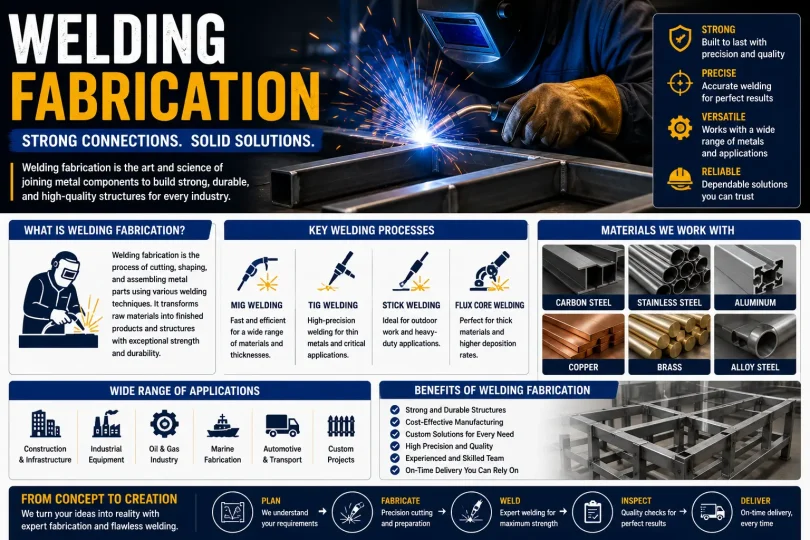
Welding fabrication is the process of taking raw metal stock and transforming it into a finished structure, machine part, or product through cutting, forming, welding, and finishing. It is not a single task. It is a complete workflow that starts on a designer’s screen and ends with an inspected, installed product that can carry real loads in the real world.
Many people use the words welding and fabrication as if they describe the same thing. They do not. Welding is one step inside fabrication, the step where two pieces of metal are permanently joined using heat. Fabrication is the larger journey: design, material selection, cutting, forming, welding, machining, finishing, and final inspection. Understanding this distinction matters because it changes how you plan a project, budget for it, and judge whether the finished part will actually perform.
If you are sourcing fabricated parts, training to become a welder, or simply trying to understand how raw steel becomes a finished structure, this guide walks you through every stage, with the practical detail that most articles on this topic leave out.
Welding Fabrication vs. Plain Welding: Why the Difference Matters
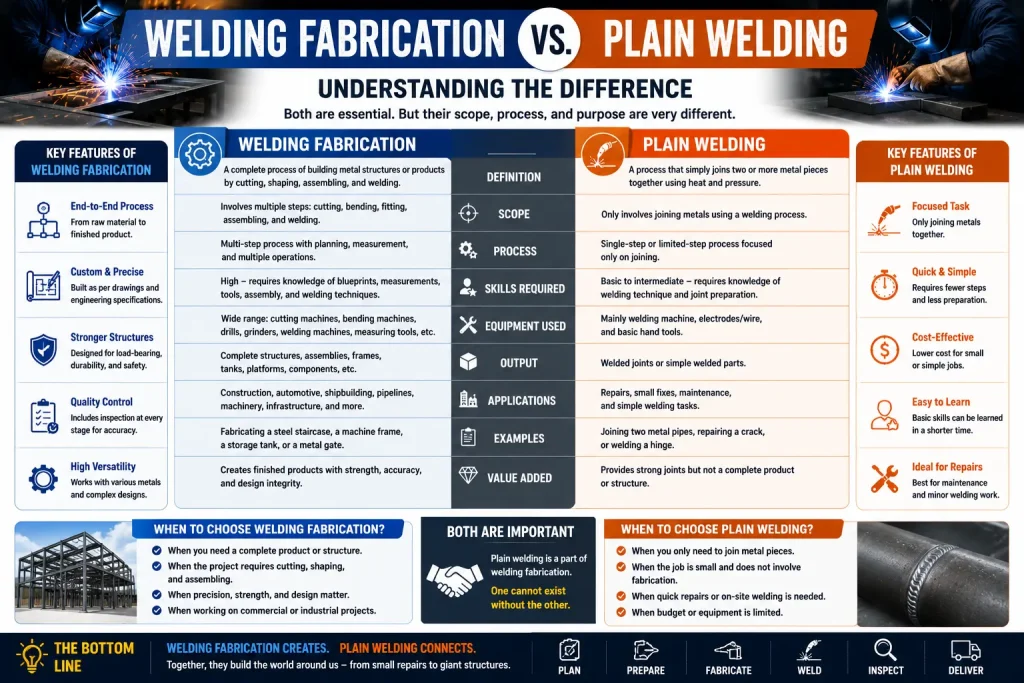
A hobbyist welder joins two pieces of metal in a garage and calls it welding. A fabrication shop takes a blueprint, sources the correct grade of steel, cuts it to exact tolerance, forms it into shape, welds it according to a qualified procedure, machines it to final dimension, inspects every joint, and ships a certified product. Both processes involve welding. Only one of them is fabrication.
This distinction is the reason fabrication shops exist as their own industry, separate from welding schools and hobby welding supply stores. Fabrication combines several skilled trades into one continuous process, and the quality of the final product depends on every single stage being done correctly, not just the welding itself.
The Welding Fabrication Process: Step by Step
A professional fabrication project moves through six core stages. Skipping or rushing any one of them is where most quality failures begin.
Step 1: Design and Engineering
Every fabrication project starts with a drawing. Today that drawing is usually a computer aided design (CAD) model, built to exact dimensions, tolerances, and material specifications. This stage also includes structural calculations, where engineers confirm the part can handle the loads, pressures, or stresses it will face in service.
A well-prepared design package includes the base material grade, thickness, weld joint types, required weld sizes, surface finish requirements, and any applicable industry codes, such as AWS D1.1 for structural steel or ASME Section IX for pressure vessels. Skipping detailed engineering at this stage is the single most common cause of expensive rework later.
Step 2: Material Selection
Choosing the right metal is not just about strength. It is about matching the material’s properties to how the part will actually be used. Key factors include:
- Weldability, since some alloys crack or become brittle when heated and cooled improperly
- Corrosion resistance, important for outdoor, marine, or chemical environments
- Strength to weight ratio, critical for aerospace, automotive, and transportable structures
- Cost and availability, since exotic alloys can multiply project cost
- Thermal conductivity, which affects how heat spreads during welding and how much distortion you should expect
Common materials in fabrication include mild steel, carbon steel, stainless steel, aluminum, and increasingly, specialty alloys like titanium and Inconel for aerospace and high temperature applications.
Step 3: Cutting and Forming
Once material is selected, it must be shaped to match the design. Modern fabrication shops rely on several cutting methods, chosen based on material, thickness, and the precision required:
- Laser cutting for tight tolerances and clean edges on thinner materials
- Plasma cutting for faster cuts on thicker steel, at a lower precision than laser
- Waterjet cutting for materials sensitive to heat, since it produces no heat affected zone
- CNC punching for repetitive hole patterns in sheet metal production
After cutting, parts are formed into their final shape through bending, rolling, or stamping. CNC press brakes are commonly used to create precise, repeatable bends, which is essential when a project involves dozens or hundreds of identical components.
Step 4: Welding and Assembly
This is the stage most people associate with the word fabrication, and it is where the components are permanently joined into a single structure.
Before final welding begins, fabricators use tack welds, small temporary welds, to hold pieces in position. Fixtures and jigs are used to maintain precise alignment throughout the welding process, since even small misalignments compound into significant errors across a large assembly. Joint preparation, including beveling edges and cleaning surfaces, directly affects how well the final weld penetrates and how strong it ultimately is.
The choice of welding process at this stage depends heavily on material, thickness, and the production volume involved. We cover the major processes in detail in the next section.
Step 5: Machining and Finishing
Welding introduces heat, and heat introduces distortion. After welds cool, parts often need precise machining to bring them back to exact final dimensions. This might include drilling mounting holes, facing surfaces flat, or threading fittings.
Finishing processes follow, including grinding welds smooth, sandblasting to remove scale, and applying protective coatings like paint, powder coat, or galvanization. Finishing is not cosmetic alone. A proper coating system is often the single biggest factor in how long a fabricated structure resists corrosion in the field.
Step 6: Inspection and Installation
Before a fabricated assembly leaves the shop, it should be inspected against the original design specification. This may involve visual inspection, dimensional checks against the CAD model, or nondestructive testing methods like ultrasonic or radiographic inspection on critical welds. Once approved, the assembly is transported and installed, often followed by a final field inspection to confirm everything fits and performs as designed.
Major Welding Processes Used in Fabrication
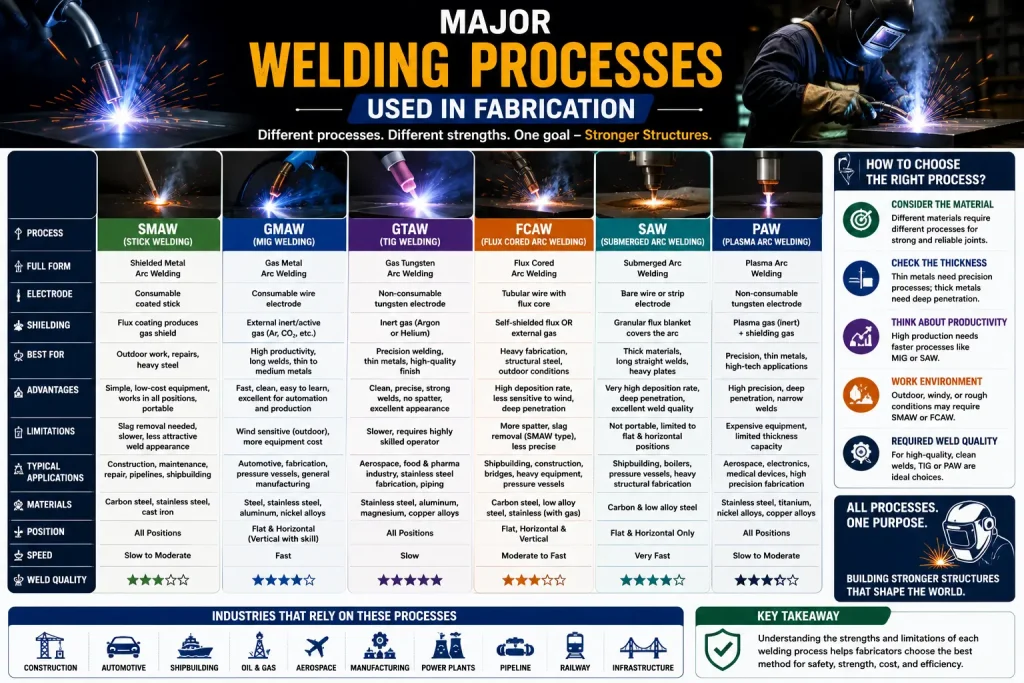
Choosing the correct welding process is one of the most consequential decisions in any fabrication project. Here is a practical breakdown of the processes you will encounter most often.
MIG Welding (GMAW)
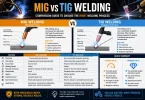
MIG welding, formally called Gas Metal Arc Welding, uses a continuously fed consumable wire electrode along with shielding gas. It is fast, relatively easy to learn, and produces good results on mild steel, stainless steel, and aluminum. This combination of speed and versatility has made MIG the workhorse process in general fabrication, automotive work, and production environments where output volume matters.
TIG Welding (GTAW)
TIG welding, or Gas Tungsten Arc Welding, uses a non-consumable tungsten electrode and a separately fed filler rod. It is slower and demands more operator skill, but it produces the cleanest, most precise welds available. TIG is the standard choice for thin materials, exotic alloys like titanium, and any application where weld appearance and integrity cannot be compromised, such as aerospace components and food grade stainless steel.
Stick Welding (SMAW)
Stick welding, formally Shielded Metal Arc Welding, uses a consumable electrode coated in flux. It does not require shielding gas, which makes it ideal for outdoor work, field repairs, and windy conditions where gas shielded processes would fail. Stick welding remains a staple in structural steel construction and pipeline work, particularly where portability matters more than speed.
Flux Cored Arc Welding (FCAW)
FCAW uses a tubular wire filled with flux instead of solid wire. It combines much of MIG welding’s productivity with stick welding’s tolerance for less than ideal conditions. FCAW is especially valuable in heavy fabrication, shipbuilding, and structural steel work, where speed and penetration on thick material matter more than a polished finish.
Submerged Arc Welding (SAW)
SAW feeds a wire electrode beneath a layer of granular flux, so the arc itself stays hidden, with no visible flash, no spatter, and very low fume generation. This process delivers extremely high deposition rates and deep penetration, which makes it the process of choice for long, straight, or circumferential welds on thick steel, common in pressure vessel and heavy plate fabrication.
Resistance Welding
Resistance welding, including spot and seam welding, joins metal using pressure and electrical current rather than an open arc. It is fast, highly automatable, and widely used in sheet metal assembly and automotive manufacturing, where thousands of identical, repeatable welds are needed.
Robotic and Automated Welding
Modern fabrication increasingly relies on robotic welding cells, which execute complex weld patterns with exact, repeatable parameters for travel speed, wire feed, voltage, and torch angle. The benefit is consistency at scale: a robot produces the same quality weld on part one thousand as it did on part one. This matters enormously for high volume manufacturing where even small defect rates translate into significant cost.
How to Choose the Right Welding Process: A Practical Framework
Most articles list welding processes without explaining how to actually choose between them. Use these five factors together, not in isolation, when deciding which process fits your project.
Material. Different metals respond differently to heat. Aluminum and titanium require more careful control than mild steel. Match the process to what the material can tolerate.
Application. Ask what the joint actually needs to do. A structural load bearing joint has different requirements than a pressure containing joint or a purely cosmetic joint.
Throughput. Low volume, high precision work favors manual TIG welding. High volume production favors MIG, resistance welding, or robotic automation.
Cost. Calculate the full cost per joint, including labor, consumables, equipment, and any post weld finishing required, not just the price of the welding machine itself.
Heat sensitivity. Thin sheet metal and tight tolerance assemblies need processes with a low heat affected zone, such as laser welding, TIG, or resistance welding, to avoid warping the part.
Common Weld Joint Types in Fabrication
The way two pieces of metal meet determines both how they are welded and how strong the final joint will be. The five basic joint types are:
- Butt joint: Two pieces meet end to end in the same plane, typically welded in a single pass
- Lap joint: One piece overlaps another, common in sheet metal work
- Tee joint: One piece meets another at a right angle, forming a T shape
- Corner joint: Two pieces meet at their edges to form an L shape or box corner
- Edge joint: Two pieces are parallel and joined along their edges
Joint design is one of the most overlooked factors in weld quality. The wrong joint geometry for a given load case can lead to premature cracking, even when the weld itself was executed perfectly.
Quality Control and Inspection in Welding Fabrication
This is a stage many guides skip entirely, yet it is often what separates a reliable fabrication partner from a risky one.
Welding Procedure Specifications (WPS)
Industrial fabrication should not rely on a welder’s personal judgment alone. A Welding Procedure Specification documents the exact parameters, including amperage, voltage, travel speed, and filler material, that have been tested and qualified to produce a sound weld for a specific material and joint type. Reputable fabrication shops weld to a qualified WPS, not by feel.
Welder Qualification
Welders working on structural, pressure, or safety critical components are typically certified to standards such as AWS D1.1 for structural steel or ASME Section IX for pressure equipment. Certification confirms a welder can consistently produce a sound weld under controlled test conditions, and it should be renewed periodically.
Nondestructive Testing (NDT)
Critical welds are often inspected without damaging the part, using methods including:
- Visual inspection, the first and most basic check, looking for surface defects like cracks, undercut, or porosity
- Ultrasonic testing, which uses sound waves to detect internal flaws invisible to the eye
- Radiographic testing, essentially an X-ray of the weld, used for the most critical joints
- Dye penetrant testing, which reveals surface breaking cracks not visible during a standard visual check
- Magnetic particle testing, used on ferromagnetic materials to find surface and near surface flaws
Common Weld Defects to Watch For
Understanding what can go wrong helps you evaluate whether a fabricated part meets the standard it should. The most common defects include porosity, where gas becomes trapped in the weld pool, undercut, where the base metal is eroded along the weld edge, lack of fusion, where the weld did not properly bond to the base metal, and cracking, which can occur during cooling if the metal was not properly preheated or the cooling rate was too fast.
Industries That Depend on Welding Fabrication
Welding fabrication underpins far more of daily life than most people realize.
Construction and structural steel. Building frames, bridges, and infrastructure rely on fabricated steel members joined to precise structural standards.
Automotive manufacturing. Vehicle frames, chassis components, and exhaust systems are produced through high volume robotic and resistance welding.
Aerospace. Aircraft components demand the tightest tolerances and highest quality welds, typically performed with TIG welding on titanium and aluminum alloys.
Oil and gas. Pipelines, pressure vessels, and refinery equipment require fabrication that meets strict pressure and safety codes.
Shipbuilding. Hulls and structural ship components use heavy fabrication techniques, often combining FCAW and SAW for speed on thick steel plate.
Energy and power generation. Power plant equipment, wind turbine towers, and industrial boilers all depend on certified welded fabrication.
Food and pharmaceutical processing. Hygienic stainless steel equipment requires precise TIG welding with smooth, crevice free finishes that prevent bacterial contamination.
Welding Fabrication Career Path and Skills
If you are considering a career in this field, it helps to understand what the path actually looks like.
Most welders begin with foundational training in MIG, TIG, stick, and flux cored welding, usually through a trade school or apprenticeship program lasting roughly nine months to two years. From there, many welders pursue additional certification in fabrication specifically, which adds blueprint reading, layout, fitting, and the math skills needed to plan and execute a complete fabrication project, not just a single weld.
Experienced fabricators often specialize, moving into roles such as pipe welder, structural welder, or robotic welding technician. According to industry data from the American Welding Society, the sector faces a meaningful skilled worker shortage, which means qualified, certified fabricators remain in strong demand across nearly every region.
Key skills that separate a strong fabricator from an average one include the ability to read complex blueprints accurately, a working knowledge of metallurgy and how different metals behave under heat, precision in layout and fitting work, and a disciplined approach to following qualified procedures rather than relying purely on instinct.
Cost Factors in Welding Fabrication Projects
Understanding what drives cost helps you plan realistic budgets and evaluate quotes intelligently.
Material cost varies enormously by metal type. Mild steel is the most economical, while stainless steel, aluminum, and exotic alloys like titanium can cost several times more per pound.
Labor and process choice matter directly. Manual TIG welding commands a higher hourly rate due to the skill required, while automated MIG or robotic welding reduces labor cost per part on high volume runs.
Complexity of design affects cost through the number of cuts, bends, and welds required, along with tolerance requirements. Tighter tolerances generally mean slower, more expensive production.
Finishing requirements add cost beyond the weld itself. Powder coating, galvanizing, and machining to final dimension all add time and expense on top of the base fabrication.
Inspection and certification needs raise cost for critical applications. A part requiring radiographic testing and certified documentation will always cost more than an uninspected structural bracket.
Safety in Welding Fabrication
Welding fabrication shops carry real hazards, and a quality fabrication partner treats safety as inseparable from quality, not as a separate department.
Workers face risks from arc flash and intense ultraviolet light, fumes generated during welding, fire and burn hazards from molten metal and hot surfaces, and noise from cutting and grinding equipment. Proper personal protective equipment, adequate ventilation, and clearly documented lockout tagout procedures for equipment maintenance are baseline requirements, not optional extras.
Shops that take safety seriously also tend to produce more consistent quality, since the same discipline that prevents accidents, careful procedure, attention to detail, and proper training, is exactly what produces sound, defect free welds.
Frequently Asked Questions About Welding Fabrication
What is the difference between welding and welding fabrication?
Welding is the act of joining two pieces of metal using heat. Welding fabrication is the complete process of turning raw material into a finished product, which includes design, material selection, cutting, forming, welding, machining, finishing, and inspection.
Which welding process is best for fabrication?
There is no single best process. MIG welding suits fast, high volume production. TIG welding suits precision work and exotic metals. Stick welding suits outdoor and field repair work. FCAW and SAW suit heavy, thick material fabrication. The right choice depends on material, application, volume, cost, and heat sensitivity.
How long does it take to become a welding fabricator?
Foundational welding training typically takes nine to ten months through a trade school program. Becoming a fully proficient fabricator, comfortable with blueprint reading, layout, and multiple welding processes, generally takes two to four years of combined training and on the job experience.
What metals are easiest to weld for beginners?
Mild steel is generally considered the most forgiving material for beginning welders, since it tolerates a wider range of technique errors than stainless steel or aluminum.
Why do fabricated parts need inspection after welding?
Welding introduces heat that can cause internal defects not visible from the surface, including porosity and lack of fusion. Inspection, particularly nondestructive testing on critical welds, confirms the part will actually perform safely under its intended load before it goes into service.
Is robotic welding replacing manual welders?R
obotic welding is expanding in high volume manufacturing, but it has not replaced manual welders. Skilled welders remain essential for custom fabrication, repair work, complex geometries, and programming and maintaining the robotic systems themselves.
Final Thoughts on Welding Fabrication
Welding fabrication is far more than joining metal with heat. It is a complete discipline that spans design, material science, precision cutting, skilled welding, careful finishing, and rigorous inspection. Every stage influences the final result, and overlooking any one of them is where quality failures and costly rework begin.
Whether you are evaluating a fabrication partner, planning your own training path, or simply trying to understand how the structures around you came to exist, the principle holds true across the entire industry: good fabrication is the sum of disciplined steps, not a single skilled weld.
You May Also Like It:
CNC Machining Tolerances: The Complete Expert Guide
MIG vs TIG Welding: Complete Guide to Differences and Procedures