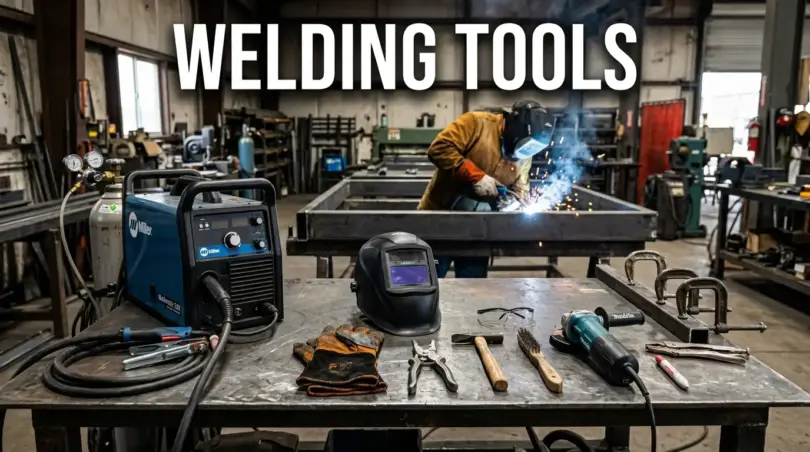

Welding tools are the machines, hand tools, power tools and safety gear used to join, cut, clean and finish metal safely. Every welding job differs in process, material and environment, so no single kit fits all work. MIG welding relies on a wire feeder and contact tips, TIG welding needs a torch and argon regulator, and stick welding depends on an electrode holder and chipping hammer.
For beginners, the right tool kit is about safety and weld quality as much as convenience. For professionals, good tools mean better productivity and consistent results. This guide covers the full welding tools list, from the basics to industrial setups.
What Are the Most Essential Welding Tools?
- Welding machine (MIG, TIG or stick, depending on your work)
- Welding helmet (auto-darkening is preferred)
- Welding gloves and protective clothing
- Clamps and locking pliers to hold workpieces
- Chipping hammer and wire brush to remove slag and dirt
- Angle grinder for cutting, grinding and weld preparation
- Measuring and marking tools such as a tape measure, square and marker
With these, you can start most basic welding and repair jobs.
What Are Welding Tools?
Welding tools include all equipment and accessories used before, during and after welding. That covers the machine that joins the metal as well as the smaller tools that hold, clean, measure and protect.
Welding Machine vs. Welding Hand Tools
A welding machine (the power source) produces the electric arc or heat that melts the metal. Hand tools such as pliers, hammers, brushes and clamps support the work through setup, positioning, cleaning and finishing. Without the machine there is no weld, and without hand tools it is hard to make a good one.
Role in Fabrication, Repair and Construction
- Fabrication: Building frames, tanks, gates and structures in a shop needs precise measuring and holding tools.
- Repair: Maintenance work favors portable machines and grinders.
- Construction: Jobsites such as structural steel and pipeline work need durable, portable, weather-resistant equipment.
Essential Welding Tools for Beginners
- Welding machine: A MIG welder is the easiest to learn on. A multi-process machine is also a good choice.
- Welding helmet: An auto-darkening helmet protects your eyes and face from arc light, spatter and UV radiation.
- Welding gloves: Heat-resistant leather gloves prevent burns.
- Welding jacket: A flame-resistant jacket shields your body from sparks and spatter.
- Welding clamps: Hold pieces in position so the joint stays square.
- Welding pliers: Cut wire, clean the nozzle and change contact tips in MIG welding.
- Chipping hammer: Removes slag after stick welding.
- Wire brush: Cleans rust before welding and residue afterward.
- Angle grinder: Cuts, grinds and bevels metal.
- Measuring and marking tools: A tape measure, square and marker keep fit-up accurate, since poor measurements ruin welds.
Types of Welding Tools
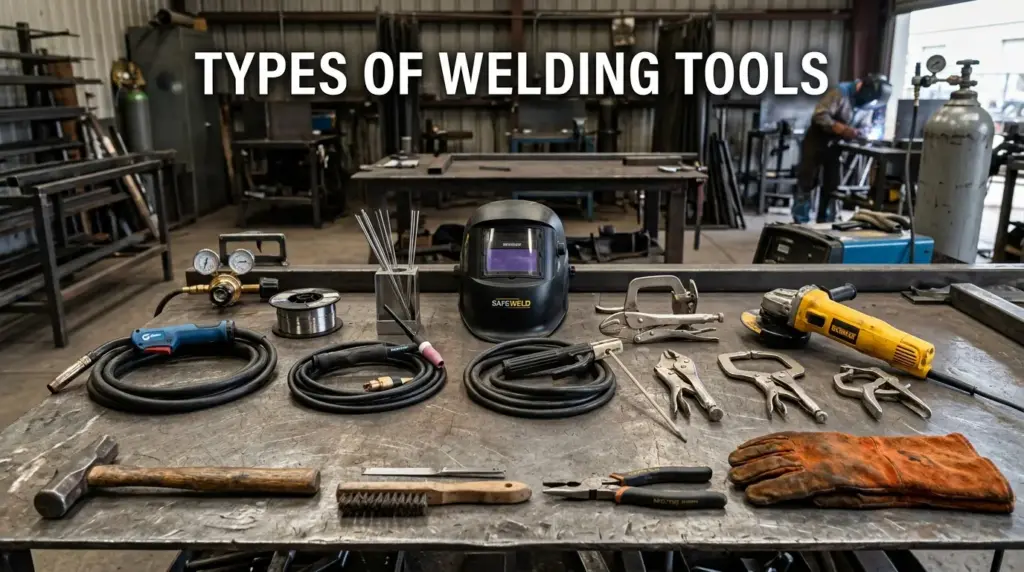
Welding Machines
- MIG welder: Uses a continuously fed wire. It is easy to learn and fast, which makes it common in workshops and auto repair.
- TIG welder: Uses a non-consumable tungsten electrode. It gives clean, precise welds on stainless steel, aluminum and thin metal, but takes more skill.
- Stick welder: Uses a coated electrode. It suits outdoor work, rusty or dirty metal and heavy repairs.
- Flux-cored welder: Uses tubular wire filled with flux. It can run outdoors without shielding gas and penetrates thick material well.
Welding Hand Tools
- Welding pliers: Wire trimming and nozzle maintenance.
- Chipping hammer: Breaking off slag.
- Wire brush: Surface and weld cleaning.
- C-clamps: Securing pieces to a table or jig.
- Locking pliers: Gripping awkward shapes firmly.
Welding Power Tools
- Angle grinder: Cutting, grinding, blending welds and removing rust.
- Die grinder: Finishing in tight spaces and inside pipes.
- Cut-off tool: Fast, straight cuts.
- Drill: Making holes in plates and brackets.
Welding Safety Tools
- Auto-darkening welding helmet: The lens darkens automatically when the arc starts.
- Welding gloves: Protection from heat and spatter.
- Protective clothing: Flame-resistant clothes, apron and boots.
- Safety glasses: Worn under the helmet during grinding and chipping.
- Respiratory protection: A respirator reduces exposure to welding fumes.
- Welding screens: Shield bystanders from arc flash.
Welding Tools for MIG Welding
MIG welding tools focus on wire delivery and torch maintenance.
- MIG welding machine: Controls power and wire speed.
- MIG gun: Delivers wire and shielding gas to the weld pool.
- Wire feeder: Feeds wire smoothly at a constant speed.
- Nozzle: Focuses shielding gas on the weld. Built-up spatter reduces gas coverage.
- Contact tips: Transfer current to the wire. They wear out, so keep spares.
- Welding pliers: Cut wire, clean the nozzle and replace tips.
- Anti-spatter tools: Spray or gel stops spatter from sticking to the nozzle and workpiece.
Welding Tools for TIG Welding
TIG welding demands precision, so its tools are more specialized.
- TIG torch: Holds the tungsten and delivers shielding gas.
- Tungsten electrode: Creates the arc. Its type and tip shape affect results.
- Argon gas regulator: Controls gas flow from the cylinder.
- Gas lens: Smooths gas flow for better coverage, especially in tight spots.
- Filler rods: Add material to the joint and are chosen to match the base metal.
- Foot pedal: Adjusts amperage in real time, useful on thin material.
Welding Tools for Stick Welding
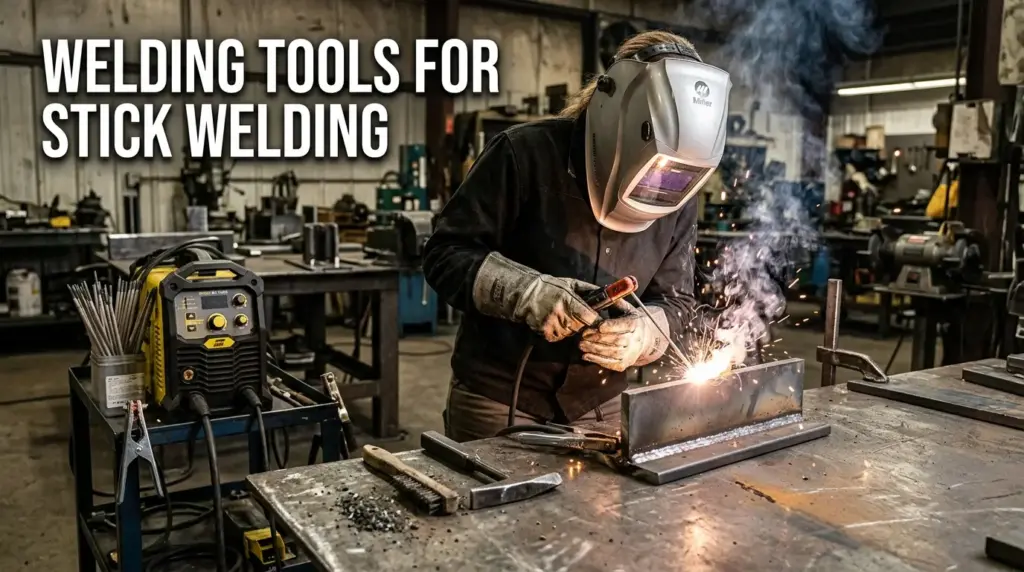
Stick welding uses a simple, portable setup.
- Stick welding machine: Supplies constant current.
- Electrode holder: Grips the electrode and carries current.
- Ground clamp: Completes the circuit. A solid connection is essential.
- Welding electrodes: Each type (such as 6013 or 7018) has its own use. Choose by base metal and position.
- Chipping hammer: Removes slag after each pass.
- Wire brush: Cleans the weld before the next pass.
Welding Measurement and Preparation Tools
A good weld starts with good preparation.
- Tape measure: Length and layout.
- Combination square: Checking 90° and 45° angles.
- Welding gauge: Checks weld size, leg length and reinforcement.
- Level: Keeps structures straight and plumb.
- Marker: Marks cut and weld points. Soapstone or paint markers work best on metal.
- Scriber: Makes fine, permanent lines on metal.
- Sheet metal tools: Snips, bending tools and hole punches for thin sheet work.
How to Choose the Right Welding Tools
- Type of welding process: MIG, TIG and stick each need different accessories.
- Material being welded: Steel, stainless steel and aluminum need different wire, rods and gas.
- Thickness of material: Thick metal needs higher amperage; thin sheet needs fine control.
- Job requirements: Precision work, structural work and general repair have different needs.
- Frequency of use: A budget machine suits occasional use; choose durable equipment for daily work.
- Workshop vs. jobsite use: Jobsites call for portable, dust-resistant, generator-compatible machines.
- Budget and tool quality: Very cheap tools often fail early. Never compromise on safety gear.
Welding Tools for Home vs. Professional Use
Basic Home Welding Tool Kit
- Entry-level MIG or multi-process welder
- Auto-darkening helmet, gloves and jacket
- Clamps and locking pliers
- Chipping hammer and wire brush
- 4.5-inch angle grinder
- Tape measure and square
Professional Welding Tool Kit
- Higher-duty MIG, TIG or multi-process machine
- Premium helmet and respirator
- Welding gauges and precision measuring tools
- Magnets, welding tables and jigs
- Die grinder and cut-off tool
- Spare consumables (tips, nozzles, electrodes)
Industrial Welding Tools
- Heavy-duty, high-amperage machines
- Automated or semi-automatic welding systems
- Positioners and fume extraction systems
- Gas manifolds and bulk gas supply
- Inspection equipment and certified safety gear
Welding Tool Maintenance and Storage
- Cleaning welding tools: Regularly remove spatter and dirt from pliers, nozzles and brushes.
- Inspecting cables and clamps: Look for cracks, loose connections and burn marks. Damaged cables waste current and create hazards.
- Maintaining grinders: Check the guard, disc and power cord. Replace worn or cracked discs immediately.
- Storing electrodes properly: Keep them dry. Moisture can cause porosity and cracking, and low-hydrogen electrodes need special storage.
- Replacing worn parts: Change contact tips, nozzles, liners and tungsten on time.
Common Welding Tool Mistakes to Avoid
- Using the wrong electrode: Produces weak or porous welds.
- Poor grounding: Makes the arc unstable and raises electrical risk.
- Using damaged PPE: Torn gloves or a cracked lens can cause serious injury.
- Incorrect grinder selection: Grinding with a cutting disc or using the wrong size is dangerous.
- Ignoring tool maintenance: A worn tip or dirty nozzle lowers weld quality.
- Using the wrong welding accessories: Wire size, tip size and gas must match the process.
Welding Tools Safety Tips
- Proper PPE: Always wear a helmet, gloves, jacket, boots and safety glasses.
- Ventilation: Use good airflow or fume extraction to avoid breathing fumes.
- Fire prevention: Clear flammable materials and keep a fire extinguisher nearby.
- Electrical safety: Work with dry hands in a dry area, and check cable condition often.
- Safe grinder operation: Keep the guard on, mount the disc correctly and hold the grinder with both hands.
- Gas cylinder safety: Secure cylinders upright, keep valve caps on and store them away from heat.
Welding Tools Checklist
| Tool | Main Use | Welding Type |
|---|---|---|
| Welding Helmet | Eye and face protection | All |
| Welding Gloves | Hand protection | All |
| Welding Pliers | Cleaning and nozzle work | MIG |
| Chipping Hammer | Slag removal | Stick |
| Wire Brush | Cleaning welds | All |
| Angle Grinder | Cutting and grinding | All |
| Welding Clamp | Holding workpieces | All |
| Tungsten Electrode | Creating the arc | TIG |
| Electrode Holder | Holding the electrode | Stick |
| Welding Gauge | Checking weld size | All |
Frequently Asked Questions About Welding Tools
What are the basic welding tools?
The basics are a welding machine, helmet, gloves, protective clothing, clamps, chipping hammer, wire brush, angle grinder and measuring tools.
What tools does a beginner welder need?
Start with a beginner-friendly MIG or multi-process welder, an auto-darkening helmet, gloves, a jacket, clamps, pliers, a wire brush and an angle grinder.
Which tools are used in MIG welding?
A MIG machine, MIG gun, wire feeder, nozzle, contact tips, welding pliers and anti-spatter products.
What tools are needed for TIG welding?
A TIG torch, tungsten electrode, argon regulator, gas lens, filler rods and a foot pedal.
What is the most important welding safety tool?
The welding helmet, because arc light can permanently damage your eyes. Gloves and protective clothing are just as important for the rest of your body.
What tools are used to clean a weld?
A wire brush, chipping hammer and angle grinder fitted with a flap disc or wire wheel.
What is the difference between welding tools and welding equipment?
“Welding equipment” usually means larger machines and systems such as welders, gas cylinders and positioners. “Welding tools” covers hand tools, power tools and accessories. In practice, people often use the two terms interchangeably.
Final Thoughts on Welding Tools
The right welding tools depend on your process, your material and the kind of work you do. Beginners should focus first on safety gear and one versatile machine, then add TIG or specialized tools as needs grow. Regular maintenance and proper storage extend tool life and keep weld quality high.
Put safety first, invest in quality tools, and keep practicing. That is the foundation of good welding results.
You May Also Like It:
Welding Training: What It Actually Takes to Become a Welder
Metal Fabrication Welding: A Complete, Practical Guide
Welding Fabrication: The Complete Guide to Process, Materials, and Quality