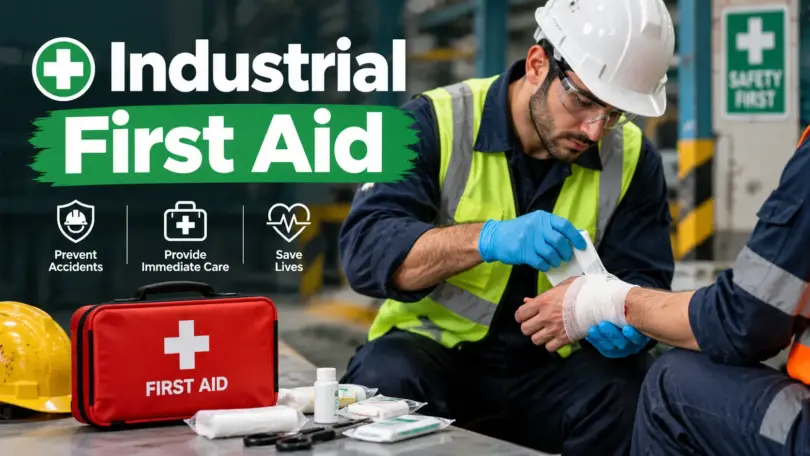

Industrial first aid is the immediate on-site care given for workplace injuries in high-risk environments like construction and industrial facilities, before emergency responders arrive. It combines the right supplies (in the US, typically an ANSI/ISEA Z308.1 Class B first aid kit for high-risk sites), a written emergency action plan, trained first aiders on every shift, and readiness for higher-severity events like heat stroke, electrical shock, and cardiac arrest not just cuts and burns. Exact legal requirements vary by country and region, so always confirm specifics with your local regulator.
What Is Industrial First Aid?
Industrial first aid is the immediate, on-site medical response given to a worker who’s been injured or become ill on a job site before professional emergency responders arrive. It covers everything from a deep cut caused by a grinder, to a burn from hot equipment, to a worker overcome by heat, to a fall from height.
The goal is simple: stop things from getting worse, control bleeding or shock, protect the injury, and keep the person stable until proper medical help takes over. It’s not about replacing a hospital it’s about buying time and preventing a bad injury from becoming a fatal one.
Industrial sites carry more risk than a typical office, so the response has to be more serious too. That’s the core difference between a basic first aid kit and true industrial first aid supplies the scale, the severity, and the type of injuries they’re built to handle.
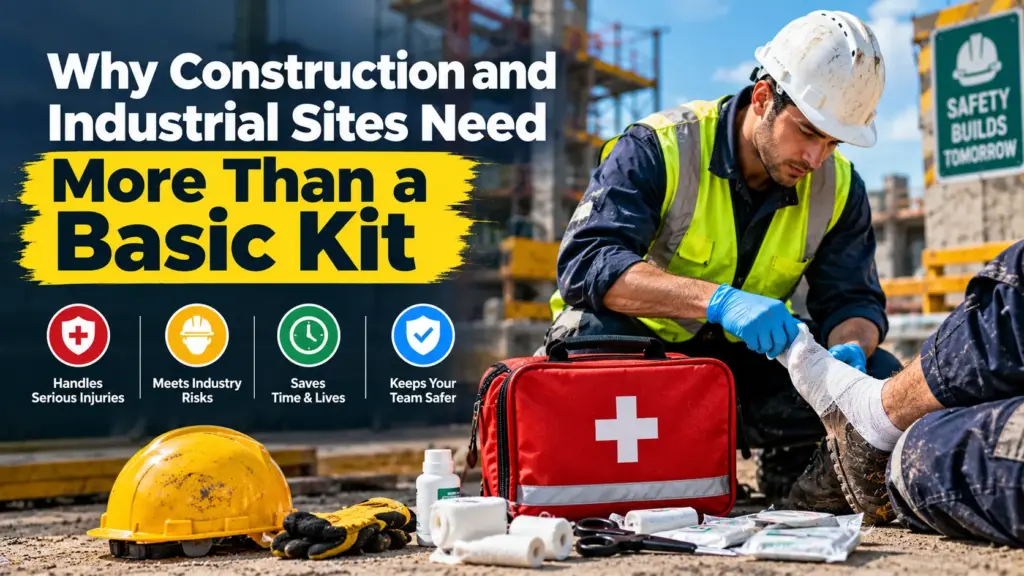
Why Construction and Industrial Sites Need More Than a Basic Kit
Think about what’s actually happening on a construction site or in an industrial facility on any given day:
- Power tools, saws, and grinders that can cause deep lacerations
- Heavy machinery and moving vehicles
- Working at height, with real fall risk
- Hot work welding, cutting, soldering
- Chemicals, solvents, and dust that can burn skin or eyes
- Confined spaces with limited air and limited room to maneuver
- Extreme heat or cold depending on the season
A kit designed for paper cuts and headaches simply isn’t built for any of that. Construction first aid kits need to handle heavier bleeding, larger wounds, burns, eye injuries, and shock because those are the injuries that actually happen on these sites.
This is exactly why regulators and safety bodies treat construction and industrial workplaces as “high-risk” categories that require a different, more robust class of first aid kit.
Build an Emergency Action Plan Before You Need One
A first aid kit without a plan is just a box of supplies. Every construction or industrial site should have a written Emergency Action Plan (EAP) that everyone on site actually knows not just a document sitting in a site office drawer.
A solid EAP covers:
- Who is in charge during an emergency a named site first aider or safety officer for every shift, with a backup if that person is unavailable
- How to raise the alarm a clear method (radio, whistle, phone tree) that works even in noisy or remote areas of the site
- Emergency contact numbers posted at the site entrance, in site offices, and in vehicles, including local emergency services and the nearest hospital with directions
- Evacuation and access routes how emergency vehicles physically reach the injured worker, especially on multi-level builds or sites with restricted access
- Roles during a response who calls for help, who meets the ambulance at the gate, who administers first aid, who controls the rest of the crew
- Site induction coverage every worker, including subcontractors and visitors, should be walked through the EAP basics on day one, not just handed a PDF
Run through this plan periodically, especially when the site layout changes or a new high-risk phase of work begins (like structural steel, height work, or hot work). A plan nobody’s rehearsed is a plan that falls apart under real pressure.
What the Standards Actually Require
You don’t need to memorize regulation numbers to run a safe site, but it helps to know what’s generally expected in a few major jurisdictions. Requirements vary by country, state/province, and sometimes by industry sector, so treat the following as a starting orientation, not a substitute for checking your local regulator’s current requirements.
In the United States OSHA’s general industry standard (29 CFR 1910.151) requires that adequate first aid supplies be readily available where there isn’t an infirmary, clinic, or hospital in near proximity; construction has its own related provisions under 29 CFR 1926. OSHA generally doesn’t prescribe exact kit contents, so most US employers reference the ANSI/ISEA Z308.1 standard developed jointly by the American National Standards Institute and the International Safety Equipment Association as the practical benchmark for what “adequate” looks like. That standard splits kits into two categories:
- Class A kits built for the most common workplace injuries: minor cuts, small burns, basic wounds. Typically sufficient for lower-risk workplaces like offices.
- Class B kits built for higher-risk, higher-traffic environments such as construction sites, industrial plants, and outdoor fieldwork. These carry more of everything more bandages, more burn treatment, more trauma pads reflecting the higher exposure to hazards.
For most active construction and industrial sites in the US, a Class B kit is the more appropriate starting point though your own hazard assessment should confirm this rather than assuming it applies universally.
In the United Kingdom the Health and Safety Executive (HSE) doesn’t mandate a fixed list of kit contents either. Instead, employers are expected to carry out a first aid needs assessment (considering workforce size, site hazards, and site spread) and stock kits accordingly, often referencing British Standard BS 8599 as a practical guide.
In Australia Safe Work Australia’s Model Code of Practice: First Aid in the Workplace treats construction work as inherently higher risk, and state/territory WHS regulators expect first aid provisions proportionate to that risk. Specific requirements can vary by state, so it’s worth checking your relevant state WHS regulator alongside the national code.
Elsewhere, the specific rule-making body changes, but the underlying principle tends to hold: the higher the risk, the more robust the first aid provision needs to be and that provision should be based on an honest hazard assessment of your actual site, not a generic assumption. If you’re unsure what applies to your site, your safety officer, WHS consultant, or local regulator’s guidance is the authoritative source this section is meant to orient you, not replace that check.
A quick way to figure out what you need:
- What kind of work is actually happening here? (cutting, welding, heights, chemicals?)
- How many people are on site workers, subcontractors, visitors at peak times?
- How spread out is the site? Do different areas need their own kit?
- How far is the nearest hospital or emergency service, realistically, in traffic?
If the answer to that last question is “more than an hour,” you need a more advanced kit with more trauma-focused supplies, because help is genuinely further away.
What Should Be Inside an Industrial First Aid Kit
Here’s where a lot of guides get vague. Let’s not do that. Below is what a properly stocked construction/industrial kit actually contains, grouped by what it’s for.
Wound care and bleeding control
- Adhesive bandages in assorted sizes
- Sterile gauze pads (3″x3″ and larger)
- Rolled gauze bandages
- Trauma pads (5″x9″) for larger wounds
- Adhesive cloth tape
- Triangular bandage (doubles as a sling)
- Elastic/roller bandages
Burns
- Burn dressings
- Burn gel or burn treatment packets
- Cold packs (instant, no refrigeration needed)
Eyes
- Eye wash solution (at least 1 oz, more for sites with dust or chemicals)
- Sterile eye coverings/pads
Infection control
- Antiseptic wipes or solution
- Antibiotic ointment packets
- Hand sanitizer
- Medical exam gloves (several pairs one use per glove)
Tools
- Scissors (trauma shears are better they cut through clothing and tape easily)
- Tweezers
- A breathing barrier / CPR face shield
Documentation and guidance
- A first aid quick-reference guide
- An incident log or notepad to record what happened and what was done
If your site involves chemicals or hazardous substances, add a chemical-specific eye wash station nearby and check the Safety Data Sheet (SDS) for that substance it will tell you if there’s a specific first aid response required beyond the standard kit.
If the site is remote or more than an hour from emergency care, consider upgrading to a trauma-focused kit with a tourniquet, larger compression bandages, and splinting material this is increasingly standard advice for isolated or high-risk sites.
How to Actually Use the Kit: A Step-by-Step Guide
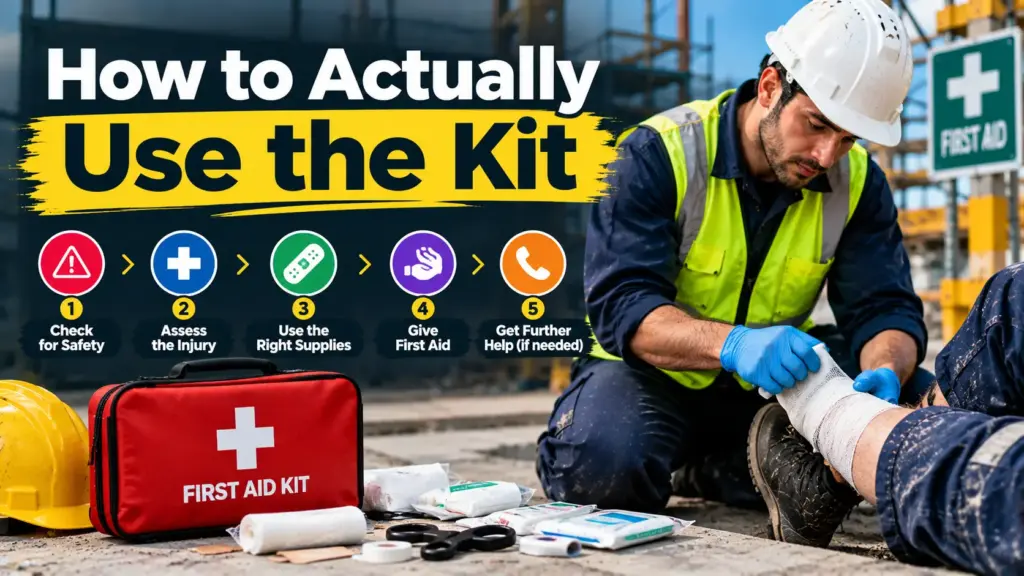
Having the kit is half the job. Knowing how to use it under pressure is the other half. Here’s a practical walkthrough for the most common site injuries.
Step 1: Make the Scene Safe First
Before you touch the injured person, check that you’re not about to become the second casualty. Is the machine switched off? Is there a live electrical hazard? Is something still falling? Only move in once it’s safe.
Step 2: Assess the Person
Check if they’re conscious and breathing. If they’re not breathing or unresponsive, call emergency services immediately and begin CPR if you’re trained this takes priority over everything else in the kit.
Step 3: Call for Help Early
Don’t wait to see “how bad it is” before calling emergency services on serious injuries deep cuts, suspected fractures, burns larger than a hand, head injuries, or anything involving loss of consciousness. Call first, treat while you wait.
Step 4: Control Bleeding
- Put on gloves from the kit before touching the wound.
- Apply direct, firm pressure with a sterile gauze pad or trauma pad.
- If blood soaks through, don’t remove the first pad add more on top and keep pressing.
- Once bleeding slows, secure the dressing with a roller bandage or tape.
- For a wound that won’t stop bleeding despite firm pressure, this is an emergency keep pressure on and get help en route immediately.
Step 5: Treat Burns
- Cool the burn with clean running water or a cold pack for several minutes don’t use ice directly on skin.
- Cover loosely with a sterile burn dressing. Don’t apply ointment to serious burns; leave that to trained medical staff.
- Never pop blisters.
- For chemical burns, flush continuously with water or eye wash and remove contaminated clothing if safe to do so.
Step 6: Flush Eye Injuries
- Use the eye wash solution to flush the affected eye continuously for at least 15–20 minutes if dust, debris, or chemicals are involved.
- Don’t let the person rub the eye.
- Cover with a sterile eye pad afterward and get them to a medical professional, even if it feels better.
Step 7: Manage Suspected Fractures or Sprains
- Don’t try to straighten or realign anything.
- Immobilize the area using a splint, triangular bandage, or whatever’s on hand to stop movement.
- Apply a cold pack to reduce swelling.
- Keep the person still and get medical help.
Step 8: Watch for Shock
Shock can follow any serious injury pale skin, rapid breathing, cold sweats, confusion. Lay the person down, keep them warm with a blanket or jacket, and keep talking to them calmly while help is on the way.
Step 9: Record What Happened
Once the person is stable, write down what happened, when, what was done, and who was involved. This matters for their ongoing care and for your site’s safety records.
Step 10: Restock Immediately
The moment the kit is used, restock it before the next shift. A half-empty kit is worse than no kit because everyone assumes it’s ready when it isn’t.
Heat Illness and Heat Stroke: Recognition and Response
Heat is one of the most underrated hazards on outdoor construction and industrial sites, and it kills workers every year often because early warning signs get brushed off as someone “just being tired.” Knowing the difference between heat exhaustion and heat stroke, and acting fast, matters as much as any bandage in the kit.
Heat exhaustion watch for:
- Heavy sweating, cool and clammy skin
- Weakness, dizziness, headache
- Nausea, muscle cramps
- Fast, weak pulse
What to do: Move the person to shade or a cool area immediately. Loosen clothing, give small sips of water if they’re alert and able to swallow, and cool them with water or a wet cloth. They should rest until fully recovered before returning to work.
Heat stroke a medical emergency watch for:
- High body temperature, hot and dry (or sometimes still damp) skin
- Confusion, slurred speech, or loss of consciousness
- Rapid, strong pulse
- Seizures
What to do: Call emergency services immediately heat stroke can be fatal within minutes to hours if untreated. While waiting, move the person to shade, remove excess clothing, and cool them as aggressively as possible wet cloths, water, fanning, ice packs at the neck, armpits, and groin if available. Do not give fluids if they’re not fully alert, due to choking risk.
Prevention matters more than treatment:
- Build in scheduled water breaks and shade access, especially during peak heat
- Encourage light-colored, breathable clothing where PPE requirements allow
- Watch out for each other heat illness often affects judgment before the person realizes something’s wrong
- Acclimatize new workers or those returning after time off gradually, since heat tolerance builds over days, not hours
Electrical Shock and Serious Trauma
Electrical incidents and major trauma (falls from height, crush injuries, being struck by machinery) are some of the most dangerous events on a job site, and they call for a different first response than a typical cut or burn.
Electrical shock:
- Never touch the person directly if they’re still in contact with the electrical source you risk becoming a second casualty. Cut power at the source if you can do so safely, or use a non-conductive object (dry wood, plastic) to separate them from the source if power can’t be cut.
- Once it’s safe, check breathing and responsiveness. Call emergency services immediately electrical injuries can cause internal damage, burns, and cardiac issues that aren’t obvious on the surface.
- Treat any visible burns as burns (see Step 5 above), but assume there may be deeper injury even if the skin looks only mildly affected.
- Begin CPR if the person is unresponsive and not breathing normally, and you’re trained to do so.
Serious trauma (falls, crush injuries, major impact):
- Do not move the person unless they’re in immediate danger (fire, unstable structure, traffic). Moving someone with a possible spinal or major fracture injury can cause further harm.
- Call emergency services immediately and describe the mechanism of injury (fall height, what struck them) this helps responders prepare.
- Control any severe bleeding using the direct pressure method (Step 4), while keeping the person as still as possible.
- Keep talking to them, keep them calm, and watch closely for signs of shock (Step 8) while help is on the way.
- If you suspect a spinal injury and the person must be moved due to immediate danger, try to keep the head, neck, and spine aligned as much as possible, ideally with more than one person assisting.
These situations move fast and the stakes are high this is exactly the kind of scenario where having trained first aiders on site, not just a stocked kit, makes the real difference.
AED and CPR: What You Need to Know
Cardiac arrest can happen from a range of causes on site electrical shock, heat stroke, or a medical event unrelated to the work itself and the first few minutes of response matter more than anything else for survival.
CPR basics:
- If someone is unresponsive and not breathing normally, call emergency services (or have someone else call while you start) and begin chest compressions immediately.
- Push hard and fast in the center of the chest roughly 100 to 120 compressions per minute allowing the chest to fully recoil between compressions.
- If you’re trained in rescue breaths, follow the ratio you learned; if not, hands-only CPR (continuous chest compressions) is still effective and recommended for untrained bystanders.
- Continue until emergency responders arrive and take over, or the person starts breathing normally.
AEDs (Automated External Defibrillators):
- An AED talks you through the process with voice prompts you don’t need to be a paramedic to use one safely.
- Turn it on, follow the prompts, attach the pads as shown on the diagram, and let the device analyze the heart rhythm. It will only advise a shock if one is actually needed.
- Use CPR and an AED together don’t stop compressions except when the device is actively analyzing or delivering a shock.
- On sites with an AED, its location should be as well-known and clearly signposted as the first aid kit itself a device nobody can find in an emergency doesn’t help anyone.
If your site doesn’t currently have an AED, it’s worth a real conversation with your safety team about adding one, particularly for larger sites, remote sites far from emergency services, or sites with older or higher-risk workforces. Regardless of AED availability, having multiple workers per shift trained in CPR not just one designated first aider significantly improves the odds of a good outcome, since you can’t guarantee the trained person will be the one nearby when it happens.
Where to Keep Kits and How Many You Need
A single kit at the site entrance isn’t enough for most construction sites. Good practice looks like:
- One kit per work zone or crew area, not just one central kit
- Kits placed within a short walk of high-risk work (cutting, welding, height work)
- Clearly signposted, unlocked, and never buried under equipment
- Every worker told where kits are during site induction not just written in a manual nobody reads
- A named, trained first aider on every shift who knows the kit and can lead a response
First Aid Training, First-Aider Ratios, and First Aid Rooms
A kit is only as good as the person using it. Training and staffing coverage are what turn “we have supplies somewhere” into “we can actually respond.”
Training At minimum, every site should have workers trained in basic first aid and CPR, refreshed periodically since skills and guidance both change over time (most certifications expect renewal every one to three years, depending on the course and region). Higher-risk sites those with hot work, height work, confined spaces, or heavy machinery benefit from a higher proportion of trained workers, not just a single designated person.
First-aider ratios How many trained first aiders you need per shift depends on site size, headcount, and risk level and this is genuinely one of the areas where local regulation and guidance differ the most between countries, states, and even industry sectors. Rather than quote a single number that won’t hold true everywhere, the practical approach is:
- Treat “one trained first aider per shift” as an absolute floor, not a target
- Scale up the number of trained first aiders as worker headcount, site spread, and hazard level increase
- Check your specific jurisdiction’s guidance (for example, HSE guidance in the UK, applicable state WHS codes in Australia, or your OSHA-consultant/insurer’s recommendation in the US) for any numeric ratio that applies to your site type and size
- When work areas are physically spread out, make sure a trained first aider is realistically reachable from every zone, not just present somewhere on site
First aid rooms Larger sites, or sites with a higher workforce count and higher-risk activity, often need a dedicated first aid room or station not just a wall-mounted kit. A first aid room typically includes:
- A clean, private space to treat an injured worker away from ongoing site activity
- A couch or bed, running water, and adequate lighting
- Larger first aid supplies and equipment than a portable kit can hold
- Clear signage and unobstructed access for a stretcher or ambulance crew
Whether a first aid room is required (versus a well-stocked portable kit being sufficient) again depends on your local regulator’s thresholds typically tied to workforce size and risk category so this is worth confirming directly with your safety officer or regulator rather than assuming a portable kit is always enough once a site grows past a certain size.
Keeping the Kit Ready
An industrial first aid kit is only useful if it’s actually stocked and current. Build this into your routine:
- Check kits weekly on active sites, monthly at minimum otherwise
- Replace anything used, expired, or damaged right away
- Check expiry dates on antiseptic, burn gel, and eye wash these do expire
- After any incident, restock before the next shift starts
- Keep a simple checklist taped inside the kit lid so anyone can do a quick inventory check
Frequently Asked Questions
What is the difference between a regular first aid kit and an industrial first aid kit?
A regular (Class A) kit is built for minor injuries typical of an office small cuts, headaches, splinters. An industrial or construction (Class B) kit carries larger quantities and more advanced supplies trauma pads, burn dressings, more eye wash, splinting material because job sites see more frequent and more severe injuries.
Is a first aid kit legally required on a construction site?
In most jurisdictions, some form of first aid provision is required, though the exact rule and threshold vary by country and region. In the US, OSHA requires adequate first aid supplies be available where a workplace isn’t near medical facilities. In the UK, employers must meet HSE first aid requirements based on a documented risk assessment. In Australia, WHS law treats construction work as high-risk and expects appropriate first aid provisions on site. Always confirm the specific requirement for your location with your local regulator, since exact obligations differ.
How many first aid kits does a construction site need?
There’s no single fixed number it depends on site size, worker count, and how spread out the work areas are. As a working rule, place a kit within easy reach of every active work zone rather than relying on one central kit, and increase the number of kits as worker headcount and site size grow.
What should never be missing from an industrial first aid kit?
At minimum: sterile gauze and trauma pads for bleeding, burn dressings and a cold pack, eye wash, antiseptic and gloves, trauma shears, a triangular bandage, and a first aid guide. Sites with chemical exposure should add extra eye wash and check the Safety Data Sheet (SDS) for substance-specific first aid steps.
How often should an industrial first aid kit be checked?
Weekly on active construction sites, and at least monthly on lower-activity industrial sites. Restock immediately after any use, and check expiry dates on antiseptic, burn gel, and eye wash regularly since these do expire.
Who is responsible for maintaining first aid kits on a job site?
Typically the site supervisor or a designated, trained first aider is responsible for checking, restocking, and ensuring kits stay accessible, unlocked, and clearly signposted and for making sure every worker knows their location during site induction.
How do you tell the difference between heat exhaustion and heat stroke?
Heat exhaustion involves heavy sweating, cool clammy skin, weakness, and nausea, and usually improves with rest, shade, and fluids. Heat stroke is a medical emergency hot, often dry skin, confusion, or loss of consciousness and needs emergency services called immediately along with aggressive cooling while help is on the way.
Does a construction site need an AED (defibrillator)?
Requirements vary by jurisdiction and site size, so check your local regulation, but many larger or higher-risk sites choose to have one regardless of a strict legal mandate, since early defibrillation significantly improves survival odds in sudden cardiac arrest. An AED is only useful if its location is well known and workers are willing to use it, so placement and basic awareness training matter as much as owning the device.
How many trained first aiders should a site have per shift?
This depends heavily on local regulation, site size, headcount, and risk level, so there’s no universal number. A trained first aider on every shift is a reasonable minimum starting point, scaling up as the site grows or risk increases check your jurisdiction’s specific guidance (HSE, relevant WHS regulator, or OSHA-aligned consultant guidance) for any required ratio that applies to your site.
What is an Emergency Action Plan and does my site need one?
An Emergency Action Plan (EAP) is a written plan covering who leads an emergency response, how to raise the alarm, emergency contacts, site access for responders, and defined roles during an incident. Most safety regulators expect some form of documented emergency planning for construction and industrial sites, and it’s good practice regardless of the exact legal threshold, since it turns a stocked kit into an actual coordinated response.
The Bottom Line
Industrial first aid comes down to four things: having the right supplies for the risks your site actually faces, a plan that turns those supplies into a coordinated response, trained people who know what to do under pressure, and readiness for the serious stuff heat illness, electrical shock, major trauma, cardiac arrest not just cuts and burns. A well-stocked kit sitting in a locked cupboard helps no one. A properly placed, properly maintained kit, backed by trained first aiders and a rehearsed emergency plan, is what actually saves time, reduces harm, and can be the difference between a minor incident and a fatality.
If you’re setting up or reviewing your site’s first aid provisions, start with a real hazard assessment, match your kit and staffing to the risks you found (not just a generic list), confirm the specific legal requirements for your jurisdiction, and make training, drills, and restocking part of your normal routine not an afterthought.
You May Also Like It:
Industrial Robot Safety: The Complete 2026 Guide for Facilities, Engineers & Safety Managers
Safety Topics: Guide to OSHA Safety Topics, Toolbox Talks, and Meeting Ideas
Industrial Safety Signs: The Complete Guide to Types, Meanings, Colors, and Standards