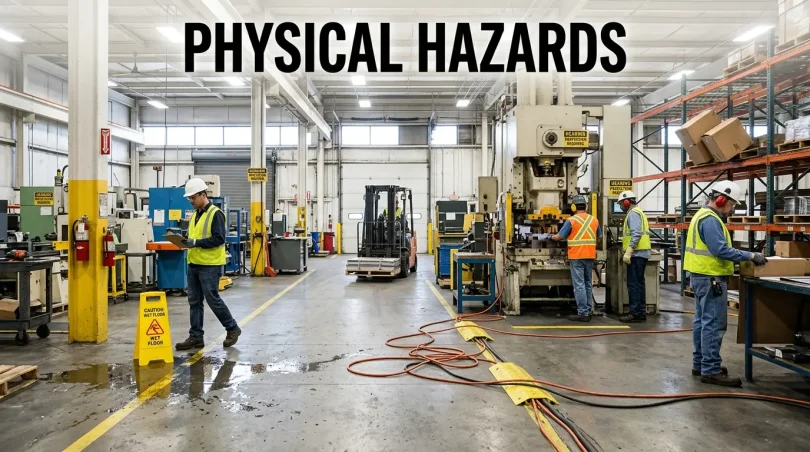

A physical hazard is any factor in the work environment that can cause bodily harm through the transfer of energy, whether or not it ever touches the worker. Hazards like noise, radiation, and extreme temperatures can injure someone from a distance, while hazards like electrical contact, machinery, and falls cause harm on direct contact. The main types of physical hazards are noise, vibration, radiation, temperature extremes, electrical hazards, fire, mechanical hazards, pressure hazards, and slip, trip, and fall hazards. OSHA requires employers to identify these hazards during routine walkthroughs, assess the level of risk, and apply controls in this order of priority: elimination, substitution, engineering controls, administrative controls, and personal protective equipment. Unlike chemical or biological hazards, physical hazards do not involve a toxic substance or living organism they are tied to energy sources and environmental conditions in the workplace.
In practice, the hazards that cause the most injuries are rarely exotic. In audits across manufacturing and warehouse floors, the same few gaps keep coming up: hearing protection that’s available but not actually worn near 90+ dBA equipment, machine guards left off after maintenance, and lighting that was adequate when a facility was built but never reassessed after racking or equipment changed the layout. Most physical hazard programs fail on follow-through, not on the initial written plan.
What Are Physical Hazards?
When people ask what are physical hazards, the simplest answer is this: they are sources of energy or physical conditions in a workplace that can injure a worker without any chemical or biological exposure. This includes things like loud machinery, unguarded moving parts, extreme heat or cold, live electrical wires, and slippery floors.
Workplace hazards are commonly grouped into categories such as physical, chemical, biological, ergonomic, and psychosocial hazards. Safety professionals and organizations may use different classification systems depending on the workplace and the risk assessment framework in use. What separates a physical hazard from the others is that the harm comes from a physical force or environmental condition rather than a toxic substance, a living organism, or a repetitive-strain body mechanic. Occupational physical hazards are consistently among the most frequently cited causes of workplace injury, which is why identifying and controlling them is a core part of any safety program.
Physical Hazards at a Glance
| Hazard Type | Common Source | Health Effect | Key Exposure Standard |
|---|---|---|---|
| Noise | Machinery, power tools, engines | Permanent hearing loss (NIHL) | OSHA PEL: 90 dBA TWA (8-hr); Action Level: 85 dBA (29 CFR 1910.95) |
| Vibration | Jackhammers, grinders, drills | Hand-Arm Vibration Syndrome (HAVS) | ACGIH/ISO 5349 exposure action value: 2.5 m/s² A(8); limit: 5.0 m/s² A(8) OSHA has no specific PEL and enforces under the General Duty Clause |
| Radiation | X-ray equipment, UV, lasers | Burns, tissue damage, cancer risk | OSHA 1910.1096: 1.25 rem/quarter whole-body (≈5 rem/yr prospective annual limit) |
| Heat | Outdoor work, foundries, kitchens | Heat exhaustion, heatstroke | Heat index 91–103°F = moderate risk; 103°F+ = high risk (NWS/OSHA) |
| Cold | Cold storage, outdoor winter work | Frostbite, hypothermia | CDC recommends scheduled warm-up breaks once wind chill drops below 20°F |
| Electrical | Exposed wiring, live panels | Shock, burns, electrocution | NFPA 70E arc flash PPE categories 1–4: 4 to 40 cal/cm² minimum arc rating |
| Mechanical | Conveyors, presses, saws | Crushing, cutting, entanglement | OSHA machine guarding, 29 CFR 1910.212 |
| Pressure | Boilers, compressed gas, hydraulics | Explosion, rupture, projectile injury | Governed by ASME Boiler and Pressure Vessel Code and OSHA 1910.169 (compressed air) |
Common Causes of Physical Hazards in the Workplace
Physical hazards usually come from a combination of the following:
- Inadequate machine guarding on moving or rotating parts
- Poor equipment maintenance leading to mechanical failure
- Defective or exposed electrical systems and wiring
- Inadequate ventilation or HVAC control
- Poor housekeeping, such as clutter or spills
- Insufficient lighting in work areas
- Lack of worker training on hazard recognition
- Failure to follow established safety procedures
- Excessive noise or vibration without protection
- Inadequate fall protection at height
- Extreme workplace temperatures without proper controls
Understanding what causes physical hazards is the first step toward preventing them, since most physical hazards are avoidable with proper maintenance, training, and safety protocols.
Types of Physical Hazards
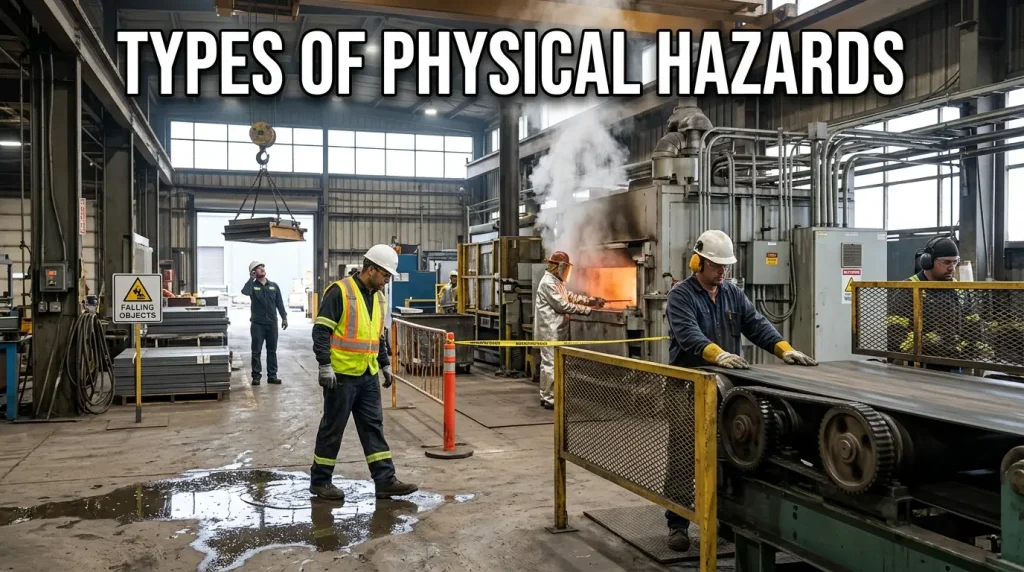
There are several recognized types of physical hazards that appear across different industries. Below are the most common categories, with the specific exposure thresholds that define when a hazard becomes a compliance issue.
1. Noise Hazards
A noise hazard occurs when employees are exposed to sound levels that exceed safe thresholds over time. Under 29 CFR 1910.95, OSHA’s permissible exposure limit (PEL) is 90 dBA as an 8-hour time-weighted average, and the action level that triggers a full hearing conservation program monitoring, audiometric testing, and hearing protection is 85 dBA. NIOSH recommends a stricter 85 dBA exposure limit using a 3 dB exchange rate, meaning every 3 dB increase halves the safe exposure time. Industries like manufacturing, construction, and aviation are especially prone to this hazard.
2. Vibration Hazards
Vibration hazards occur when workers use tools or machinery that transmit vibration into the hands, arms, or entire body. Over time, this can lead to Hand-Arm Vibration Syndrome (HAVS). ACGIH and ISO 5349 set a daily exposure action value of 2.5 m/s² A(8), above which controls and health surveillance are recommended, and an exposure limit value of 5.0 m/s² A(8) that should not be exceeded. OSHA has no dedicated vibration PEL and addresses it through the General Duty Clause. Jackhammers, power drills, and heavy construction equipment are common sources.
3. Radiation Hazards
Radiation hazards include exposure to ionizing radiation (such as X-rays) and non-ionizing radiation (such as UV light or lasers). Under 29 CFR 1910.1096, OSHA limits whole-body occupational dose to 1.25 rem per calendar quarter, which corresponds to a prospective annual limit of about 5 rem per year. Healthcare, manufacturing, and energy sectors often deal with this hazard, and it requires strict shielding, dosimetry monitoring, and access-restricted areas.
4. Temperature Extremes
Temperature extremes involve both excessive heat and excessive cold. On the heat side, OSHA and the National Weather Service treat a heat index of 91–103°F as moderate risk requiring heightened precautions, and 103°F and above as high risk requiring additional protective measures such as more frequent rest breaks and hydration monitoring. On the cold side, CDC guidance recommends scheduled warm-up breaks once wind chill drops below 20°F, with ACGIH work/warm-up schedules tightening further as wind speed increases. Outdoor construction workers and employees in foundries or cold storage facilities are commonly affected.
5. Electrical Hazards
Electrical hazards include exposed wiring, overloaded circuits, faulty equipment, and improper grounding. Beyond shock and electrocution risk, arc flash events are assessed using NFPA 70E’s four PPE categories, which require arc-rated clothing rated from 4 cal/cm² (Category 1, low-voltage panel inspection) up to 40 cal/cm² (Category 4, high-risk energized work). These hazards make electrical work one of the most serious physical hazard categories.
6. Slip, Trip, and Fall Hazards
Slip, trip, and fall hazards are among the most common causes of workplace injury across nearly every industry. Wet floors, uneven surfaces, poor lighting, and cluttered walkways all contribute to this risk category, and OSHA’s walking-working surfaces standard (29 CFR 1910.22) requires floors to be kept clean, dry, and orderly.
7. Fire Hazards
Fire hazards arise from flammable materials, faulty electrical systems, or improper storage of combustible substances. Fire prevention plans, proper storage under NFPA guidelines, and functioning fire suppression systems are essential controls.
8. Mechanical Hazards
Mechanical hazards come from moving machine parts and include risks such as crushing, cutting, shearing, and entanglement. These hazards are especially common around conveyor belts, presses, saws, and rotating equipment. OSHA’s machine guarding standard, 29 CFR 1910.212, requires that all points of operation, rotating parts, and pinch points be guarded.
9. Pressure Hazards
Pressure hazards arise from pressurized systems such as boilers, compressed gas cylinders, and hydraulic or pneumatic equipment. A sudden release of pressure can cause explosions, ruptures, or projectile injuries. Boilers and pressure vessels are typically governed by the ASME Boiler and Pressure Vessel Code, while OSHA 1910.169 addresses compressed air use, making regular inspection and pressure relief systems essential.
10. Lighting and Visibility Hazards
Poor lighting and visibility hazards increase the risk of slips, trips, falls, and contact with moving equipment, since workers may not see obstacles, edges, or hazards in time to react. Adequate lighting, especially in stairwells, loading areas, and walkways, is a simple but often overlooked control.
Physical Hazards Examples by Industry
Physical hazards look different depending on the work environment. Here are industry-specific examples of physical hazards, including a few sectors that don’t get as much attention as construction and manufacturing but carry equally significant risk.
Physical hazards in construction: falls from height remain one of the leading causes of death in this industry, often caused by working at height without fall protection, unstable scaffolding, or unguarded floor openings. Other common risks include exposure to loud machinery, electrical hazards from temporary wiring, and heat stress on outdoor sites.
Physical hazards in manufacturing: unguarded machinery, repetitive vibration exposure, high noise levels, and burns from hot surfaces.
Physical hazards in healthcare: exposure to radiation equipment, slips from spilled fluids, and injuries from moving or lifting patients and equipment.
Physical hazards in warehousing and logistics: forklift and pedestrian traffic collisions, workers struck by falling racked inventory, noise from material-handling equipment, and confined-space entry into trailers, silos, or storage tanks during loading and cleaning operations. A mistake I’ve seen repeatedly on warehouse floors is treating forklift lanes as a striping problem rather than a traffic-control problem paint alone doesn’t stop a blind-corner collision.
Physical hazards in oil and gas: high-pressure equipment, confined space entry into tanks and vessels, exposure to extreme temperatures on outdoor rigs, and noise from drilling and compression equipment. Confined space work in this sector typically requires atmospheric testing, a permit system, and standby rescue personnel before entry.
How Are Physical Hazards Different From Other Hazard Types?
Physical hazards are one of five commonly used hazard categories, and understanding where the boundaries sit helps with both hazard identification and OSHA recordkeeping classification.
- Physical vs. chemical hazards: Physical hazards involve energy or physical conditions, such as noise, heat, or electricity. Chemical hazards involve exposure to substances that can cause harm through inhalation, skin contact, or ingestion, such as solvents, gases, or corrosive materials.
- Physical vs. biological hazards: Physical hazards stem from energy and environmental conditions, while biological hazards come from exposure to living organisms such as bacteria, viruses, or mold. A construction site mostly deals with physical hazards, while a hospital or laboratory may face both physical and biological hazards side by side.
- Physical vs. ergonomic hazards: Physical hazards are tied to external energy sources, while ergonomic hazards come from how a task is physically performed repetitive motion, awkward postures, and manual lifting that cause musculoskeletal disorders over time. A forklift’s noise is a physical hazard; the awkward reach a driver uses to check a blind spot repeatedly is an ergonomic one. In practice, the two often overlap on the same job, which is why a hazard walkthrough should assess both.
Risk Assessment for Physical Hazards
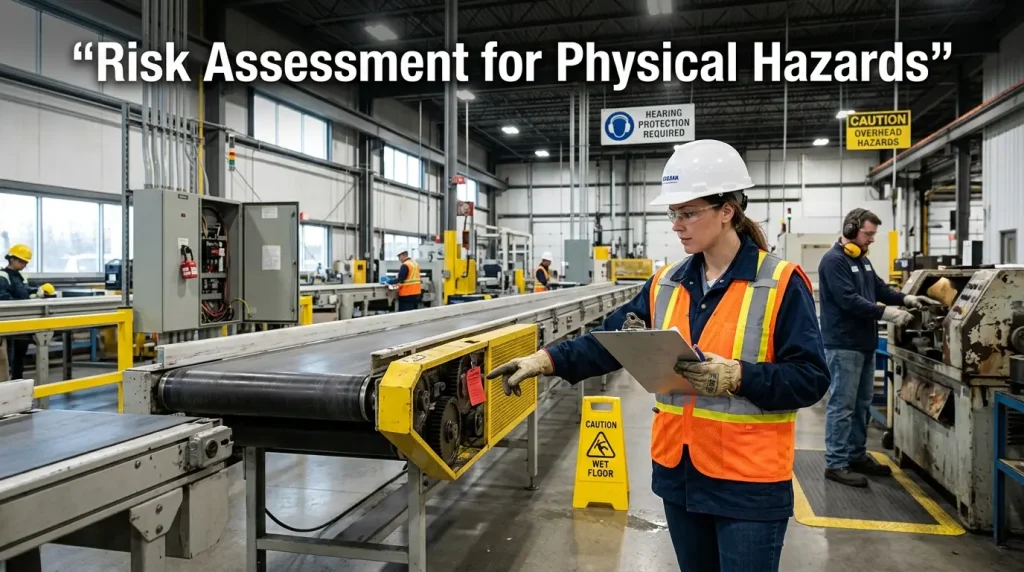
Identifying a hazard is only the first step the next is ranking it so limited safety resources go where they matter most. A standard approach scores each hazard along three factors:
- Severity: How serious would the injury be if the hazard caused harm first aid, lost time, permanent disability, or fatality?
- Likelihood: How probable is it that the hazard results in an incident, given current controls?
- Exposure duration and frequency: How often, and for how long, are workers actually near the hazard?
Multiplying rough scores for these three factors (for example, on a 1–5 scale) produces a risk ranking that separates hazards needing immediate action from ones that can be scheduled for the next maintenance cycle. A quiet packaging line with a minor guarding gap that few workers pass ranks very differently from a high-noise cutting station where operators stand for a full shift, even though both are technically “unguarded” or “loud.” This is also where the hierarchy of controls comes in: higher-risk hazards should be addressed with elimination or engineering controls first, not just added PPE.
PPE by Hazard Type
Generic PPE guidance (“wear the appropriate protection”) is one of the more common gaps in physical hazard programs. Matching PPE to the specific hazard and its severity matters:
- Noise: Hearing protectors with a Noise Reduction Rating (NRR) sufficient to bring exposure below the 85 dBA action level foam plugs typically offer an NRR around 25–33 dB, while earmuffs vary by model.
- Vibration: Anti-vibration gloves rated to ISO 10819, combined with limiting continuous trigger time on high-vibration tools.
- Radiation: Lead aprons and thyroid shields for ionizing radiation work, dosimeter badges for exposure tracking, and UV-rated eyewear for welding or laser work.
- Heat: Cooling vests or bandanas, light-colored breathable clothing, and hydration schedules paired with work/rest cycles once heat index passes 91°F.
- Cold: Insulated, layered clothing rated for the expected wind chill, with waterproof outer layers and warm-up break schedules.
- Electrical: Arc-rated clothing matched to the NFPA 70E PPE category for the task (4 to 40 cal/cm²), insulated gloves rated to the system voltage, and arc-rated face shields or hoods.
- Mechanical: Cut-resistant gloves, safety glasses with side shields, and steel-toe or metatarsal-guard boots near heavy equipment.
- Falls: Full-body harnesses with shock-absorbing lanyards, rated anchor points, and self-retracting lifelines for work above 6 feet in most general industry settings.
Common Mistakes in Physical Hazard Programs
A few patterns show up again and again in facilities that have a hazard program on paper but still see repeat incidents:
- Treating PPE as the primary control instead of the last resort. Handing out hearing protection is easier than fixing a loud machine, but the hierarchy of controls exists because PPE depends on consistent human compliance, which engineering fixes don’t.
- Reassessing hazards only after an incident. Layout changes, new equipment, and process changes shift exposure levels, but many programs only update their hazard assessment reactively.
- Assuming machine guards removed for maintenance get reinstalled. This is one of the most common OSHA citation triggers under 1910.212 the gap is almost always temporary, and almost always where the injury happens.
- Setting noise or vibration controls at the PEL instead of the action level. Waiting until 90 dBA to act, rather than 85 dBA, means workers spend more time above the level where measurable hearing damage begins.
- Confined space entries treated like routine tasks. In sectors like oil and gas and warehousing, confined space entry sometimes gets skipped past the permit and atmospheric-testing steps because “it’s just a quick check,” which is exactly when fatalities occur.
OSHA Physical Hazards Guidelines
OSHA addresses physical workplace hazards through standards and guidance covering areas such as occupational noise, electrical safety, machine guarding, fall protection, and heat-related hazards, rather than through a single universal definition. Employers are required to identify and control hazards in these areas as part of their overall safety management system. This guidance generally covers:
- Noise and hearing conservation standards (29 CFR 1910.95)
- Electrical safety standards
- Fall protection standards
- Heat and cold stress guidance
- Machine guarding requirements (29 CFR 1910.212)
OSHA compliance in this area means employers must conduct regular hazard assessments, provide appropriate PPE, train employees on hazard recognition, and maintain equipment to reduce risk. Internationally, ISO 45001 provides a similar framework, encouraging a continuous cycle of hazard identification, risk assessment, and improvement.
How to Identify Physical Hazards
Knowing how to identify physical hazards is the foundation of any prevention plan. This typically involves:
- Conducting routine walkthroughs and workplace inspections
- Reviewing incident and near-miss reports for recurring patterns
- Collecting employee feedback on conditions they encounter daily
- Measuring exposure levels, such as noise (dBA) or vibration (m/s²), with calibrated equipment
- Reassessing hazards whenever new equipment, processes, or work areas are introduced
Once hazards are identified, they can be scored using the severity-likelihood-exposure method above so controls are applied where they matter most.
How to Prevent Physical Hazards
Knowing how to prevent physical hazards starts with a structured approach rather than a one-time fix. The most effective strategies include:
- Conducting regular hazard assessments to identify new or overlooked risks.
- Applying engineering controls such as machine guards, proper insulation, and soundproofing.
- Implementing administrative controls like job rotation, rest breaks in extreme temperatures, and clear signage.
- Providing appropriate, hazard-matched PPE, following the breakdown above.
- Training employees to recognize hazards and respond correctly when conditions change.
- Maintaining equipment on a regular schedule to prevent electrical faults or mechanical failure.
How to Control Physical Hazards
Controlling physical hazards follows the standard hierarchy of controls used across occupational safety:
- Elimination: Remove the hazard entirely where possible, such as replacing a noisy machine with a quieter model.
- Substitution: Replace a hazardous process with a safer alternative.
- Engineering controls: Install barriers, guards, or ventilation systems.
- Administrative controls: Adjust schedules, provide training, and enforce safety procedures.
- Personal protective equipment: Use PPE as the last line of defense when other controls cannot fully eliminate the risk.
This hierarchy applies whether you are dealing with noise, vibration, radiation, temperature extremes, or any other type of physical hazard.
Frequently Asked Questions
What are physical hazards?
Physical hazards are workplace dangers caused by energy sources or environmental conditions, such as noise, electricity, extreme temperatures, and moving machinery, rather than chemical or biological exposure. They can harm a worker whether or not the hazard makes direct contact with the body.
What causes physical hazards?
Poor equipment maintenance, lack of machine guarding, faulty wiring, poor housekeeping, inadequate lighting, and prolonged exposure to noise or vibration above the 85 dBA action level are among the most common causes.
How can physical hazards be prevented?
Through regular hazard assessments, engineering controls, proper training, and hazard-matched PPE, following the OSHA framework and the standard hierarchy of controls.
What is the OSHA noise exposure limit?
OSHA’s permissible exposure limit is 90 dBA as an 8-hour time-weighted average, with a lower 85 dBA action level that triggers a full hearing conservation program under 29 CFR 1910.95.
What is the difference between a physical hazard and a safety hazard?
A physical hazard is a workplace condition or source of physical energy that can cause harm, such as noise, radiation, heat, electricity, or moving machinery. Safety hazard is a broader workplace-safety term often used for conditions that can cause accidents or injuries, including falls, struck-by hazards, caught-in hazards, and unsafe equipment.
How are workplace hazards typically categorized?
Workplace hazards are commonly grouped into categories such as physical, chemical, biological, ergonomic, and psychosocial hazards. Different organizations and risk assessment frameworks may use slightly different groupings, but physical hazards are consistently one of the most frequently encountered categories.
Can a physical hazard cause harm without touching a worker?
Yes. Hazards like noise, heat, radiation, and cold can damage the body from a distance through prolonged exposure, unlike hazards such as machinery contact or falls, which require direct physical interaction.
What heat index is considered dangerous for outdoor work?
A heat index of 91–103°F is considered moderate risk requiring extra precautions, while 103°F and above is high risk requiring more frequent breaks, hydration, and close monitoring, per OSHA and National Weather Service guidance.
What industries have the highest risk of physical hazards?
Construction, manufacturing, oil and gas, healthcare, and warehousing/logistics tend to report the highest rates of physical hazard exposure due to heavy machinery, working at height, confined spaces, and exposure to noise, vibration, and temperature extremes.
Who is responsible for controlling physical hazards in the workplace?
Under OSHA’s General Duty Clause, employers are legally responsible for providing a workplace free of recognized hazards likely to cause death or serious physical harm, including physical hazards. Workers also have a role in following safety procedures and reporting hazards.
What is the first step in managing physical hazards?
The first step is hazard identification, typically done through workplace inspections, incident reports, and employee feedback, followed by a risk assessment scoring severity, likelihood, and exposure duration to prioritize which hazards need controls first.
Do physical hazards apply to office environments too?
Yes, though at lower intensity. Offices can still have physical hazards such as poor lighting, trip hazards from cables, extreme temperatures from faulty HVAC systems, and electrical hazards from overloaded outlets.
How often should physical hazards be reassessed?
Physical hazards should be reassessed regularly, such as during routine safety audits, after any incident or near miss, and whenever new equipment, processes, or work areas are introduced.
Final Thoughts
Physical hazards remain one of the most common and preventable causes of workplace injury. The programs that actually reduce incidents aren’t the ones with the most detailed written policy they’re the ones that catch the guard left off after maintenance, act at the 85 dBA action level instead of waiting for the 90 dBA PEL, and reassess exposure whenever the floor plan or equipment changes. By understanding the specific exposure limits behind each hazard type, recognizing examples across industries, and applying the standard hierarchy of controls, organizations can build a safer work environment through continuous hazard identification, risk scoring, and employee training.
You May Also Like It:
Industrial Robot Safety: The Complete 2026 Guide for Facilities, Engineers & Safety Managers
Safety Topics: Guide to OSHA Safety Topics, Toolbox Talks, and Meeting Ideas
Industrial Safety Signs: The Complete Guide to Types, Meanings, Colors, and Standards
Safety Equipment Supplier: The Complete Buyer’s Guide for US Businesses