
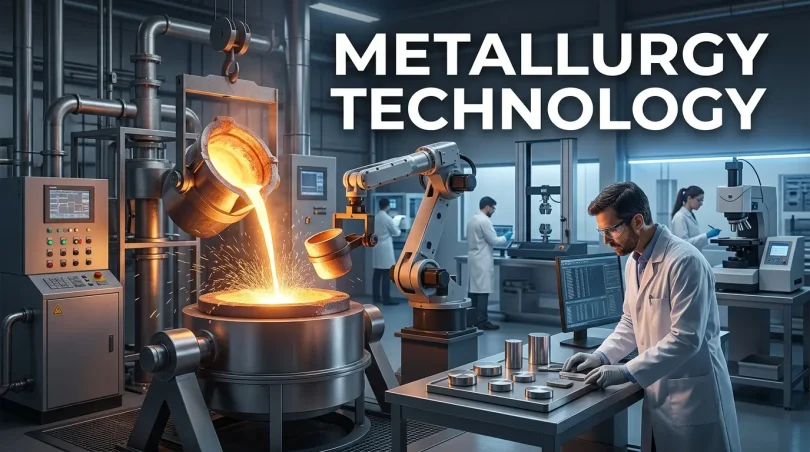

Metallurgy technology is the branch of materials science and engineering that studies the physical and chemical behavior of metals and applies that knowledge to extract, refine, and shape metals for industrial use. Its three core branches are extractive metallurgy (recovering metal from ore), physical metallurgy (studying structure and properties), and mechanical metallurgy (shaping metal through force). Powder metallurgy and vacuum metallurgy are specialized branches built on these core principles, focused on precision manufacturing and high-purity processing.
What Is Metallurgy Technology?
Metallurgy technology refers to the scientific and industrial processes used to obtain metals from raw ores and transform them into usable materials and products. It sits at the intersection of chemistry, physics, and engineering, giving industries the tools to produce everything from steel beams to aircraft-grade alloys.
Unlike traditional metalworking, which relies on craft and experience, metallurgy technology is grounded in scientific principles that explain why metals behave the way they do at a molecular level. This understanding is used to control strength, corrosion resistance, conductivity, and durability.
A person who specializes in this field is called a metallurgist. Their work supports nearly every modern industry, including construction, automotive, aerospace, electronics, and energy.
How Does Metallurgy Work?
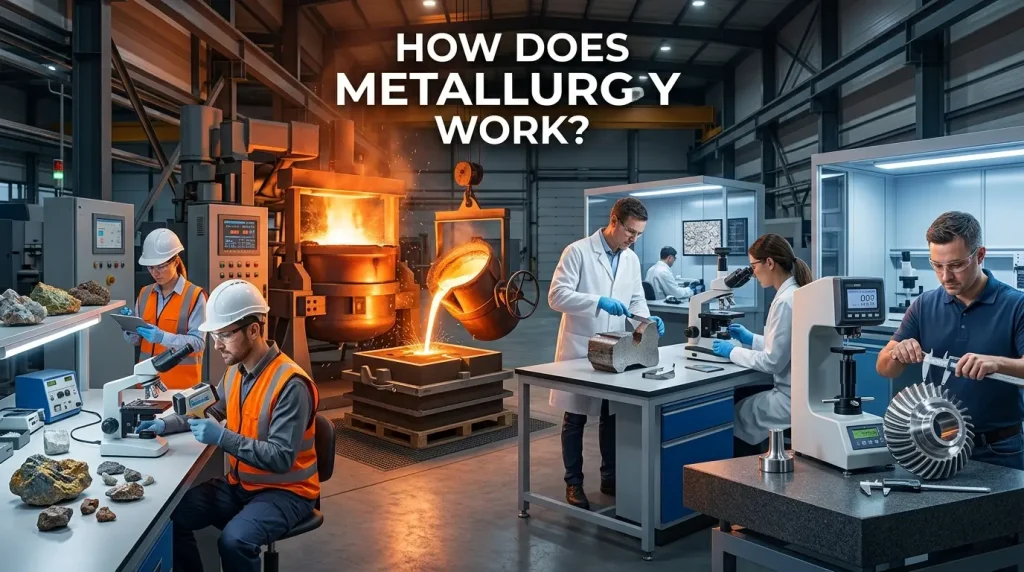
At its core, metallurgy works by manipulating the composition and internal structure of metals to achieve desired properties. This happens in three general stages:
- Extraction – metal is separated from ore using heat or chemical reactions
- Refinement and alloying – impurities are removed and other elements are added to adjust strength, hardness, or resistance to corrosion
- Shaping and finishing – the refined metal is formed into a usable part through casting, forging, machining, or additive methods
The specific combination of these stages depends on the metal involved and the performance requirements of the final product.
At the center of this process is a relationship metallurgists rely on constantly: composition, processing, microstructure, and properties are directly linked. Changing what elements go into a metal, or how it is heated, cooled, or deformed, changes its internal microstructure, the arrangement of grains, phases, and defects at a microscopic level. That microstructure, in turn, determines the metal’s real-world properties, including strength, hardness, ductility, and resistance to corrosion or fatigue. Controlling this chain is what allows metallurgists to design a metal for a specific purpose rather than relying on trial and error.
Types of Metallurgy
Metallurgy is generally organized into three core branches. Powder metallurgy and vacuum metallurgy are specialized disciplines that apply the same underlying science to more specific manufacturing and processing needs, rather than standing as equivalent categories.
Extractive Metallurgy
Extractive metallurgy focuses on separating valuable metal from ore. Key processes include:
- Smelting – using heat and chemical reactions to extract metal from ore
- Leaching – dissolving metal from ore using chemical solvents
- Refining – purifying extracted metal to remove impurities
- Recycling – recovering metal from scrap for reuse, reducing raw material demand
This branch is essential to mining and heavy industry and forms the foundation of the global metal supply chain.
Physical Metallurgy
Physical metallurgy studies the internal structure of metals at a microscopic level and how that structure affects properties like strength, ductility, and corrosion resistance. It includes:
- Alloy development
- Heat treatment processes such as annealing and quenching
- Microstructure analysis using metallography
- Failure analysis to understand why metal components crack or fail
Physical metallurgy is what allows engineers to design metals with specific performance characteristics for a given application.
Mechanical Metallurgy
Mechanical metallurgy deals with shaping metal into finished parts through physical force. Common techniques include:
- Forging
- Rolling
- Extrusion
- Welding
- Machining and CNC cutting
This branch bridges the gap between raw material and finished product and is central to manufacturing industries worldwide.
Powder Metallurgy (Specialized Manufacturing Discipline)
Powder metallurgy produces parts by compacting metal powder into a mold and then sintering it under heat, without fully melting the metal. It is valued for:
- Near-net-shape manufacturing with minimal material waste
- Producing complex geometries difficult to achieve with casting
- High-volume, cost-efficient part production for automotive and industrial use
Because it generates significantly less scrap than traditional forming methods, powder metallurgy is often considered a more resource-efficient manufacturing route.
Vacuum Metallurgy (Specialized Processing and Refining Technology)
Vacuum metallurgy processes metals in a controlled, low-pressure environment to prevent contamination from atmospheric gases. Applications include:
- Vacuum degassing of molten steel
- Vacuum arc remelting for high-purity alloys
- Thin-film metal deposition used in semiconductors and optics
This technology is critical for producing ultra-clean metals used in aerospace, medical devices, and electronics.
Comparison Table
| Type | Main Purpose | Common Processes | Typical Applications |
|---|---|---|---|
| Extractive | Recover metal from ore | Smelting, leaching, refining | Mining, raw metal supply |
| Physical | Control structure and properties | Heat treatment, alloying, metallography | Aerospace, automotive |
| Mechanical | Shape and strengthen metal | Forging, rolling, extrusion, welding | General manufacturing |
| Powder | Produce near-net-shape parts | Compaction, sintering | Automotive, industrial components |
| Vacuum | High-purity processing | Degassing, arc remelting | Aerospace, electronics, medical |
Key Metallurgical Processes
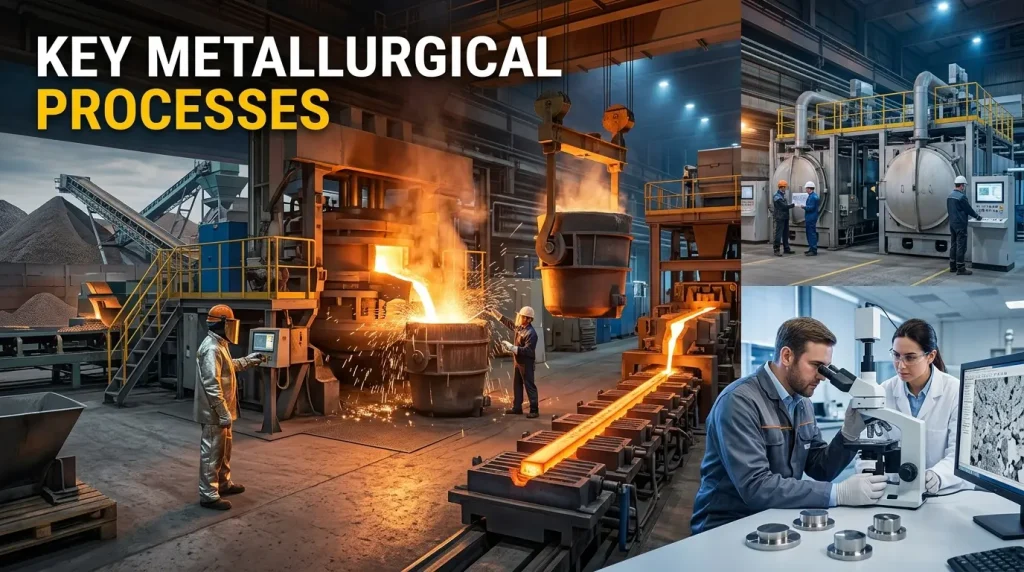
Across all branches, a set of core processes repeats in different combinations:
- Smelting – extracting metal from ore using heat
- Refining – removing impurities from extracted metal
- Alloying – combining metals or adding elements to change properties
- Heat treatment – altering strength and hardness through controlled heating and cooling
- Casting – pouring molten metal into a mold to form a shape
- Forging – shaping metal using compressive force
- Rolling – passing metal through rollers to reduce thickness or change shape
- Welding – joining metal parts using heat or pressure
- Sintering – bonding metal powder particles together using heat below the melting point
Modern Metallurgy Technologies
Several developments are actively changing how metals are produced and processed.
Machine Learning in Alloy Design Machine learning models are increasingly used to predict how different combinations of elements will perform before they are physically tested. These models are trained to capture the same composition–processing–microstructure–property relationship that underlies traditional metallurgy, allowing researchers to estimate how a proposed alloy’s processing route and internal structure will translate into mechanical properties without running a full physical experiment first. Research has applied this approach to high-entropy alloys, high-strength steels, and aluminum alloys, using models trained on existing material data to narrow down promising compositions and reduce the number of costly lab experiments needed to develop new materials.
Additive Manufacturing Metal 3D printing builds parts layer by layer, allowing manufacturers to create complex, customized components with less material waste than traditional casting or forging. It is widely used in aerospace and medical implants, where geometric precision and part customization matter most.
Automation and Digital Monitoring Automated furnaces, robotic handling systems, and real-time sensor monitoring are improving consistency and process control across metallurgy plants, reducing variability between production batches.
Sustainable and Low-Carbon Metallurgy Sustainability has become a defining focus in metallurgy technology, particularly in steelmaking, which is one of the most energy-intensive industrial sectors. Key developments include:
- Electric arc furnaces (EAF), which use recycled scrap steel and electricity instead of coal-fired blast furnaces, lowering emissions per ton of steel produced
- Hydrogen-based direct reduction of iron (H-DRI), which uses hydrogen instead of carbon as the reducing agent in ironmaking. This process releases water vapor instead of carbon dioxide, and pilot and commercial-scale projects such as HYBRIT in Sweden and Stegra’s hydrogen-based steel plant are actively demonstrating the approach at industrial scale
- Waste heat recovery, which captures and reuses heat generated during smelting and processing to cut overall energy consumption
- Slag utilization, which repurposes byproducts of steelmaking into materials for construction and cement production
- Circular metallurgy, which prioritizes recycling and scrap recovery to reduce dependence on newly mined ore
Applications of Metallurgy Technology
Metallurgy technology is applied differently depending on the performance demands of each industry:
- Aerospace – nickel-based and cobalt-based superalloys, titanium alloys, and vacuum-processed metals for high-temperature, high-strength components; additive manufacturing for lightweight, complex parts
- Automotive – advanced high-strength steels and aluminum alloys, heat-treated for crash resistance and weight reduction, along with powder metallurgy for gears and engine components
- Construction – structural steel, rebar, and load-bearing frameworks produced through rolling and mechanical forming
- Electronics – high-purity copper wiring and vacuum-deposited thin metal films used in semiconductors
- Medical – titanium and cobalt-chromium alloys and surgical-grade stainless steel, often shaped using additive manufacturing for custom implants
- Energy – corrosion-resistant alloys used in turbines, pipelines, and renewable energy infrastructure
Metallurgy vs Metallurgical Engineering vs Materials Science
These three terms are related but distinct:
- Metallurgy is the science that studies the physical and chemical behavior of metals specifically.
- Metallurgical engineering applies that science to design industrial processes and equipment for producing and shaping metals at scale.
- Materials science is the broader field that studies all materials, including metals, polymers, ceramics, and composites, with metallurgy as one of its specialized branches.
Benefits and Challenges of Modern Metallurgy
Benefits
- Enables stronger, lighter, and more durable materials for demanding applications
- Reduces material waste through near-net-shape processes like powder metallurgy and additive manufacturing
- Supports recycling and circular material use, lowering dependence on raw ore
- Improves product consistency through automation and digital process control
Challenges
- High energy demand, particularly in extractive and smelting processes
- Significant upfront cost for transitioning to newer technologies such as hydrogen-based reduction or advanced automation
- Technical complexity in scaling lab-proven innovations, such as AI-designed alloys, to full industrial production
- Dependence on raw material availability and price volatility for key metals
Careers in Metallurgy Technology
Metallurgy offers strong career paths for those interested in materials science and industrial engineering. Common roles include:
- Metallurgical Engineer
- Materials Scientist
- Process Engineer
- Quality Control Specialist
- Research and Development Metallurgist
These roles are in demand across mining, automotive, aerospace, and manufacturing industries, with growing opportunities tied to sustainable production and advanced materials research.
Frequently Asked Questions
What are the main processes used in metallurgy?
The main processes used in metallurgy include smelting, refining, alloying, casting, heat treatment, forging, rolling, welding, and sintering. Each process serves a different stage of turning raw ore into a finished metal product, from extraction through shaping and finishing.
What is metallurgy technology in simple terms?
Metallurgy technology is the science and process of extracting, refining, and shaping metals for practical use, using principles from chemistry and physics.
What are the three main branches of metallurgy?
The three main branches are extractive metallurgy, physical metallurgy, and mechanical metallurgy. Powder metallurgy and vacuum metallurgy are specialized disciplines built on these core principles rather than equal fourth and fifth branches.
Is metallurgical engineering a good career?
Yes. Metallurgical engineering offers strong job stability and growth, particularly in mining, aerospace, automotive, and advanced manufacturing, due to constant demand for stronger, lighter, and more durable materials.
How is machine learning used in metallurgy?
Machine learning models are trained on existing material data to predict how new alloy compositions will perform, helping researchers narrow down promising candidates for steels, aluminum alloys, and high-entropy alloys before running physical experiments.
What is hydrogen-based direct reduction?
Hydrogen-based direct reduction is a steelmaking process that uses hydrogen instead of carbon to reduce iron ore, producing water vapor instead of carbon dioxide as a byproduct. It is being demonstrated at industrial scale through projects such as HYBRIT in Sweden.
What is the difference between metallurgy and metalworking?
Metallurgy is the scientific study of metal behavior and properties, while metalworking is the practical craft of shaping metal into objects. Metallurgy provides the scientific foundation that informs modern metalworking techniques.
What industries rely most on metallurgy technology?
Aerospace, automotive, construction, electronics, energy, and medical device manufacturing rely heavily on metallurgy technology for material strength, durability, and precision.
You May Also Like It:
he Sintering Process: A Complete, Practical Guide
References
- Novák, P. “Advanced Powder Metallurgy Technologies.” Materials, MDPI, 2020. DOI: 10.3390/ma13071742.
- Metal Powder Industries Federation (MPIF). “Introducing Powder Metallurgy.”
- World Steel Association. “Hydrogen (H2)-Based Ironmaking Fact Sheet.” worldsteel.org.
- Midrex Technologies, Inc. “Hydrogen in Iron and Steelmaking: Ore-Based Metallics and Carbon-Neutral Steel.”
- IEEFA. “Hydrogen Unleashed: Opportunities and Challenges in the Evolving H2-DRI-EAF Pathway.” ieefa.org.
- U.S. Department of Energy. “Scaling Hydrogen-Direct Reduced Iron Pathways to Decarbonize Iron and Steelmaking.” energy.gov.
- Xie, S. R., et al. “Machine Learning-Guided Design and Development of Metallic Structural Materials.” Journal of Materials Informatics, 2021.
- Rao, Z., et al. “Machine Learning-Enabled High-Entropy Alloy Discovery.” Science, 2022. DOI: 10.1126/science.abo4940.
- Gubernatis, J., and Lookman, T. “Machine Learning in Materials Design and Discovery: Examples from the Present and Suggestions for the Future.” Physical Review Materials, 2018





[…] Metallurgy Technology: Definition, Types, Processes, and Applications […]