
What Is Powder Metallurgy Steel?
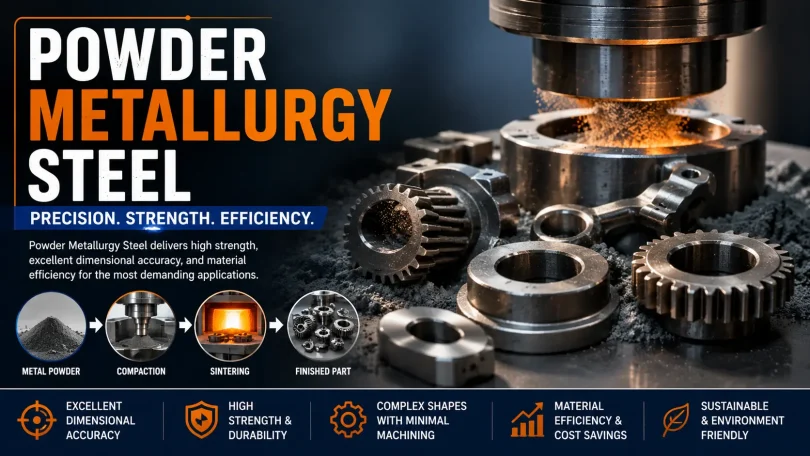
Powder metallurgy steel, often shortened to PM steel, is steel manufactured from fine metal powder rather than from a single molten ingot. Instead of pouring liquid steel into a mold and letting it cool as one solid mass, manufacturers atomize molten steel into tiny droplets, which solidify into powder. That powder is then pressed, shaped, and heated to bond the particles together into a finished material.
This different starting point changes everything that follows. Because each powder particle solidifies almost instantly during atomization, the alloying elements inside it are distributed with remarkable uniformity. In conventional steel, by contrast, elements separate unevenly as the large molten mass cools slowly, creating an uneven internal structure with larger, less consistent carbide particles. That single difference in how the steel forms is the reason PM steel can achieve combinations of hardness, toughness, and wear resistance that conventional steelmaking simply cannot match.
If you have ever wondered why a premium kitchen knife or an industrial cutting tool costs significantly more than a basic equivalent, powder metallurgy is very often the answer.
A Brief History of Powder Metallurgy Steel
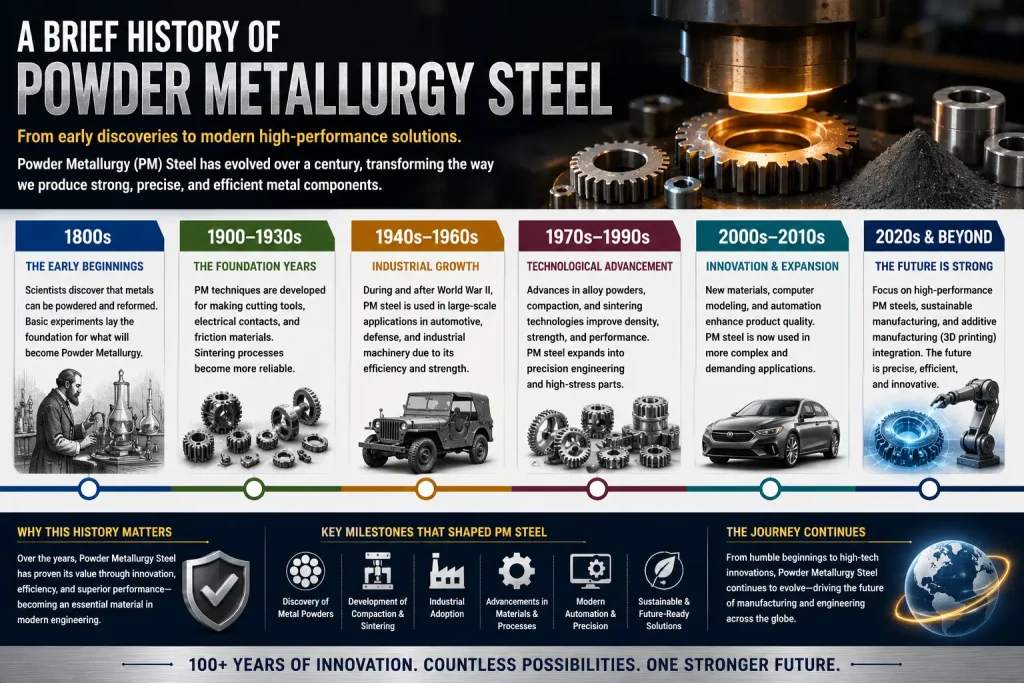
Powder metallurgy as a manufacturing concept dates back further than most people expect, with early powder based metal forming used for components as far back as ancient civilizations working with sponge iron. Modern powder metallurgy steel, however, has its roots in the 1960s, when manufacturers began developing controlled atomization techniques specifically to introduce higher levels of alloying elements than conventional ingot casting allowed.
The breakthrough that brought PM steel into mainstream tool and knife manufacturing came from Crucible Industries in Syracuse, New York, with a proprietary process trademarked as Crucible Particle Metallurgy, commonly known as CPM. This innovation made it possible to add significantly more vanadium and other carbide forming elements to a steel alloy than traditional casting methods could handle without the resulting carbides becoming too large and unevenly distributed. Since then, other major producers including Bohler-Uddeholm and Carpenter Technology have developed their own proprietary powder processes, each producing steels with their own naming conventions but built on the same fundamental principle.
How Powder Metallurgy Steel Is Made: The Process Explained
Understanding the manufacturing process is the key to understanding why PM steel performs the way it does. The process generally follows four core stages.
Step 1: Powder Production Through Atomization
The process begins by melting the steel alloy to a precise composition, then forcing the molten metal through a narrow nozzle under high pressure. As the liquid stream exits the nozzle, high pressure jets of gas or water break it apart into a fine spray of tiny droplets. These droplets cool and solidify almost instantly, in a fraction of a second, before they have time to separate into uneven layers.
Gas atomization, typically using inert gases like nitrogen or argon, is the most common method because it minimizes oxidation of the powder and produces clean, spherical particles. Because each droplet solidifies independently and so rapidly, every single particle ends up with the same uniform distribution of carbon, chromium, vanadium, and other alloying elements throughout its structure. This is the foundational advantage of powder metallurgy steel, and it cannot be replicated by conventional casting, no matter how carefully the ingot is processed afterward.
Step 2: Powder Blending
Once the base metal powder is produced, it is blended with any necessary additives. For structural PM steel parts, this commonly includes a lubricant wax to aid compaction, along with controlled additions of carbon, copper, or nickel to fine tune the final properties. The goal of this stage is to ensure a homogeneous powder mixture before the material moves to shaping.
Step 3: Compacting
The blended powder is pressed into a die under high pressure, usually at room temperature, forming what is called a green compact. This stage shapes the powder into something close to its final form, with precision normally very close to the die’s exact dimensions. At this point, the compacted part has enough mechanical strength to be handled, but it has not yet developed its true material properties. It is still essentially powder held together by pressure.
Step 4: Sintering
The green compact is heated in a carefully controlled atmosphere, typically just below the melting point of the primary metal. This heating causes the individual powder particles to bond together at a molecular level, a process called sintering. The atmosphere during sintering matters enormously, since exposure to oxygen at these temperatures would degrade the material. As the particles fuse, the part develops the strength and density that define its final mechanical performance.
Optional Step 5: Secondary Processing
Many PM steel products undergo further processing after sintering to achieve specific properties. This can include powder forging, where a sintered preform is reheated and hot forged to near full density, eliminating most residual porosity and producing properties close to conventionally wrought steel. Hot isostatic pressing, often called HIP, applies heat and pressure uniformly from all directions to further eliminate internal voids. Heat treatment, including hardening, tempering, and sometimes cryogenic treatment, is then applied to set the final hardness and toughness balance for the intended application.
Why Powder Metallurgy Steel Performs Differently Than Conventional Steel
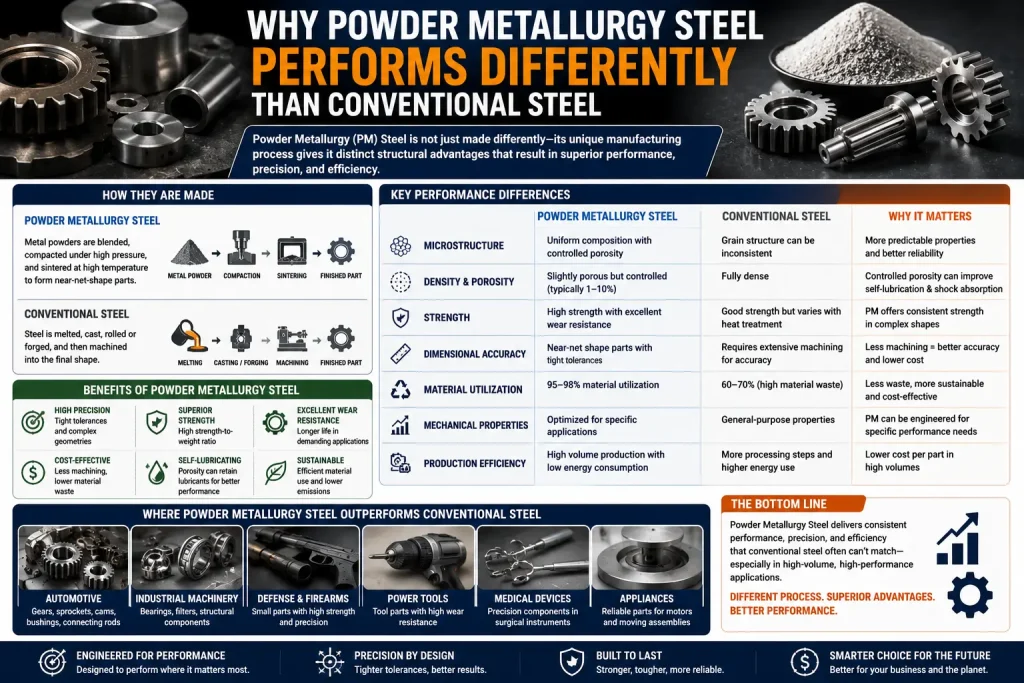
This is the section most competing articles either skip entirely or explain poorly. Here is what actually changes at the material level.
Carbide Size and Distribution
In conventional steel, carbides, the hard particles within the steel that provide wear resistance, form as the molten metal cools slowly. Slow cooling gives these carbides time to grow large and to cluster unevenly throughout the structure. Large, unevenly distributed carbides create weak points in the steel where cracks can start and spread under stress.
In powder metallurgy steel, because each particle solidifies in a fraction of a second during atomization, carbides have no time to grow large. The result is a fine, uniform distribution of small carbides throughout the entire material. This single structural difference is responsible for nearly every performance advantage associated with PM steel.
The Vanadium Advantage
Vanadium forms some of the hardest, most wear resistant carbides used in tool steel and knife steel. In conventional steelmaking, vanadium content was historically limited to roughly four to five percent, because adding more caused the resulting carbides to grow too large and brittle. Powder metallurgy removed this ceiling. Because PM processing keeps carbides fine regardless of how much vanadium is added, modern PM steels can incorporate significantly higher vanadium content, unlocking wear resistance levels that were simply not achievable through conventional casting.
Toughness Gains
The most measurable improvement powder metallurgy delivers is in toughness, meaning the material’s ability to resist cracking or chipping under sudden impact. Independent testing comparing conventional and PM versions of the same steel grade, including CruWear, D2, and 154CM, consistently shows the PM versions achieve meaningfully higher toughness at equivalent hardness levels. This happens because the fine, evenly distributed carbide structure in PM steel does not create the stress concentration points that larger, clustered carbides cause in conventional steel.
When Powder Metallurgy Does Not Help
It is worth noting honestly that PM processing is not universally beneficial. Steels that naturally have a small amount of carbide and a fine grain structure, such as most low alloy tool steels and simple carbon steels, do not gain much from powder metallurgy processing, and in some cases the added cost is simply not justified. The real advantage of PM steel grows as wear resistance and alloy content increase. For high carbide steels designed for extreme wear resistance, the difference between conventional and powder produced versions becomes dramatic.
The Porosity Trade-Off: What Most Articles Don’t Explain
Here is a critical detail that many competing guides leave out entirely, particularly when writing about industrial structural PM steel parts rather than tool steel.
Conventional press and sinter PM steel parts typically retain between five and fifteen percent internal porosity, meaning microscopic voids remain within the material even after sintering is complete. This porosity exists because pressing powder into a die and sintering it does not achieve the full density that melting and casting naturally produces.
This porosity has real consequences. It reduces mechanical properties compared to fully dense wrought steel of the same composition, and research on PM stainless steels has confirmed that porosity plays the predominant role in reducing corrosion resistance, since the voids provide pathways for corrosive elements to attack the material from within rather than just the surface.
Manufacturers address this trade-off in several ways. Powder forging and hot isostatic pressing can push density close to that of fully wrought steel, essentially eliminating the porosity disadvantage for critical applications. For less demanding structural components, the inherent porosity is simply an accepted part of the cost and performance equation, since press and sinter PM steel remains significantly cheaper to produce in high volume than machining the equivalent part from solid bar stock. Manufacturers commonly target final densities between 6.8 and 7.4 grams per cubic centimeter for structural PM steel parts, depending on the application’s strength requirements.
Premium tool steel and knife steel grades, the kind most people encounter as consumers, use different production routes, typically involving hot isostatic pressing as a standard step, which largely avoids this porosity issue and is part of why these grades command a higher price.
Powder Metallurgy Steel vs. Conventional Steel: Direct Comparison
| Property | Conventional Steel | Powder Metallurgy Steel |
|---|---|---|
| Carbide size | Large, uneven | Fine, uniform |
| Alloying element distribution | Uneven across the mass | Uniform within each particle |
| Maximum practical vanadium content | Roughly 4 to 5 percent | Significantly higher |
| Toughness at equal hardness | Lower | Higher |
| Wear resistance potential | Limited by carbide size | Higher due to controlled carbide structure |
| Grindability and finishing | More difficult at high alloy content | Generally easier despite high alloy content |
| Manufacturing cost | Lower | Higher |
| Best suited for | General purpose steel, simple alloys | High alloy, high wear, high performance applications |
| Part-to-part consistency | Variable | Highly consistent |
| Complex shape capability | Requires machining from bar stock | Can be near net shape, reducing waste |
Where Powder Metallurgy Steel Is Used
Knife Making
This is the application most consumers encounter directly. Premium knife blades increasingly use PM steel grades because the fine carbide structure allows manufacturers to achieve higher hardness and wear resistance without sacrificing the toughness needed to prevent chipping. Well known PM knife steel families include the CPM series from Crucible such as CPM-S30V, CPM-S35VN, CPM-3V, and CPM-M4, alongside Bohler-Uddeholm’s M390 and Elmax, and Carpenter’s CTS series. Each manufacturer’s process differs slightly in technical detail, but all rely on the same atomization and consolidation principle.
Cutting and Machining Tools
Industrial cutting tools, drill bits, and high speed steel inserts benefit enormously from PM processing. High speed steel grades produced through powder metallurgy, such as PM T15 and PM M48, retain hardness at elevated operating temperatures far better than their conventionally produced equivalents, and the improved toughness means these tools are also significantly easier to grind during manufacturing and less prone to chipping during use.
Automotive Components
Powder metallurgy is one of the largest volume applications of all, used extensively to produce automotive parts including gears, connecting rods, bearing components, and structural brackets. The near net shape capability of press and sinter PM steel means parts can be produced very close to their final dimensions with minimal machining, which significantly reduces material waste and manufacturing cost at high production volumes. This combination of cost and weight reduction has made PM steel a standard choice across the automotive industry for decades.
Aerospace and High Performance Engineering
For aerospace applications requiring an exceptional strength to weight ratio and resistance to extreme conditions, PM steel processed through hot isostatic pressing delivers near fully dense material with properties that rival or exceed conventionally wrought equivalents, while still allowing more complex, near net shape part geometries than casting alone would permit.
General Structural and Industrial Parts
Beyond automotive, powder metallurgy structural components are widely produced for industrial machinery, hardware, and consumer products wherever a manufacturer needs precise, repeatable parts at high volume with minimal post processing.
Quality Control and Testing of Powder Metallurgy Steel
This is an area most consumer focused articles skip entirely, but it matters significantly for anyone sourcing PM steel parts for industrial or engineering use.
Density Verification
Since porosity directly affects mechanical performance, density testing is a standard quality control step. This is typically performed using the Archimedes principle, measuring a part’s weight in air versus its weight submerged in water, or through mercury porosimetry, which measures the volume and distribution of pores directly.
Mechanical Testing
Finished PM steel parts undergo tensile testing to verify strength, impact testing to confirm toughness, and fatigue testing to predict how the part will perform under repeated stress cycles over its service life.
Nondestructive Testing
Critical PM steel components are often inspected without damaging the part itself. Ultrasonic testing uses sound waves to detect internal flaws that are invisible from the surface. X-ray examination identifies internal porosity or cracking that could compromise the part under load. These methods are particularly important for safety critical applications such as automotive and aerospace components.
Choosing Between Powder Metallurgy Steel and Conventional Steel
If you are deciding between PM and conventional steel for a project, consider these factors together rather than in isolation.
Performance requirements. If your application demands a combination of high hardness, high wear resistance, and good toughness simultaneously, particularly at high alloy content, PM steel is very likely the better choice. If your requirements are modest, conventional steel may perform just as well at a lower cost.
Production volume and part complexity. For high volume manufacturing of complex shaped parts, press and sinter PM steel can be significantly more cost effective than machining the same shape from conventional bar stock, since it generates far less waste material.
Budget. PM steel costs more to produce due to the additional processing stages involved, and that cost is passed through the supply chain. For applications where the performance gain will not actually be used in practice, conventional steel remains the more economical choice.
Corrosion resistance needs. For press and sinter PM steel parts where porosity has not been eliminated through secondary processing, be aware that internal voids can reduce corrosion resistance compared to a fully dense equivalent. For corrosion critical applications, specify a PM grade that has undergone hot isostatic pressing or equivalent densification.
Common Myths About Powder Metallurgy Steel
Myth: PM steel is always better than conventional steel. This is not accurate. PM processing offers the greatest benefit for high alloy, high wear resistance steels. For simpler, low alloy steels, the performance difference can be minimal, and the added cost may not be justified.
Myth: PM steel is always stainless or corrosion proof. Powder metallurgy is a manufacturing process, not a chemical composition. Whether a PM steel is stainless depends entirely on its chromium content, the same rule that applies to conventional steel. Many popular PM tool steels, including CPM 3V, are not stainless and will oxidize without proper care.
Myth: PM steel is always harder to sharpen. This depends heavily on the specific alloy and its carbide volume, not simply on whether it was produced through powder metallurgy. Some PM steels are actually easier to achieve a polished finish on than their conventional equivalents, precisely because the carbide structure is more uniform.
Myth: All powder metallurgy processes are the same. Different manufacturers use proprietary variations of the basic process, and these variations affect cleanliness, exact carbide structure, and final performance. CPM, the trademarked Crucible process, is one specific implementation. Bohler’s Microclean process and Carpenter’s processes are others. The results, while built on the same core principle, are not identical.
Environmental and Cost Considerations
Powder metallurgy carries genuine sustainability advantages that are often overlooked. The near net shape capability of the process significantly reduces material waste compared to machining parts from solid bar stock, since less material needs to be cut away and discarded as scrap. This translates directly into lower raw material consumption across high volume manufacturing.
On the cost side, the picture is more nuanced. The powder production and consolidation steps add cost compared to simple casting, which is why PM steel commands a price premium, particularly for premium tool and knife steel grades. However, for complex, high volume structural parts, the reduced machining time and material waste of press and sinter PM steel can offset and even reverse that premium, making PM steel the more economical choice once the entire production process is accounted for rather than just the raw material cost.
Frequently Asked Questions About Powder Metallurgy Steel
What does PM stand for in steel?
PM stands for Powder Metallurgy, referring to the manufacturing process of producing steel from fine metal powder rather than from a single cast ingot.
What does CPM mean?
CPM stands for Crucible Particle Metallurgy, a specific trademarked powder metallurgy process developed by Crucible Industries. It is one of several proprietary powder metallurgy processes used across the industry, alongside others from manufacturers like Bohler-Uddeholm and Carpenter Technology.
Is powder metallurgy steel stronger than conventional steel?
PM steel typically offers better toughness and wear resistance at a given hardness level compared to conventional steel of the same composition, due to its fine, uniform carbide structure. Whether it is meaningfully stronger depends on the specific alloy and the application’s requirements.
Why is powder metallurgy steel more expensive?
The atomization process, additional handling of fine powder, and often additional secondary processing such as hot isostatic pressing all add cost compared to conventional casting. This added cost is justified for high performance applications but may not be necessary for simpler steel grades.
Does powder metallurgy steel rust?
Whether a PM steel rusts depends entirely on its chromium content, exactly as with conventional steel. PM processing does not inherently make a steel stainless. Always check the specific alloy’s composition, not just whether it was produced through powder metallurgy.
Is powder metallurgy steel harder to sharpen?
This varies by specific alloy and carbide volume rather than being universally true. Some high wear resistance PM steels with large carbide volumes are genuinely more difficult to sharpen, while other PM grades sharpen comparably to or more easily than conventional steel due to their uniform structure.
What industries use powder metallurgy steel the most?
Automotive manufacturing represents the largest volume use of powder metallurgy steel, primarily for gears, bearings, and structural components. Knife making, industrial cutting tools, and aerospace applications represent smaller volume but high value uses where the performance benefits justify the additional cost.
Final Thoughts on Powder Metallurgy Steel
Powder metallurgy steel is not simply a marketing term attached to premium products. It represents a genuinely different manufacturing approach that changes the internal structure of the steel at a microscopic level, with measurable consequences for hardness, toughness, wear resistance, and consistency.
The right way to think about PM steel is not as universally superior to conventional steel, but as a specialized tool for applications where high alloy content, fine grain structure, and consistent part-to-part performance genuinely matter. Whether you are choosing a knife steel, sourcing automotive components, or specifying material for a precision tool, understanding how the powder metallurgy process actually changes the material lets you make a decision based on real performance characteristics rather than price alone.
You May Also Like It:
CNC Machining Tolerances: The Complete Expert Guide
MIG vs TIG Welding: Complete Guide to Differences and Procedures