Blogs

How to Select a Vertical Turbine Pump for Deep-Well and Industrial Water Applications

vertical turbine pump
Written by admin

Selecting pumping equipment for a deep well, irrigation system, municipal water installation, or industrial facility requires more than matching the pump connection to existing piping. The equipment needs to deliver the required flow and head while operating reliably within the physical and environmental conditions of the site. Engineers evaluating Griswold vertical turbine pump equipment should consider hydraulic performance, shaft construction, driver configuration, lubrication, installation requirements, and long-term maintenance before making a final specification.

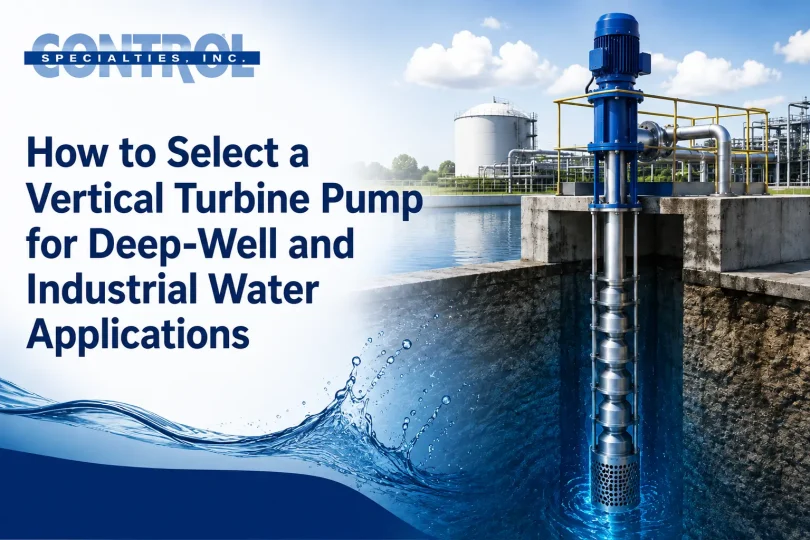
Vertical turbine pumps are commonly considered when the water source is located below the pump installation point. Their vertical configuration allows the hydraulic components to extend into the water source while the driver and discharge arrangement remain accessible above ground.

That arrangement can provide practical advantages, but it also introduces several engineering considerations involving shaft construction, motor sizing, gear drives, bowl design, lubrication, and installation.

Why Vertical Turbine Pumps Are Used for Deep-Water Applications

A conventional horizontal pump is not always practical when water must be lifted from a deep well or similar source. A vertical turbine arrangement allows the pumping elements to be positioned at the required depth.

The pump bowls and impellers are installed vertically, while a shaft transfers mechanical power from the driver to the hydraulic assembly.

This configuration can be relevant to:

  • Agricultural irrigation
  • Municipal water supply
  • Industrial water systems
  • Deep-well dewatering
  • Construction water handling
  • Oil and refinery applications
  • Raw-water pumping

The appropriate configuration depends on flow, total dynamic head, source depth, water characteristics, and expected operating conditions.

Start With the Hydraulic Requirements

Pump selection should begin with the system rather than the equipment catalog.

The two primary hydraulic parameters are generally flow rate and total dynamic head.

Flow determines how much water must be moved over a specific period. Total dynamic head represents the energy required to move that water through the system, including elevation changes and friction losses.

Engineers should establish the expected operating point before comparing pump configurations.

Other useful information may include:

  • Static water level
  • Pumping water level
  • Well depth
  • Well diameter
  • Discharge pressure
  • Pipe length
  • Pipe diameter
  • Fitting losses
  • Fluid temperature
  • Water quality

Accurate field information helps prevent pump oversizing or undersizing.

Understanding the Vertical Shaft Arrangement

The vertical shaft is a defining feature of many turbine pump systems.

It transfers rotational power from the driver to the impellers located in the pump bowls. In deeper installations, the shaft may consist of multiple sections supported along the vertical assembly.

This arrangement requires attention to alignment, bearing support, lubrication, and shaft length.

A vertical shaft pump should therefore be considered as an integrated mechanical system. Shaft construction affects maintenance requirements as well as the way power reaches the hydraulic components.

During specification, shaft length should be established from the actual installation depth and pump configuration.

Choosing the Right Drive Arrangement

One of the important decisions in vertical pump selection is the type of driver.

A vertical turbine system can use a vertical hollow-shaft electric motor or a right-angle gear drive, depending on the application and equipment configuration.

A vertical motor places the driver directly above the pump shaft. A right-angle gear arrangement can allow the motor to be positioned horizontally while transferring power into the vertical shaft.

Neither configuration is universally preferable.

The decision should consider available space, motor requirements, operating speed, maintenance access, equipment layout, and site conditions.

When a Right-Angle Gear Drive Makes Sense

A vertical gearbox pump configuration can be useful where a horizontal motor arrangement offers practical advantages.

A right-angle gear drive changes the direction of power transmission between the motor and vertical shaft. Depending on its design, it can also provide a speed relationship between the motor and pump shaft.

Engineers should evaluate:

  • Input motor speed
  • Required pump speed
  • Gear ratio
  • Torque requirements
  • Gearbox power rating
  • Lubrication
  • Ambient conditions
  • Maintenance access

The gearbox should be specified as part of the complete pump system rather than treated as an independent component.

Selecting the Vertical Pump Motor

The vertical pump motor must provide sufficient power for the pump’s operating point.

Motor horsepower should be based on hydraulic requirements, expected operating range, and applicable service conditions.

Electrical characteristics also matter. Voltage, phase, frequency, starting method, enclosure, and environmental conditions should all be established before selecting the motor.

A motor that is too small may struggle to meet operating requirements. An unnecessarily large motor can increase capital and operating costs.

The best approach is to coordinate motor selection with the pump curve and expected duty point.

Understanding Line Shaft Turbine Pump Construction

Many vertical turbine systems use extended line-shaft arrangements.

Line shaft turbine pumps transfer power from the driver through the column assembly to the pump bowls. Bearings support the shaft at intervals, and the lubrication method must be compatible with the pump configuration.

Water-lubricated and oil-lubricated line-shaft arrangements are both used in vertical turbine pump designs.

The selection can depend on the application, water conditions, maintenance requirements, and manufacturer’s design.

Lubrication should receive particular attention during commissioning and preventive maintenance because inadequate lubrication can contribute to premature bearing and shaft wear.

Pump Bowl Selection Also Affects Performance

The pump bowls contain the impellers and hydraulic passages that generate the required head.

Depending on the application, multiple stages may be required to achieve the desired pressure.

Engineers should evaluate the pump curve rather than selecting a bowl size based solely on pipe diameter.

Flow, head, efficiency, impeller diameter, number of stages, and operating point should all be considered together.

Material Selection for Water and Industrial Service

Material compatibility is another important part of pump specification.

Water quality can vary considerably between applications. A relatively clean municipal water source may present different material requirements from an industrial process stream containing abrasive particles or corrosive constituents.

Engineers may need to evaluate:

  • Pump bowl materials
  • Impeller materials
  • Shaft materials
  • Bearing materials
  • Seals
  • Fasteners
  • Coatings

The operating environment should determine the material specification.

For example, bronze components may be appropriate for certain water-service applications, while other industrial services may require different materials.

Consider the Discharge Head

The discharge head connects the vertical pumping assembly with the downstream piping and can influence the overall installation arrangement.

Engineers should consider how the discharge head interfaces with existing piping, foundations, valves, access platforms, and maintenance areas.

Alignment is particularly important.

The foundation and piping arrangement should avoid placing unnecessary mechanical loads on the pump assembly.

Installation Planning Should Happen Early

Large vertical pumping systems can be difficult to install if lifting and access requirements are considered too late.

Before equipment arrives at the site, the installation team should review:

  1. Equipment dimensions
  2. Total assembly weight
  3. Lifting points
  4. Crane capacity
  5. Available overhead clearance
  6. Foundation dimensions
  7. Shaft assembly sequence
  8. Motor installation
  9. Discharge piping
  10. Electrical connections

The installation sequence should account for the length of the vertical assembly.

Maintenance access should also be considered at the design stage. Components requiring periodic inspection should remain accessible without extensive disassembly.

Comparing Vertical Turbine and Submersible Pump Arrangements

Vertical turbine pumps are not the only option for deep-water applications.

A submersible turbine arrangement places the motor and pumping equipment below the water level. This can provide advantages in certain well and installation configurations.

For projects where engineers are comparing different pumping arrangements, Griswold submersible turbine equipment can be evaluated alongside vertical turbine configurations according to well characteristics, required flow, total head, electrical requirements, maintenance access, and pumping depth.

The choice between a vertical turbine and submersible configuration depends on the specific installation.

When a Centrifugal Pump May Be More Appropriate

Horizontal or other centrifugal pump configurations can be more suitable when the water source and installation do not require a deep vertical pumping assembly.

For example, centrifugal pump designs can accommodate applications where the pump remains accessible at the installation level.

Engineers can compare Griswold E F G centrifugal pump series with vertical configurations when evaluating different installation arrangements and hydraulic requirements.

The decision should be based on the actual application rather than simply choosing the pump style that is most familiar.

Efficiency and Operating Cost

Pump efficiency has a direct relationship with long-term operating costs.

A pump operating away from its preferred range may consume more energy than necessary and experience increased mechanical stress.

Engineers should therefore review the pump curve and identify the expected operating point before finalizing the equipment.

Motor efficiency also matters, particularly for installations operating continuously or for many hours each day.

Agricultural irrigation and municipal water systems can have substantial annual operating hours, making energy consumption an important part of lifecycle evaluation.

Maintenance Considerations

A preventive maintenance program should be developed around the actual pump configuration.

For a vertical turbine system, maintenance personnel may monitor:

  • Shaft condition
  • Bearing wear
  • Lubrication
  • Motor performance
  • Gearbox condition
  • Vibration
  • Packing or seal condition
  • Impeller wear
  • Bowl condition
  • Discharge piping

Water-lubricated and oil-lubricated systems have different maintenance requirements.

The manufacturer’s recommended inspection and lubrication procedures should be followed rather than relying on a generic pump maintenance schedule.

What Procurement Teams Should Include in a Specification

Incomplete specifications can lead to unsuitable equipment being quoted.

A pump specification should provide enough information for suppliers and engineers to evaluate the complete system.

Useful information includes:

  • Required flow
  • Total dynamic head
  • Pumping depth
  • Well dimensions
  • Fluid characteristics
  • Operating temperature
  • Driver type
  • Motor horsepower
  • Motor speed
  • Lubrication preference
  • Discharge arrangement
  • Material requirements
  • Applicable standards

Procurement teams should also identify whether the installation is new construction or a replacement project.

For replacement work, existing foundation dimensions, shaft length, discharge connections, and available installation space can be especially important.

Building a Reliable Selection Process

A structured approach makes pump selection easier to manage.

Begin with the hydraulic requirements. Establish flow and head, then document the source depth and site conditions.

Next, compare available pump configurations and determine whether a vertical motor or right-angle gear arrangement better suits the installation.

After that, evaluate shaft construction, lubrication, materials, discharge configuration, and maintenance access.

Finally, compare lifecycle considerations such as energy consumption, expected operating hours, maintenance requirements, and component availability.

This approach helps engineering and procurement teams evaluate the complete system rather than selecting equipment based on one specification.

A Practical Resource for Pump Selection

Engineers researching vertical turbine pumping equipment can compare available configurations against the requirements of the installation.

For broader technical research, Control Specialties industrial pump guide can be used when reviewing different pump categories and configurations.

The objective should be to understand the application first and then identify the equipment configuration that satisfies those requirements.

Final Selection Checklist

Before approving a vertical turbine pump specification, the engineering team should be able to answer several basic questions:

  • What flow rate is required?
  • What total head must the pump develop?
  • How deep is the pumping source?
  • What is the required shaft length?
  • Which driver arrangement is appropriate?
  • Is a right-angle gearbox required?
  • What motor horsepower and speed are needed?
  • Which lubrication system is appropriate?
  • What materials are compatible with the fluid?
  • How will the pump be installed?
  • How will the equipment be accessed for maintenance?

If these questions are clearly addressed, the final equipment comparison becomes much more straightforward.

Final Thoughts

Vertical turbine pumping systems can provide an effective solution for deep-water, irrigation, municipal, and industrial applications, but successful selection requires consideration of the complete system.

Hydraulic performance is only one part of the decision. Shaft construction, motor selection, gearbox configuration, lubrication, materials, discharge arrangement, installation conditions, and maintenance requirements all contribute to long-term performance.

For engineers and procurement professionals, an application-based selection process provides a stronger foundation than choosing equipment based solely on nominal pump size or motor horsepower.

The most suitable configuration is the one that matches the actual hydraulic duty, site conditions, operating environment, and maintenance strategy.

About the author

admin

Leave a Comment