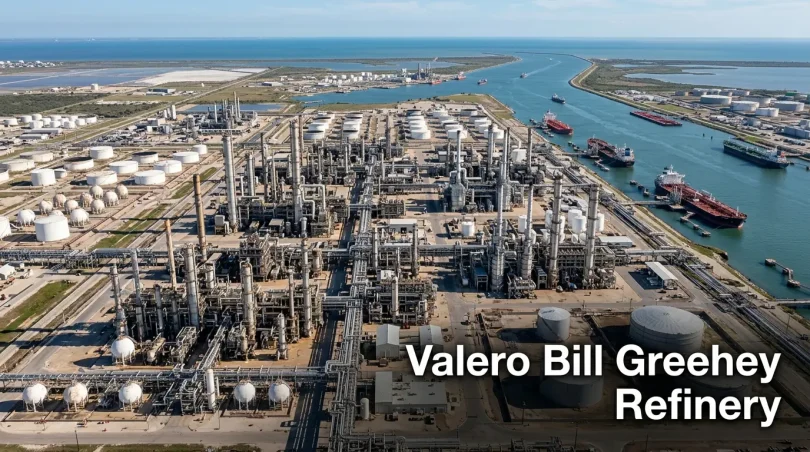

The Valero Bill Greehey Refinery, also widely known as the Valero Corpus Christi Refinery, is one of the largest and most strategically important oil refineries in the United States, located in Corpus Christi, Texas. Owned and operated by Valero Energy Corporation, this Corpus Christi oil refinery supplies gasoline, diesel, and jet fuel to the central Texas market and beyond. This guide covers the Valero Bill Greehey Refinery’s location and address, history, capacity, West Plant and East Plant, products, jobs, and the latest operational developments through 2026.
Quick Facts: Valero Bill Greehey Refinery
| Fact | Details |
|---|---|
| Refinery name | Valero Bill Greehey Refinery (Valero Corpus Christi Refinery) |
| Address | 1147 Cantwell Lane, Corpus Christi, TX 78407 |
| Owner/Operator | Valero Energy Corporation |
| Plants | West Plant and East Plant |
| Listed throughput capacity | 370,000 bpd (Valero, current) |
| Employees | ~730 (plus contractors) |
| Key products | Gasoline, ultra-low-sulfur diesel, jet fuel, asphalt, petrochemicals |
| Ship access | Corpus Christi Ship Channel |
| Phone | (361) 289-6000 |
Valero Bill Greehey Refinery Overview and Location
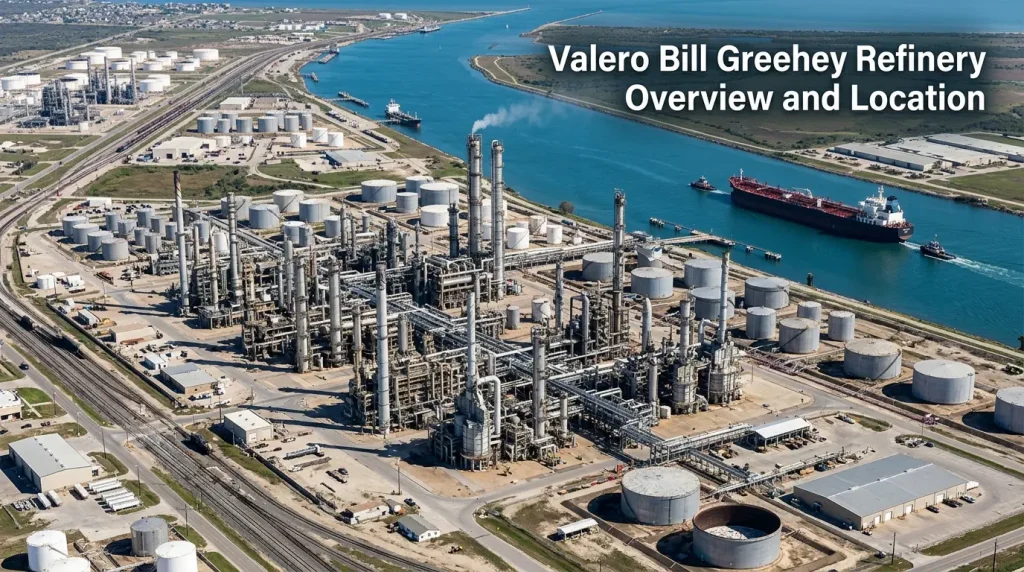
The Valero Bill Greehey Refinery is not a single plant but two adjoining refining complexes operating as one unit in Corpus Christi, Texas:
- Corpus Christi West Plant – Valero’s original grassroots refinery in the city, developed from a small facility (originally known as Saber Refinery) acquired around 1980.
- Corpus Christi East Plant – acquired by Valero in 2001, located less than a mile from the West Plant.
Together, the two plants sit on roughly 523 acres of land along the Corpus Christi Ship Channel and are named after Bill Greehey, the former long-serving CEO of Valero Energy, recognized for both his corporate leadership and philanthropic work.
Valero Bill Greehey Refinery History
- 1980: Valero acquired a stake in the small Saber Refinery in Corpus Christi.
- Early 1980s: Valero developed the site into a full-scale grassroots refinery. Valero’s own materials give slightly different commissioning dates in different places the company’s location page cites 1983, while other historical materials point to 1984 for the start of full refining operations. Treat this as “commissioned in the early-to-mid 1980s” rather than a single fixed date.
- 1994: The Corpus Christi site became the first petroleum refinery to win the Governor’s Award for Environmental Excellence.
- 2001: Valero acquired the East Plant, a 115,000 bpd facility located near the West Plant, consolidating both under unified operations.
- 2009: A hydrocracker fire at the West Plant led to a temporary shutdown; a subsequent leak forced a second closure for repairs later that month.
- 2018: A fire incident at the Corpus Christi refinery caused significant damage, though no worker injuries were reported.
- 2025: A third-party power outage was reported to have forced a partial shutdown of refining units (October 2025).
- 2026: A community alert filing reported operating conditions at the East Plant that made flaring necessary (May 2026), with the filing citing a refinery capacity of 290,000 bpd for that unit.
Corpus Christi Refinery Location and Infrastructure
The West Plant benefits from 4,700 feet of ship channel frontage on the Corpus Christi Ship Channel, simplifying the loading and unloading of feedstock and finished products via tankers and barges. Along with Valero’s Texas City and Benicia (California) refineries, the Corpus Christi complex is part of a network historically described as sharing 58 crude oil and intermediate feedstock storage tanks with a combined capacity of roughly 11 million barrels a figure that comes from older industry reporting and should be treated as historical rather than current.
The refinery also operates an eight-bay truck rack to serve local markets and connect into a broader regional pipeline distribution network.
How the Refinery Works
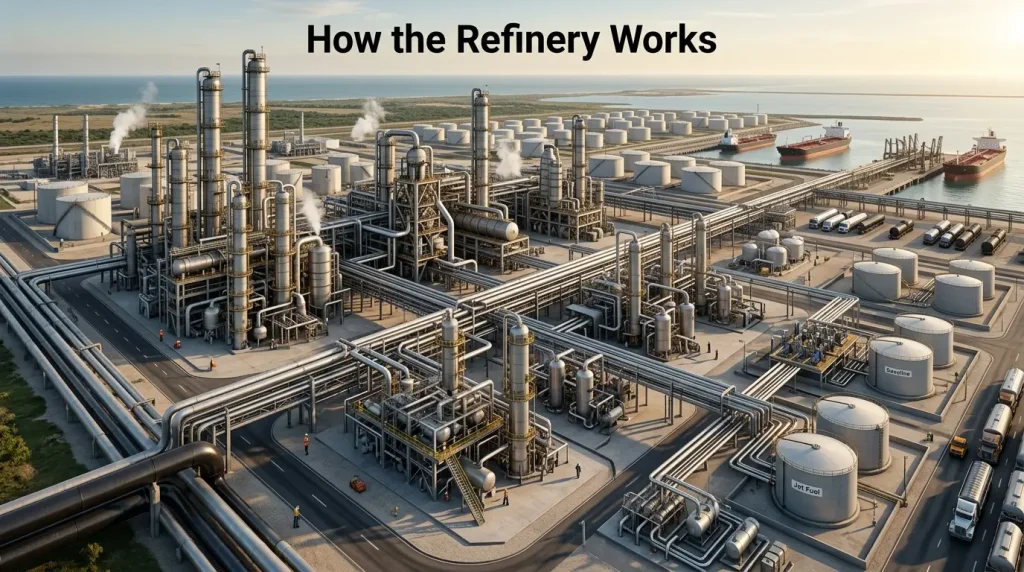
Like other complex refineries, the Bill Greehey Refineries process crude oil through several stages:
- Crude receipt – crude oil arrives by ship, pipeline, or truck via the Ship Channel and connecting pipeline systems.
- Distillation – crude is separated into fractions (light gases, naphtha, gasoline-range material, distillates, heavier residuals) based on boiling point.
- Conversion – heavier fractions are upgraded into higher-value products. The West Plant’s hydrocracker is a key conversion unit here, breaking down heavier molecules into lighter, more valuable products like gasoline and diesel.
- Treating – sulfur and other impurities are removed to meet clean-fuel specifications (e.g., ultra-low-sulfur diesel, reformulated gasoline).
- Blending and distribution – finished products are blended to specification and shipped out via pipeline, truck rack, or marine vessel.
West Plant vs. East Plant
| Feature | West Plant | East Plant |
|---|---|---|
| Origin | Valero’s original grassroots refinery | Acquired in 2001 |
| Crude processed | Sweet crude, sour crude, and residual fuel oil | Primarily sour crude |
| Key products | Gasoline (including RFG), ultra-low-sulfur diesel | Gasoline, ultra-low-sulfur diesel, jet fuel, asphalt, petroleum coke |
| Distinguishing feature | High-conversion hydrocracker (~36,000 bpd), ship channel frontage | Processes heavier/sour crude into a high yield of light products |
Valero Bill Greehey Refinery Capacity and Output
Valero’s current published materials list the combined Bill Greehey Refineries at 370,000 bpd of throughput capacity this is the figure most people searching for “Valero Bill Greehey Refinery capacity” or “Valero Corpus Christi refinery capacity” are looking for. Older industry reporting cited figures closer to 325,000–340,000 bpd, and individual unit-level filings (such as the East Plant community alert in May 2026) have referenced capacity figures around 290,000 bpd for that specific plant. Actual day-to-day throughput can vary depending on crude slate, planned maintenance, unit availability, and operating conditions so treat any single number as a snapshot rather than a fixed constant.
For scale, Corpus Christi is one of Valero’s larger refineries, but it is not the company’s largest: Valero’s Port Arthur, Texas refinery has a larger listed capacity (around 435,000 bpd), with St. Charles, Louisiana close behind at around 340,000 bpd. Corpus Christi is best described as one of Valero’s largest and most strategically important refining complexes, rather than its single largest.
Valero Bill Greehey Refinery Products
- Gasoline (including reformulated gasoline, RFG)
- Ultra-low-sulfur diesel
- Jet fuel
- Petrochemicals
- Propane and butane
- Light naphthas
- Asphalt and petroleum coke
Pipeline Network and Crude Supply (Historical)
The following pipeline details reflect historical industry reporting, primarily from the early-to-mid 2000s, and may not reflect current infrastructure or contractual arrangements:
- Valero has historically sourced part of its crude supply around 80,000 bpd from Mexico for its Corpus Christi and Wilmington, California operations.
- A 70-mile pipeline with a reported 120,000 bpd capacity has linked the Corpus Christi refinery to Valero’s Three Rivers refinery.
- The Houston, San Antonio, and Rio Grande Valley pipeline systems historically connected the refinery to those regional markets (reported capacities of 105,000 bpd, 24,000 bpd, and 27,100 bpd respectively) before these systems were sold in 2003.
- In 2003, Valero entered a supply agreement with MGI Supply Limited, a Pemex subsidiary, to deliver 5,000 bpd of propane from the Corpus Christi refinery to northern Mexico, supported by pipeline investment from NuStar Energy (formerly Valero LP).
Readers relying on these figures for business or investment purposes should verify current arrangements directly with Valero, as pipeline ownership and contracts have changed since these reports.
Safety and Environmental Record
Valero states that both plants have held VPP (Voluntary Protection Program) safety status for roughly 20 years. Notable incidents on record include:
- October 2009: Hydrocracker fire and subsequent leak, requiring two rounds of unit shutdowns.
- November 2018: A fire at the refinery caused property damage but no reported worker injuries.
- October 2025: Reports indicated a third-party power outage forced a partial shutdown of refining units.
- May 2026: A community alert filing reported operating conditions at the East Plant that required flaring.
The site’s 1994 Governor’s Award for Environmental Excellence remains a notable historical distinction it was the first refinery in Texas to receive it.
Valero Bill Greehey Refinery Jobs, Employment and Community Role
Valero currently lists about 730 employees at the Corpus Christi Refineries, with additional contractors supporting day-to-day operations and turnarounds. The refinery is one of the larger industrial employers in the Corpus Christi area.
People searching for Valero Corpus Christi refinery jobs or Valero Bill Greehey Refinery careers can find current openings ranging from process operators and mechanical/instrumentation technicians to engineering and safety roles through Valero Energy Corporation’s official careers portal, valero.com/careers, rather than third-party job boards, to avoid outdated or fraudulent listings.
The refinery’s team is also active in local community programs including volunteer initiatives, fundraising events such as the Valero Texas Open Benefit for Children, and partnerships with organizations like United Way and Make-A-Wish.
Frequently Asked Questions
Is Valero Bill Greehey Refinery the same as Valero Corpus Christi Refinery?
Yes “Bill Greehey Refineries” is the official name for what is commonly called the Valero Corpus Christi Refinery, comprising the West and East Plants.
Who was Bill Greehey?
Bill Greehey was the former CEO of Valero Energy Corporation, credited with building the company into a major independent refiner, and known for his philanthropic contributions to Corpus Christi and San Antonio.
What is the refinery’s current capacity?
Valero’s current materials list combined throughput capacity at 370,000 bpd, though actual throughput varies with operating conditions.
Is it Valero’s largest refinery?
No. Valero’s Port Arthur, Texas refinery has a larger listed capacity. Corpus Christi is one of Valero’s largest and most important refineries, but not the single largest.
Where does the refinery get its crude oil?
Historically, the refinery has processed both domestic and imported crude, including Mexican crude shared with Valero’s Wilmington, California refinery though current sourcing should be verified against up-to-date Valero disclosures.
What is the address of the Valero Bill Greehey Refinery?
The refinery’s listed address is 1147 Cantwell Lane, Corpus Christi, TX 78407, with a main line at (361) 289-6000.
Does the Valero Bill Greehey Refinery hire locally?
Yes. Valero recruits for the Corpus Christi Refineries through its official careers site, and the refinery is a significant local employer with roughly 730 direct employees plus contractors.
What is the difference between the Valero Bill Greehey Refinery West Plant and East Plant?
The West Plant is Valero’s original grassroots refinery and processes sweet crude, sour crude, and residual fuel oil through a high-conversion hydrocracker. The East Plant was acquired in 2001 and primarily processes sour crude into a high yield of light products, including asphalt and petroleum coke.
You May Also Like It:
ZNOG Stock: Complete Investor Guide to Zion Oil & Gas (OTCMKTS: ZNOG)
Oil Smells Like Gas? 7 Causes, Warning Signs, and Fixes
Oil Well Packer: Complete Guide to Types, Functions, and Selection