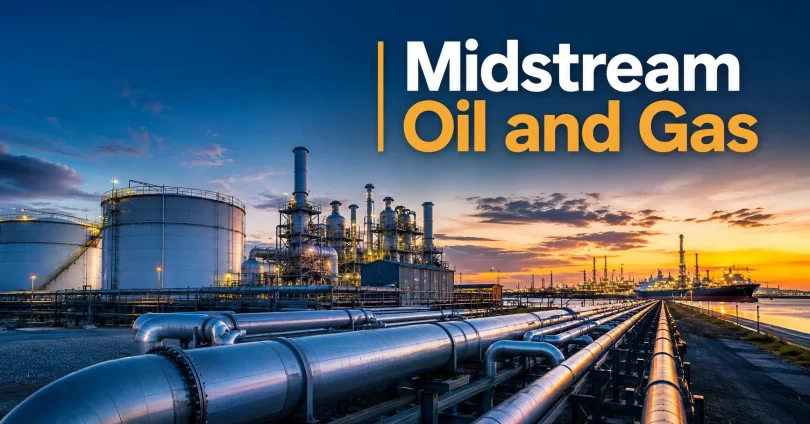

If you have ever wondered what is midstream oil and gas, the short answer is this: it is the link between the wellhead and the world. Midstream oil and gas is the segment of the energy industry that transports, stores, and processes crude oil and natural gas after they are extracted from the ground and before they reach a refinery, power plant, or consumer.
Without midstream infrastructure, upstream production would have nowhere to go and downstream refineries would have nothing to refine. This article breaks down what midstream oil and gas actually means, how it fits into the wider industry, the companies and infrastructure involved, and why this sector matters more than most people realize.
What Is Midstream in Oil and Gas?
The oil and gas industry is traditionally divided into three segments: upstream, midstream, and downstream.
- Upstream covers exploration and production. This is the search for oil and gas reserves and the drilling of wells to bring hydrocarbons to the surface.
- Midstream covers everything that happens between the well and the refinery or end customer. This includes gathering, processing, transporting, and storing crude oil, natural gas, and natural gas liquids (NGLs).
- Downstream covers refining, marketing, and distribution of finished products such as gasoline, diesel, jet fuel, and petrochemicals.
So when someone asks what is midstream in oil and gas, the clearest way to explain it is that midstream is the connective tissue of the energy supply chain. It takes raw, unprocessed hydrocarbons from remote production sites and delivers them, safely and efficiently, to the facilities and markets that need them.
Why Oil and Gas Midstream Exists
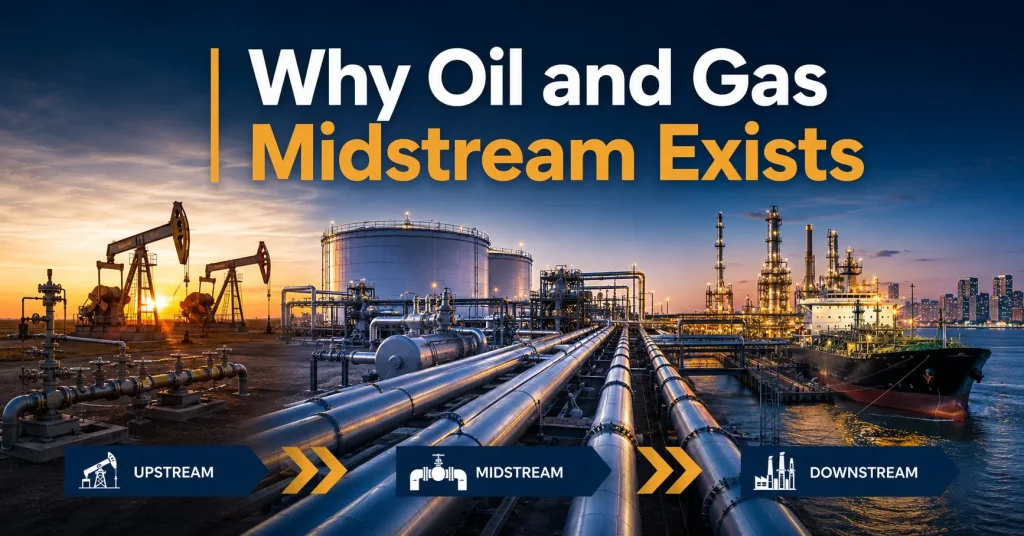
Oil and gas reserves are rarely located near refineries or major population centers. A well in a remote basin might be hundreds or thousands of miles from the nearest refinery, port, or industrial customer. Oil & gas midstream operations solve this geographic mismatch.
Midstream companies build and operate the pipelines, storage terminals, processing plants, and transport fleets that move hydrocarbons across that distance. Their work determines whether energy actually reaches the people and industries that depend on it, which is why the sector is often described as the backbone of the energy value chain.
Midstream Oil and Gas Market Size and Growth
The scale of midstream oil and gas is easy to underestimate because most of its infrastructure is buried underground or tucked away at industrial terminals. In reality, it is one of the largest infrastructure categories in the global energy system.
Industry estimates place the global oil and gas midstream market in the range of USD 75 to 250 billion in 2026, depending on how broadly the category is defined, with most forecasts pointing to steady annual growth through 2031 and beyond. In the United States alone, the midstream market is valued at roughly USD 17 to 18 billion in core services for 2026, with pipelines commanding the largest single share of that spend.
Three forces are driving this growth in 2026:
- LNG export expansion. U.S. LNG export capacity is on track to grow significantly by 2028 as new Gulf Coast terminals come online, pulling more natural gas through gathering, processing, and trunkline systems.
- Data center power demand. The rapid buildout of AI-focused data centers is increasing natural gas consumption for power generation, adding new pressure on pipeline throughput in several U.S. regions.
- Consolidation. Large operators are acquiring smaller midstream companies to build multi-commodity corridors, a trend that concentrates market share among a handful of major players while improving the economics of new infrastructure.
The Core Functions of Midstream Oil and Gas
Midstream oil and gas activity generally falls into four main functions.
1. Gathering
Gathering systems are small-diameter pipelines and collection networks that move crude oil or natural gas from individual wellheads to a central point, such as a processing facility or a larger transmission pipeline. This is the first step in moving hydrocarbons out of the field.
2. Processing
Raw natural gas straight from the wellhead is rarely ready for use. It often contains water, natural gas liquids, and impurities such as hydrogen sulfide or carbon dioxide. Processing plants clean and separate these components, producing pipeline-quality natural gas and valuable byproducts like ethane, propane, and butane.
Crude oil also undergoes basic treatment at this stage, including stabilization and the removal of water and sediment, before it moves further down the chain.
3. Transportation
Transportation is the most visible part of oil and gas midstream, and it happens through several methods:
- Pipelines, which carry the largest volumes of crude oil, natural gas, and refined products over long distances and are widely regarded as the safest and most cost-efficient transport method.
- Rail cars, used where pipeline capacity is limited or unavailable.
- Tankers and barges, used for waterborne transport, including international crude oil shipments and coastal or inland distribution.
- Trucks, typically used for shorter distances or the last leg of delivery to a facility that isn’t connected to a pipeline.
4. Storage
Storage facilities, including tank farms, underground salt caverns, and LNG storage terminals, hold crude oil and natural gas until it is needed. Storage acts as a buffer against supply disruptions, seasonal demand swings, and price volatility, giving the market flexibility that a purely just-in-time system could never provide.
Key Midstream Infrastructure
To fully understand midstream oil and gas, it helps to look at the physical assets that make it work.
- Crude oil pipelines, which move unrefined oil from production sites to refineries.
- Natural gas pipelines, which move raw or processed gas from wells to processing plants and, eventually, to utilities and industrial customers.
- Gas processing plants, which strip out NGLs and impurities.
- Compressor and pumping stations, which maintain pressure and flow along a pipeline route.
- Storage terminals, including tank farms and underground gas storage.
- LNG (Liquefied Natural Gas) facilities, which cool natural gas into liquid form for storage or export by tanker.
- LPG (Liquefied Petroleum Gas) facilities, which handle propane and butane for distribution.
- Marine terminals and ports, where crude oil and products are loaded onto or offloaded from tankers.
Midstream Oil and Gas Companies
Midstream companies range from large, publicly traded pipeline operators to regional gathering and processing businesses. Their role typically falls into one or more of these categories:
- Pipeline operators who build and maintain long-distance transmission systems.
- Gas processing and fractionation companies that separate NGLs into individual products.
- Storage and terminal operators who manage tank farms, caverns, and marine terminals.
- Marketing and trading firms that handle the wholesale sale of crude oil, natural gas, and NGLs.
- Water management companies that handle the disposal and recycling of produced water, a service increasingly grouped under the midstream umbrella.
Some of the largest midstream companies operating in North America include Kinder Morgan, Enterprise Products Partners, Energy Transfer, Enbridge, ONEOK, TC Energy, Williams Companies, and Plains All American. Globally, integrated majors such as Shell, Chevron, and BP also run substantial midstream divisions alongside their upstream and downstream businesses. In Canada, Pembina Pipeline and TC Energy anchor the oil sands corridor linking Alberta production to Gulf Coast refineries. Recent consolidation, such as ONEOK’s multibillion-dollar acquisition of EnLink, illustrates how operators are combining assets to build larger, multi-commodity networks.
How Midstream Companies Make Money
One detail that separates a genuinely useful midstream explainer from a surface-level one is understanding how these companies actually get paid, since it explains why the sector behaves so differently from upstream drillers. There are four common contract structures.
- Cost-of-service. Used for FERC-regulated interstate pipelines. Regulators set a tariff that lets the pipeline recover its costs plus a reasonable return, so revenue has no direct link to commodity prices.
- Fee-based (ship-or-pay). The producer commits to a minimum volume and pays a set fee per unit moved, processed, or stored, regardless of where oil and gas prices go. This is now the dominant structure across the industry.
- Percent-of-proceeds (POP). The midstream company processes the gas, sells the resulting natural gas liquids and residue gas, and splits the proceeds with the producer, typically in a split such as 80/20. Revenue here moves with commodity prices.
- Keep-whole. The midstream company extracts and keeps the NGLs from a producer’s gas stream and returns an equivalent energy value in dry gas. Profitability depends on the spread between NGL prices and gas prices, which makes this the highest-risk structure of the four.
Since the mid-2010s, the industry has shifted heavily toward fee-based and minimum-volume-commitment contracts, which is why midstream cash flows are often described as more predictable and less commodity-sensitive than upstream earnings. This predictability is also a major reason private equity and infrastructure funds are drawn to midstream assets.
Who Regulates Midstream Oil and Gas
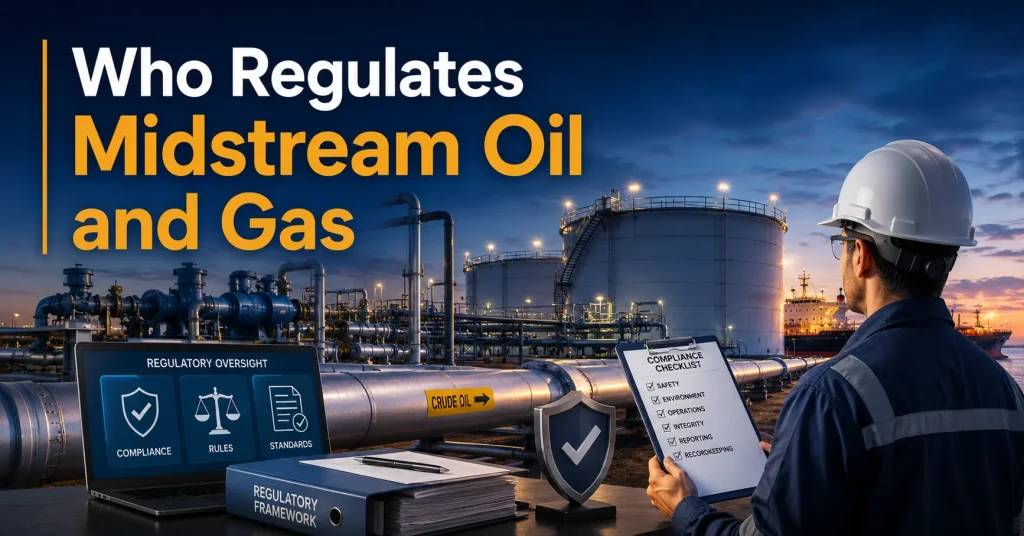
Midstream oil and gas sits inside a layered regulatory framework in the United States.
- The Federal Energy Regulatory Commission (FERC) regulates rates and terms of service for interstate natural gas pipelines and, in many cases, interstate crude oil and products pipelines.
- The Pipeline and Hazardous Materials Safety Administration (PHMSA) sets and enforces pipeline safety standards, including integrity management and leak prevention rules.
- State regulators and agencies, such as state utility commissions and environmental agencies, oversee intrastate pipelines, gathering systems, and facility permitting.
- The North American Energy Standards Board (NAESB) maintains standardized contract and business practice conventions used across the industry, including gas purchase, sale, and transportation agreements.
Notably, many small-diameter gathering pipelines are exempt from FERC jurisdiction under the Natural Gas Act, though the line between an unregulated gathering line and a regulated transmission pipeline is frequently contested and decided case by case.
Why the Midstream Sector Matters
The importance of oil and gas midstream extends well beyond logistics.
- Energy security. Reliable midstream infrastructure ensures that energy supply reaches homes, businesses, and industries without interruption.
- Market efficiency. Storage and transportation flexibility help balance regional supply and demand, which in turn affects energy prices.
- Economic development. Pipelines, terminals, and processing plants create long-term jobs and tax revenue in the regions where they operate.
- Export capability. LNG and marine terminals allow producing countries to sell surplus natural gas and crude oil into global markets.
Put simply, upstream production is only valuable if midstream infrastructure exists to move it, and downstream refining is only possible if midstream delivers a steady, reliable feedstock.
Challenges Facing Midstream Oil and Gas
The sector also faces real operational and environmental pressures.
- Environmental impact. Pipeline construction and operations affect land, water, and wildlife habitats, and methane leaks from gathering and transport systems remain a significant emissions concern.
- Safety and regulation. Midstream assets are closely regulated to prevent leaks, spills, and explosions, and operators must invest continuously in inspection, maintenance, and monitoring technology.
- Permitting and public opposition. New pipeline projects often face lengthy regulatory reviews and local opposition, which can delay or block new infrastructure.
- Capital intensity. Building pipelines, terminals, and processing plants requires large upfront investment with long payback periods, which makes midstream sensitive to financing conditions.
- Energy transition pressure. As economies diversify their energy mix, midstream companies are increasingly investing in carbon capture, hydrogen, and renewable natural gas infrastructure to stay relevant.
Midstream Trends to Watch in 2026
The sector is evolving quickly, and a few trends stand out this year.
- Digital pipeline monitoring. Operators are rapidly adopting IoT sensors, automation, and AI-driven analytics to detect leaks earlier, cut downtime, and squeeze more throughput out of existing pipelines instead of building new ones from scratch.
- LNG-driven build-out. New Gulf Coast LNG terminals are triggering fresh investment in feeder pipelines, gathering systems, and fractionation plants to keep export facilities supplied.
- Data center demand. Natural gas-fired power for AI data centers is emerging as a meaningful new source of firm pipeline contracts in several U.S. markets.
- Decarbonization investment. A growing share of midstream operators are directing capital toward carbon capture and hydrogen-ready pipeline infrastructure as ESG expectations and customer demand evolve.
- Faster permitting reform, slower court reality. Regulatory reforms aimed at shortening federal pipeline reviews are moving forward, but many projects still face court challenges that extend timelines.
Midstream vs Upstream vs Downstream: A Quick Comparison
| Segment | Main Activity | Example Assets |
|---|---|---|
| Upstream | Exploration and production | Wells, drilling rigs |
| Midstream | Gathering, processing, transport, storage | Pipelines, terminals, processing plants |
| Downstream | Refining, marketing, distribution | Refineries, gas stations, petrochemical plants |
Careers in Midstream Oil and Gas
The midstream sector employs engineers, pipeline technicians, terminal operators, safety inspectors, logistics coordinators, and commercial analysts, among many other roles. Because midstream is considered a more stable, regulated part of the industry, it is often seen as an attractive entry point for professionals looking for long-term career security within energy.
Frequently Asked Questions
What is midstream oil and gas in simple terms?
It is the part of the oil and gas industry that transports, processes, and stores crude oil and natural gas between the production site and the refinery or end user.
What is midstream in oil and gas compared to upstream and downstream?
Upstream finds and produces oil and gas, midstream moves and stores it, and downstream refines and sells the finished products.
What are examples of midstream oil and gas assets?
Pipelines, gas processing plants, storage terminals, LNG facilities, and marine terminals are all core midstream assets.
Is midstream oil and gas a good industry to work in?
Yes. It is generally viewed as a stable, fee-based segment of the energy industry with strong long-term demand for skilled technical and operational roles.
Why is oil and gas midstream considered lower risk than upstream?
Midstream companies typically earn fee-based revenue for moving volume through their systems, rather than depending directly on commodity price swings, which makes cash flow more predictable.
How big is the midstream oil and gas market?
Estimates vary by definition and scope, but most 2026 industry reports place the global midstream market somewhere between USD 75 billion and USD 250 billion, with steady growth projected through 2031 on the back of LNG exports and rising gas demand.
Who are the biggest midstream oil and gas companies?
Kinder Morgan, Enterprise Products Partners, Energy Transfer, Enbridge, ONEOK, TC Energy, Williams Companies, and Plains All American are among the largest midstream operators in North America.
Who regulates midstream pipelines?
In the United States, FERC regulates interstate pipeline rates and service terms, PHMSA sets pipeline safety standards, and state agencies oversee intrastate pipelines and facility permitting.
Final Thoughts
Midstream oil and gas may not get the same attention as drilling rigs or gas station prices, but it is the sector that quietly keeps the entire energy supply chain connected. From gathering lines at the wellhead to LNG terminals loading tankers for export, midstream infrastructure determines how reliably, safely, and affordably energy moves through the economy. Understanding what midstream in oil and gas actually involves gives you a much clearer picture of how the energy you use every day gets from the ground to your door.
You May Also Like It:
CNC Machining Tolerances: The Complete Expert Guide
MIG vs TIG Welding: Complete Guide to Differences and Procedures