
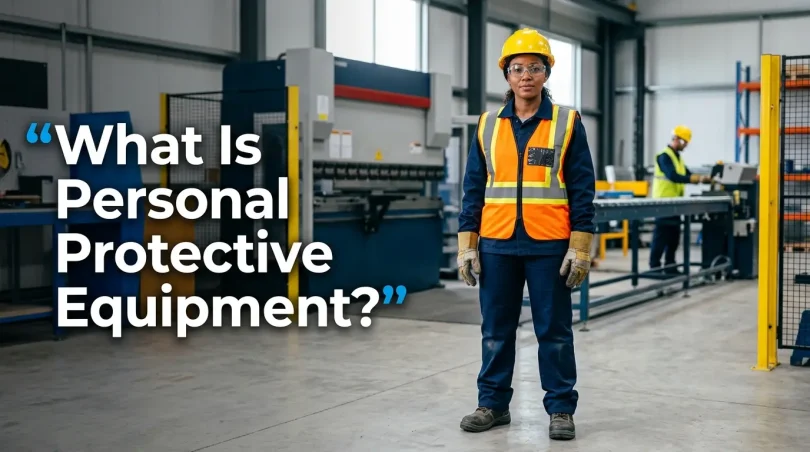

Personal protective equipment, commonly known as PPE, is any clothing, gear, or equipment worn by a person to reduce exposure to hazards that could cause injury or illness at work. Common examples include gloves, safety glasses, hard hats, respirators, and protective clothing. PPE is considered the last line of defense against workplace hazards, used only after engineering and administrative controls have been applied. Under OSHA regulations, employers must supply the right PPE, keep it in good condition, and train every worker on how to use it correctly.
What Is PPE?
PPE stands for personal protective equipment. It refers to any wearable item designed to protect a worker’s body from physical, chemical, biological, electrical, or mechanical hazards encountered on the job.
Think of PPE as a physical barrier between a person and a hazard. A welder’s face shield stops sparks from reaching the eyes. A respirator keeps harmful dust out of the lungs. Steel-toe boots protect feet from falling objects. Each piece of equipment is designed for a specific type of risk, and no single item can protect against every hazard.
Workplace safety agencies, including OSHA in the United States and the World Health Organization globally, treat PPE as the final safeguard in a broader safety strategy. Before PPE is even considered, employers are expected to try to remove the hazard entirely through engineering controls, such as machine guarding, or administrative controls, such as adjusting work schedules or procedures. PPE steps in when those measures cannot fully eliminate the risk.
This is an important distinction. PPE does not remove a hazard. It reduces the chance that the hazard will cause harm to the person wearing it.
PPE Meaning: Where the Term Comes From
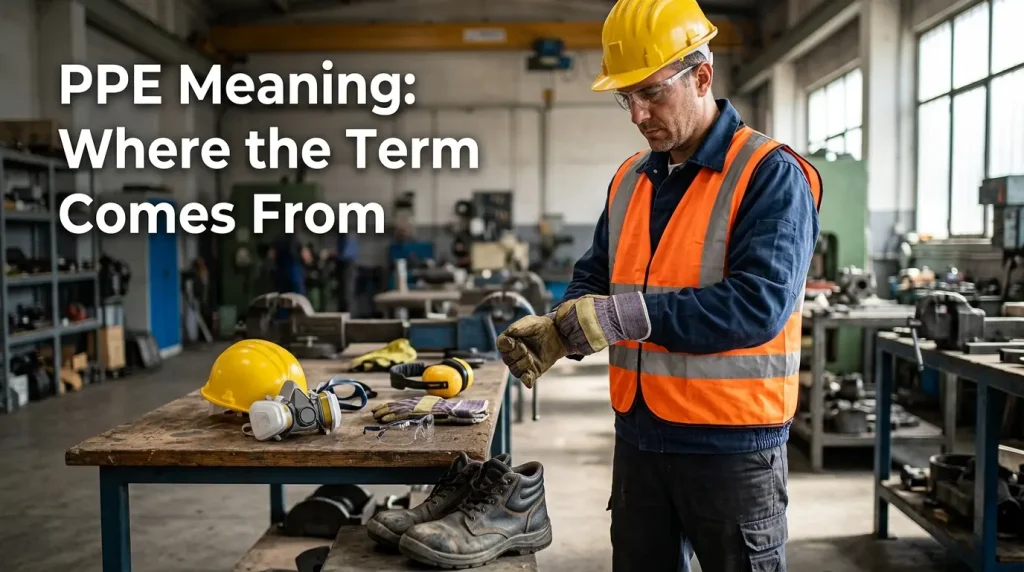
The meaning of PPE becomes clearer once you break the term down word by word:
- Personal, it is worn by an individual and fitted to that person specifically.
- Protective, its function is to guard against harm, not to perform the work task itself.
- Equipment, it is a physical item or device, not a rule or a procedure.
So when someone asks about the PPE meaning, the simplest way to explain it is this: PPE is equipment that a person wears on their body to lower their personal risk of injury or illness while doing a task that involves some level of danger.
This term is used across many industries, not just construction or manufacturing. Hospitals, laboratories, food processing plants, mining sites, and even everyday households during a disease outbreak all rely on some form of PPE.
How Does PPE Work?
PPE protects a worker in a few distinct ways, depending on the type of hazard involved. Understanding this makes it much easier to choose the right equipment for a given task.
- Creates a physical barrier. Gloves, aprons, and coveralls stop a hazardous substance from making direct contact with the skin.
- Reduces or filters exposure. Respirators trap airborne dust, fumes, or particles before they reach the lungs, and ear protection reduces the volume of noise that reaches the eardrum.
- Absorbs or deflects impact. Hard hats and safety footwear are built to absorb the force of an impact so it does not transfer fully to the body.
- Isolates the body from heat or chemicals. Heat-resistant clothing and chemical-resistant suits keep extreme temperatures or corrosive substances away from the skin.
- Arrests a fall. Harnesses and lanyards are engineered to catch and stop a fall before it results in a ground-level impact, distributing the force across the body instead of a single point.
- Improves visibility. High-visibility clothing makes a worker easier to see in low light or around moving vehicles, reducing the chance of a collision.
In every case, PPE works by standing between the worker and the hazard. It does not remove the hazard from the environment, which is why it is always paired with other safety measures whenever possible.
PPE vs Other Safety Controls: Where It Fits in the Hierarchy
A common misunderstanding is treating PPE as the primary way to manage workplace risk. In reality, safety professionals follow a structure called the hierarchy of controls, developed by NIOSH, which ranks safety measures from most effective to least effective. PPE sits at the bottom of that hierarchy, not because it is unimportant, but because it depends entirely on correct selection, fit, and consistent use by the worker.
The five levels, from most to least effective, are:
- Elimination – removing the hazard completely. Example: redesigning a task so work no longer needs to happen at height.
- Substitution – replacing the hazard with something safer. Example: switching from a toxic solvent to a non-toxic cleaning agent.
- Engineering controls – isolating people from the hazard through design. Example: installing a machine guard or a ventilation system.
- Administrative controls – changing how people work. Example: rotating workers to limit exposure time, or requiring a documented safety procedure before a task begins.
- Personal protective equipment – protecting the individual worker directly. Example: safety glasses, gloves, or a respirator.
Here is how the same hazard might be addressed at each level:
| Control Type | Example |
|---|---|
| Engineering control | Installing a physical guard around a moving machine part |
| Administrative control | Training workers on safe procedures and limiting exposure time |
| PPE | Wearing safety glasses and gloves while operating the machine |
The reason PPE ranks last is simple: it relies on human behavior. A machine guard protects a worker even if they forget it is there. PPE only works if it is worn correctly, fits properly, and is used every single time exposure is possible. This is exactly why OSHA requires employers to first evaluate whether a hazard can be eliminated or controlled through engineering or administrative means, and to use PPE only when those options are not fully sufficient on their own.
In most real workplaces, safety is not achieved through a single control. It comes from layering several levels together, for example, a ventilation system (engineering control) combined with a documented handling procedure (administrative control) and a respirator (PPE) for a task involving airborne chemicals.
Types of Personal Protective Equipment
PPE is generally grouped by the part of the body it protects. The table below summarizes each category along with what it protects against and common examples.
| PPE Type | Protects Against | Examples |
|---|---|---|
| Head protection | Falling objects, impact, bumps | Hard hats, bump caps |
| Eye protection | Dust, chemical splashes, flying particles | Safety glasses, goggles |
| Face protection | Splashes, sparks, intense light | Face shields, welding shields |
| Hearing protection | Excessive or prolonged noise | Earplugs, earmuffs |
| Respiratory protection | Dust, fumes, gases, airborne pathogens | Filtering facepiece respirators, cartridge respirators |
| Hand protection | Cuts, chemicals, heat, abrasion | Safety gloves, chemical-resistant gloves |
| Foot protection | Crushing injuries, punctures, slips | Steel-toe or composite-toe boots |
| Body protection | Chemical exposure, heat, contamination | Coveralls, aprons, chemical suits |
| Fall protection | Falls from height | Harnesses, lanyards, lifelines |
A closer look at each category:
Head protection Hard hats and bump caps guard against falling objects, low clearances, and impact injuries. This category is essential on construction sites and anywhere overhead work is taking place.
Eye and face protection Safety glasses, goggles, and face shields protect against flying debris, chemical splashes, and intense light, such as from welding. Eye protection and face protection are often used together, since a shield alone does not always seal against splashes the way goggles do.
Hearing protection Earplugs and earmuffs reduce exposure to loud, continuous noise that can cause permanent hearing damage over time. This is especially important in manufacturing plants, near heavy machinery, or on airport tarmacs.
Respiratory protection Respiratory protection includes filtering facepiece respirators and other approved respirators selected according to the specific airborne hazard. This is not a single, interchangeable category. A basic dust mask may be adequate for light, non-toxic dust, but it offers little to no protection against toxic gases, vapors, or fine chemical fumes. Selecting the correct respirator depends on identifying the exact contaminant and its concentration in the air, which is why a hazard assessment always comes before respirator selection.
Hand protection Gloves are selected based on the hazard involved, whether it is heat, chemicals, cuts, or biological contamination. A glove rated for cut resistance will not necessarily protect against a corrosive chemical, so matching the glove material to the hazard matters.
Body protection Coveralls, aprons, and chemical-resistant suits shield the torso and limbs from spills, heat, or contact hazards.
Foot protection Steel-toe or composite-toe boots protect against crushing injuries, punctures, and slips.
Fall protection Harnesses, lanyards, and lifelines are used by anyone working at height to prevent or arrest a fall.
Choosing the right combination depends entirely on the hazards present in a specific work environment, which is why a proper hazard assessment always comes before PPE selection.
Why Personal Protective Equipment Matters
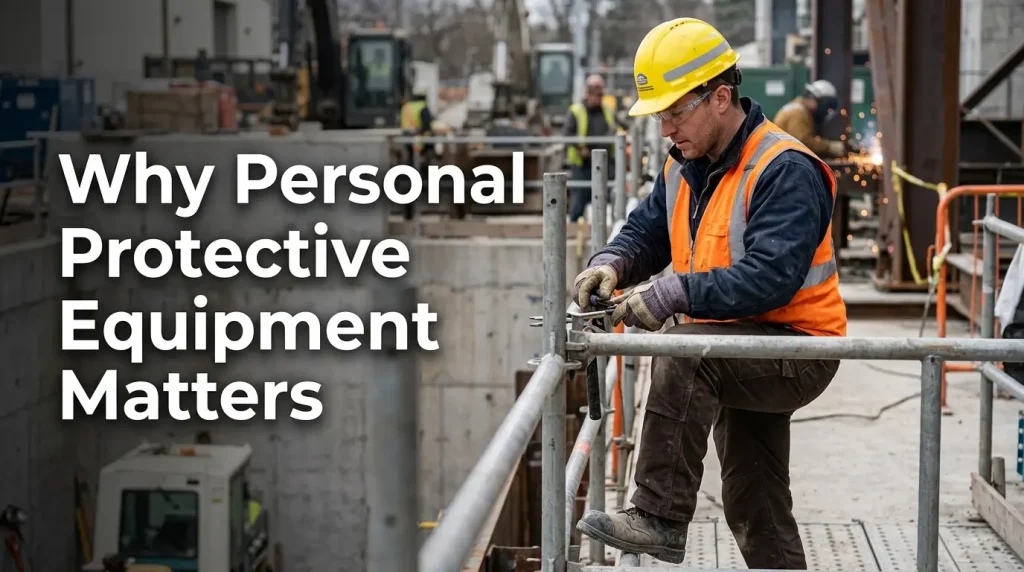
Workplace injuries and illnesses often happen in the seconds after something goes wrong: a spark flies, a chemical spills, a tool slips, or airborne particles are inhaled. PPE is what stands between that moment and a serious injury.
A few reasons PPE remains essential:
- It reduces the severity of an incident. Even when an accident cannot be avoided, proper PPE can turn a life-threatening injury into a minor one.
- It protects against invisible hazards. Chemical fumes, radiation, and airborne pathogens are not always visible, and PPE is often the only defense against them.
- It supports legal and regulatory compliance. Most countries have workplace safety laws that require PPE in specific industries.
- It builds a culture of safety. When PPE is used consistently, it signals that safety is a genuine priority, not just a policy on paper.
- It protects others, not just the wearer. In healthcare and food handling, PPE such as gloves and masks also prevents the spread of contamination to other people.
Who Is Responsible for Training Workers on the Use of PPE?
This is one of the most common questions asked by both employers and employees, and the answer is straightforward: the employer is responsible for training workers to use personal protective equipment correctly.
Under OSHA Standard 29 CFR 1910.132(f), employers must assess the workplace for hazards and then train workers on how to properly wear, use, maintain, and replace their PPE. This responsibility is not optional. It applies whenever a job task requires the use of protective equipment, and it starts before a worker ever begins that task.
A proper PPE training program generally requires the employer to make sure each worker understands:
- Why the PPE is necessary and what hazard it protects against
- When the PPE must be worn
- How to put it on and take it off correctly
- How to check it for damage before use
- How to clean, store, and maintain it
- What the limitations of the equipment are
Employers are also expected to confirm that each worker can demonstrate proper use of the PPE before being allowed to perform the task, and to retrain anyone who does not show a clear understanding.
That said, responsibility does not end with the employer alone. Effective PPE training is really a shared effort between employers, supervisors, safety officers, and the workers themselves. Employees are expected to attend training sessions, follow the instructions given, wear their equipment as directed, and report any damage or fit issues right away. Regulatory bodies such as OSHA set the minimum standards that this training must meet, but keeping people safe day to day depends on cooperation between everyone on site.
In short, if you are asking who holds the legal duty, it is the employer. If you are asking who makes the training actually work in practice, it is a joint effort across the whole workplace.
How to Choose the Right PPE
Selecting PPE is not a one-size-fits-all decision. A proper process usually follows these steps:
- Conduct a hazard assessment. Identify what risks exist in the specific work area or task.
- Try to eliminate or reduce the hazard first. PPE should never be the first or only line of defense.
- Match the equipment to the hazard. A dust mask will not protect against toxic gas, and general-purpose gloves will not protect against a strong acid.
- Check for proper fit. PPE that does not fit correctly can fail exactly when it is needed most.
- Set a maintenance and replacement schedule. Worn-out or damaged PPE offers little real protection.
- Document and repeat training regularly. Refresher sessions matter, especially when equipment or hazards change.
PPE Selection by Hazard Type
Matching PPE to the actual hazard is where most real-world mistakes happen. A few common examples:
- Chemical handling – chemical-resistant gloves paired with goggles or a face shield, and a respirator if fumes are present.
- Welding – a welding helmet with the correct shade lens, flame-resistant gloves, and protective clothing to guard against sparks and UV radiation.
- Construction sites – a hard hat, safety footwear, and eye protection as a baseline, with hearing protection added near heavy equipment.
- High-noise environments – earplugs or earmuffs, chosen based on the noise level and how long the exposure lasts.
- Dust or fume-heavy areas – a respirator matched to the specific contaminant, not a generic dust mask.
PPE Standards and Regulations
In the United States, PPE requirements are primarily governed by OSHA under 29 CFR 1910.132 for general industry, with additional standards for construction and maritime work. This regulation covers several employer obligations:
- Hazard assessment – employers must evaluate the workplace to identify hazards that require PPE.
- PPE selection – equipment must be appropriate for the specific hazard identified.
- Training – workers must be trained before using PPE and retrained when necessary.
- Fit and payment – employers must generally provide PPE at no cost to the employee and ensure it fits properly.
- Industry-specific requirements – certain sectors, such as construction, healthcare, and manufacturing, have additional PPE rules layered on top of the general standard.
Beyond OSHA, a few other organizations play a role worth knowing about, though they serve different purposes and are not interchangeable with OSHA regulations:
- NIOSH conducts research and certifies certain respiratory protection equipment, such as N95 respirators.
- ANSI develops voluntary consensus standards for specific PPE, such as eye protection and hard hats, which OSHA often references.
- ISO provides international standards used outside the United States, relevant for companies operating globally.
OSHA sets the legal requirement in the US, while NIOSH, ANSI, and ISO provide the technical standards that specific PPE products are often tested and certified against.
PPE Inspection Checklist
PPE only works if it is in good condition. Before using any piece of equipment, take a moment to check for the following:
- Cracks or dents in hard hats or helmets
- Tears or thinning in gloves, aprons, or protective clothing
- Broken or frayed straps on harnesses or headgear
- Scratched or damaged lenses on goggles or glasses
- Worn soles or exposed toe caps on safety footwear
- Signs of contamination or chemical residue
- Expired filters or cartridges on respirators
- Missing components, such as buckles or clips
- A proper, snug fit with no gaps
Making this a habit before every use, not just during periodic checks, catches problems before they become injuries.
Limitations of PPE
PPE is valuable, but it is not foolproof. Understanding its limitations is part of using it safely.
- PPE does not eliminate the hazard. It only reduces the chance or severity of harm if exposure occurs.
- Incorrect selection reduces or removes protection. Equipment chosen for the wrong hazard may offer a false sense of safety.
- Poor fit weakens performance. A respirator that does not seal properly, or gloves that are too loose, can fail exactly when needed.
- Damaged PPE may not protect at all. A cracked lens or a torn glove can let a hazard through undetected.
- Some PPE introduces new risks. Loose clothing near machinery, or restricted vision from a face shield, can create secondary hazards if not managed carefully.
- PPE requires ongoing inspection and maintenance. Equipment that is not checked and cared for degrades in effectiveness over time.
This is precisely why OSHA requires that workers understand not just how to use their PPE, but also its limitations, so they know when a piece of equipment is no longer providing adequate protection.
PPE Best Practices for Employers and Workers
- Never substitute PPE for proper hazard controls; use it as the last layer of protection.
- Inspect equipment before every use, not just occasionally.
- Replace damaged or expired PPE immediately rather than waiting for the next scheduled check.
- Store PPE in a clean, dry place to preserve its protective quality.
- Encourage workers to report discomfort or poor fit early, since this often leads to non-use.
- Keep written records of all training sessions for compliance and accountability.
Frequently Asked Questions
What does PPE stand for?
PPE stands for personal protective equipment, referring to gear worn to reduce exposure to workplace hazards.
What are the 5 main types of PPE?
While there are several categories, the most commonly referenced five are head protection, eye and face protection, hearing protection, respiratory protection, and hand protection. Body protection and fall protection are often added as additional categories depending on the industry.
What is PPE used for?
PPE is used to reduce a worker’s exposure to physical, chemical, biological, or mechanical hazards that cannot be fully controlled through engineering or administrative measures.
Is PPE the last line of defense?
Yes. In the hierarchy of controls, PPE sits below elimination, substitution, engineering controls, and administrative controls, making it the final layer of protection rather than the first.
Who pays for PPE?
Under OSHA rules, employers generally must provide and pay for required PPE, subject to specific exceptions. Requirements can differ under other countries’ laws.
What PPE is required on a construction site?
Required PPE depends on the hazards and tasks involved. Common construction PPE includes hard hats, eye protection, safety footwear, hearing protection, gloves, high-visibility clothing, and fall protection where applicable.
What is the difference between PPE and safety equipment?
PPE refers specifically to items worn on the body by an individual worker. Safety equipment is a broader term that can include fixed items like machine guards, fire extinguishers, or ventilation systems that are not worn by a person.
How often should PPE be inspected?
PPE should be visually inspected before every single use, in addition to any periodic formal inspections required by the employer’s safety program.
Can PPE be reused?
Many types of PPE, such as hard hats, goggles, and gloves, can be reused as long as they pass inspection and are properly cleaned. Some items, like certain respirator filters or disposable gloves, are designed for limited or single use only.
What happens if PPE does not fit properly?
Poorly fitting PPE can fail to provide adequate protection. A loose respirator may not seal correctly, oversized gloves can reduce dexterity and increase the risk of an accident, and an ill-fitting harness may not distribute force correctly during a fall.
Final Thoughts
Personal protective equipment plays a small but critical role in a much larger safety system. It cannot replace good hazard control, but when hazards cannot be fully removed, PPE is what stands between a worker and a serious injury. Understanding what PPE means, how it works, where it fits in the hierarchy of controls, and who is responsible for training workers to use it correctly is the foundation of building a genuinely safe workplace, not just a compliant one.
You May Also Like It:
Industrial Robot Safety: The Complete 2026 Guide for Facilities, Engineers & Safety Managers
Safety Topics: Guide to OSHA Safety Topics, Toolbox Talks, and Meeting Ideas
Industrial Safety Signs: The Complete Guide to Types, Meanings, Colors, and Standards
Safety Equipment Supplier: The Complete Buyer’s Guide for US Businesses


[…] protection. Mandating personal protective equipment such as hard hats, safety vests, and eye protection, along with the training required to use it […]
[…] hazards can’t be eliminated through engineering or administrative controls, PPE becomes the last line of defense. OSHA requires employers […]
[…] order of priority: elimination, substitution, engineering controls, administrative controls, and personal protective equipment. Unlike chemical or biological hazards, physical hazards do not involve a toxic substance or living […]
[…] PPE and health hazards: about 1 hour combined […]