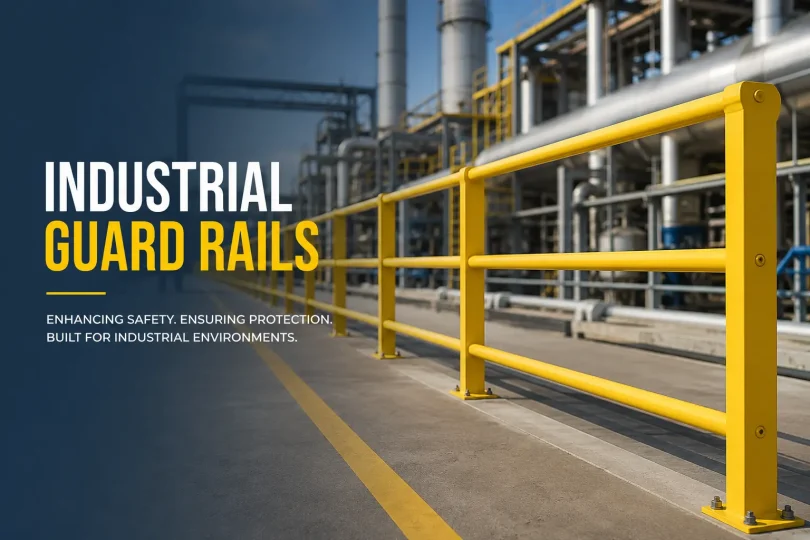

Every year, forklifts and other powered industrial vehicles cause thousands of preventable accidents inside warehouses and manufacturing plants. Industrial guard rails are the single most effective physical barrier a facility manager can install to stop that damage before it happens. This guide covers what industrial guard rails are, the different types available, real injury and cost data, OSHA requirements, common buying mistakes, and a checklist you can use before you order.
This article was researched using current OSHA fall protection and walking-working surface regulations, published injury data from the National Safety Council and Bureau of Labor Statistics, and an analysis of leading industrial safety suppliers, so the information reflects both regulatory requirements and real-world product practice.
What Are Industrial Guard Rails?
Industrial guard rails are fixed, heavy-duty barrier systems built from steel, HDPE-sleeved pipe, or engineered polymer that are bolted or anchored to a facility floor to separate people, machinery, and infrastructure from moving vehicles and fall hazards. A complete guard rail system is made up of horizontal rails, connecting posts, and base plates, and it is engineered to absorb and redirect impact energy rather than transferring that force directly into the equipment or structure being protected.
Unlike a simple handrail, which mainly gives a person something to hold onto, an industrial guard rail is a structural safety device. It is rated for a specific impact load, tested against forklift and pallet jack collisions, and installed according to defined height and strength rules. In short, an industrial guard rail is both a physical barrier and a visual warning system that tells workers and vehicle operators exactly where a safe boundary begins.
Why Guard Rails Matter: The Real Injury Statistics
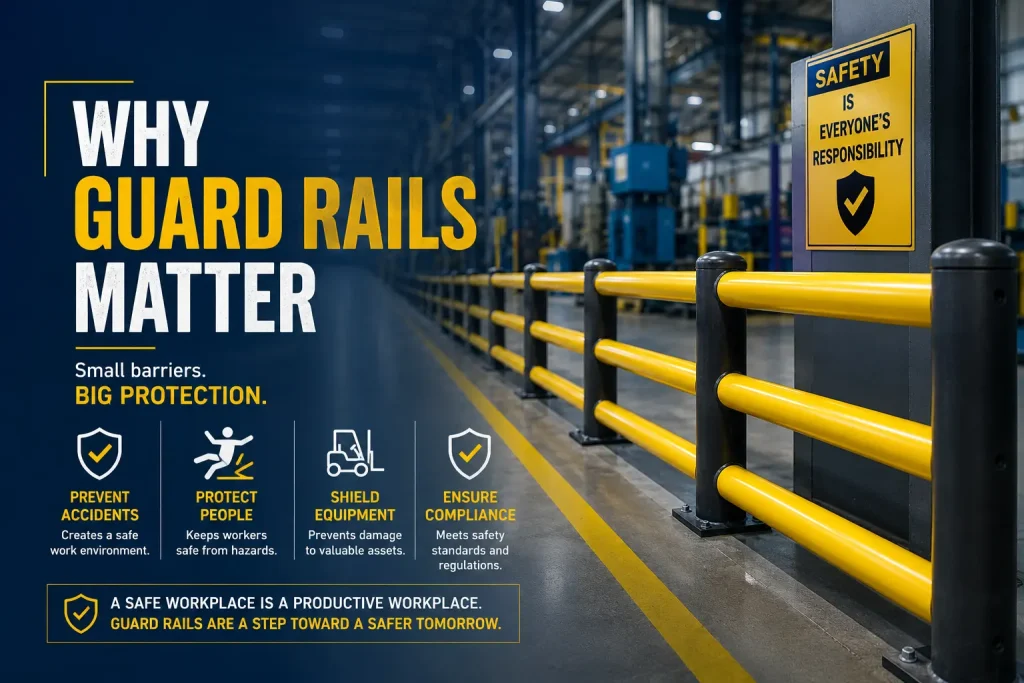
Warehouse and industrial facilities are not low-risk environments, and the data backs that up. Warehouse injury rates run at roughly 4.8 cases per 100 workers, more than double the all-industry average, and forklifts alone are linked to somewhere between 35,000 and 62,000 injuries every year in the United States. Roughly 75 to 100 workers are killed annually in forklift-related incidents, and forklift tip-overs account for close to a quarter of all forklift accidents. Loading docks are especially dangerous, tied to around 25 percent of all warehouse accidents, and every reported loading dock injury is estimated to represent hundreds of near-misses that went unreported.
Two numbers matter most for anyone specifying guard rails. First, OSHA and industry researchers estimate that a large share of powered industrial vehicle accidents are preventable through better training and engineering controls such as barriers. Second, being struck by a moving or falling object remains one of the most common non-fatal injury types in the transport and storage sector. Warehouse safety barriers, forklift barriers, and pedestrian barriers exist specifically to interrupt this chain of events before a vehicle ever reaches a person, a rack, or a piece of equipment.
These figures are the strongest argument for installing rated impact protection systems rather than relying on paint lines, cones, or verbal warnings alone.
Expert Insight
Facilities handling frequent forklift traffic should prioritize impact-rated guard rail systems over standard barriers, because repeated low-speed collisions can weaken untested structures over time even when no single impact looks severe on its own. A guard rail that has never been engineer-tested against a rated load may hold up fine against one hit and then fail unexpectedly after the fifth or sixth impact, right when a worker happens to be nearby. Specifying a guard rail with a documented, third-party impact rating, not just a “heavy duty” label, is the detail that separates a system that actually protects people from one that only looks like it does.
Types of Industrial Guard Rails
Not every area of a facility needs the same level of protection. Matching the guard rail type to the actual hazard is the difference between an effective system and wasted budget.
| Type | Material | Impact Resistance | Best Use |
|---|---|---|---|
| Heavy Duty Guard Rail | Steel / HDPE-sleeved steel | High (rated for forklift impact) | Loading docks, forklift aisles, high-traffic zones |
| Light Duty Guard Rail | Steel | Low to moderate | Pedestrian walkways, office partitions, low-risk areas |
| Flexible / Self-Healing Guard Rail | Engineered polymer | Moderate to high, flexes and recovers | Warehouses with frequent low-speed contact |
| Industrial Safety Guard Rail | Steel | Meets OSHA fall protection criteria | Mezzanines, elevated platforms, open-sided floor holes |
| Modular Drop-In Guard Rail | Steel | High | Rack ends, aisles that need frequent reconfiguration |
Heavy Duty Industrial Guard Rails
Heavy duty guard rails are built for high-traffic zones where forklifts, sweepers, and other powered vehicles travel at meaningful speed, such as loading docks, aisle ends, and mezzanine edges. These systems typically use welded or bolt-down steel pipe, sometimes sleeved in HDPE plastic to resist corrosion and reduce maintenance. They are engineered to take repeated hits from vehicles weighing several thousand pounds without failing structurally.
Light Duty Guard Rails
Light duty guard rails are designed for lower-risk areas such as office partitions inside a warehouse, pedestrian walkway edges, or zones where only occasional, low-speed contact is expected. They use lighter-gauge rail and post material, which lowers cost while still creating a clear visual and physical boundary. Light duty guard rails are a good fit when the goal is traffic separation rather than absorbing a high-impact vehicle strike.
Industrial Safety Guard Rails
Industrial safety guard rails is a broader term that covers guard rail systems specifically installed to meet occupational safety requirements, including fall protection at elevated platforms, mezzanines, and open-sided floor holes. These systems are engineered to meet the strength and height criteria set out in general industry safety regulations rather than being selected purely for vehicle-impact resistance.
Industrial Guards
Industrial guards is a wider category that includes not only guard rails but also machine protection barriers, column protectors, bollards, rack protection, and safety gates. Guard rails are one component within this larger family of industrial safety equipment, and many facilities combine several types of industrial guards to create a complete warehouse protection system around a hazard area.
Modular and Self-Healing Guard Rails
Some manufacturers now offer flexible, drop-in or lift-out rail systems made from resilient polymer resin. These self-healing rails are designed to flex on impact and return to shape, cutting down on repair and replacement costs compared to rigid welded steel guard rail in very high-traffic aisles.
Industrial Guard Rails vs Other Safety Barriers
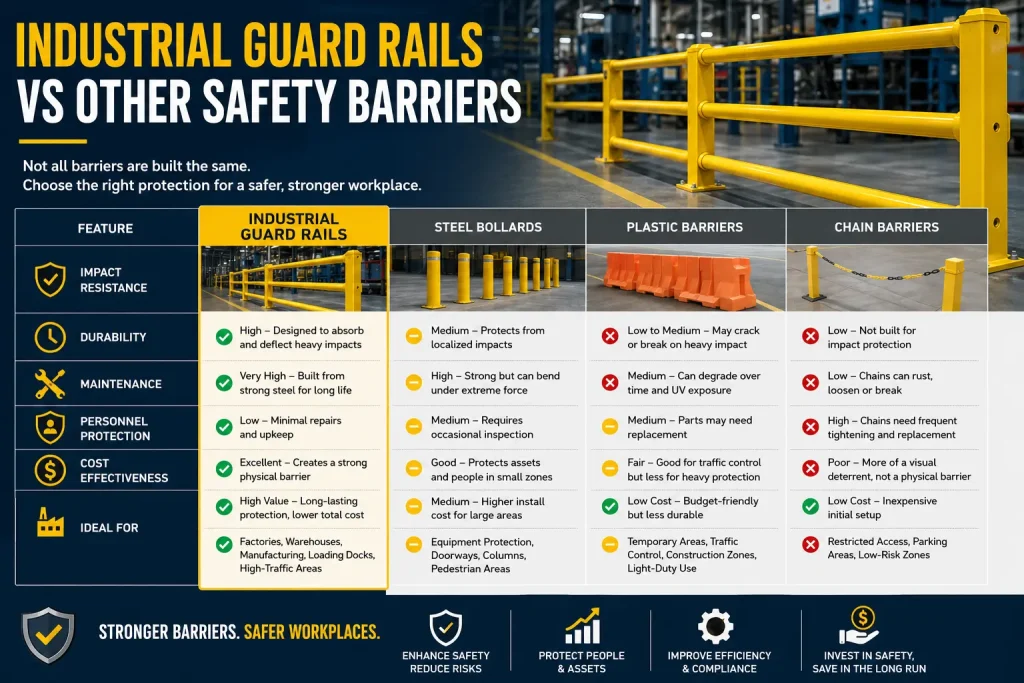
Buyers frequently confuse guard rails with related safety products. Here is how they actually differ.
| Product | Primary Function | Typical Placement | Impact Rated? |
|---|---|---|---|
| Industrial Guard Rail | Absorbs vehicle impact, separates traffic | Aisles, docks, rack ends | Yes, for heavy duty systems |
| Bollard | Protects a single fixed point or asset | Columns, doorways, equipment corners | Yes, but point protection only |
| Handrail | Provides a handhold for balance | Stairs, ramps, elevated walkways | No, not designed for impact |
| Safety Barrier (mobile/fixed) | General perimeter separation | Temporary work zones, construction areas | Varies, often lower rated |
| Guard Fencing | Encloses a wider hazard area | Machine cells, robotic work zones | Rarely, mainly a visual/access barrier |
Guard rails vs bollards: A bollard protects a single point, such as a column corner or a control panel, while a guard rail protects an entire line or edge. Facilities often use both together, bollards at vulnerable corners and guard rail along the length of an aisle.
Guard rails vs handrails: A handrail is a support device for people walking on stairs or ramps and is not engineered to stop a vehicle. A guard rail is a structural barrier meant to absorb impact, so the two are not interchangeable even though both sit at a similar height.
Guard rails vs safety barriers: General safety barriers, including portable or lightweight fixed barriers, are often used for temporary hazard zones. Industrial guard rails are permanent, load-rated, and intended for ongoing daily traffic exposure.
Guard rails vs guard fencing: Guard fencing typically encloses a larger area, such as a robotic cell or an entire machine zone, and is more about restricting access than absorbing a direct vehicle hit. Guard rails are usually linear and placed specifically where vehicle or pedestrian paths run close to a hazard.
OSHA Requirements for Industrial Guard Rails
Guard rails used for fall protection in general industry facilities are governed primarily by 29 CFR 1910.29. Understanding these OSHA guard rail requirements is essential before specifying or installing a system.
- Height: The top edge height of top rails must be 42 inches, plus or minus 3 inches, above the walking-working surface.
- Strength of the top rail: Guardrail systems must withstand a force of at least 200 pounds applied in a downward or outward direction within 2 inches of the top edge, without failing.
- Deflection limit: When that 200-pound test load is applied downward, the top rail cannot deflect below 39 inches in height.
- Midrail strength: Midrails, screens, mesh, and other intermediate members must resist at least 150 pounds of force applied in any downward or outward direction.
- Midrail placement: Midrails are required midway between the top rail and the walking surface whenever there is no wall or parapet at least 21 inches high.
- When guard rails are triggered: OSHA requires guardrails on any walking-working surface that is 4 feet or more above a lower level, and stairways with 4 or more steps must have a stair rail system with a handrail. If employees are working near dangerous equipment, guardrails are required at any height to prevent falls.
- Surface finish: Guard rail systems must be smooth-surfaced to avoid punctures, lacerations, or snagged clothing.
For vehicle-impact guard rails around racking and pedestrian aisles, OSHA does not set a specific impact rating, so facilities typically rely on ANSI-recognized impact test standards published by individual manufacturers to confirm a system will hold up against expected forklift traffic.
Industrial Guard Rail Cost Guide
Cost is one of the most searched questions for this product category, and pricing varies widely based on material, height, and run length.
Average Cost
Steel warehouse guard rail typically runs between roughly $30 and $80 per linear foot for materials alone, with the exact number depending on rail height, single-high versus double-high configuration, and steel gauge. Larger runs generally bring the per-foot price down slightly, while short runs under 100 feet often carry a premium because fixed costs like end posts and mobilization get spread across less material.
Installation Cost
As a rule of thumb, installation labor for warehouse guard rail often ends up roughly equal to the material cost itself. A project with $10,000 in guard rail materials commonly lands around $20,000 total once labor is included, though this ratio shifts if the facility has a difficult layout, concrete cutting requirements, or limited crew access.
Maintenance Cost
Bare steel guard rail generally needs periodic repainting and rust treatment, particularly in humid or outdoor-adjacent environments. HDPE-sleeved steel and polymer resin systems reduce this cost significantly because they resist corrosion and chipping, which is why many facilities accept a higher upfront price for sleeved or self-healing rail in exchange for lower lifetime maintenance.
Factors Affecting Price
- Material type: Bare steel is cheaper upfront; HDPE-sleeved and polymer systems cost more initially but need less upkeep.
- Single-high vs double-high: Double rail configurations use more steel and more posts per linear foot, raising material cost.
- Post spacing and run length: Tighter post spacing increases strength but also increases material and labor cost per foot.
- Site conditions: Concrete footing requirements, uneven flooring, or limited access can add significant installation cost.
- Impact rating: Systems engineer-tested for high-speed, heavy-vehicle impact cost more than standard light duty rail.
- Freight: Guard rail is heavy, so shipping is often billed separately and can be a meaningful share of total project cost.
Common Mistakes When Buying Industrial Guard Rails
- Wrong height for the application: Installing a rail at a height that does not meet OSHA’s 42-inch (plus or minus 3 inches) requirement for fall protection zones, or choosing a vehicle-barrier height that does not match actual forklift bumper height.
- Wrong anchors: Using anchors that are not rated for the facility’s floor thickness or concrete strength, which lets the entire post pull loose on impact.
- Cheap, unrated material: Buying generic steel tube dressed up as a guard rail without any documented impact rating, then discovering it deforms permanently after one moderate hit.
- Ignoring the impact rating: Placing a light duty guard rail in a zone with heavy forklift traffic, which guarantees premature failure and repeat replacement costs.
- Skipping post-installation inspection: Assuming a guard rail is permanently safe once bolted down, instead of scheduling routine checks for loosened bolts, cracked welds, or bent rail sections.
- Overlooking maintenance cost: Choosing the cheapest material without factoring in long-term repainting, corrosion, and replacement costs over the system’s service life.
- Treating all barriers as interchangeable: Using a bollard where a full guard rail run is needed, or a handrail where an impact-rated barrier is actually required.
Where Industrial Guard Rails Should Be Installed
- Loading dock guard rails and dock doors
- Pallet racking aisles and rack ends, as part of a broader rack protection plan
- Pedestrian barriers and walkway crosswalks
- Mezzanines and elevated platforms
- Conveyor lines and automated equipment
- Battery charging stations
- In-plant offices and control rooms
- Building columns and structural supports, alongside machine protection barriers
- Freezer, cooler, and mechanical room panels
How to Choose the Right Industrial Guard Rail System
- Identify the hazard type: Decide whether you are protecting against vehicle impact, fall hazards, or both, since this determines whether you need heavy duty, light duty, or fall-protection-rated guard rails.
- Check the load rating: Match the guard rail’s tested impact rating to the weight and speed of vehicles actually operating in that zone.
- Confirm height and clearance: Verify the rail height meets OSHA’s 42-inch (plus or minus 3 inches) requirement for fall protection applications, and check local building codes for vehicle-barrier applications.
- Choose the installation method: Bolt-down systems offer maximum rigidity, while drop-in or lift-out modular rails allow easier reconfiguration as your layout changes.
- Consider maintenance needs: HDPE-sleeved and polymer resin systems reduce long-term repainting and corrosion costs compared to bare steel.
- Plan for visibility: Safety yellow finishes and reflective elements improve recognition in low-light or high-traffic zones.
- Budget for the full project, not just materials: Include installation labor, concrete footing work, and freight in your total cost estimate rather than comparing suppliers on per-foot material price alone.
Before Buying Industrial Guard Rails: Checklist
- [ ] Forklift and vehicle traffic in the zone has been assessed
- [ ] OSHA height requirement (42 inches, plus or minus 3 inches) verified for any fall-protection application
- [ ] Material selected (steel, HDPE-sleeved, or polymer) based on impact and maintenance needs
- [ ] Impact rating confirmed against actual vehicle weight and speed
- [ ] Anchor type matched to floor thickness and concrete rating
- [ ] Single-high vs double-high configuration decided
- [ ] Installation method chosen (bolt-down vs modular drop-in)
- [ ] Full project budget calculated, including materials, labor, and freight
- [ ] Routine inspection schedule planned after installation
Frequently Asked Questions
What is the standard height for an industrial guard rail?
For fall protection applications, OSHA requires the top rail to sit 42 inches above the walking-working surface, with a tolerance of plus or minus 3 inches.
What is the difference between industrial guard rails and light duty guard rails?
Industrial guard rails, particularly heavy duty versions, are built to absorb high-impact hits from forklifts and other powered vehicles in busy traffic zones. Light duty guard rails use lighter materials and are meant for lower-risk pedestrian separation rather than direct vehicle impact.
How much do industrial guard rails cost?
Steel guard rail material typically costs between roughly $30 and $80 per linear foot, and total installed cost, including labor, often runs close to double the material cost once a project is fully priced out.
Do industrial guard rails need to be OSHA compliant?
Any guard rail used specifically for fall protection on an elevated walking-working surface must meet OSHA’s 1910.29(b) height and strength requirements. Guard rails used purely for vehicle-impact protection around racking are governed more by manufacturer impact ratings than by a specific OSHA number, though good practice still applies OSHA’s general safety principles.
Can guard rails be reconfigured if my warehouse layout changes?
Yes. Modular drop-in or lift-out guard rail systems are designed specifically so sections can be removed, relocated, or added without cutting or rewelding, which makes them well suited to warehouses that change layout frequently.
How much weight can an industrial guard rail withstand?
It depends on the system. Standard OSHA-compliant top rails must resist 200 pounds of force without failing, while heavy duty vehicle-barrier guard rails from industrial manufacturers are commonly engineer-tested to withstand multiple hits from forklifts weighing several thousand pounds at several miles per hour.
Final Thoughts
Industrial guard rails remain one of the most cost-effective ways to protect people, equipment, and infrastructure inside a busy facility, and the injury and cost data make the case clearly: forklift and warehouse incidents are common, expensive, and largely preventable with the right engineering controls. Whether you need heavy duty guard rails for a high-traffic loading dock, light duty guard rails for a pedestrian walkway, or a full industrial safety guard rail system to meet OSHA fall protection rules, matching the right product to the actual hazard, and budgeting for the full installed cost rather than just materials, is the decision that determines both safety outcomes and long-term expense. Use the checklist above before you order, and review your facility’s traffic patterns, elevation changes, and equipment layout so the guard rail system you choose is rated for the loads it will actually face.
You May Also Like It:
CNC Machining Tolerances: The Complete Expert Guide