
Power outages and emergencies rarely announce themselves in advance. A storm rolls in, a transformer fails, a wildfire threatens the grid, or a cyberattack knocks out a utility’s control systems and within minutes, homes and businesses are in the dark. According to national safety agencies, the average household now experiences several hours of power interruption every year, and major weather events can knock out electricity for entire regions for days or even weeks.
This guide brings together practical, up-to-date, and expert-reviewed power outage safety tips what causes outages, how to build a blackout preparation checklist, how to stay safe during an outage, and how to recover afterward. Whether you’re a homeowner, a renter, a caregiver for someone on medical equipment, or a business owner responsible for continuity planning, this article is built to be the most complete resource on outages and emergencies.
What Counts as an “Outage” or “Emergency”?
An outage is any unplanned interruption of a critical service most commonly electricity, but the term also applies to water, gas, internet, telecom, and IT systems. An emergency, in this context, is any situation that threatens health, safety, or property and requires an immediate, organized response.
Outages and emergencies are closely linked because a single event a hurricane, an ice storm, a wildfire, or even a cyber incident can trigger both at once. Understanding the relationship between the two is the first step toward building a plan that actually works when it matters.
Common Types of Outages
- Power outages (blackouts and brownouts): Full loss of electricity or a temporary voltage drop, usually caused by storms, equipment failure, or grid overload.
- Planned power outages (PSPS events): Utilities may proactively shut off power during extreme fire-risk weather to prevent wildfires.
- Water outages: Main breaks, treatment plant failures, or contamination events that interrupt safe water supply.
- Natural gas outages: Supply interruptions or safety shutoffs following leaks or damage.
- Internet and telecom outages: Network or ISP failures that cut off connectivity, often compounding a power emergency by disabling communication.
- IT and cloud service outages: For businesses, a data center or cloud provider outage can be just as disruptive as a physical utility failure.
Common Causes of Outages and Emergencies
- Severe weather thunderstorms, hurricanes, ice storms, high winds
- Equipment failure aging transformers, worn cables, overloaded circuits
- Human error construction crews striking underground lines, vehicle accidents involving poles
- Wildfires and extreme heat both a cause and a consequence of grid stress
- Cyberattacks and technical failures increasingly common for utilities and IT infrastructure
- Natural disasters earthquakes, floods, and landslides damaging infrastructure
Before an Outage: Blackout Preparation Checklist
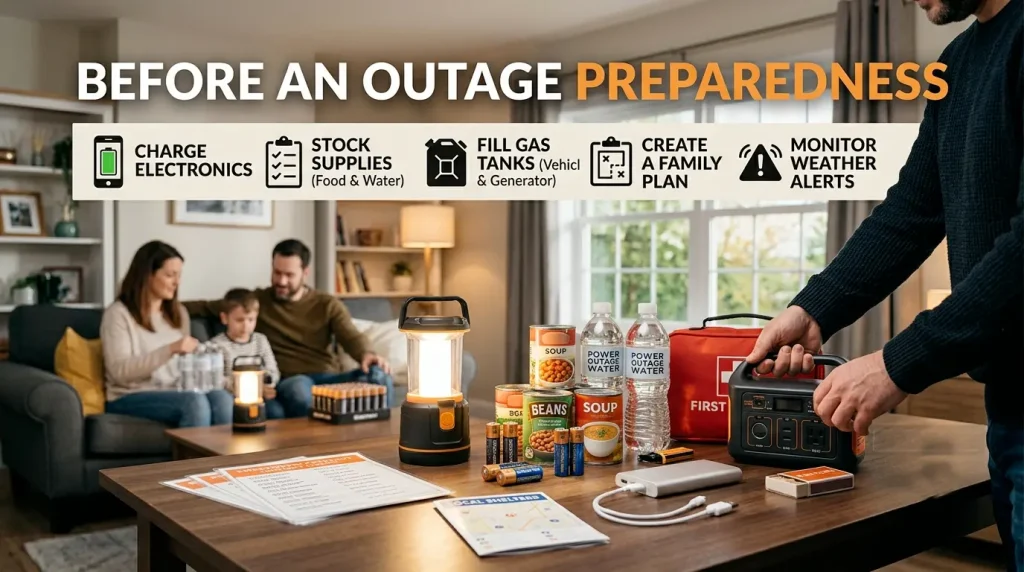
Preparation is the single biggest factor in how safely a household or business gets through an outage. A good blackout preparation checklist covers five areas: information, supplies, communication, backup power, and medical needs.
1. Create a Household or Business Emergency Plan
- Identify which systems or activities are essential (refrigeration, medical devices, security systems, production lines, servers).
- Map out interdependencies if one system fails, what else is affected?
- Assign roles: who checks on elderly neighbors, who monitors alerts, who manages a generator.
- Set a re-evaluation schedule; a plan that isn’t reviewed annually goes stale fast.
2. Assemble a Power Outage and Emergency Kit
A well-stocked kit should include:
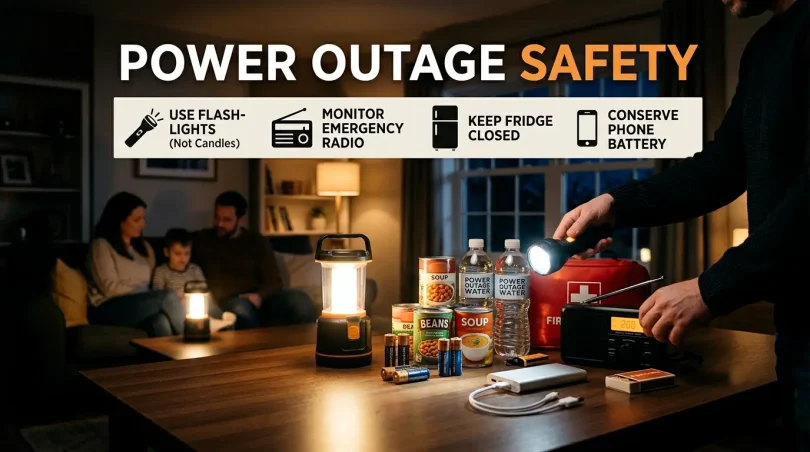
- Flashlights and headlamps with extra batteries (avoid candles fire risk)
- A battery-powered or hand-crank radio for emergency broadcasts
- Portable power banks and a car charger
- A minimum three-day supply of water and non-perishable food per person
- A basic first-aid kit and any critical medications
- A backup battery or corded (non-cordless) landline phone, since many cordless phones fail without power
- Copies of emergency contacts stored on paper, not just on a phone
3. Plan for Emergency Power Backup
- Generators: Only run generators outdoors, at least 20 feet from windows, doors, and vents, to prevent carbon monoxide poisoning. Never use one inside a garage, even with the door open.
- UPS (uninterruptible power supply): Ideal for protecting sensitive electronics and short outages.
- Solar generators and power stations: A quieter, fuel-free option for essential devices, and a reliable form of emergency power backup during extended blackouts.
- Whole-home standby systems: Best for households with continuous medical equipment needs or frequent extended outages.
4. Prepare for Medical and Special Needs
If anyone in the household depends on power for medical equipment oxygen concentrators, CPAP machines, refrigerated insulin register with your utility’s medical baseline or priority restoration program in advance. Talk to your provider about how long medication can safely be stored at higher temperatures, and identify a backup facility with power in case you need to relocate equipment.
5. Use Local Outage Tools: Outage Maps, Trackers, and Alerts
Most utilities now offer digital tools that make preparation and response far easier:
- Power outage map: Most utility websites and apps display a live power outage map showing affected areas, estimated crew arrival, and restoration progress in real time.
- Electric outage tracker: An electric outage tracker lets you follow the status of a specific reported outage from report to resolution, so you know whether crews are already on the way.
- Utility outage alerts: Sign up for utility outage alerts by text, call, or app push notification so you’re notified the moment an outage is detected in your area often before you even notice the lights are off.
- Enroll in local emergency alerts and weather warnings as well. These systems often give the earliest warning of planned outages or fast-developing severe weather.
What to Do During a Power Outage: Step-by-Step Safety Tips
- Check for safety hazards first. Look for downed power lines, gas odors, or sparking equipment. Never approach downed lines treat every one as live, and call 911 and your utility immediately.
- Report the outage to your utility. Knowing how to report a power outage quickly helps crews prioritize repairs. Use your utility’s app, website, live chat, or phone line most electric outage trackers update automatically once a report is logged, even if you assume others already reported it.
- Check your circuit breakers. If neighbors still have power, the issue may be isolated to your home’s electrical panel.
- Unplug sensitive electronics to protect them from power surges when electricity is restored.
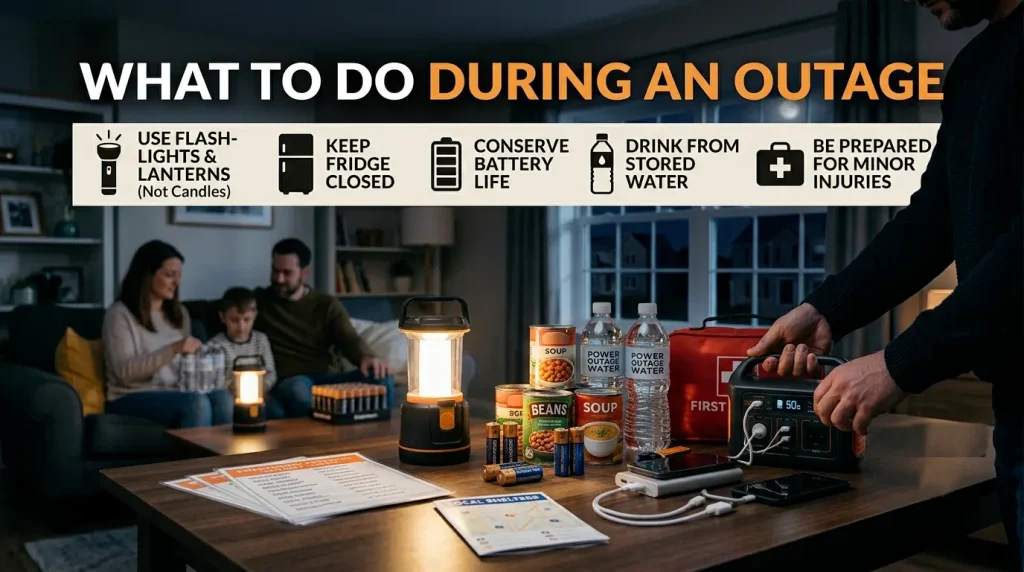
- Keep refrigerator and freezer doors closed. A full freezer holds temperature for about 48 hours; a half-full one for about 24 hours. An unopened refrigerator stays safely cold for about 4 hours.
- Manage indoor temperature safely. In winter, close off unused rooms and layer clothing rather than using an oven for heat (a serious fire and carbon monoxide risk). In summer, move to the lowest floor and use battery-powered fans or damp towels to cool down.
- Stay connected without draining your phone. Use text messages instead of calls where possible texts often go through even when networks are congested, and they use less battery.
- Check the power outage map periodically for restoration updates instead of repeatedly calling the utility, which can tie up phone lines during large-scale events.
- Check on vulnerable neighbors, especially elderly individuals, people with disabilities, and those relying on medical devices.
After an Outage: Safe Recovery Steps
- Inspect before switching everything back on. Look for damaged wiring, tripped breakers, or water intrusion before restoring power to major systems.
- Check food safety. Discard any perishable food that was above 40°F (4°C) for more than two hours, and anything with unusual odor, color, or texture. When in doubt, throw it out.
- Reset and test equipment. Restart transfer switches, reset control panels, and top off generator fuel for the next event.
- Document the impact. For businesses especially, recording downtime, losses, and response gaps makes the next plan stronger.
- Hold a short debrief. What worked, what didn’t, and what needs to change before the next outage or emergency.
Outages and Emergencies for Businesses: Continuity Planning
For businesses, an outage isn’t just an inconvenience it can mean data loss, spoiled inventory, missed deadlines, and lasting reputational damage. A strong business continuity plan should:
- Define which operations are mission-critical and how long they can tolerate being offline (the “disruption threshold”).
- Build a prioritized restoration checklist which systems come back online first based on business impact.
- Maintain redundant communication channels so frontline staff can be reached even if primary systems fail.
- Include cybersecurity incident response alongside physical outage response, since IT and cloud outages are now just as common a threat as storms.
- Review supplier and supply-chain dependencies, particularly for temperature-sensitive or time-critical goods.
- Invest in commercial-grade emergency power backup (generators or UPS systems) sized correctly for critical loads.
Frequently Asked Questions
How do I report a power outage?
Report a power outage through your utility’s mobile app, website outage-reporting form, or customer service phone line. Most utilities also let you confirm your outage on their power outage map or electric outage tracker, which updates automatically as crews are dispatched and restoration progresses.
How long can a house stay without electricity?
There’s no fixed limit a house itself is safe indefinitely without power, but comfort and safety risks grow the longer an outage lasts. Refrigerated food stays safe for about 4 hours unopened, frozen food for 24–48 hours, and extreme indoor temperatures can become dangerous within a day, especially for young children, older adults, and anyone using medical equipment. This is why an emergency power backup plan matters for outages expected to last more than a few hours.
How long does food stay safe during a power outage?
An unopened refrigerator keeps food safely cold for about 4 hours. A full freezer maintains a safe temperature for about 48 hours, and a half-full freezer for about 24 hours, provided the doors stay closed.
Is it safe to run a generator in a garage?
No. Generators should only be operated outdoors, at least 20 feet from windows, doors, and vents, due to the serious risk of carbon monoxide poisoning, which can be fatal within minutes.
What should I do if I see a downed power line?
Stay at least 30 feet away, treat it as live even if it looks inactive, and call 911 and your utility provider immediately. Never attempt to move it yourself.
How can I prepare if I depend on electric medical equipment?
Register with your utility’s medical baseline or priority restoration program, keep a doctor’s letter describing your equipment needs, and have a backup battery or an alternate location with power identified in advance.
What’s the difference between a blackout and a brownout?
A blackout is a complete loss of power, while a brownout is a temporary drop in voltage that can dim lights and affect appliance performance without a full outage.
Final Thoughts
Outages and emergencies are unpredictable, but the impact they have on your safety, health, and finances doesn’t have to be. A clear plan, a well-stocked kit, a reliable emergency power backup option, and a calm, step-by-step response can turn a potentially dangerous situation into a manageable one for individuals, families, and businesses alike. Review your blackout preparation checklist at least once a year, update it after every real event, bookmark your utility’s power outage map, and make sure everyone who depends on the plan actually knows it exists.
You May Also Like It:
CNC Machining Tolerances: The Complete Expert Guide
Prototype CNC Machining: The Complete Expert Guide
Steel Grade: The Complete Guide to Understanding Every Type of Steel