
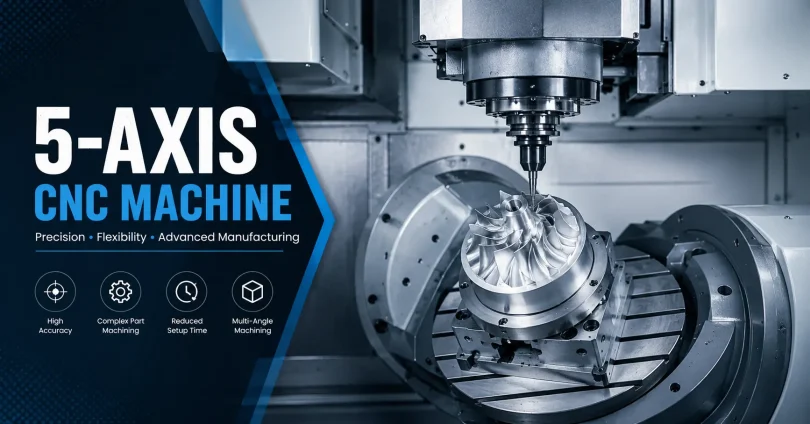

A 5-axis CNC machine was once considered equipment that only aerospace manufacturers and high-end mold shops could afford. Today, more compact machine designs and more accessible CAM software have made five-axis machining relevant to job shops, prototyping facilities, and specialized manufacturers of all sizes.
This guide covers what a 5-axis CNC machine is, how it works, the main configurations and types available, simultaneous vs. 3+2 machining, price ranges by category, what to compare when buying, common mistakes, and how to decide if it’s the right investment for your shop.
What Is a 5-Axis CNC Machine?
A 5-axis CNC machine is a computer-controlled machining system that moves a cutting tool and/or workpiece along five different axes three linear (X, Y, Z) and two rotary (typically two of A, B, or C) either one at a time or all together.
A standard 3-axis machine only moves in straight lines: left-right, forward-back, up-down. That’s enough for flat faces and simple pockets, but the moment a part needs an angled cut or a different face machined, the operator has to stop, unclamp, and reposition the part manually. Every reposition adds time and a chance of misalignment.
By adding two rotary axes, five-axis CNC machining lets the tool approach the part from almost any angle without touching the fixture again. A job that needed three or four separate setups on a 3-axis machine can often be finished in a single continuous run on a 5-axis machining center.
How Does a 5-Axis CNC Machine Work?
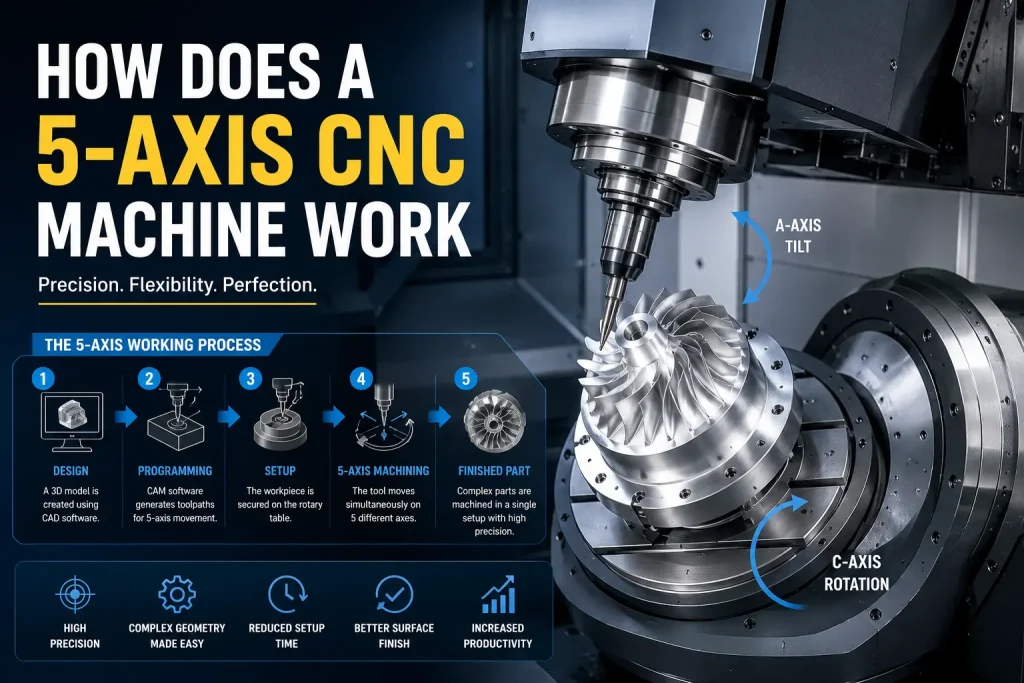
At its core, a 5-axis machine runs on the same basic CNC logic as any mill: the controller reads a toolpath, interpolates the motion, and drives the axes to cut the programmed geometry. The difference is that the controller now synchronizes five axes instead of three, and the CAM software has to generate toolpaths that actually take advantage of the extra motion not just reposition the part.
The two rotary axes work in one of two ways:
- Tilting the spindle head the tool itself tilts to reach an angle, while the part stays fixed. Common on machines built for large or heavy workpieces.
- Rotating/tilting the worktable the part sits on a trunnion or rotary table that rotates (C-axis) and tilts (A or B-axis) while the spindle stays fixed. Common on compact vertical machining centers.
The 5 Axes Explained
| Axis | Type | Motion |
|---|---|---|
| X | Linear | Left–right movement of tool/table |
| Y | Linear | Front–back movement |
| Z | Linear | Up–down movement (cutting depth) |
| A | Rotary | Rotation around the X-axis |
| B | Rotary | Rotation around the Y-axis |
| C | Rotary | Rotation around the Z-axis (used in place of A or B depending on design) |
Machines typically use two of the three rotary axes commonly A/C (trunnion-style) or B/C (swivel-head style) since only two extra axes are needed to reach five total.
Common 5-Axis CNC Machine Configurations
There isn’t one single way to build a 5-axis machine. In practice, most equipment on the market falls into one of five configurations:
- Table-table configuration both rotary axes are built into the worktable (a trunnion setup). The part rotates and tilts while the spindle moves only in X, Y, Z. Best suited to smaller and medium-sized parts, and widely used in compact 5-axis vertical machining centers.
- Head-head configuration both rotary axes are built into the spindle head, so the tool itself tilts and rotates while the part stays fixed. Common on machines designed for large or heavy workpieces that shouldn’t be moved.
- Head-table configuration one rotary axis is on the spindle head, the other on the table. This hybrid balances rigidity and reach, and is common on gantry-style machines used in aerospace and large mold work.
- 5-axis CNC router built for wood, composites, foam, and softer materials, these machines apply the same five-axis motion principles but at higher speeds and lighter cutting forces than metal-cutting mills.
- 5-axis mill-turn machine combines turning (lathe) capability with 5-axis milling in one machine, allowing turned and milled features to be produced in a single setup without moving the part to a separate machine.
Each configuration trades off rigidity, work envelope, and cost differently, so the right choice depends heavily on part size, material, and typical cutting strategy.
Simultaneous 5-Axis vs. 3+2 (5-Sided) Machining
This is where a lot of buyers get confused, and it’s worth understanding before comparing machines or quotes:
- 3+2 machining (5-sided machining): the two rotary axes position the part at a fixed angle, then the machine cuts using only X, Y, Z essentially running 3-axis operations from five different orientations. Cutting pauses briefly during each repositioning.
- True simultaneous 5-axis machining: all five axes move together continuously, letting the tool maintain an optimal, near-constant angle against curved or freeform surfaces throughout the cut.
3+2 is simpler to program and generally more affordable to run, and it covers most day-to-day shop work. Simultaneous 5-axis becomes necessary for complex freeform geometry turbine blades, impellers, medical implants where a controlled tool angle directly affects surface quality and part strength.
5-Axis vs. 4-Axis vs. 3-Axis: Comparison
| Feature | 3-Axis | 4-Axis | 5-Axis |
|---|---|---|---|
| Movement | X, Y, Z | X, Y, Z + 1 rotary | X, Y, Z + 2 rotary |
| Setups for complex parts | Multiple | Fewer | Often just one |
| Surface finish on curves | Limited | Better | Best |
| Programming complexity | Low | Moderate | High |
| Typical relative cost | Lowest | Mid-range | Highest |
| Best for | Flat/simple parts | Cylindrical/indexed parts | Complex, multi-sided, contoured parts |
Benefits of 5-Axis CNC Machining
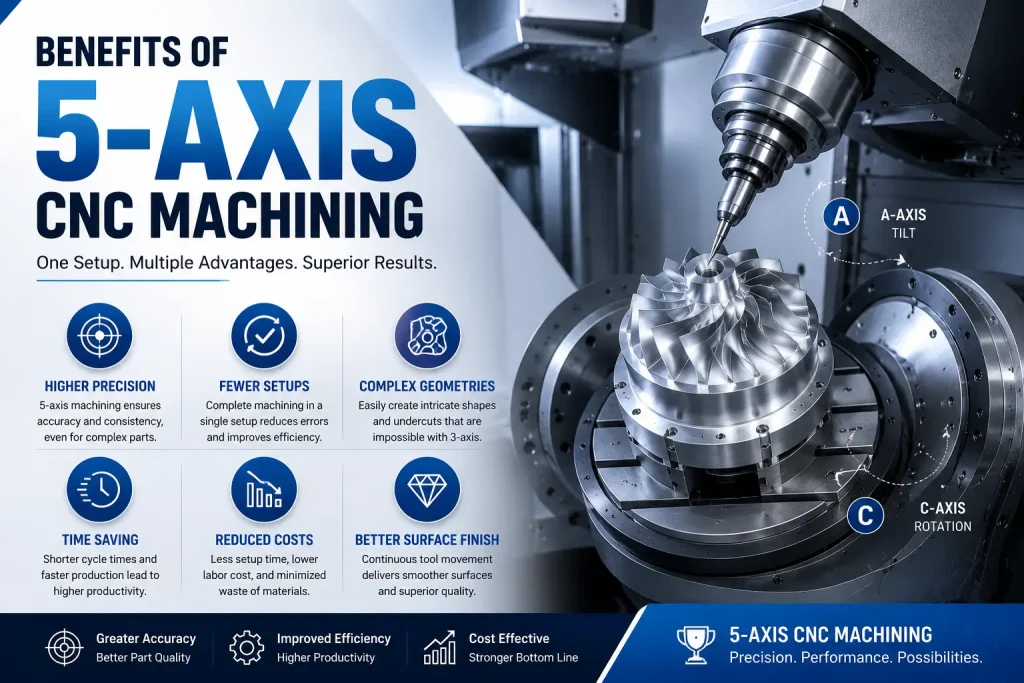
- Fewer setups, fewer errors one setup instead of three or four means less chance of misalignment
- Shorter cycle times less time spent re-clamping and re-zeroing the part
- Access to complex geometry undercuts, deep pockets, and compound angles that are difficult on 3-axis machines
- Better surface finish keeping the tool at an optimal cutting angle reduces the need for hand-finishing
- Longer tool life in many applications controlled tool-to-surface contact can reduce unnecessary wear and cutting force compared to compensating with a fixed tool angle
Industries That Use 5-Axis Machining Centers
- Aerospace turbine blades, structural brackets, lightweight housings
- Medical implants, surgical instruments, prosthetics
- Automotive & motorsport engine components, molds, lightweight structural parts
- Mold and die making complex cavity and core geometries
- Energy impellers, turbine components, precision housings
- Jewelry and precision fabrication small, intricate multi-angle parts
5-Axis CNC Machine Price by Category
Pricing varies widely by brand, configuration, controller, automation, and country. The ranges below are approximate, general market indicators, not quotes:
| Machine Category | Approximate Price Range |
|---|---|
| Hobby or desktop 5-axis machine | $5,000 – $30,000 |
| Entry-level compact industrial machine | $50,000 – $150,000 |
| Mid-range 5-axis machining center | $150,000 – $400,000 |
| High-end aerospace-grade machine | $400,000 – $1,000,000+ |
| Used 5-axis CNC machine | Varies significantly by condition, spindle hours, and brand |
Prices are approximate as of mid-2026 and may vary by brand, configuration, country, controller, automation features, tooling, and installation and training costs. Confirm exact pricing with the manufacturer or a dealer before budgeting a purchase.
Beyond the machine price itself, total cost of ownership includes tooling, workholding, CAM software licenses, operator training, facility power and floor-space requirements, and ongoing maintenance.
Specifications to Compare When Buying
A price range alone doesn’t tell you whether a machine fits your work. When comparing options, check:
- Maximum workpiece diameter and weight capacity
- Rotary-axis travel limits (how far the A/B/C axis can rotate or tilt)
- Spindle speed and torque
- Positional accuracy and repeatability
- Tool magazine capacity
- Controller brand and CAM/post-processor compatibility
- Probe and tool-setter availability
- Local service network and spare-parts availability
- Warranty terms
- Installation and operator training included
- Power supply and floor-space requirements
Common 5-Axis Machining Mistakes
Even experienced shops run into avoidable problems when moving to 5-axis work:
- Incorrect work offsets small errors are far less forgiving on 5-axis setups than on 3-axis
- Wrong pivot-point calibration an inaccurate rotational center throws off every subsequent move
- Poor post-processor selection a post-processor not matched to the machine’s exact kinematics can generate unsafe or incorrect toolpaths
- Tool-holder collisions the rotary axes introduce new collision paths that don’t exist on 3-axis machines
- Insufficient simulation skipping a full toolpath simulation before cutting increases crash risk
- Excessively long tools longer tools reduce rigidity and increase the chance of interference during rotation
- Ignoring rotary-axis travel limits programming a move beyond the machine’s physical rotary range
New vs. Used 5-Axis CNC Machine
Buying used can lower the upfront cost significantly, but it carries specific risks worth checking before purchase:
- Spindle hours and condition high spindle hours may signal reduced remaining life
- Backlash and calibration rotary axes especially should be tested for play and repeatability
- Service history documented maintenance records reduce risk of hidden issues
- Controller support confirm the manufacturer still supports and services that controller generation
- Rigging and reinstallation 5-axis machines are sensitive to leveling and alignment after a move
A pre-purchase inspection by an independent technician is generally recommended for any used 5-axis machine before committing to a purchase.
Is a 5-Axis Machine Right for Your Shop?
| Requirement | Recommended Choice |
|---|---|
| Mostly flat, simple parts | 3-axis |
| Cylindrical or indexed features | 4-axis |
| Multi-sided parts machinable at fixed angles | 3+2 (5-sided) on a 5-axis machine |
| Curved aerospace, medical, or freeform parts | Simultaneous 5-axis |
Basic 5-Axis CNC Setup Checklist
This is a general orientation checklist, not a substitute for manufacturer training or your machine’s operating manual:
- Check axis alignment before running any job all axes should move parallel and true to each other.
- Secure the workpiece firmly, accounting for the added forces introduced by rotary movement.
- Set work offsets carefully, since 5-axis positioning is far less forgiving of small errors than 3-axis.
- Choose tooling based on both material and the angles the part geometry requires.
- Simulate the toolpath in CAM before cutting to catch collisions the rotary axes can introduce.
Safety note: Always follow the machine manufacturer’s operating manual, training requirements, guarding procedures, tool limits, and collision-avoidance guidelines. A simulated toolpath does not replace a controlled dry run and proper operator supervision.
FAQs
How much does a 5-axis CNC machine cost?
Prices range from roughly $5,000–$30,000 for hobby or desktop machines up to seven figures for high-end aerospace-grade machining centers, depending on frame rigidity, control system, table size, and automation features. Confirm current pricing with a manufacturer or dealer, as figures change over time.
Is a 5-axis CNC machine worth it for a small shop?
If you regularly outsource multi-setup or angled work, it can be the reduced cycle time and setup cost may offset the machine’s cost over time. For simple, flat parts, a 3-axis machine may remain more economical.
Can I get a 5-axis CNC machine for home use?
Yes compact desktop 5-axis routers and mills exist for hobbyists and small studios, though they trade some rigidity and work envelope for size and price.
Do I need special software for 5-axis machining?
Yes. 5-axis toolpath generation is significantly more complex than 3-axis programming, and most shops use CAM software with dedicated simultaneous 5-axis post-processors and collision simulation.
What’s the difference between a 5-axis mill and a 5-axis machining center?
The terms are often used interchangeably, but “machining center” usually implies added automation tool changers, pallet changers built around the core 5-axis milling capability.
How long do 5-axis CNC machines last?
A well-maintained industrial 5-axis CNC machine can remain productive for many years. Its useful life depends on operating hours, maintenance quality, spindle condition, control-system support, accuracy requirements, and the availability of replacement parts.
Sources & References
- Manufacturer technical documentation (Haas Automation, DMG MORI, Hurco, Okuma)
- Industry guides from DATRON, Geomiq, and Makera on 5-axis CNC fundamentals
- Wikipedia: Multiaxis Machining (Pricing figures are general market estimates for informational purposes; verify with current manufacturer or dealer quotes before making a purchasing decision.)
Final Thoughts
A 5-axis CNC machine isn’t just a mill with two extra motors it’s a different approach to manufacturing that trades multiple manual setups for one continuous, high-precision operation. Whether you’re comparing a compact 5-axis mill for a small shop, a 5-axis CNC router for composites, or a full industrial 5-axis machining center for aerospace-grade parts, understanding how the axes and configurations work together and whether you need true simultaneous machining or 3+2 is enough is the key to choosing the right machine for your production needs.
You May Also Like It:
CNC Machining Tolerances: The Complete Expert Guide
Prototype CNC Machining: The Complete Expert Guide
Steel Grade: The Complete Guide to Understanding Every Type of Steel



[…] 5-axis CNC machining reaches complex surfaces in one setup: turbocharger housings, intake ports, performance cylinder heads, and EV housings with angled features. Fewer setups mean less accumulated error. […]